Healthcare public relations is the strategic management of communication between healthcare organisations and the people who depend on, regulate, fund or report on their services. Effective healthcare PR combines accurate medical information, responsible media engagement, patient-centred messaging and crisis preparedness. Hospitals, doctors, pharmaceutical businesses and health technology companies use these activities to explain complex developments, address concerns and establish credibility without treating patient trust as a promotional claim.
What is healthcare public relations?
Healthcare public relations (PR) is the practice of building informed, trustworthy relationships between healthcare organisations and their stakeholders. It involves communicating verified medical information, managing public concerns, supporting expert spokespeople and explaining healthcare developments through appropriate channels. Unlike conventional promotion, healthcare PR must account for patient safety, privacy and sector-specific communication rules.
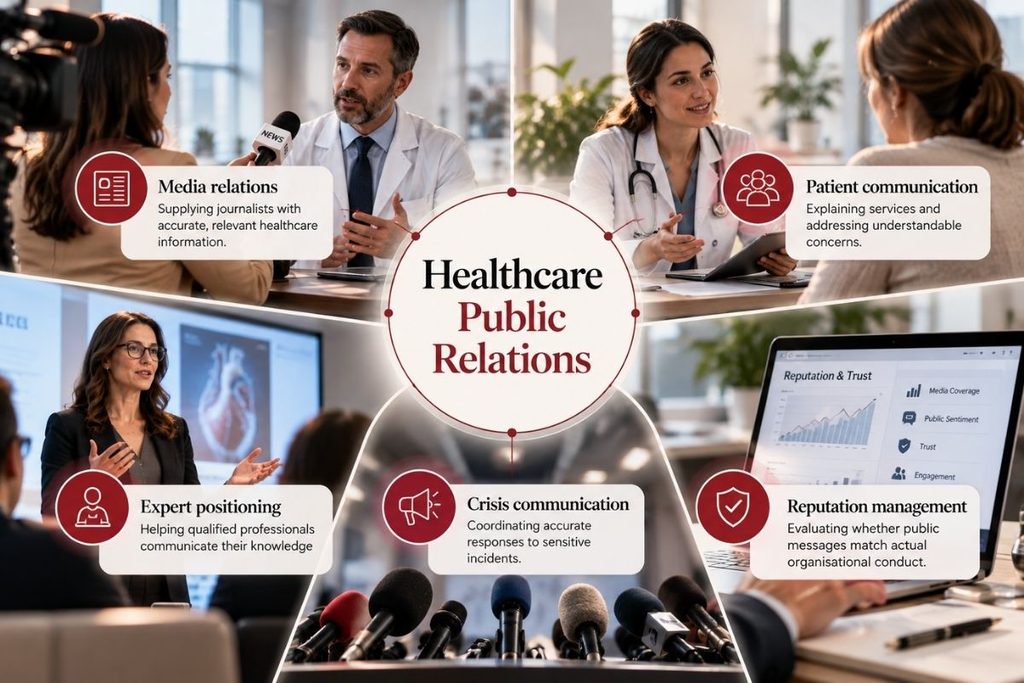
Its five core activities are:
Media relations: Supplying journalists with accurate, relevant healthcare information.
Patient communication: Explaining services and addressing understandable concerns.
Expert positioning: Helping qualified professionals communicate their knowledge.
Crisis communication: Coordinating accurate responses to sensitive incidents.
Reputation management: Evaluating whether public messages match actual organisational conduct.
What does healthcare public relations include?
Public relations in healthcare covers more than press releases or media interviews. It connects clinical expertise, organisational decisions and public understanding through communication activities tailored to different audiences. A hospital explaining a new diagnostic service needs a different approach from a biotechnology company announcing research findings or a public health organisation addressing misinformation.
A practical healthcare PR strategy begins by identifying the intended audience and the information that audience can reasonably verify.
Activity
Main audience
Practical purpose
Media relations
Journalists
Explain verified developments
Patient education
Patients, families
Improve understanding
Expert commentary
Media, professionals
Clarify clinical topics
Internal communication
Healthcare staff
Maintain consistent information
Crisis communication
Affected stakeholders
Address urgent concerns
Public health PR
Communities
Support informed decisions
Reputation monitoring
Leadership
Identify communication gaps
Healthcare media relations and clinical accuracy
Healthcare media relations involves supplying journalists with information that is timely, understandable and supported by appropriate evidence. Suitable material may include an independently verifiable research announcement, a service update or expert commentary on a public health issue.
A medical spokesperson should distinguish established evidence from preliminary findings. Communications teams should also avoid presenting a single patient’s experience as proof that a treatment works for everyone.
The broader principles of media relations apply, but healthcare stories require additional clinical review. When planning outreach in Türkiye, identifying relevant Turkish media outlets is more useful than distributing the same statement indiscriminately.
Patient education, public health PR and internal communication
Public health PR focuses on communicating information that helps communities understand health risks, preventive measures and available services. This may involve educational materials, expert interviews or responses to misleading claims.
The World Health Organization’s approach to risk communication emphasises timely information and meaningful community engagement. Healthcare organisations can apply that principle by listening to recurring patient questions before deciding which topics deserve a public explanation.
Internal communication matters equally. Reception staff, clinicians and communications teams should not give conflicting explanations about appointment procedures, service interruptions or eligibility requirements.
For example, if a hospital changes its visiting arrangements, employees should receive an approved explanation before public channels announce the change. Otherwise, accurate publicity may still produce confusion at the point of care.
The essential distinction is that healthcare communication must serve different information needs without compromising clinical accuracy. That requirement becomes especially important when PR is compared with advertising.
How does healthcare PR differ from medical advertising?
Healthcare PR or medical advertising for patient trust is a meaningful comparison because the two activities serve different purposes and operate under different controls. PR generally focuses on explanations, relationships and editorial communication, while advertising involves paid promotional placement. Neither format makes an unsupported medical claim acceptable.
The difference is particularly important for private hospitals and medical practices operating in regulated markets.
Criterion
Healthcare PR
Medical advertising
Primary purpose
Inform and build relationships
Promote an offering
Placement
Earned or owned channels
Paid placements
Editorial control
Limited in independent media
Greater control
Clinical claims
Evidence required
Evidence required
Patient privacy
Must be protected
Must be protected
Legal restrictions
Jurisdiction-specific
Jurisdiction-specific
A journalist may independently decide whether to publish a hospital’s research announcement. By contrast, a paid campaign places promotional content according to the applicable advertising rules. Earned coverage should never be described as guaranteed.
In Türkiye, healthcare communication must be evaluated against the Ministry of Health’s rules on promotion and information activities. The regulation published on 12 November 2025 distinguishes permitted information activities from prohibited advertising in the relevant healthcare context.
That distinction affects how healthcare organisations describe services, professional qualifications, patient experiences and medical outcomes. A statement that appears routine in another industry may be inappropriate when it encourages patients to expect a particular clinical result.
Before publication, a healthcare communications team should check:
Whether the proposed claim is medically substantiated.
Whether the format complies with applicable promotional restrictions.
Whether identifiable patient information is included.
Whether the message could mislead readers about expected outcomes.
Whether the appropriate clinical and legal reviewers have approved it.
These checks apply to websites, interviews, press materials and social content, although specific legal obligations depend on the activity and jurisdiction.
Medical public relations should therefore be judged by accuracy and suitability, not simply by the attention a campaign receives. The next challenge is translating that discipline into communication that patients and professionals can trust.
How can hospitals and doctors build public trust?
A healthcare public relations strategy for private hospitals should begin with patient information needs rather than publicity targets. Patients need understandable explanations of services, clinicians need accurate professional representation, and journalists need evidence they can independently assess. Trust develops when these messages remain consistent with the actual care experience.
A useful starting point is a stakeholder matrix.
Stakeholder
Information need
Suitable approach
Patients
Services, access, safety
Clear service information
Families
Procedures, support
Accessible guidance
Clinicians
Accurate representation
Reviewed expert commentary
Journalists
Evidence, context
Verified media materials
Regulators
Compliance, accountability
Formal disclosures
Partners
Capabilities, governance
Factual organisational updates
Public relations for doctors launching a specialist clinic
Public relations for doctors launching a specialist clinic should prioritise factual professional information and useful explanations of the clinic’s scope.
A new specialist clinic may need to communicate where it operates, which professional qualifications its clinicians hold, how appointments are arranged and what patients should know before attending. Any promotional activity must remain within applicable professional and healthcare advertising rules.
An educational interview can help explain a medical topic, provided the clinician’s qualifications and evidence are represented accurately. It should not imply that a particular doctor can guarantee recovery or superior treatment outcomes.
Media training for healthcare spokespeople can help clinicians communicate within their expertise, respond to difficult questions and distinguish general information from individual medical advice.
The two-stage approval process
A useful healthcare communications safeguard separates clinical verification from publication approval.
Clinical verification checks the scientific meaning of the statement: whether the evidence supports the claim, whether uncertainty is described and whether terminology is accurate.
Publication approval checks the context: whether patient consent and privacy requirements are satisfied, whether promotional restrictions apply and whether the chosen channel is appropriate.
A communications director should not be expected to validate clinical efficacy independently. Likewise, a clinician’s approval of a medical statement does not automatically establish that its promotional use is lawful.
For sensitive materials, both approvals should be documented, with a named owner responsible for the final published version.
This separation reduces avoidable ambiguity and provides a stronger foundation for case studies, interviews and other practical healthcare PR activities.
What are practical healthcare public relations examples?
Healthcare public relations examples are most useful when they show a communication decision, the evidence required and the risks to avoid. A hospital service announcement, a research update and a patient education initiative may all generate media interest, but they require different messages and approval processes.
The following scenarios are illustrative rather than claims about completed campaigns.
Example 1: A hospital introduces a diagnostic service
A hospital plans to inform its community about a newly available diagnostic service. The communication team prepares a factual explanation of the service’s purpose, access requirements and relevant professional qualifications.
The medical team reviews all statements concerning clinical applications and limitations. The legal or compliance reviewer checks whether the proposed announcement falls within permitted information activities.
The communications team then considers whether an independent news angle exists. If the development is not sufficiently newsworthy, an accurate service information page may be more appropriate than a press release.
Decision criterion: Choose the channel based on public relevance, not the desire to generate coverage.
Example 2: A health technology company announces research
A health technology business wishes to discuss findings from a research project. Its PR team first establishes whether the results are preliminary, peer-reviewed or independently validated.
A responsible announcement explains the research context, its limitations and the difference between technical performance and demonstrated clinical benefit.
If a press release is appropriate, industry press release examples can help structure the announcement. The scientific claims still require separate verification.
Decision criterion: Evidence maturity determines the strength of the claim.
Example 3: A public health organisation addresses misinformation
A community organisation identifies recurring confusion about a preventive health measure. Instead of publishing a confrontational promotional campaign, it gathers the questions people are asking and works with qualified experts to prepare understandable answers.
The resulting materials explain what is known, what remains uncertain and where people can obtain authoritative guidance.
Distribution may involve community organisations, healthcare professionals and relevant media channels.
Decision criterion: Measure whether the information addresses actual concerns, not only how widely it is shared.
Example 4: A medical organisation prepares a media announcement
A healthcare organisation has verified information that could interest specialist journalists. It prepares an evidence summary, an approved spokesperson statement and a clear explanation of why the development matters.
Before choosing a press release distribution platform, the team checks whether the service reaches relevant publications and supports appropriate targeting.
A broad distribution list is not automatically better than a focused one.
Decision criterion: Prioritise relevant editorial audiences and verifiable claims over distribution volume.
These examples show why healthcare PR cannot rely on a single campaign template. When communication concerns an incident rather than a planned announcement, the decision process must become more urgent and more controlled.
How should healthcare organisations manage crisis communication?
How to manage healthcare PR during a patient data breach is a critical operational question because a privacy incident may affect patient rights, organisational credibility and legal obligations simultaneously. Communications teams should not speculate about the cause, scope or consequences before responsible investigators establish the facts.
A crisis response must distinguish public communication from technical investigation, clinical management and mandatory regulatory processes.
Patient data breaches and privacy protection
In Türkiye, health information is classified as a special category of personal data under the Personal Data Protection Law, commonly referred to as KVKK. Organisations must assess applicable processing, security and notification obligations with qualified advisers.
The first public statement should not disclose additional sensitive information or suggest that all affected records have been identified before that conclusion is supported.
A practical communication sequence includes:
Confirm the incident: Coordinate with information security, clinical leadership and legal advisers.
Identify affected groups: Determine which individuals and stakeholders require information.
Assess obligations: Establish applicable notification requirements and responsible authorities.
Prepare verified messages: Separate confirmed facts from matters under investigation.
Provide useful guidance: Explain available contact channels and relevant protective steps.
Update responsibly: Correct earlier information when new findings materially change it.
The communications team should maintain a version-controlled record of approved statements. Different employees must not independently estimate the number of affected patients.
Responding to clinical incidents and public concern
A suspected clinical incident requires additional sensitivity. The organisation should acknowledge concerns without assigning blame prematurely or revealing confidential patient details.
Statements should be reviewed by appropriate clinical, operational and legal personnel. If patient safety instructions are necessary, those instructions must come from qualified clinical or public health authorities.
The World Health Organization describes risk communication as an exchange of information that helps people facing a threat make informed decisions. That principle supports clear updates, accessible language and opportunities for affected communities to ask questions.
Silence can create uncertainty, but speed does not justify publishing unverified medical conclusions.
A crisis plan should therefore define authorised spokespeople, escalation contacts, review responsibilities and update procedures before an incident occurs.
Once an organisation has established these safeguards, it can evaluate healthcare PR performance using measures that reflect communication quality rather than publicity alone.
How can healthcare PR performance and costs be measured?
Healthcare PR performance should be assessed against specific communication objectives, including accurate media coverage, stakeholder understanding and the quality of public information. Counting mentions without reviewing their content can reward irrelevant or misleading exposure.
The same principle applies when evaluating healthcare PR services: the scope of work matters more than the number of promised placements.
Healthcare PR tools and measurement criteria
Healthcare PR tools may include media monitoring software, website analytics, stakeholder surveys and internal issue-tracking systems. Their value depends on the questions they help answer.
Objective
Measurement
Warning sign
Media relevance
Coverage in suitable outlets
Irrelevant mentions
Message accuracy
Correct factual representation
Unsupported claims
Public understanding
Recurring questions resolved
Persistent confusion
Website engagement
Relevant referral traffic
Unqualified visits
Crisis response
Approved updates and feedback
Conflicting statements
Spokesperson quality
Accurate expert quotations
Misrepresented expertise
For example, an article quoting a clinician accurately in a specialist publication may contribute more to a research communication objective than several unrelated mentions.
Website analytics can indicate whether readers move from coverage to an information page. They cannot, by themselves, establish that a patient trusts an organisation or that a clinical decision was influenced appropriately.
How much do healthcare PR services cost for small clinics?
How much healthcare PR services cost for small clinics depends on the work required, the market, the number of stakeholders and the level of clinical and compliance review involved. A universal fixed price would be misleading without a defined scope.
A clinic considering external support should request an itemised proposal covering:
Initial communication assessment and stakeholder mapping.
Messaging development and spokesperson preparation.
Content creation and medical review responsibilities.
Media outreach and reporting deliverables.
Crisis support arrangements and response availability.
Third-party expenses and any separately billed services.
A monthly advisory arrangement and a one-off clinic announcement are not equivalent purchases. Comparing their headline prices without examining deliverables creates an unreliable decision.
For organisations operating across borders, translation quality, local regulatory review and market-specific media knowledge can also affect the workload.
An external communications partner should explain what it can control, such as research, drafting and outreach, and what remains outside its control, including independent editorial decisions.
The most useful commercial question is therefore not simply which provider offers the lowest fee. It is whether the proposed work addresses the organisation’s communication risks and provides transparent, measurable deliverables.
Frequently asked questions
What is PR in healthcare?
PR in healthcare is the management of communication between healthcare organisations and their stakeholders. It includes media relations, patient education, expert commentary, reputation management and crisis communication. Its purpose is to support accurate information and trustworthy relationships while respecting clinical, privacy and regulatory requirements.
What is the role of public relations in healthcare?
Public relations helps healthcare organisations explain services, communicate verified developments, respond to concerns and maintain relationships with patients, employees, journalists and communities. It also supports qualified medical spokespeople and coordinates communication during sensitive incidents.
What are the seven types of PR used in healthcare?
Seven common healthcare PR activities are media relations, crisis communication, reputation management, digital communication, leadership positioning, internal communication and patient education. These are practical categories rather than a universally mandated classification. Organisations combine them according to their audiences, responsibilities and communication risks.
How much do healthcare PR services cost?
Healthcare PR costs vary by location, project scope, medical review requirements, media outreach, reporting and crisis support. A small clinic’s announcement may require fewer resources than a hospital’s ongoing communications programme. An itemised proposal is more useful than comparing unspecified monthly fees.
Conclusion
Healthcare public relations works best when credible medical information, stakeholder needs and responsible communication practices guide every decision. Hospitals, doctors and healthcare businesses need more than visibility: they need accurate messaging, appropriate approvals and meaningful ways to evaluate whether information reaches the right audiences. Clinical verification, privacy safeguards and realistic performance expectations help distinguish a sustainable communications programme from short-term publicity.
For organisations communicating healthcare developments to audiences in Türkiye, locally informed media planning can support a more relevant approach. Explore digital PR services in Turkey to understand how targeted media relations and structured communications can support appropriate healthcare visibility.
B2B public relations is the strategic management of communication and reputation between businesses and their professional audiences. It helps companies establish credibility with buyers, demonstrate industry expertise, and communicate through relevant media and independent voices. Unlike consumer-focused publicity, B2B PR addresses specialised audiences, complex purchasing decisions, and longer sales cycles. An effective programme connects industry media relations, thought leadership, credible evidence, and measurable communication objectives.
B2B public relations (B2B PR) builds awareness and trust among organisations that purchase products or services from other businesses. It uses earned media, expert commentary, executive visibility, and evidence-based stories to help buyers assess a company’s credibility. Its purpose is not simply to generate publicity but to support informed business decisions.
Its four core functions are:
Establishing credibility with relevant business audiences.
Communicating expertise through independent industry media.
Supporting purchasing decisions with trustworthy information.
Protecting and strengthening long-term corporate reputation.
What is B2B public relations, and why does it matter?
B2B public relations is a communication discipline focused on relationships between businesses, industry stakeholders, and professional decision-makers. Business to business public relations helps organisations explain their expertise, demonstrate reliability, and build recognition in markets where purchasing decisions often involve substantial financial commitments, technical assessments, and several internal stakeholders.
A company selling industrial automation equipment, for example, must communicate more than product availability. Potential buyers may need evidence of technical compatibility, operational reliability, implementation experience, and ongoing support. Relevant editorial coverage and expert commentary can make these subjects easier to investigate before a sales conversation begins.
The role of credibility in B2B purchasing
B2B purchasing committees frequently include people with different responsibilities. A technical manager evaluates performance, a financial decision-maker examines commercial implications, and procurement assesses supplier suitability. Public relations can provide credible information for each perspective without replacing technical documentation or direct sales discussions.
Earned media is particularly relevant because journalists and editors independently decide which stories deserve coverage. A company may pay for PR support, but that payment does not guarantee publication or control over editorial conclusions.
Effective PR for B2B companies therefore focuses on information that deserves professional attention:
Original research with a transparent methodology.
Expert analysis of relevant industry developments.
Verified customer experiences and case studies.
Significant corporate developments with clear market implications.
Practical insight into technical or operational challenges.
Business to business PR also supports relationships beyond prospective customers. Investors, partners, employees, industry associations, and regulators may all encounter the same corporate communications.
A useful distinction is that visibility creates an opportunity to be noticed, while credibility gives an audience a reason to investigate further. Both matter, but they require different evidence and communication choices.
How does B2B PR differ from B2C PR and advertising?
B2B PR differs from B2C public relations primarily in audience structure, purchasing complexity, and the information required to establish confidence. Consumer campaigns may prioritise broad recognition or immediate interest, while B2B communications often address smaller professional audiences assessing long-term business relationships. Advertising adds another distinction: paid placement offers greater control over delivery, whereas earned editorial coverage depends on independent decisions.
The difference does not mean B2B communications must be technical or inaccessible. Clear explanations are essential when a complex product needs to be understood by financial, operational, and executive stakeholders.
B2B public relations or advertising for enterprise buyers
B2B public relations or advertising for enterprise buyers should be evaluated according to the decision stage and the communication objective. Advertising can place a defined message in front of a selected audience. PR can contribute independent context through specialist publications, interviews, and expert analysis.
Consider a cybersecurity supplier entering a new market. Paid advertising could direct relevant professionals to a product demonstration. An independently reported interview about emerging security risks could help establish the supplier’s technical perspective. Neither activity automatically proves product quality, and both require accurate claims.
A common mistake is evaluating earned media using the same assumptions as paid placements. PR professionals can pitch stories and provide supporting materials, but editors retain control over whether, when, and how coverage appears.
For companies combining these approaches, the strongest starting point is a shared set of verified messages. That consistency becomes especially important when several decision-makers evaluate the same supplier.
How does B2B PR influence business decision-makers?
B2B PR influences purchasing decisions by making relevant expertise, independent information, and organisational credibility easier to assess. It does not replace procurement procedures or guarantee a contract. Instead, it can help stakeholders understand a supplier’s capabilities before they request a proposal, evaluate a demonstration, or begin technical due diligence.
Different members of a buying committee look for different kinds of reassurance. A single generic company announcement rarely answers every question.
Stakeholder
Main concern
Useful evidence
CTO
Technical suitability
Expert analysis
CFO
Commercial risk
Verified outcomes
Procurement
Supplier reliability
Company credentials
Operations
Implementation
Practical case study
CEO
Strategic relevance
Market perspective
A chief technology officer may value commentary explaining an emerging technical standard. A chief financial officer may be more interested in a documented business case, including assumptions and limitations. Procurement teams may look for clear organisational information and a consistent public record.
Thought leadership that supports buyer confidence
Thought leadership is most useful when it provides a distinctive, defensible interpretation of an industry issue. Publishing an executive’s opinion is not enough. The content should help readers understand a development, evaluate a risk, or make a better-informed decision.
For example, a manufacturing technology company could explain how production teams should assess interoperability before investing in new equipment. A technical executive might identify common implementation constraints and explain which questions buyers should ask vendors.
The strongest expert content distinguishes between established facts, professional interpretation, and commercial claims. Where a case study mentions customer results, the company should confirm permission to disclose the information and explain the measurement context.
Executive positioning also requires preparation. Specialists who speak to journalists need to communicate clearly without overstating evidence. Structured media training can help executives handle technical questions, sensitive topics, and interview limitations.
These considerations turn corporate expertise into information that professional audiences can actually use. They also establish the foundation for a focused B2B PR strategy.
How to build a B2B PR strategy for technology companies
How to build a B2B PR strategy for technology companies begins with defining the business audience, the communication objective, and the evidence available to support the company’s claims. A successful b2b pr strategy should connect commercial priorities with relevant industry conversations rather than treat media mentions as an isolated goal.
The same principles apply to engineering, manufacturing, energy, and specialist professional services. The subjects and audiences change, but the need for credible, relevant information remains consistent.
Define the audience and communication objective
A business entering a new market may need recognition among distributors, potential customers, and industry commentators. An established supplier launching a technical capability may instead need to explain why the development matters to existing buyers.
A practical planning sequence includes:
Identify the business decision-makers and stakeholders.
Define one primary communication objective.
Establish the company’s evidence and expert resources.
Select relevant industry conversations and publication categories.
Prepare clear messages with supporting documentation.
Agree on performance indicators before outreach begins.
This approach prevents a common mistake: producing announcements without identifying who should care or what new information they provide.
Build specialist B2B media relations
B2B media relations focuses on journalists, editors, and publications serving relevant professional communities. A highly specialised trade publication may be more valuable to a particular campaign than a general news outlet with a much larger audience.
Effective media relations begins with understanding editorial relevance. A journalist covering industrial cybersecurity will need a different angle from an editor reporting on enterprise software investment.
For technology businesses, b2b tech pr can involve expert commentary, independently verifiable research, technical developments, and practical applications. B2B technology public relations should make complex subjects understandable without removing qualifications that matter to professional readers.
Turn expertise into useful stories
Strong b2b public relations strategies connect technical expertise to a specific industry problem. Instead of announcing that a company is innovative, a spokesperson can explain a measurable operational challenge, the available approaches, and the evidence needed to compare them.
Useful materials include:
Expert interviews grounded in direct experience.
Research summaries with transparent methodology.
Customer-approved case studies.
Technical explainers for non-specialist decision-makers.
Commentary on meaningful industry developments.
The choice of distribution infrastructure is a separate operational decision. Companies evaluating channels can consult a guide to choosing a press release distribution platform rather than treating platform selection as the communication strategy itself.
A strategy becomes stronger when each proposed story has a clear audience, a defensible claim, and a reason for publication. The next step is applying those principles to realistic business situations.
What are examples of B2B public relations in practice?
B2B public relations examples demonstrate how organisations can communicate specialised knowledge, business developments, and industry relevance. Effective programmes vary according to the market and the purchasing process. Technology businesses may emphasise technical expertise, manufacturers may demonstrate operational capabilities, and professional services firms may explain regulatory or commercial developments.
The following are illustrative scenarios, not claims about actual campaigns or guaranteed results.
Technology and cybersecurity
A cybersecurity company preparing to enter an enterprise market could develop expert commentary on common risk-assessment mistakes. Its technical leadership might contribute interviews to specialist publications, supported by clearly explained research findings.
The communication objective would be to establish a credible technical perspective among security leaders and enterprise buyers. Relevant coverage could then provide useful background material during business development conversations.
Industrial manufacturing and engineering
A manufacturer introducing a new production capability could explain the operational problem it addresses, the technical constraints involved, and the conditions under which customers might benefit.
A customer-approved case study could provide additional evidence. However, performance claims would need an appropriate baseline, measurement period, and explanation of the operating environment.
This type of pr b2b activity is particularly relevant when purchasing teams need technical and commercial information before considering a supplier.
Professional services and research
A specialist consultancy could publish an evidence-based analysis of an industry development, supported by commentary from a qualified executive. The goal would be to help potential clients understand a problem rather than promote a service through unsupported claims.
A useful B2B case study answers four questions:
What business problem existed?
What action was taken?
Which evidence supports the outcome?
What limitations affect interpretation?
These principles also apply to formal announcements. Companies can review industry-specific press release examples to understand how different developments may be structured for professional readers.
Examples become particularly valuable when adapted to the audience’s local business environment. That requirement is central to international companies communicating in Turkey.
How does B2B media relations work in Turkey?
B2B media relations for manufacturing companies in Turkey requires an understanding of local industry audiences, publication priorities, and the business context surrounding the announcement. International companies should not assume that a story written for a global audience will automatically be relevant to Turkish editors or professional buyers.
A meaningful localisation process starts with the question: Why does this development matter to businesses operating in Turkey?
For example, a foreign industrial supplier announcing a technical investment may need to explain its relevance to local manufacturers, service partners, or customers. Merely translating a global announcement does not establish that connection.
Localise evidence, not just language
International B2B companies should align their Turkish and English communications around the same verified facts. Product specifications, executive titles, financial statements, and customer references should remain consistent across languages.
Localisation can also involve adapting terminology, selecting relevant examples, and clarifying whether a product or service is currently available in the Turkish market.
A practical review should check:
The announcement’s relevance to Turkish businesses.
Accuracy of local availability and partnership claims.
Consistency between Turkish and English materials.
Suitability of the spokesperson for local questions.
Whether technical statements require further explanation.
Choose publications by audience relevance
Turkey’s media landscape includes general business publications and specialist outlets covering technology, manufacturing, energy, logistics, and other industries. A B2B media company typically produces information for professional or organisational audiences rather than general consumers.
A company should assess whether a publication reaches the people involved in its purchasing process. Its editorial subject matter, readership profile, and relevance to the proposed story matter more than audience size alone.
An overview of Turkish media outlets can provide additional context for understanding the country’s publication landscape.
For international organisations, the commercial value of local communication also depends on follow-through. A company receiving interest from a Turkish publication should have an appropriate spokesperson and reliable supporting materials available.
These practices help make B2B communication locally relevant without weakening the accuracy of the original message. Their effectiveness should then be assessed against clearly defined outcomes.
How should B2B PR performance and costs be evaluated?
B2B PR performance should be evaluated against communication objectives, audience relevance, and credible indicators of business interest. Media coverage alone cannot establish that a programme generated revenue. Companies should distinguish between communication outputs, audience responses, and commercial outcomes, especially when sales cycles involve multiple interactions over several months.
A useful measurement framework separates the following indicators:
Level
Measurement
Output
Relevant coverage
Quality
Message accuracy
Audience
Target relevance
Engagement
Referral visits
Commercial
Qualified enquiries
How to measure B2B PR impact on qualified leads
How to measure B2B PR impact on qualified leads requires combining communication data with website analytics and sales qualification criteria. A relevant media mention may lead to referral visits, branded searches, direct enquiries, or subsequent interactions that cannot all be attributed to one publication.
Google Analytics 4 and UTM parameters can help identify visits from measurable campaign links. However, editorial links may not always include tracking parameters, and privacy controls can limit attribution.
Sales teams can provide additional context by recording whether prospects mention industry coverage or use published expert materials during discussions. These observations are useful but should not be presented as proof of direct causation.
How much does B2B PR cost for a market entry campaign?
How much does B2B PR cost for a market entry campaign? depends on the target market, communication scope, language requirements, content development, spokesperson preparation, and reporting expectations. There is no reliable universal price that applies to every company or programme.
An international business entering Turkey may need bilingual materials and locally relevant expert positioning. Another company with established local resources may require only selected communication activities.
A budget should distinguish strategy, content preparation, media outreach, and measurement. External specialist support is one possible delivery model; companies evaluating that option can consult the digital PR agency overview.
The strongest commercial assessment asks whether the proposed activities reach relevant decision-makers and produce useful, verifiable communication outcomes. It does not assume that a particular number of publications, backlinks, or sales opportunities can be guaranteed.
Frequently asked questions
What is B2B PR?
B2B PR is public relations focused on companies selling products or services to other businesses. It builds professional credibility through relevant media coverage, expert commentary, thought leadership, and reputation management. Its audiences include business buyers, industry stakeholders, partners, and other decision-makers.
What is an example of B2B public relations?
An industrial technology supplier publishing verified research and providing expert commentary to a relevant trade publication is an example of B2B PR. The communication helps professional buyers understand an industry issue and assess the supplier’s expertise without guaranteeing a commercial outcome.
How is B2B PR different from B2B advertising?
B2B advertising uses paid placements with defined targeting and greater control over delivery. B2B PR seeks earned editorial attention through newsworthy information and expert perspectives. Editorial decisions remain independent, so publication is not guaranteed. Both methods can support the same communication objective.
What is a B2B media company?
A B2B media company produces information for business professionals, organisations, or specific industries. Its publications may cover technology, manufacturing, finance, or other specialist markets. B2B PR teams assess these outlets according to their editorial focus and relevance to professional decision-makers.
Conclusion
B2B public relations helps companies communicate expertise, establish credibility, and provide relevant information throughout complex business purchasing processes. Its effectiveness depends on understanding decision-makers, presenting defensible evidence, working with appropriate industry media, and evaluating outcomes beyond publication volume.
For international organisations, these principles become especially important when communicating with professional audiences in Turkey. Local relevance, accurate messaging, and suitable spokespersons can support more meaningful industry conversations.
Companies planning a market entry, specialist announcement, or sustained corporate visibility programme can explore PR Turkey’s digital PR services to assess communication options aligned with their business objectives.
A press release in 2026 costs anywhere from $0 on free submission sites to more than $1,500 for a national US newswire release with an image. Most brands pay between $100 and $900 per release for distribution, plus $200 to $1,000 if a professional writes it. The final price depends on three things: where the release goes, how long it is, and whether you need guaranteed publication or only a wire feed.
This guide breaks down what each part costs, compares the major wire services, and explains what distribution costs when your target audience is in Turkey.
What makes up the cost of a press release?
The price you see on a rate card is rarely the price you pay. A press release budget usually has five parts:
Cost component
Typical range (2026)
What drives the price
Writing
$0 (in-house) to $1,000+
Writer seniority, industry complexity, number of revisions
Annual memberships and minimum contracts can add more. Several US wires charge a yearly membership fee before you send your first release.
How much do the major wire services charge?
The figures below come from published rate cards and 2026 pricing reviews. Wire services change their prices and bundle options often, so treat these numbers as reference points and confirm them before you buy.
Service
Starting price per release
Notes
PR Newswire (Cision)
~$350 local, ~$805 US national
Annual membership around $195. Extra words and images are billed separately
Business Wire
~$760+ US national
Charges per extra 100 words; first image adds a few hundred dollars
GlobeNewswire
~$600 to $1,500
Pricing is mostly quote-based or on annual plans
PRWeb (Cision)
$99 / $189 / $389
Tiered self-service packages
eReleases
~$399+
Includes editorial review
Newswire.com
~$199 to $999+
Tiered packages
EIN Presswire
$149 single release; ~$67–$83 in bulk
700-word limit on the single-release plan
A 600-word national US release with one photo on a premium wire can pass $1,500. Budget wires stay in the $100–$350 range, but their pickup is mostly automated syndication rather than editorial coverage.
Why international distribution costs more
Adding countries is where budgets grow fastest. On most global wires, each additional country or regional circuit is a separate line item. Geographic targeting can easily double or triple the base price.
The bigger issue is not price but fit. A global wire sends your release to a broad feed, but in a market like Turkey:
Most newsrooms publish in Turkish. An English release is far less likely to be picked up as-is.
National reach runs through local news agencies such as İHA and DHA and a set of high-traffic news portals. The structure of Turkish media is different from US or UK media.
Coverage is checked by Turkish-language monitoring. A global report may miss local placements.
So a brand entering Turkey can pay for a premium global circuit and still get little Turkish coverage. That is why many international companies pair a global wire with a local distributor.
How much does press release distribution cost in Turkey?
Local distribution in Turkey is usually cheaper than a US national wire and more targeted. Prices depend on the number of guaranteed publications, whether national news agencies are included, and whether the release appears in Google News Türkiye.
As a reference, here is how PRTURKEY packages are structured:
Package
Price
What is included
Basic
€99
Editorial review, up to 600 words, 1 image + 1 logo, guaranteed publication on at least 50 news websites, monitoring report within 3 business days
Pro
€299
Everything in Basic, up to 800 words, up to 2 images + logo + video link, at least 150 news websites, targeted Turkish media and journalist contacts, guaranteed Google News Türkiye inclusion
Premium
€699
Up to 1,000 words, at least 250 news websites, distribution through İHA and DHA national news agencies, placement on two of Turkey’s most visited news platforms, Google News Türkiye inclusion
Optional add-ons include Turkish translation with editorial review (€29 per release) and extra images (€29 each). Multiple-order discounts are available. See the full pricing page for current details.
For comparison: the Premium package, which includes national news agencies, costs less than a single US national release on most premium wires, and it reaches Turkish newsrooms in Turkish.
Free vs. paid press release distribution: is free worth it?
Free submission sites cost nothing, but they rarely deliver what brands actually need:
No guaranteed publication. Your release sits on the submission site itself.
Little editorial value. Journalists do not monitor these sites for stories.
Limited SEO value. Most links are nofollow, and the pages have low authority.
Free sites can work for minor updates or a test run. For a launch, a funding announcement, or market entry, paid distribution with guaranteed placements and a monitoring report is the safer choice. If you are unsure which provider fits, our guide on choosing a press release distribution platform covers the evaluation criteria.
Hidden costs to check before you buy
Rate cards often leave out these charges:
Word-count overages. Major wires charge per extra 100 words. A 900-word release on a 400-word base package can cost far more than expected.
Image and video fees. Each asset may be billed separately.
Membership or setup fees. Some wires require an annual membership.
Per-country fees. International circuits are usually priced per country or region.
Translation. Global wires often treat each language as a separate release.
Reporting. Some providers charge for detailed coverage reports. Ask whether a monitoring report is included and what it measures.
Rush fees. Same-day distribution can carry a 25–50% premium.
How to estimate your press release budget
Use this simple formula:
Total cost = writing + distribution + (extra words + extra assets) + translation + reporting
Example for an international SaaS company announcing its Turkey launch:
Item
Option
Cost
Writing
In-house draft, local editorial review
€0 (included)
Translation
Turkish translation with editorial review
€29
Distribution
Pro package, 150+ sites, Google News Türkiye
€299
Reporting
Monitoring report in 3 business days
Included
Total
€328
The same announcement on a premium US national wire, with one country add-on and one image, would typically land well above $1,000 before translation.
How to get more value from every euro
Write for the market. A release built around a Turkish angle gets picked up more often than a translated global release. Avoid the common mistakes brands make in Turkey.
Keep it within the word limit. 500–600 words is enough for most news.
Send fewer, stronger releases. One release with real news beats three releases with minor updates.
Use a proven structure. Start from our press release examples and templates.
Measure the result. Ask for a placement list with links, not only a reach estimate.
Frequently asked questions
How much does a press release cost on average?
Most brands pay between $100 and $900 to distribute a single press release in 2026. Premium US national wires can exceed $1,500 per release with images and extra words. Local distribution in a single market such as Turkey usually costs €99–€699.
How much does it cost to write a press release?
A freelance writer typically charges $200–$500 per release. Agencies charge $500–$1,000 or more, depending on industry and revisions. Some distribution services include editorial review in the package price.
Is PR Newswire worth the price?
PR Newswire is a strong choice for US national reach, investor relations, and regulatory disclosure. For a single non-English market, a local distributor is often more cost-effective because it publishes in the local language and works directly with local newsrooms. Many brands use both.
How much does press release distribution cost in Turkey?
Distribution in Turkey ranges from about €99 for guaranteed publication on 50 news websites to €699 for national news agency distribution (İHA and DHA) and 250+ websites. Turkish translation can be added for around €29.
Do I need to translate my press release into Turkish?
Yes, in most cases. Turkish newsrooms publish mainly in Turkish, and translated releases are far more likely to be picked up. Professional translation with editorial review is better than raw machine translation.
Are free press release sites worth it?
Free sites can work for minor updates, but they do not guarantee publication, rarely reach journalists, and offer limited SEO value. For important announcements, paid distribution with guaranteed placements is more reliable.
Get a clear price for your Turkey press release
PRTURKEY distributes press releases for international brands entering Turkey, with editorial review, guaranteed placements, and a monitoring report within three business days.
Compare packages and submit your press release →
Need a custom plan for multiple releases or a launch campaign? Contact our team for a quote.
Fintech public relations is the strategic management of how a financial technology company communicates with journalists, customers, investors, partners and other stakeholders. Unlike conventional technology PR, it must balance visibility with trust, regulatory compliance and careful handling of financial claims.
A fintech company cannot simply make louder claims to earn attention. It needs credible evidence, understandable messaging and spokespeople who can explain complex products without creating unnecessary risk. This guide covers that process from positioning and fintech media relations to distribution, measurement and agency selection.
What is fintech public relations?
Fintech public relations is the strategic process of building and protecting the reputation of a financial technology company through credible messaging, media relations, thought leadership, announcements and crisis communications. It translates complex products into understandable stories while accounting for the trust and regulatory expectations associated with financial services.
That makes PR for fintech different from promoting many conventional software products.
A standard technology campaign might emphasize speed, features or convenience. A financial technology company may also need to explain how its product works, who can use it, what role regulated partners play, where it is available and whether specific claims require legal or compliance review.
Area
Tech PR
Fintech PR
Core story
Product and innovation
Product, trust and financial relevance
Claims
Product-led
Often requires greater compliance scrutiny
Audience
Users and tech media
Users, media, investors, partners and financial stakeholders
Risk
Product/reputation
Reputation plus potential regulatory sensitivity
Expertise
Technology
Technology and financial context
This does not mean every sentence needs legal language. It means the communications process should identify sensitive claims before they reach journalists.
For example, a payments startup claiming it is “the safest payment platform” creates a very different communications problem from one explaining a specific security feature with verifiable evidence.
Good financial tech PR strategy therefore starts with a simple principle: make the story easy to understand without making it easier to misunderstand.
Why does PR matter for fintech companies?
Fintech companies often ask customers and partners to trust them with decisions involving money, payments, financial information or business infrastructure. That raises the credibility threshold.
Effective fintech public relations can support four areas: reputation, fundraising visibility, commercial partnerships and customer discovery.
For an early-stage company, fintech startup PR may establish category credibility before the brand is widely known. For a scale-up, communications may need to support expansion, executive thought leadership and partnerships simultaneously.
Consider an anonymized scenario. A B2B payments startup has strong technology but describes itself through technical architecture and product features. Trade journalists struggle to identify the story. Reframing the narrative around the operational problem being solved—while retaining evidence for every material claim—creates a clearer editorial proposition.
The same principle applies to funding.
A funding announcement is not automatically interesting because capital was raised. Journalists typically need the wider story: what the company is building, why the investment matters, what changes next and whether there is evidence of meaningful momentum.
PR can support:
Trust: third-party editorial visibility can provide context beyond company-owned messaging.
Funding communications: announcements can explain the business trajectory and investment rationale.
Partnerships: relevant trade coverage can reach potential commercial stakeholders.
Customer acquisition: earned coverage and branded search can introduce qualified audiences to the company.
PR does not replace product-market fit, performance marketing or sales. Its job is to strengthen the credibility surrounding them.
What are the biggest fintech companies PR challenges?
The hardest fintech companies PR challenges usually come from the collision between technical complexity, financial claims and the pressure to communicate quickly.
The first problem is regulatory sensitivity. A communications team may write a compelling statement that compliance cannot approve. Building the approval process into campaign planning is more efficient than rewriting an announcement immediately before publication.
The second problem is complexity. Terms familiar to a product team may mean little to a business journalist or customer. The communications team must simplify without distorting.
Other recurring challenges include:
Unsupported claims about savings, security, performance or market leadership
Confusing licensing status or regulated activities
Technical language that obscures the customer problem
Media skepticism toward promotional funding or product stories
Multiple markets with different communications requirements
Founders improvising answers on sensitive subjects
Common mistake: treating compliance as the department that says yes or no after the copy is finished.
A stronger process identifies which statements require evidence and approval while messaging is being developed.
Imagine a fintech preparing to enter a new country. Marketing wants to announce that the service is “launching nationally,” while operations knows availability will initially be limited. A precise launch definition prevents the media story from creating expectations the product cannot yet meet.
Fintech PR is strongest when communications, product, legal/compliance and leadership work from the same factual source.
How do you build a fintech public relations strategy?
A useful fintech public relations strategy can be organized around the TRUST framework: Truth, Relevance, Understandability, Spokespeople and Tracking.
It gives communications teams a practical checklist before pitching begins.
T — Truth
Document every claim that could attract scrutiny.
What does the company actually provide? Where is it available? What licenses or regulated relationships are relevant? Which performance claims have evidence?
Avoid turning internal marketing shorthand into public facts.
R — Relevance
Determine why the story matters outside the company.
A new feature is rarely news because development finished. It becomes more useful to media when connected to a measurable customer problem, market change, partnership or broader industry question.
U — Understandability
Explain the product in language a non-specialist can repeat accurately.
If a journalist cannot summarize the company after a short conversation, the positioning is probably too complicated.
Create three levels of messaging:
One-sentence company description
Three core messages
Supporting proof points for each message
S — Spokespeople
Select spokespeople by subject, not seniority alone.
A founder may handle vision and funding. A product leader may explain infrastructure. Another executive may be better suited to market-entry or partnership questions.
Media training should cover difficult questions, bridging techniques and what the spokesperson should decline to speculate about.
T — Tracking
Decide what success means before outreach starts.
For one campaign, success may be credible trade-media coverage. For another, it may be referral traffic, investor visibility or qualified partnership inquiries.
A fintech PR agency should be able to explain this measurement logic before presenting a target publication list.
How should fintech media relations and PR distribution work?
Fintech media relations works best when the distribution method matches the news.
A press release is useful when the company has a clear, verifiable announcement: funding, a product launch, market entry, a significant partnership, executive appointment or another material development.
Thought leadership works differently. It earns attention through expertise rather than corporate news.
Format
Best use
Primary goal
Press release
Concrete announcement
Establish the news
Media pitch
Journalist-specific angle
Earn editorial interest
Thought leadership
Expertise or analysis
Build authority
Trade media
Specialist story
Reach industry audiences
Owned content
Detailed company context
Control source information
A practical fintech PR distribution model has three layers.
Owned media provides the authoritative source: newsroom, company blog, executive channels and supporting materials.
Earned media involves direct pitching to journalists and editors who cover the relevant subject.
Distribution infrastructure can extend the announcement across broader networks where appropriate.
These outputs should not be reported as interchangeable. A syndicated release is not the same as a journalist independently deciding to develop a story.
The same distinction matters when teams evaluate how to distribute a press release. Fintech PR distribution should combine reach with relevance rather than treating recipient volume as the primary objective.
A second anonymized example makes the difference clear. A startup has just closed a funding round. Broad distribution establishes the announcement publicly, while targeted pitches give selected financial and technology journalists deeper context about expansion plans. One asset supports availability; the other creates editorial opportunity.
Fintech PR across launch, funding and expansion stages
Fintech PR should change as the company changes. A pre-launch startup should not communicate like a scale-up entering its fourth market.
Pre-launch
Before launch, communications should establish positioning, message architecture, spokesperson responsibilities, FAQs and issue scenarios.
The goal is readiness rather than maximum coverage.
Funding round
A funding announcement needs more than the investment amount.
Communications should explain why the capital was raised, what it enables and which aspects of the company’s progress can be substantiated. Executive availability, investor-approved messaging and timing should be coordinated before outreach.
Product launch
Product PR should answer practical questions quickly: what is new, who is it for, what problem does it solve and when is it available?
If the product touches regulated activity, claims should be reviewed before the launch narrative is finalized.
Market expansion
Expansion adds localization.
A story written for one market may not explain why another country matters. Local relevance, availability, partnerships and executive messaging need to be reconsidered rather than simply translated.
This is especially important for fintech companies entering Türkiye, where local media targeting and market-specific communication can sit alongside global messaging.
How should fintech PR performance be measured?
Fintech PR measurement should distinguish activity from outcomes.
The number of articles published tells the team what happened. It does not automatically reveal whether the right audience saw the story, understood the message or took a meaningful next step.
Useful measures include:
Share of voice within a defined competitive or category set
Relevance and authority of publications
Inclusion of priority messages
Quality backlinks earned editorially
Referral traffic from coverage
Branded search movement
Qualified demo, partnership or investor inquiries
Executive visibility in relevant media
Sentiment and factual accuracy
Conversion behavior from PR-driven traffic
Coverage should also be classified correctly. Earned editorial articles, press release syndication, sponsored content and owned publication are different outputs.
PR Turkey’s guidance on measuring a brand launch similarly separates media quality from broader audience and business outcomes.
A fintech team should therefore ask, “What changed because of this campaign?” rather than “How many links are in the report?”
That question produces better decisions.
How do you choose the best PR agency for fintech startups?
The best PR agency for fintech startups is not necessarily the firm with the longest media logo slide. The right partner understands the product, can identify communications risk, knows how journalists evaluate financial stories and can explain exactly how strategy, pitching, distribution and measurement fit together.
When comparing fintech PR firms or fintech PR companies, ask:
Question
Strong answer
How will you learn our product?
Structured discovery involving product and communications stakeholders
How do you handle sensitive claims?
Defined evidence and approval workflow
How do you build media lists?
By beat, relevance, geography and story
How do you report results?
Separates earned, syndicated, paid and owned outcomes
How do you prepare executives?
Message preparation plus difficult-question practice
How do you measure PR?
Links media activity to communication and business objectives
How do you localize campaigns?
Rebuilds relevance for each target market
Red flags
Be cautious when a fintech public relations agency:
Guarantees favorable editorial coverage
Promises tier-1 media before understanding the story
Treats distribution volume as earned coverage
Cannot explain how sensitive claims will be reviewed
Uses one media list for every campaign
Reports only impressions or publication count
Pushes press releases when there is no genuine announcement
There is also a resourcing question: fintech PR agency vs in-house communications team.
An internal communications leader usually has deeper day-to-day access to the company. An agency can add media relationships, campaign capacity, external perspective and market-specific execution. Scale-ups often use both, with internal teams owning strategy and approvals while external specialists support execution.
The cost question follows the same logic. Teams asking how much they should budget for PR should compare scope rather than a generic price: markets covered, strategic support, media relations, content creation, distribution, executive preparation, monitoring and reporting can substantially change the engagement.
Where does PR Turkey fit into fintech PR?
For fintech companies targeting Türkiye, local execution becomes especially relevant when a global story needs to be translated into a credible Turkish media narrative.
PR Turkey’s publicly described model combines Turkish media access, press release management, distribution and post-campaign monitoring. Its site also describes access to media across Türkiye alongside international distribution capabilities, allowing market-entry communications to connect local targeting with broader visibility.
That model can be relevant to a fintech company that already has global messaging but needs to answer local editorial questions: Why Türkiye? Why now? Who can use the product? What changes for customers or partners in the market?
The differentiators to evaluate are practical:
Local media infrastructure: the ability to map Turkish national, business, technology and specialist publications.
Distribution plus media execution: press release distribution can sit alongside targeted communications rather than operating as an isolated send.
Reporting: publication and campaign monitoring gives communications teams a record of where announcements appeared and how visibility developed.
For a fintech entering a new market, these capabilities matter most when they are connected to positioning, evidence and a locally relevant story—not treated as distribution alone.
Frequently asked questions
How to launch a fintech company?
From a PR and go-to-market perspective, start with positioning, verified claims, compliance review, spokesperson preparation and a clear launch narrative. Then coordinate owned content, targeted fintech media relations and distribution around the actual availability date. PR should support product readiness rather than create demand for something customers cannot yet access.
How do you value a fintech company?
Fintech valuation is a financial exercise that can consider revenue, growth, margins, market opportunity, risk and comparable transactions, depending on the business model and stage. PR does not determine valuation, but credible brand positioning, executive reputation and trusted market visibility can influence how investors and partners perceive the company.
How to get into fintech companies?
Candidates can enter fintech through technology, product, compliance, finance, sales, marketing, communications and operations roles. Learn the business model behind the product rather than treating fintech as a single discipline. For communications roles, understanding financial terminology, regulation-sensitive messaging and complex B2B storytelling is particularly useful.
What are the best fintech PR agencies recommended by industry experts?
There is no universal best agency for every fintech. Evaluate sector understanding, market access, compliance-aware messaging, relevant journalist relationships, executive preparation, measurement and geographic capabilities. The strongest partner should explain what it will do, what it cannot guarantee and how its work connects to business objectives before discussing media targets.
Conclusion
Fintech public relations works when visibility is built on credibility. Strong positioning, defensible claims, prepared spokespeople, disciplined fintech media relations and meaningful measurement matter more than raw publication volume. The same framework can support a startup preparing for launch, a scale-up announcing funding or an established fintech entering a new market.
Companies planning communications in Türkiye can evaluate PR Turkey as a local partner for media targeting, press release distribution and broader PR execution, then define the engagement around the markets, audiences and outcomes that actually matter.
Media training is practical preparation that helps people communicate effectively during journalist interviews, live broadcasts, press appearances, podcasts, and other media interactions. It typically covers message development, difficult questions, tone and body language, interview technique, and adapting answers to different media formats.
For an executive or spokesperson, the objective is not to memorize perfect answers. It is to understand what needs to be communicated, answer questions accurately, and remain clear when an interview becomes unpredictable.
Think of this as media training 101 plus the practical detail that basic definitions often leave out: what happens in a session, what “media trained” actually means, which skills matter, how to practice, and what international executives should consider before speaking with media in Türkiye.
What Is Media Training? (Media Training Meaning)
What is media training? It is structured preparation for communicating with journalists and responding effectively in media interviews. The media training meaning is broader than simply learning how to look comfortable on camera: it combines message development, interview technique, verbal delivery, nonverbal communication, difficult-question practice, and realistic rehearsal.
Training can prepare a spokesperson for television, radio, print interviews, podcasts, virtual interviews, online publications, and situations in which comments may later appear as short digital or social-media excerpts.
The media training basics remain similar across these formats: know what you need to communicate, understand the journalist’s question, answer it clearly, avoid unsupported speculation, and recognize that different formats reward different types of answers.
A live television interview, for example, places greater emphasis on concise delivery, pace, posture, and immediate responses. A print interview may allow more detailed explanations, but anything said on the record may still be condensed into a short quotation. Podcasts can allow longer answers while requiring the speaker to maintain structure across an extended conversation.
Media training is also defined by what it is not.
It is not training in “spin.” It should not teach someone to evade every difficult question. It is not designed to erase a spokesperson’s personality or replace natural speech with corporate language. Nor should it depend on memorizing entire answers word for word.
The goal is more practical: communicate accurate information clearly, protect against avoidable mistakes, and make key messages understandable without sounding scripted.
That distinction becomes clearer when looking at what being media trained actually changes.
What Does It Mean to Be Media Trained?
The media trained meaning is straightforward: someone who is media trained has deliberately practiced the skills required to handle interviews and other press interactions.
If someone asks “what is media trained?”, the phrase does not describe a formal professional status. It describes preparation. A media trained executive or spokesperson has usually practiced messages, interview responses, difficult questions, delivery, and the rules that govern conversations with journalists.
Similarly, what does media trained mean in practice? It means the person is less likely to enter an interview without a message plan or discover interview conventions for the first time while the conversation is already being recorded.
What a media-trained spokesperson does differently
A media-trained spokesperson generally enters an interview knowing the two or three ideas the audience should understand afterward.
That person listens to the full question before responding, distinguishes facts from speculation, and avoids filling silence simply because a pause feels uncomfortable. If a question moves away from the central subject, the spokesperson can acknowledge it and return naturally to relevant information.
Being media trained also changes preparation. Instead of predicting only friendly questions, the speaker considers skeptical, unexpected, technical, repetitive, and potentially sensitive questions.
A trained spokesperson understands that brevity can be useful. A strong answer may be shorter than the executive would use in an internal presentation because journalists need clear statements that remain meaningful when quoted independently.
What media training does not guarantee
Media training does not guarantee positive coverage.
A journalist retains editorial independence. Training cannot determine the questions asked, control which quotation is selected, dictate a headline, or ensure that an interview becomes a favorable story.
It also cannot eliminate every mistake. A person can be thoroughly prepared and still encounter an unexpected question.
The practical value lies in reducing preventable communication errors and increasing the spokesperson’s ability to respond thoughtfully under pressure.
What Do You Learn in Media Training?
Media training teaches the practical skills needed to move from “I know this subject” to “I can explain this subject clearly while someone questions me.”
A subject-matter expert may understand an issue in exceptional detail yet struggle to condense it into an answer suitable for a television segment. Conversely, a confident speaker may sound polished while failing to communicate a meaningful message. Effective training works on both content and delivery.
Skill
What you practice
Why it matters
Key messages
Defining a small number of priority ideas
Keeps answers focused
Tough questions
Responding under pressure
Reduces reactive answers
Bridging
Returning naturally to relevant messages
Prevents interviews from drifting
Tone and pace
Speaking clearly without rushing
Improves comprehension
Body language
Posture, eye contact and movement
Supports on-camera credibility
Format adaptation
TV, radio, print, podcast and virtual interviews
Matches delivery to the medium
Crisis interviews
High-pressure and hostile questioning
Tests preparation before risk is real
Key message development
A key message is the central idea an organization wants its audience to understand. It should be specific enough to communicate meaning and simple enough to express without reading from a script.
Strong interview preparation often starts with the same discipline used when learning how to write a press release: identify what is actually new or relevant, remove unnecessary corporate language, and make the main point understandable early.
A useful message is not an answer to every possible question. It is a reference point that helps the spokesperson decide what information deserves emphasis.
Tough questions and bridging
Bridging is an interview technique in which a speaker answers or acknowledges a question and then connects the response to relevant information.
It should not become a device for ignoring legitimate questions. If every answer abruptly returns to the same slogan, the spokesperson can appear evasive.
The better approach is to address what can responsibly be answered, then bridge to useful context.
Soundbites and concise answers
A soundbite is a short, self-contained statement that can be understood outside the longer interview.
A soundbite does not need to be theatrical. Clear statements with one idea, concrete language, and minimal jargon are easier to quote accurately.
Executives should practice saying the same message in several lengths: a short answer for broadcast, a slightly expanded answer for follow-up questions, and a detailed explanation when context permits.
On the record, off the record and background
On the record generally means information may be published and attributed to the speaker.
Off the record and background can have different working interpretations depending on the journalist, publication, and prior agreement. A spokesperson should not casually assume that a sensitive comment becomes protected simply by saying “off the record” after making it.
A practical rule in training is to clarify the terms of a conversation before discussing sensitive information.
Tone, pace and body language
Delivery influences whether a technically correct answer is understandable.
Training can reveal habits that speakers rarely notice themselves: speaking too quickly, looking away repeatedly, using excessive filler words, giving very long answers, or adopting a defensive tone when a question becomes challenging.
Recorded practice is especially useful because the participant can compare how an answer felt while speaking with how it actually appears to an audience.
Different interview formats
Television rewards concise answers and controlled visual delivery. Radio removes visual cues and places more weight on voice, pace, and verbal clarity. Print may support more detail but still requires quotable statements.
Podcasts can create conversational depth, while virtual interviews add practical considerations such as camera framing, audio, eye line, and interruptions.
Crisis and hostile interviews
Crisis preparation tests what happens when normal interview conditions disappear.
Questions may become repetitive, accusatory, or based on incomplete information. The spokesperson practices distinguishing confirmed facts from unknowns, correcting false premises without becoming combative, and explaining what can be said at that moment.
These exercises prepare the speaker for pressure without pretending that every future question can be predicted.
How Does Media Training Work? A Typical Session Step by Step
How does media training work? A useful session typically moves from objectives and messages into increasingly realistic interview practice. The emphasis should be on active rehearsal rather than spending the entire session listening to communications theory.
A typical process looks like this:
Define the objective. The trainer identifies who will be interviewed, by which type of media, about what subject, and what risks or opportunities matter.
Develop key messages. Participants reduce a complex subject to a small number of defensible points supported by facts.
Review interview techniques. The session covers question types, concise answers, bridging, clarification, and interview terminology.
Run a mock interview. The participant answers realistic questions under conditions that resemble the expected interview. The exercise may be recorded.
Review the performance. Feedback focuses on both substance and delivery: clarity, answer length, jargon, unsupported claims, pace, posture, and missed opportunities.
Repeat difficult sections. The participant answers revised versions of challenging questions and applies the feedback immediately.
Plan follow-up practice. Messages and likely questions are updated as the actual interview or announcement approaches.
Training format and preparation
Sessions can be one-to-one or group-based, in person or virtual. Some are built around a focused short online rehearsal; others use a broader half-day-style workshop or several hours of preparation. The appropriate structure depends on the objective rather than a universal duration.
Before attending, participants should bring the actual material they expect to discuss whenever possible: the campaign or announcement, key facts, likely sensitive questions, previous interview examples, and existing corporate messages.
Before training
During training
Define the interview objective
Test the key messages
Collect likely questions
Run realistic interviews
Review previous interviews
Identify communication habits
Confirm facts and boundaries
Practice difficult answers
Identify sensitive areas
Record and review delivery
The closer the exercises are to the real interview, the more useful the feedback becomes.
Who Needs Media Training?
Media training is not reserved for professional spokespeople or famous public figures. Anyone who may represent an organization in a journalist interview can benefit when the communication carries reputational, commercial, or operational consequences.
Media Training for Executives
Media training for executives is particularly useful because senior leaders are often asked to speak about subjects broader than their individual technical responsibilities.
CEOs, CFOs, founders, regional directors, and other senior leaders may need to explain strategy, performance, investment, market entry, organizational change, or difficult events. Executive media training helps them translate internal business language into concise external communication.
A senior title does not automatically create interview skill. Executive expertise may actually create a different challenge: knowing so much about the subject that every answer becomes too detailed.
For that reason, media training for executives often emphasizes prioritization as much as confidence.
Media Training for Celebrities and Public Figures
What is media training for celebrities? It is the same core discipline applied to people whose public visibility creates frequent or high-attention interviews.
They may practice concise responses, boundaries around private topics, difficult questions, live interviews, and consistent public messaging.
But media training for celebrities is only one use case. The method is equally relevant to executives, technical specialists, founders, nonprofit spokespeople, and other people speaking publicly on behalf of an organization.
Spokespeople, Subject-Matter Experts and PR Teams
Subject-matter experts often provide the strongest technical knowledge but may need help converting specialist terminology into language a general audience can understand.
A corporate spokesperson may require broader preparation because questions can move beyond one technical subject into organizational policy or reputation.
The PR team supports this process by coordinating messages, identifying likely questions, preparing facts, aligning internal stakeholders, and helping the spokesperson understand the media context.
Do Small Companies and Startups Need It?
A small company does not automatically need a large training program.
Training becomes more valuable when an upcoming interview has meaningful consequences: a product launch, fundraising announcement, market entry, sensitive operational issue, or first major media appearance.
A founder facing one important interview may benefit more from focused preparation than from a broad generic program.
Media Training vs. PR Training vs. Public Speaking vs. Crisis Training
These disciplines overlap, but they solve different communication problems.
Training type
Main focus
Best for
Media training
Journalist interviews
Spokespeople and experts
PR training
PR strategy and execution
Communications practitioners
Public speaking
Speaking to an audience
Events and speeches
Crisis training
High-risk communications
Crisis teams and leaders
Presentation skills
Structured presentations
Meetings and pitches
Media training is interview-centered. Public-speaking training generally prepares a speaker to deliver information to an audience with greater control over the structure. A journalist interview reverses that dynamic because another person controls the questions.
Crisis communications training overlaps with media preparation but usually adds broader decision-making, stakeholder communication, escalation, scenario planning, and response coordination.
What Is Media PR Training?
The phrase media PR training can be ambiguous.
The PR training meaning usually relates to developing public-relations skills such as strategy, media relations, campaigns, pitching, communications planning, and measurement. Someone asking “what does PR training mean?” may therefore be looking for practitioner training rather than spokesperson preparation.
Similarly, what does it mean to be PR trained is different from being media trained. The first can refer to professional PR capabilities; the second usually refers specifically to preparation for interviews and media appearances.
Some people nevertheless use “PR training” informally when they mean interview preparation, so the scope should always be clarified before booking a course or service.
What Is Another Name for Media Training?
Media training is also commonly described as media coaching, media interview training, spokesperson training, or media skills training.
The labels overlap, but the service may not. One provider may use “media coaching” for a highly individualized rehearsal, while another uses the same phrase for a general workshop.
Compare the actual exercises and deliverables rather than choosing by title alone.
Types of Media Training and What to Choose
The best format depends on who is being prepared, what interview is expected, and how much individual feedback is required.
Format
Best use
Trade-off
One-to-one
Senior spokesperson
Deep individual feedback
Group
Multiple spokespeople
Shared standards
In-person
Camera and physical delivery
Requires scheduling
Virtual
Distributed teams
Easier logistics
General
Ongoing readiness
Less event-specific
Crisis-focused
High-risk scenarios
Narrower, intensive focus
On-camera
Broadcast preparation
Specialized practice
A media training course can provide structured instruction across common principles. Broader media training courses are useful when several participants need a shared foundation.
By contrast, individualized media training services can be built around one executive, announcement, or anticipated interview. Corporate media training often combines both approaches: shared standards for the organization plus individual rehearsal for designated spokespeople.
Media relations training serves a related but different audience. It often teaches communications professionals how to work with journalists, pitch stories, coordinate interviews, and manage ongoing media relationships rather than teaching only spokesperson performance.
Choosing between a course and personalized media training services therefore depends on whether the need is general capability-building or preparation for a specific media situation.
Benefits and Limits of Media Training
Media training can improve preparation, clarity, consistency, and confidence, but its value should be understood without treating it as a mechanism for controlling journalism.
Benefits
Limits
Clearer key messages
Cannot control questions
Better difficult-question preparation
Cannot dictate coverage
More concise answers
Cannot predict every scenario
Greater format awareness
Does not replace factual preparation
More consistent spokesperson communication
Skills weaken without practice
Early identification of risky wording
Cannot guarantee favorable outcomes
The reputational benefit comes largely from reducing avoidable communication problems. A prepared spokesperson is more likely to know what can be confirmed, what requires checking, and which statements could be misunderstood when removed from a longer explanation.
That connects media readiness directly with reputation management. Interview preparation is not the whole of reputation management, but spokesperson behavior can influence how an organization is understood during visible moments.
The same discipline applies to measurement. Organizations should distinguish between simply obtaining coverage and determining whether audiences are actually recognizing or understanding the brand. A broader framework to measure brand awareness can help place media activity in that wider context.
The biggest limitation is that training is perishable. One session can identify habits and teach techniques, but continued rehearsal is what makes those behaviors easier to use under pressure.
Media Training Tips You Can Use Today
The following media training tips can improve preparation even before a formal session.
Enter with three priority messages. If everything is a priority, the interview has no hierarchy. Decide what the audience should remember before predicting individual questions.
Listen to the entire question. Starting an answer before the journalist finishes can cause the speaker to answer the wrong question or miss an important qualification.
Keep the first answer concise. Give the core answer first. The journalist can request detail, and the speaker can expand when context requires it.
Use pauses deliberately. A short pause before answering is usually less damaging than filling space with speculation or unnecessary qualifiers.
Do not speculate. If a fact is unknown or cannot be confirmed, separate that uncertainty from what is known.
Replace “no comment” with useful boundaries. When information cannot be discussed, explain what can be confirmed rather than automatically repeating a phrase that offers no context.
Remove internal jargon. Terms that are normal inside a company may be meaningless to the public. Replace acronyms and technical shorthand with plain-language explanations.
Assume attributable comments require care. Do not treat informal conversation as permission to say something that would be problematic if quoted.
Record a rehearsal. Ask a colleague to conduct a mock interview and watch the recording afterward. Look for long answers, filler words, defensive expressions, and unclear messages.
Practice hostile versions of ordinary questions. A comfortable rehearsal can create false confidence. Reframe likely questions skeptically and test whether the same facts still support the answer.
Pro tip: Do not rehearse until every sentence sounds identical. Rehearse until the underlying message remains consistent even when the wording changes.
Media Training in Türkiye: What International Executives Should Prepare For
International executives preparing for Turkish media should add a localization layer to normal interview preparation. The goal is not simply to translate global talking points but to make sure the spokesperson can explain why the announcement is relevant to the intended audience in Türkiye.
[VERIFY: The language and format expectations for any specific Turkish outlet should be confirmed directly with the journalist, producer, or local communications team before the interview.]
Decide the interview language early
Confirm whether the interview will take place in Turkish or English and whether interpretation will be required.
If an interpreter is involved, answers should generally be structured in shorter units so the conversation can move naturally. Speakers should avoid unexplained idioms, wordplay, and internal abbreviations that may not translate cleanly.
Key messages should also be adapted rather than mechanically translated. A grammatically correct Turkish version may still need editing to sound natural and preserve the intended meaning.
Prepare for the actual media format
[VERIFY: The editorial format, recording process, expected interview length, live or prerecorded status, and quotation arrangements should be confirmed with the relevant Turkish media contact.]
An international executive might encounter national television, print, digital publications, business media, or specialist industry outlets. The preparation should follow the actual outlet and journalist rather than assumptions about “Turkish media” as one homogeneous category.
Localize market-entry messages
Global corporate messaging often answers “What are we announcing?” A local interview is also likely to require a clear explanation of “Why does this matter here?”
Prepare accurate answers about the company’s reason for entering the market, local availability, customers, operations, partnerships, investment, or other relevant elements—but only where those claims are confirmed and authorized for external communication.
Executives should know in advance which subjects require additional internal approval and who should respond if a question falls outside the spokesperson’s remit.
For political or otherwise sensitive topics, preparation should focus on having a clear organizational communications policy rather than improvising a position during an interview.
[VERIFY: Any Türkiye-specific legal obligations or restrictions relevant to the interview subject should be reviewed by qualified local counsel or the appropriate internal legal team.]
Rehearse with local context
A final rehearsal with people familiar with the intended Turkish audience can expose language that is technically accurate but unclear locally.
It can also identify the obvious follow-up question that a global team overlooked.
This is where local communications coordination adds practical value: the executive arrives with global message consistency without treating localization as simple translation.
How Do I Get Media Training?
If you are asking how to get media training, start with the interview risk rather than the provider.
A founder preparing for one podcast does not necessarily need the same program as a multinational organization training several regional spokespeople. Define the situation first, then evaluate the training format.
Steps to get started
Identify the interviews or scenarios you need to prepare for.
Decide which executives or experts may speak publicly.
Choose between individual, group, virtual, and in-person formats.
Gather current messages and difficult questions.
Evaluate potential trainers or providers.
Schedule training far enough ahead to allow additional practice.
Rehearse again as the actual interview approaches.
How to choose a media trainer, coach or agency
A media trainer should be able to explain how the session will move beyond presentation theory into realistic interview practice.
A media training coach may be especially useful when one senior spokesperson needs repeated individual feedback. Media training consultants can also support organizations developing broader spokesperson programs.
If evaluating a media training agency or media training company, compare methodology and customization rather than relying on the service label alone.
Question to ask
What a useful answer looks like
Have you worked with journalists or newsroom-style interviews?
Relevant understanding of interview mechanics
Is the session customized?
Exercises based on your real issues
Do you run mock interviews?
Realistic question-and-answer practice
Can sessions be recorded?
Playback and specific feedback
Is follow-up available?
A process for continued practice
Can training match the interview language?
Practice in the required language
Can you provide references?
Verifiable evidence appropriate to the engagement
Do you cover crisis scenarios?
Pressure-testing when relevant
How much does media training cost?
There is no useful universal price because scope varies substantially.
Cost can depend on whether training is individual or group-based, virtual or in person, the length and complexity of the engagement, the trainer’s experience, the number of participants, recording requirements, customized research, crisis scenarios, and follow-up support.
When requesting proposals, ask what the quoted scope includes. A lower fee for generic instruction is not directly comparable with a customized session involving research, recorded interviews, detailed feedback, and follow-up.
Should I hire a media training expert?
Should I hire a media training expert? Professional support is most useful when the consequences of an interview are high, the spokesperson has limited experience, the subject is sensitive, or an executive is preparing for a major one-time media opportunity.
Self-practice can still provide a strong starting point. Learning how to be media trained is partly about repetition: record answers, review them critically, shorten unclear sections, and ask someone else to challenge the message.
A professional trainer adds an external perspective and can create pressure that is difficult to reproduce alone.
Can you practice on your own?
Yes.
Write three key messages, list ten difficult questions, and record yourself answering them without reading from a script. Then review whether each answer begins clearly, remains factual, avoids jargon, and finishes before the central idea becomes buried.
Repeat the exercise with a colleague who is instructed to interrupt, challenge assumptions, and ask follow-up questions.
That simple process will not reproduce every benefit of professional training, but it reveals communication habits that silent preparation misses.
When Is the Right Time for Media Training?
The best time to train is before media attention becomes urgent.
Before a product launch: spokesperson preparation can be coordinated with the product launch message so interviews and written communications use consistent facts without sounding mechanically identical.
Before market entry: regional and global executives can rehearse how they will explain the local relevance of the expansion.
Before a funding announcement: founders and executives can prepare for questions that go beyond the headline announcement.
Before a merger or major organizational change: leadership can identify what is confirmed, what cannot yet be discussed, and which questions require additional internal coordination.
Before an executive transition: incoming or outgoing leaders may face questions about strategy, continuity, culture, and performance.
Before a crisis: this is often more useful than introducing interview techniques after pressure has already escalated. Crisis-focused simulations expose weaknesses while there is still time to correct them.
Regular refreshers can also be useful for spokespeople whose roles change or who speak to different types of media over time.
Frequently Asked Questions
What is media training?
Media training is practical preparation for journalist interviews and media appearances. Participants typically practice key messages, difficult questions, concise answers, interview techniques, tone, body language, and format-specific delivery. The purpose is to communicate accurately and clearly under realistic interview conditions rather than memorize scripted answers.
What does it mean to be media trained?
Being media trained means a person has practiced how to prepare for and participate in media interviews. A trained spokesperson understands key messages, interview conventions, difficult-question techniques, concise delivery, and communication boundaries. The term describes preparation and capability rather than a universal formal qualification.
What do you learn in media training?
You typically learn message development, difficult-question handling, bridging, concise answers, tone, pace, body language, on-camera behavior, and adaptation to television, radio, print, podcasts, and virtual interviews. More advanced preparation can include crisis scenarios and hostile interview simulations.
What is media training for celebrities?
Media training for public figures uses the same core interview principles applied to situations involving high public visibility. It can include message preparation, boundaries around personal topics, difficult questions, and live interviews. Media training is not exclusive to celebrities; executives, founders, experts, and corporate spokespeople also use it.
What is media PR training?
“Media PR training” is sometimes used loosely for media interview preparation, while PR training can refer more broadly to public-relations skills such as strategy, campaigns, pitching, and media relations. Before choosing a program, confirm whether it trains spokespeople for interviews or PR professionals for communications work.
What is another name for media training?
Common alternatives include media coaching, media interview training, spokesperson training, and media skills training. These terms often overlap, but providers may structure them differently. Compare whether the program includes customized message work, realistic mock interviews, recorded practice, and individual feedback rather than relying on the name alone.
How do I get media training?
Start by defining the interview or communication situation you need to prepare for. Decide who requires training and whether individual, group, virtual, or in-person preparation fits the need. Then compare a media trainer, course, coach, consultant, or agency based on customization, mock interviews, feedback, relevant experience, and follow-up.
How much does media training cost?
Costs vary according to format, duration, participant count, trainer experience, customization, recording, crisis simulations, travel, and follow-up. Instead of comparing price alone, request a clear scope showing what preparation, exercises, feedback, materials, and post-session support are included.
How long does a media training session take?
There is no single standard duration. A focused rehearsal for one spokesperson may be shorter than a broader program involving message development, multiple mock interviews, group exercises, and detailed feedback. Choose the length according to the interview risk, participant experience, and amount of realistic practice required.
Is there a certification for media trainers?
There is not one universally applicable credential that, by itself, establishes the quality of every media trainer. When evaluating a provider, examine relevant professional experience, methodology, customization, realistic interview practice, references where available, and the quality of feedback rather than relying only on a certificate or course title.
Conclusion
Media training works best when it turns communications theory into realistic practice. A well-prepared spokesperson knows the message, understands how interviews work, can answer difficult questions without unnecessary speculation, and adapts delivery to the medium while remaining natural.
For an international executive preparing to speak with Turkish media, that preparation should also account for language, local relevance, message adaptation, and coordination with people who understand the intended audience. Organizations planning broader communications activity in Türkiye can explore PR Turkey to understand its current PR capabilities and determine what support fits their needs.
The opening paragraph of a news story is the lead: the first one or two sentences that give readers the most important information and establish why the story matters. A strong lead identifies the central development quickly rather than making readers work through background information before reaching the news.
For journalists, the lead determines how a story begins. For PR professionals, the same discipline can make a press release or journalist pitch clearer, more credible and easier to assess. This guide explains the terminology, 5W1H, common lead formats, a practical writing process, original examples and the difference between a lead and a news hook.
What is the opening paragraph of a news story called?
The opening paragraph of a news story is called the lead, also traditionally spelled lede. It introduces the most newsworthy information and gives readers enough context to understand the central development. In straightforward reporting, the lead usually prioritises the strongest facts rather than background, commentary or promotional language.
When someone asks what is a lead in journalism, the practical answer is therefore not simply “the first paragraph.” A journalistic lead is the editorial entry point into the story. It tells the audience what has happened, who is involved and why the development deserves attention.
The question what is a lead in writing can have broader answers in other forms of writing, but within journalism the term has a specific news function. A lead paragraph should establish the story quickly enough that a reader can understand the essential news even without reading every paragraph that follows.
Consider this fictional development:
A Turkish logistics company will open a new temperature-controlled distribution centre in Ankara in November, expanding its capacity for pharmaceutical deliveries.
That sentence establishes the company action, location, timing and practical significance without starting with company history.
A news lead therefore performs two jobs at once: it informs and prioritises. The writer is not merely deciding what to say first; the writer is deciding which fact is important enough to define the story.
This is the core definition of lead in journalism: the opening that communicates the central news angle as efficiently and accurately as possible.
What is the first paragraph of a news story?
The first paragraph should communicate the strongest available news while answering the most relevant parts of who, what, when, where, why and how, commonly known as 5W1H. It does not need to force all six elements into one sentence. The writer selects the details readers need immediately and moves secondary information lower in the story.
A conventional news story lead is often one or two sentences. For a straightforward hard-news article, roughly 25 to 35 words can be a useful editing target rather than an absolute rule. If a sentence becomes overloaded with names, dates, locations and qualifications, clarity matters more than hitting a particular word count.
For example:
A renewable-energy developer will begin construction of a solar facility near Izmir in September after receiving final project approval this week.
The sentence answers several immediate questions without explaining every project detail. Capacity, executives, project history and additional context can follow.
How the inverted pyramid shapes the first paragraph
Traditional news reporting often follows the inverted pyramid: the most important information comes first, followed by supporting facts, quotations and increasingly detailed background.
That structure makes writing a lead paragraph an exercise in prioritisation. If readers stop after the first paragraph, they should still understand the central event. If editors shorten the article from the bottom, the essential news should remain intact.
The principle is especially useful in PR. A news article lead that starts with the announcement itself is easier to evaluate than one that opens with broad claims about an industry, a company mission or a lengthy executive quotation.
The first paragraph is therefore not a miniature version of the entire article. Effective lead writing selects the fact that earns the rest of the story the right to be read.
Types of leads in journalism
The main types of leads differ according to the story, tone and amount of context a reader needs. A summary lead is usually the safest choice for direct corporate news, while anecdotal, question, quote and contrast openings can work when the format and subject justify a slower or more distinctive entry.
Understanding the main kinds of leads in journalism helps a writer choose a structure because it serves the story—not simply because it sounds creative.
Summary lead
A summary lead presents the central facts immediately. It works particularly well for announcements, breaking developments, appointments, transactions, launches and other stories with a clear factual event.
Original example:
A food manufacturer will open its second production facility in Bursa next month, adding a new export line for frozen products.
This approach is less suitable when the story depends heavily on an individual experience or a scene that needs to be established before the broader issue becomes meaningful.
Anecdotal lead
An anecdotal lead begins with a short scene, person or incident that represents a wider story.
Original example:
At 6 a.m., the first crates arrive at the neighbourhood market already labelled with the farms where their produce was harvested the previous afternoon.
This can work for features, profiles and human-interest stories. It is usually a poor choice for urgent corporate news because it delays the core announcement.
Question lead
A question lead opens by asking something the story will answer.
Original example:
What happens when a retailer can trace every package from the warehouse shelf to the customer’s door?
Questions can suit explanatory or feature content, but they are easy to overuse. If the reader’s immediate response is “I don’t know” or “I don’t care,” the opener has created work rather than interest.
Quote lead
A quote lead begins with someone’s words.
Original example:
“The next stage is not about opening more stores; it is about making each delivery faster,” the company’s operations director said.
Quote openings should be reserved for language that genuinely carries the story. Routine statements such as “we are delighted to announce” rarely justify taking the most valuable position in the article.
Surprise or contrast lead
A contrast lead places two apparently conflicting facts beside each other to reveal the angle.
Original example:
The company’s newest office has twice the meeting space of its previous headquarters but only half as many permanent desks.
Among the different kinds of leads, this approach can make a trend or strategic shift immediately visible. It should not manufacture surprise where none exists.
An example of a lead is useful only when considered alongside the story it serves. Format follows news value.
How to begin a news story: how to write a good lead, step by step
To begin a news story effectively, identify the single most newsworthy development, select only the 5W1H details needed to understand it, and write the clearest version before adding context. Anyone learning how to write a lead should focus first on editorial priority, then on style.
A practical process is:
Identify what actually changed. Ask what is new today that was not true before. “Company X operates in technology” is background; “Company X will open its first Istanbul office in June” is news.
Choose the strongest angle. A story may contain a new product, executive comment, investment and market expansion. The lead should not give all four equal weight. Select the development most relevant to the intended reader.
Answer the essential 5W1H questions. Decide which of who, what, when, where, why and how are necessary immediately. A useful test for the opening paragraph of a news story is whether removing a detail makes the central event harder to understand.
Write the news before the background. Avoid opening with the company’s founding date, mission, market philosophy or a broad statement about the sector unless one of those facts is itself the news.
Use specific verbs and concrete nouns. “Will open,” “acquired,” “appointed,” “launched” and “signed” communicate action. Vague phrases such as “continues its journey” force readers to decode what actually happened.
Cut unnecessary qualifiers. Once the first draft exists, remove adjectives, corporate slogans and details that belong later. Learning how to write a good lead is often as much about deletion as composition.
Test it without the headline. Read the paragraph by itself. A reader should understand the main development without depending on the headline for essential context.
When considering how to write a lead paragraph, resist the urge to make the opening carry the entire story. Its purpose is to establish the angle clearly enough for the next paragraph to develop it.
What is a good opening sentence for a news article?
A good opening sentence communicates a specific development in plain language, puts the strongest information early and gives the reader a reason to continue. It should be understandable without promotional claims or unnecessary background and should make the story’s angle visible from the start.
A strong lead sentence usually has four qualities:
Specific: it identifies an actual event or change.
Relevant: it prioritises information important to the intended audience.
Concise: it does not carry details that can wait.
Independent: it makes sense without requiring the headline or previous context.
The difference becomes clearer through editing.
Weak vs. strong opening
Weak:
Continuing its commitment to innovative solutions and customer-focused growth, fictional company Northline is proud to announce an exciting new development in its ongoing expansion journey.
The sentence contains almost no usable news. Readers still do not know what happened.
Strong:
Fictional logistics company Northline will open its first warehouse in Istanbul in October to support same-day deliveries across the city’s European side.
The second version gives the reader a concrete action, place, timing and purpose.
For an example of a news lead, this illustrates an important distinction: concise does not mean stripped of detail. The goal is to retain the details that explain the news while removing language that merely praises it.
A useful example of a summary lead should pass the “so what?” test quickly. If the reader cannot identify the development after one sentence, the opening probably needs another edit.
Lead vs. news hook: what is the difference?
A news hook is the reason a story is timely, relevant or newsworthy now; a lead is the way the writer presents the story at the beginning. The hook exists at the level of editorial value, while the lead exists at the level of writing and structure.
Imagine a fictional manufacturer announcing a new facility. Its hook might be that the facility marks the company’s entry into Turkey. The lead would be the sentence used to communicate that development.
Concept
Main question
Example
News hook
Why does this matter now?
First expansion into Turkey
Lead
How should the news begin?
Company will open its first Turkish facility in Ankara in September
A newspaper hook can come from timing, change, consequence, proximity, relevance, conflict, novelty or another legitimate news factor. It should be identified before the writer decides how to start news coverage.
That distinction matters in PR because polishing a sentence cannot repair a weak underlying story. A well-written opener may be clear, but clarity alone does not create newsworthiness.
For anyone asking how to start a news report, the sequence should therefore be: find the actual news, establish the angle, then write the lead. Style comes after editorial judgment.
What PR professionals can learn from the news lead
PR professionals can apply journalistic lead principles by putting the announcement before company messaging, removing promotional language and making the relevance of the news obvious. A press release or media pitch is easier to assess when a journalist can identify the development without searching through background copy.
Four practices are particularly useful:
Lead with the change, not the organisation. A launch, appointment, expansion, partnership or other development usually deserves priority over corporate description.
Separate fact from positioning. Put verifiable information in the opening and reserve executive interpretation or brand messaging for supporting paragraphs.
Make the pitch angle visible immediately. In a journalist email, the first lines should show why the story is relevant to that journalist’s audience.
Use supporting material after the core news. Quotes, background, company information and context become more useful once the announcement is clear.
The same approach improves a press release because journalists can scan the opening and assess relevance quickly. It also prevents a common PR problem: a release that reads like advertising before the actual announcement appears.
Original press release opening example
Suppose a fictional software company is entering the Turkish market.
Promotional version:
As part of its commitment to empowering businesses through innovative technology, Novara Cloud is delighted to announce an exciting new chapter in its international journey.
News-led version:
Fictional software company Novara Cloud will enter the Turkish market in May, opening an Istanbul office to support local sales and customer operations.
The second version does not attempt to persuade through adjectives. It gives journalists the factual development first and leaves space for evidence, quotations and context afterward.
The principle also applies to pitches. A journalist does not need a compressed company brochure in the opening lines. The journalist needs to know what happened, why it matters now and why it fits the publication or audience.
For international companies seeking Turkish media attention, that distinction becomes especially important. A global announcement may need a clear local angle—such as a Turkish launch, local partnership, executive appointment, investment or market-specific development—to become relevant to local editors.
Conclusion
The opening paragraph of a news story is where editorial judgment becomes visible: the writer identifies the strongest development, selects the essential facts and presents them before secondary context. Good leads are specific, concise and built around genuine newsworthiness rather than promotional language.
The same discipline strengthens press releases and journalist pitches. PR teams that establish the news hook first and write the lead second give editors a clearer reason to keep vreading. Brands seeking support with press release development, Turkish media relations or communicating news to local journalists can contact PR Turkey for professional PR support.
Frequently asked questions
What is a news stvory’s first paragraph called?
It is called the lead, with “lede” also used as a traditional newsroom spelling. Its purpose is to introduce the most important information, establish the central angle and give readers enough context to understand why the story matters.
What is the first paragraph of a news story?
The first paragraph is the story’s lead. It normally presents the most important news first and may answer the most relevant elements of who, what, when, where, why and how. Supporting details, quotations and background information generally follow.
How to begin a news story?
Begin by identifying what has changed or happened and why it matters. Choose the strongest angle, include only the essential facts, use concrete language and move background information lower in the story. The reader should understand the core development immediately.
What is a good opening sentence for a news article?
A good opening sentence is specific, clear and news-led. It identifies a meaningful development without unnecessary background, promotional adjectives or vague claims. It should tell the reader something concrete and create a logical path into the supporting details that follow.
Tracking media coverage means systematically finding, recording and evaluating where a brand, executive, product or campaign appears across relevant media. Effective tracking combines automated alerts with manual checks, records each verified mention in one place and turns those findings into a consistent report that communications teams can use.
For teams working across countries, the process also needs to account for language, local publications and syndicated content. The framework below explains how to track media coverage after a campaign or press release, which monitoring methods serve different purposes, how to build a practical reporting template and what changes when the target market is Turkey.
What is media coverage?
Media coverage is exposure that a company, organization, person, product or story receives through media channels. In PR reporting, the most important distinction is usually between earned coverage, where an outlet independently reports or discusses the story, paid placements purchased by the brand, and owned content published on channels the brand controls.
That distinction matters when tracking media coverage. A press release reproduced by several websites, an independently written trade feature and an article published on the company’s own website may all be URLs, but they represent different communication outcomes.
Examples of media coverage
Common examples of media coverage include:
A national news publication mentioning a company’s announcement.
A news or distribution partner publishing a press release.
A trade publication developing the announcement into an editorial feature.
A television or radio program mentioning the organization.
A podcast, journalist or relevant public account discussing the story on a public social channel.
The context matters as much as the format. For example, a product launch announcement could generate direct pickups of the original announcement and separate editorial stories written after journalists investigate the launch. Similarly, event announcements can produce coverage before, during and after an event.
A useful media coverage report therefore records not merely whether a URL exists, but what kind of mention it represents.
Why tracking media coverage matters
Media coverage tracking converts PR activity into evidence that communications teams can review and act on. Without a structured record, useful mentions can disappear into search results, duplicated pickups can inflate reporting and important editorial reactions can go unnoticed.
There are four practical reasons to establish a consistent process:
Prove what happened after a campaign. A consolidated record shows which publications covered the story, when coverage appeared and what was actually published.
Catch issues early. Monitoring helps communications teams identify factual errors, unexpected interpretations or potentially sensitive coverage. If an issue develops beyond an individual article, a broader framework to protect your reputation becomes relevant.
Identify journalists and outlets already interested in the subject. Previous coverage can reveal which reporters, editors and publications may be relevant to future announcements.
Improve future pitching. Comparing stories, outlets, timing and message pickup helps teams see which angles generated genuine editorial interest rather than merely counting placements.
Coverage should not be used as a substitute for broader brand measurement. Teams that need to evaluate recognition or familiarity should separately measure brand awareness using metrics suited to that question.
How to track media coverage: a 6-step process
How to track media coverage effectively depends less on one search or platform than on creating a repeatable workflow. The following process can be used after a press release, product launch, market-entry announcement or ongoing PR campaign.
Create the monitoring query list. Start with the official company name, common abbreviations, product names, campaign terminology and key executives. Include spelling variations that journalists might use. For a Turkish campaign, add Turkish versions and relevant characters or localized terminology rather than searching only the original English wording.
Set up proactive alerts. Configure alerts for the priority terms before distribution where possible. Media tracking should cover the period before the announcement as well as afterward; this makes it easier to distinguish existing mentions from coverage generated during the campaign.
Check distribution and wire pickups. After sending a release, review publications associated with the distribution process and search distinctive phrases from the headline or lead. A newswire can create broad syndication, but a pickup of distributed copy should be distinguished from a journalist writing an independent story. If the announcement itself still needs preparation, start by learning how to write a press release that earns coverage.
Add reactive discovery checks. Automated press release monitoring should be supplemented by evidence that reveals mentions indirectly. Review referral traffic in web analytics, ask sales or customer-facing teams where relevant prospects heard about the company, and investigate unexplained traffic from publication domains. These signals can uncover coverage that an alert missed.
Log every verified mention in one place. Maintain a central media tracker rather than separate screenshots, inbox alerts and browser bookmarks. Record the outlet, headline, date, URL, language and relevant observations. Mark syndicated copies separately from original editorial articles so that coverage tracking remains interpretable.
Report on a fixed schedule. The reporting window should match the campaign. A time-sensitive announcement may require frequent checks immediately after distribution, while an ongoing communications program may be summarized weekly or monthly. Keep the underlying log even after the formal reporting period ends because coverage can appear later.
Proactive vs reactive media monitoring
Proactive media monitoring searches for predefined terms and notifies the team when matching content appears. Reactive monitoring works in the opposite direction: the team notices a signal—such as referral traffic, a journalist interaction or a customer mentioning an article—and investigates its source.
Neither approach should be treated as exhaustive. Names can be misspelled, headlines may omit the company name, content can be inaccessible to a particular index, and an article may describe a product without using the monitored phrase.
The strongest media coverage tracking process therefore combines automated discovery with deliberate manual verification. Automation reduces repetitive searching; reactive checks help find the exceptions.
Methods and tool types for media tracking
Different methods observe different parts of the media environment. A communications team should choose a combination based on the channels it needs to see, the markets and languages involved, reporting requirements and the consequences of missing an important mention.
Method
What it covers
Strengths
Limits
Free alert services
Indexed web pages matching selected terms
Easy to establish; useful for basic web monitoring
Coverage can be incomplete or delayed
Social listening platforms
Public social conversations, mentions and selected social sources
Useful for public conversations and fast-moving reactions
Does not represent the full editorial media landscape
All-in-one monitoring platforms
Multiple online and sometimes broadcast or print sources
Centralized media tracking and reporting
Coverage varies by provider, geography and language
Print clipping services
Newspapers, magazines and other print publications
Useful where relevant coverage remains offline
Often requires separate handling from digital results
Newswire/distribution reports
Publications and pickups connected to distribution
Useful for verifying syndication after a release
Should not automatically be treated as independent earned editorial coverage
The practical choice is not necessarily one category. An international communications team might combine alerts for broad discovery, a centralized monitoring service for routine press coverage tracking and local verification for priority markets.
A useful decision rule is to work backward from the report. If stakeholders need online, print and public social mentions in several languages, the monitoring process must be capable of collecting those inputs consistently rather than relying on whichever results are easiest to find.
What to include in a media coverage report
A media monitoring report should make coverage verifiable and comparable. At minimum, a reader should be able to see when a mention appeared, which outlet published it, what the story was, where it can be reviewed and whether the campaign’s key message survived publication.
A simple media coverage report can use the following structure. All three rows below are fictional examples created only to demonstrate the format.
Date
Outlet
Headline
Link
Language
Reach/audience estimate
Key message present
Notes
12 Sep
Example Business Daily
ExampleCo Announces Turkey Launch
example URL
English
Internal estimate
Yes
Release pickup
13 Sep
Örnek Ekonomi
ExampleCo Türkiye pazarına giriyor
example URL
Turkish
Internal estimate
Yes
Localized editorial article
15 Sep
Sample Industry Review
New Market Entrant Targets Turkish Sector
example URL
English
Internal estimate
No
Independent trade feature
The “reach/audience estimate” field should identify the source or methodology used internally rather than presenting an unsupported number as fact. If reliable audience data is unavailable, the field can be marked accordingly.
Media coverage analysis begins after the clippings are collected. Look at whether priority messages appeared, which outlet types responded, how Turkish and English coverage differed, and when stories appeared relative to distribution.
It is also useful to separate publication volume from editorial development. Ten URLs carrying substantially identical agency copy tell a different story from ten publications independently reporting the announcement. A good report preserves that distinction instead of collapsing every link into a single placement count.
For recurring campaigns, keep the fields consistent. Standardization makes it easier to compare one media monitoring report with the next without rebuilding the methodology for every announcement.
Tracking media coverage in Turkey
Press coverage tracking in Turkey requires a language-aware approach. International brand names may remain unchanged, but headlines and article text will predominantly use the terminology natural to Turkish readers. Search both the original names and Turkish spellings, localized product descriptions, executive names and relevant Turkish category terms.
Do not rely exclusively on English-language alerts. A company may be discussed in a Turkish article even when the global campaign originated in English. Reviewing the types of Turkish media outlets can also help teams decide whether national, business, sector, technology or regional publications need particular attention.
Syndication needs careful handling as well. Agency or distributed copy can be republished across multiple websites. Count and preserve the individual outlets where necessary, but classify repeated copy separately from original reporting so that press coverage tracking does not confuse distribution footprint with editorial interest.
National news-agency pickups are also worth checking because agency copy may subsequently appear elsewhere. Search distinctive phrases from both the Turkish and English versions of the announcement and verify each result rather than assuming every similar headline is a separate story.
For brands entering the market, monitoring should be built into the launch workflow rather than added at the end. A broader PR checklist for doing business in Turkey can help coordinate localization, media preparation and post-launch follow-up around the same market-entry plan.
After you distribute: press release monitoring with PRTURKEY
Distribution is not the end of the PR workflow. Press release monitoring shows where the announcement appeared and creates the evidence needed for follow-up, internal reporting and future media decisions.
PRTURKEY provides press release distribution, digital PR, media monitoring and reporting for brands entering Turkey. According to PRTURKEY’s published service information, its network reaches Turkish outlets across 81 cities, while its PR Newswire partnership provides access to a network spanning 170+ countries. PRTURKEY also states that its press release packages include a media monitoring report delivered within three business days.
For an international communications team, the practical value of combining distribution with monitoring is continuity: the announcement can be followed from release through publication and reporting instead of leaving post-distribution discovery as an unstructured manual task.
That does not eliminate the need to interpret the results. Press release monitoring should still distinguish syndicated publication from independently developed editorial coverage and preserve enough information for meaningful media coverage analysis.
Frequently asked questions
How to track media coverage?
Start by listing the brand, product, executive and campaign terms that journalists may use. Set alerts, check distribution pickups, run manual searches, investigate referral traffic and record every verified mention in a central sheet. Tracking media coverage works best when automated discovery and manual verification are used together.
What is a media tracker?
A media tracker is a structured system for recording press and media mentions. It can be a spreadsheet, database or reporting interface containing fields such as publication date, outlet, headline, URL, language and notes. The important feature is consistency: every verified mention should be recorded using the same fields.
What is the best media tracking software, app or tool?
There is no universally best option. Evaluate the channels covered, web/social/print requirements, language and geographic support, alert speed, export and reporting functions, and available budget. International teams should also verify whether the service has adequate source coverage in each target market rather than assuming global coverage is equally deep everywhere.
What are the top 5 monitoring tools?
The five useful categories are web alert services, social listening platforms, multi-source monitoring platforms, print clipping services and newswire or distribution reporting systems. The right mix depends on which channels, languages and markets need to be monitored; no single category necessarily captures every relevant mention.
How do I know if my social media is being tracked?
Public posts can be detected by social listening systems when the relevant platform and content are accessible to them. Native platform insights can show tags, mentions and account activity. Private accounts, private posts and direct messages are not exposed to ordinary external social listening in the same way as publicly available content.
What is the best way to track social media analytics?
Combine native platform analytics with social listening when broader public conversation matters. Native analytics provides first-party performance data for the brand’s own accounts, while listening can identify relevant public mentions beyond those accounts. Keep social reporting separate from editorial coverage where stakeholders need to distinguish the two.
What is media coverage?
Media coverage is exposure a company, person, product or story receives through media outlets or relevant media channels. For PR reporting, distinguish earned editorial stories from paid placements, owned content and syndicated press release pickups so that the report shows what type of exposure actually occurred.
Conclusion
Knowing how to track media coverage means combining predefined search terms, proactive alerts, distribution checks, reactive discovery, a central record and scheduled reporting. Tracking media coverage becomes more reliable when teams also distinguish syndicated pickups from original reporting and adapt queries to each market’s language.
For Turkey campaigns, local-language searches and outlet-level verification are particularly important. Brands that distribute announcements into the market should treat monitoring as part of the same PR workflow rather than a separate afterthought.
A press release boilerplate is the short, reusable company description that usually appears near the end of a press release. If you are wondering what is a boilerplate in a press release, think of it as the standard “About [Company]” section that tells journalists who the organization is, what it does, and why it is relevant.
In PR, a boilerplate is standardized corporate background copy. The term “boilerplate” is also used in software, law, and other fields to describe reusable or standardized material, but this guide focuses specifically on the boilerplate press release format.
A good boilerplate gives journalists useful context without turning the end of a press release into a sales pitch.
A press release boilerplate is a reusable company overview placed near the end of a release. It normally explains what the company does, whom it serves, where it operates, and where readers can find official information.
What Is a Boilerplate in a Press Release?
A press release boilerplate is standardized background information about the organization issuing the release. It gives journalists a compact company overview so they can understand the source of the announcement without searching through the company’s entire website.
This also answers variations such as what is a boilerplate in press release, what is a boilerplate for a press release, and what is the boilerplate in a press release. They all refer to the reusable corporate description included in press materials.
which customers, industries, or communities it serves;
where it is based or operates;
when it was founded, if relevant;
one or two useful and verifiable facts;
where readers can find official company information.
The section is often introduced with “About [Company]”.
It serves a narrower purpose than a full About Us page. An About Us page can cover history, leadership, culture, products, values, and other detailed information. A boilerplate extracts only the information that helps a media reader understand the organization behind the news.
A media boilerplate should therefore work as a reference point, not as an advertisement. A journalist unfamiliar with the company should be able to read it and quickly understand what kind of organization is speaking.
For the rest of the release—from the headline and dateline to the body and closing elements—see PR Turkey’s guide on how to write a press release.
What Is Meant by a Boilerplate?
A boilerplate is standardized material designed to be reused with little or no change. The term is also used for reusable code in software development and standardized language in legal documents. In PR, however, a boilerplate statement normally refers to the recurring company description included in press materials.
The distinction matters because a generic search for “boilerplate definition” can refer to several unrelated concepts. In public relations, the purpose is much more specific: provide consistent corporate context alongside an announcement.
What Does “Boilerplate” Mean in Journalism?
In journalism and newsroom-related PR work, a boilerplate is a standardized company description that can accompany repeated communications from the same organization. It provides background on the source of the announcement rather than explaining the announcement itself.
That distinction helps keep the press release structure clear.
The headline, lead, dateline, quotes, and body communicate the news. The boilerplate identifies the organization behind it.
For example, if a technology company announces a new product, the main body should explain the product launch. The boilerplate should explain what the technology company itself does.
What Does “Boilerplate” Mean in Marketing?
In marketing, boilerplate can refer more broadly to reusable approved copy such as an About Us description, mission statement, corporate introduction, or required legal text.
In PR, the use is narrower. The company boilerplate is usually a concise corporate description designed to accompany press materials.
Marketing and PR teams can work from the same approved company facts, but a media-facing boilerplate should prioritize factual context over promotional language.
Where Does the Boilerplate Go in a Press Release?
The boilerplate normally appears toward the end of the release, after the main news content. If someone asks what is a boilerplate on a press release, its location is one of the easiest ways to recognize it: the section is separated from the actual announcement and presented as company background.
There is not one universal closing format followed by every company, newsroom, or distribution platform.
Two structures you may encounter are:
Structure A
Structure B
Main release body
Main release body
Boilerplate
###
Media contact
Boilerplate
###
Media contact
The “###” mark is traditionally used to signal the end of a press release, although current formatting varies between organizations and distribution systems.
The important point is clarity. The reader should be able to distinguish the news story, company description, media contact, and closing elements.
So, where does the boilerplate go in a press release? Near the end, after the substantive announcement.
And where does the boilerplate go on a press release? Its exact position relative to contact information and the closing mark can follow the organization’s established template or the requirements of the distribution channel.
If you are also deciding how the finished release will reach journalists, PR Turkey’s guide explaining what a newswire is provides useful context on the distribution side of the process.
How Long Should a Press Release Boilerplate Be?
A press release boilerplate should be short enough to scan quickly but detailed enough to identify and contextualize the organization.
There is no single word count that works for every company, industry, or distribution platform. Length should follow function rather than an arbitrary number.
A useful editing test is:
Keep
Usually remove
Core business
Generic praise
Relevant market
Complete product catalogue
Useful company fact
Repeated claims
Location or geographic context
Long company history
Official website
Internal terminology
Relevant scale information
Unsupported superlatives
A young specialist company may need only a compact paragraph.
A multinational entering a new market may need an additional sentence explaining its global presence and another clarifying what it is doing locally.
The goal is not to compress the company’s entire About Us page into one paragraph. It is to give journalists enough context to understand the organization before deciding whether they need additional research.
What Should a Company Boilerplate Include?
A company boilerplate should contain the minimum set of facts required to identify the organization accurately.
The exact information will vary by company, but the following elements provide a useful starting point.
1. Company identity
State the official or commonly used company name and business category clearly.
A reader should not need to infer whether the organization is a technology company, manufacturer, consultancy, nonprofit, retailer, or another type of organization.
2. Core activity
Explain what the organization actually does.
Avoid descriptions built entirely from brand positioning language. “Provides supply-chain planning services to manufacturers” communicates more than “delivers innovative solutions for tomorrow’s businesses.”
3. Audience or market
Explain whom the organization serves when this adds meaningful context.
This could be consumers, manufacturers, financial institutions, healthcare providers, local communities, or another clearly defined audience.
4. Relevant company background
A founding year, headquarters location, or geographic footprint may be useful when it helps establish context.
Not every company needs all three.
5. A meaningful, verifiable fact
A relevant figure, specialization, geographic presence, or other defining fact can strengthen the description if it helps readers understand the company.
Only use information that can be verified.
6. Official website
Give journalists and readers a clear route to additional corporate information.
Not every boilerplate needs every element above. A nonprofit may prioritize its mission and communities served. A B2B technology company may need to explain an unfamiliar technical category. A foreign brand entering Turkey may need to clarify both its global business and its local presence.
The key question is simple: Does this information help an outside reader understand the organization?
If not, it may belong on the About Us page instead.
How to Write a Boilerplate for a Press Release
If you are researching how to write a boilerplate, start with verified company facts rather than brand adjectives.
A useful boilerplate establishes the company category immediately, explains its activity in plain language, and adds only the background information that helps journalists understand the organization.
1. Start with a clear company description
The first sentence should answer three questions:
Who is the company? What does it do? Who does it serve?
A simple framework is:
“[Company] is a [category] company that [does what] for [audience or market].”
This provides a factual foundation before additional company information is introduced.
2. Add context that changes understanding
A founding year, headquarters, geographic reach, or verified scale figure can follow when relevant.
Do not add numbers simply because they appear in a corporate presentation.
If the information does not help an outside reader understand the company, it probably does not belong in the boilerplate.
3. Use third person
A press release boilerplate is normally more reusable when written in third person.
For example:
“Northstar Grid develops…”
rather than:
“We develop…”
Third-person copy can be reused across releases and external media materials without changing perspective.
4. Remove unsupported superlatives
Words such as “leading,” “best,” “revolutionary,” and “world-class” should not replace evidence.
Compare:
Promotional wording
Factual alternative
A leading innovator
A software company
World-class services
Advisory services
Revolutionary platform
Cloud-based platform
Industry-leading solutions
Supply-chain software
If a positioning claim cannot be supported or clearly attributed, factual language is safer and more useful.
5. Keep core facts consistent
Company name, founding year, headquarters, market description, and approved corporate figures should not change between releases without a reason.
A communications team can maintain one approved master boilerplate and create shorter and longer versions from the same factual source.
This is especially useful when several internal or external people produce corporate communications. For a broader explanation of how these responsibilities can be structured, PR Turkey’s What Is a PR Team? article can be linked here once its current canonical URL is confirmed.
6. Review the boilerplate regularly
Companies change.
They enter new markets, open offices, update websites, change product categories, acquire businesses, and revise their corporate positioning.
A scheduled review at least once a year is a practical internal process, with additional updates whenever an important company fact changes.
7. Maintain short and long approved versions
Not every communication channel has the same space or editorial needs.
Instead of rewriting the company description from scratch each time, teams can maintain:
a short boilerplate;
a standard press release version;
a longer corporate background version.
The wording does not need to be identical. The underlying facts and positioning should remain consistent.
Boilerplate Examples and Press Release Boilerplate Examples
A useful boilerplate example demonstrates structure without encouraging companies to copy another organization’s claims.
The following press release boilerplate examples use fictional companies. They are intentionally marked as fictional and should be adapted using verified company information.
What Is a Boilerplate Example?
A boilerplate example is a sample standardized company description showing how an organization can summarize its identity, activity, and relevant background for repeated use. For example, a fictional software company might identify its product category, customer group, headquarters, and official website in one concise paragraph.
Technology company — fictional example
About Northstar Grid
Northstar Grid is a fictional company that develops energy-management software for commercial property operators. Founded in 2018 and headquartered in Amsterdam, the company provides monitoring and reporting tools for teams managing multi-site property portfolios. More information is available at [fictional website].
This company boilerplate example establishes the category, activity, audience, founding year, and headquarters without making unsupported claims about market leadership.
Services or consulting company — fictional example
About Meridian Bridge Advisory
Meridian Bridge Advisory is a fictional consulting company supporting manufacturers with market research, supply-chain planning, and international expansion projects. The firm works with mid-sized and multinational businesses across selected European markets. More information is available at [fictional website].
Notice that this example does not include a founding year. A boilerplate does not need to fill every possible field if the information does not improve the description.
Nonprofit organization — fictional example
About Open Coast Foundation
Open Coast Foundation is a fictional nonprofit organization supporting coastal education and community-led marine conservation projects. The organization works with schools, researchers, and local groups to develop educational programs and public resources. More information is available at [fictional website].
For a nonprofit, mission and beneficiaries may provide more useful context than commercial positioning.
Foreign brand entering Turkey — fictional example
About LumaHome
LumaHome is a fictional European home-technology company developing connected energy and climate-control products for residential use. Founded in 2016, the company operates across selected European markets. LumaHome entered the Turkish market in [year] through [verified local operating model]. More information is available at [fictional website].
The final sentence separates global corporate identity from Turkey-specific context. That can be useful when an international brand needs to explain why a global announcement is relevant to the Turkish market.
For product announcements, the boilerplate should remain separate from the actual launch story. PR Turkey’s product launch press release guide explains how the announcement itself can be structured while the boilerplate remains reusable company background.
The same principle applies to event communications. Event details belong in the body of the release, while the corporate description remains a separate closing element. See PR Turkey’s event press release examples for the broader format.
Press Release Boilerplate Template
A press release boilerplate template should be treated as a drafting framework rather than finished copy.
Replace the placeholders with verified company information and remove anything that does not help an outside reader understand the organization.
About [Company]
[Company] is a [company category] that [what the company does] for [customer/audience]. Founded in [year] and headquartered in [location], the company [relevant operating context, specialization, or verified scale information]. [Optional sentence explaining a relevant market presence, mission, or differentiator using verifiable language.] Learn more at [website].
This boilerplate template can also be shortened for channels with limited space.
For example:
About [Company]
[Company] is a [category] company providing [product/service] to [audience]. The company operates in [relevant markets/location]. Learn more at [website].
The template should not force every company into the same structure. A useful boilerplate reflects what is actually important about the organization.
How Should a Press Release Boilerplate Be Adapted for Turkey?
An international company sending a press release to Turkey may need more than a direct translation of its global boilerplate.
The practical question is whether a Turkish reader receives enough context to understand both the company globally and what its presence in Turkey means.
Consider maintaining English and Turkish versions
A company communicating with both international and Turkish-language media can maintain an English master boilerplate and a professionally localized Turkish version.
Localization should preserve:
official company names;
verified company facts;
approved figures;
legal or corporate terminology where relevant;
the actual meaning of the global positioning.
It should not simply translate idioms or promotional phrases word for word.
A practical framework is:
Global company context
Turkey-specific context
Company category
Local activity
Core business
Market-entry or presence status
Headquarters
Relevant local entity
International footprint
Local operating model
Global website
Turkish website/contact if applicable
Explain the company’s Turkish activity clearly
An international company’s global boilerplate may not explain what it actually does in Turkey.
A separate verified sentence can solve that problem:
“[Company] began operations in Turkey in [year] and serves [verified customer or market description] through [verified operating model].”
This sentence should only be used when those details have been confirmed.
Avoid implying that the company has a Turkish subsidiary, office, team, distribution network, or other local structure unless that information is accurate.
Give international readers enough context about Turkish companies
Turkish companies writing for international media face the reverse problem.
A company type, location, sector term, or scale figure that is obvious to a domestic reader may require explanation for an international audience.
For example, ask:
Will an international journalist understand the company’s business category?
Does a Turkish legal company designation require explanation or translation?
Is a geographic reference meaningful outside Turkey?
Does a domestic market position need supporting context?
Are local figures being presented in a way an international reader can understand?
The goal is not to make the boilerplate longer. It is to remove assumptions that only a domestic reader would understand.
Match the language to the recipient
There is no reliable basis for claiming that every Turkish journalist expects an English boilerplate or that every Turkish press release must use a bilingual format.
Language choice can depend on the publication, journalist, announcement, target audience, and distribution method.
For broader international market-entry communications, PR Turkey’s PR checklist for doing business in Turkey provides additional points to review before adapting and distributing press materials.
Common Press Release Boilerplate Mistakes
Most weak boilerplates have the same underlying problem: they try to sell the company instead of explaining it.
Common mistakes include:
making the paragraph unnecessarily long;
filling it with promotional adjectives;
leaving outdated company information in approved copy;
using conflicting company descriptions across different channels;
switching to first person without a deliberate reason;
using unsupported “leading,” “best,” or similar claims;
listing every product and service;
copying the entire About Us section;
using internal company terminology that journalists may not understand;
translating a global boilerplate literally when local context is needed.
A useful editing question is:
Would a journalist learn a relevant, verifiable fact from this sentence?
If the answer is no, the sentence may not belong in the boilerplate.
Boilerplate PR, Links, and SEO
A boilerplate PR section can include an official company website when the link provides journalists and readers with a clear route to further information.
Company naming should also remain consistent. If the organization uses one official brand spelling, repeatedly changing the name or abbreviation across releases can create unnecessary ambiguity.
Links should serve the reader first.
Avoid turning the boilerplate into a collection of keyword-rich links or repeatedly linking the same commercial pages.
The boilerplate’s primary function remains corporate identification and context. Clear and consistent company information can support broader entity clarity across corporate communications, but the boilerplate should not be treated as a guaranteed SEO ranking mechanism.
Likewise, links from distributed releases should not automatically be treated as guaranteed ranking gains or guaranteed valuable backlinks.
Write the section for journalists and readers first.
Frequently Asked Questions
Does every press release need a boilerplate?
Not necessarily. A boilerplate is common because it gives readers quick context about the organization behind an announcement, but formatting requirements vary between companies and distribution channels. It is particularly useful when the company may be unfamiliar to the journalists or audiences receiving the release.
Can I change the boilerplate for each release?
Yes, but core company facts should remain consistent. A company can maintain an approved master version and adjust emphasis for a specific market, audience, or business unit. Changes should provide relevant context rather than cause the company’s identity, scale, or positioning to shift unpredictably between announcements.
Should the boilerplate include links?
It can. The official company website is usually the most useful link because it gives journalists a clear destination for additional information. Other links should have a specific purpose. Avoid turning a short company description into a list of promotional URLs or keyword-focused links.
How often should I update it?
Review the boilerplate regularly and whenever a material company fact changes. An annual review is a practical internal checkpoint, but major changes such as a new company name, headquarters, website, market presence, business model, or operating footprint should trigger an earlier review.
What is the difference between a boilerplate and an About Us page?
A boilerplate is a compact, reusable company description written for press materials. An About Us page can be much broader, covering history, leadership, culture, mission, products, milestones, and other background. A boilerplate extracts only the context most useful to a media reader.
Do Turkish journalists expect an English boilerplate?
It depends on the publication, journalist, release, and intended audience. International or English-language media may work with English materials, while Turkish-language outlets may benefit from localized copy. Rather than assume one format, communications teams should match the language to the intended recipient and distribution context.
Conclusion
A press release boilerplate should answer one basic question for a journalist: Who is the organization behind this news?
The strongest boilerplates are concise, factual, reusable, and specific enough to distinguish the company without turning corporate background into advertising.
Start with what the company does. Add only the background that changes the reader’s understanding. Use verifiable information, write in third person, keep the core facts consistent, and update the text when the company changes.
For international brands communicating in Turkey, there is an additional layer: context. A global company description may need a localized Turkish version or a verified sentence explaining the company’s activity in the Turkish market.
PR Turkey supports international and Turkey-focused corporate communications.
An event press release example should show more than where to place a date, quote, and contact name. A strong event press release gives journalists a clear news angle, essential event details, credible context, and usable material for developing their own coverage.
The distinction matters because journalists are not event calendars. A release must answer not only what is happening? but also why does this event matter to the publication’s audience?
How do you write an event press release? Lead with the newsworthy development behind the event, then provide the essential who, what, when, where, and why. Add supporting context, an attributable quote, complete attendance information, a concise boilerplate, and a media contact who can arrange interviews or provide additional assets.
A publication-ready release should include:
A factual, specific headline
Dateline and concise lede
Date, time, location, and attendance details
Supporting facts and a useful spokesperson quote
Boilerplate and media contact information
What makes a good event press release?
A good event press release makes an editorial decision easier. Within the headline and opening paragraph, a journalist should understand what is happening, who is involved, when and where it will happen, and—most importantly—why the event has news value.
The standard event press release format can be organized as follows:
Element
Purpose
Headline
States the actual news
Dateline
Establishes place and timing
Lede
Answers the essential 5Ws
Body
Adds evidence and context
Details
Gives date, time, venue and access
Quote
Adds attributable insight
Boilerplate
Explains the organization
Contact
Enables journalist follow-up
Write a headline journalists can understand immediately
“Company X Announces Exciting Upcoming Event” gives an editor almost nothing to work with.
A stronger headline identifies the development:
Company X to Unveil New Battery Technology at Istanbul Mobility Summit on Oct. 14
The second version establishes the company, announcement, subject, event, location, and timing. Headlines should stand on their own, provide key context, and avoid misleading or overpromising language—principles also reflected in newsroom style guidance.
Put the news in the lede
The opening paragraph should answer the essential questions without forcing a journalist to search through promotional language.
For example:
ISTANBUL, Sept. 21, 2026 — Company X will unveil its next-generation commercial battery platform at the Istanbul Mobility Summit on Oct. 14, bringing together fleet operators, technology companies and mobility specialists for the product’s first demonstration in Turkey.
That paragraph establishes the announcement before moving into supporting detail.
Dates and times should also be consistent. In AP-style English copy, months such as October are abbreviated when paired with a specific date, while times are generally written as “10 a.m.” rather than “10:00 a.m.”
Make quotes earn their space
Weak quote:
“We are extremely excited about this amazing event.”
Useful quote:
“Fleet operators are under pressure to reduce charging downtime without adding operational complexity. The demonstration will show how the new platform addresses that problem in real operating conditions.”
The second quote gives a reporter context and an attributable perspective instead of repeating the announcement. Professional release-writing guidance similarly recommends quotes that give editors a meaningful angle to work with.
For teams researching how to write an event press release for journalists, that is the central test: every element should reduce the amount of work required to understand, verify, or develop the story.
Event press release example for a product launch
The following press release example for event promotion shows how a technology company could announce an international product launch. It is intentionally written as a complete release rather than disconnected sample paragraphs.
Example 1: Product launch event
FOR IMMEDIATE RELEASE
NovaGrid to Unveil New Energy Management Platform at Istanbul Technology Launch
Company will demonstrate its new platform for manufacturers and energy-intensive businesses during an Oct. 22 launch event.
ISTANBUL, Sept. 21, 2026 — NovaGrid, an enterprise energy technology company, will introduce its new industrial energy management platform at a launch event in Istanbul on Oct. 22, bringing together manufacturers, technology partners and energy specialists for the platform’s first live demonstration in Turkey.
The new platform is designed to give industrial operators a consolidated view of energy consumption across facilities, production lines and connected equipment. During the event, NovaGrid specialists will demonstrate the monitoring dashboard, reporting tools and integration workflow using a simulated manufacturing environment.
The launch comes as industrial companies increasingly examine how energy data can be incorporated into operational planning. NovaGrid will use the event to explain how the platform has been designed for multi-site organizations and to demonstrate its implementation process.
“Energy management becomes much more useful when operational teams can connect consumption data with what is happening on the production floor,” said Elena Martin, Chief Product Officer at NovaGrid. “The Istanbul event gives companies an opportunity to see that workflow directly and ask our technical team detailed implementation questions.”
Event details
Date: Oct. 22, 2026 Time: 10 a.m.-1 p.m. Location: Istanbul, Turkey Format: Product presentation, live demonstration and Q&A Media access: Registration required
Journalists attending the launch may request individual interviews with NovaGrid executives and access product imagery, technical background materials and demonstration footage.
About NovaGrid
NovaGrid develops energy management software for industrial organizations seeking greater visibility into facility and equipment-level energy consumption. The company works with manufacturers and commercial operators across multiple international markets.
Media Contact Jane Taylor Communications Director press@novagrid.example +00 000 000 0000
###
This sample press release for an event works because the product demonstration is not treated as sufficient news by itself. The release explains the operational issue behind the launch, what journalists can see at the event, who will be available, and which media assets can support coverage.
For an international product launch event press release, those supporting details become particularly important because journalists may need to establish why a global announcement matters in their local market.
Press release example for a corporate or industry event
Press release examples for events should not all follow the same narrative. A product launch is built around a new product or capability; an industry event needs a stronger subject, participant, research, or market angle to prevent the release from becoming a conference invitation.
Example 2: Industry event and press conference
FOR IMMEDIATE RELEASE
Industry Leaders to Discuss AI Governance at Istanbul Business Forum
Executives, researchers and technology specialists will examine practical AI governance challenges during a Nov. 5 industry forum.
ISTANBUL, Sept. 21, 2026 — More than 250 business leaders, technology specialists and researchers are expected to meet in Istanbul on Nov. 5 for the Responsible AI Business Forum, an industry event focused on how organizations can establish practical governance processes for artificial intelligence.
The one-day program will include executive panels, technical sessions and case-based discussions addressing governance responsibilities, internal review processes and the challenges companies face when deploying AI across multiple business functions.
The organizers will also publish the findings of a survey of participating business leaders during the opening session. A media briefing and press conference will follow, giving accredited journalists an opportunity to question the research team and participating executives.
“Organizations have moved from asking whether they will use AI to asking how responsibility should be assigned once those systems become part of everyday operations,” said Daniel Hart, Program Director of the Responsible AI Business Forum. “The forum is structured around those implementation questions rather than broad predictions about the technology.”
Accredited media will receive the survey findings, speaker biographies, event photography and supporting background materials. Interview requests can be submitted before the event.
About the Responsible AI Business Forum
The Responsible AI Business Forum is an industry event bringing together business leaders, researchers and technology specialists to examine practical approaches to artificial intelligence governance and implementation.
Media Contact Alex Morgan Media Relations mailto:media@raibf.example +00 000 000 0000
###
As a news release example about an event, this version creates several potential editorial entry points: new research, expert access, a timely industry subject, and a scheduled press conference.
An example of a press conference announcement should likewise explain who will speak, what journalists will learn, when questions can be asked, and whether supporting documents or interview opportunities will be available. Simply writing “a press conference will be held” leaves too much unanswered.
Event press release or media advisory: which should you send?
A press event may require both an event press release and a media advisory. The release explains the story and its significance; the advisory is a shorter operational document designed primarily to help journalists decide whether and how to attend.
Professional PR guidance distinguishes the two in a similar way: press releases communicate the wider announcement, while media advisories or alerts usually provide concise event information and contact details to encourage media attendance.
Release
Advisory
Explains the story
Promotes attendance
Adds context
Prioritizes logistics
Includes quotes
Usually very concise
Can stand alone
Supports event planning
Distributed broadly
Often sent to targeted media
A company launching a new facility, for example, might distribute the full release several days before the opening. A concise advisory can then be sent to relevant local journalists with arrival time, address, parking instructions, spokesperson availability, photography opportunities, and accreditation requirements.
The mistake is assuming the advisory can always replace the event media release. If the underlying announcement requires context, evidence, executive commentary, or market explanation, journalists still need the complete release.
Common mistakes to avoid in a press release for event coverage
A press release for event coverage fails when it reads like promotional event-page copy rather than usable editorial material. The most common problems are practical rather than stylistic.
Burying the actual announcement: State what is happening in the headline and lede.
Forgetting logistics: Include exact date, time, location, access, registration, and media requirements.
Writing for attendees instead of journalists: “Register now” is not a media angle.
Using empty quotes: Give spokespeople something substantive to explain.
Overusing adjectives: Replace “groundbreaking” and “incredible” with verifiable facts.
Missing media assets: Prepare high-resolution images, captions, biographies, logos, and relevant supporting documents.
Sending too late: Give journalists enough time to assess attendance, arrange interviews, and commission coverage.
Treating distribution as coverage: Publication through a distribution network and independently developed editorial coverage are different outcomes.
The final point matters when deciding whether to handle outreach internally or professionally. The value of distribution should be judged by relevant reach, localization, media targeting, and the campaign’s objective—not simply the number of recipients.
Event press release template: a copyable format
The following event press release template can be adapted to product launches, conferences, corporate events, openings, exhibitions, and other legitimate news events.
FOR IMMEDIATE RELEASE
[COMPANY] to [ANNOUNCEMENT] at [EVENT] on [DATE]
[One-sentence subheadline explaining why the event matters]
[CITY, DATE] — [Company/organization] will [main announcement] at [event name] on [event date] in [location]. The event will [explain what will happen] and will bring together [relevant participants/audience].
[Second paragraph: explain the news value, market context, new product, research, investment, partnership, milestone, or issue behind the event.]
[Third paragraph: provide specific evidence, program information, speaker details, demonstrations, research findings, or other material that strengthens the story.]
“[Quote that adds interpretation, strategy or significance rather than repeating the announcement],” said [Full Name], [Title] at [Organization].
[Optional paragraph explaining photography, demonstrations, media briefing, press conference, interview access, or downloadable assets.]
About [Organization]
[Two or three factual sentences describing the organization.]
Media Contact [Name] [Title] [Email] [Phone]
###
For anyone searching how to write a news release for event promotion, this framework provides the mechanics. The next step is editorial: replace every placeholder with information that gives a journalist a concrete reason to care.
How should an event press release be localized for Turkish media?
An international event press release should not be translated word for word and automatically distributed to Turkish journalists. Localization needs to preserve the facts while establishing why the event, announcement, or participating company matters specifically to audiences in Turkey.
That distinction becomes especially important for international brands entering the Turkish market. Useful local angles can include Turkish product availability, investment, partnerships, local executives, customer implications, market-specific data, or the first Turkish demonstration of an international product.
A practical localization review should ask:
Does the headline communicate the Turkish relevance?
Is the terminology natural for Turkish business and media usage?
Are dates, currencies, titles, locations, and names presented correctly?
Does the release explain why the announcement matters in Turkey?
Are Turkish spokespeople or locally relevant experts available?
Have journalists been selected by beat and audience rather than database size?
Are Turkish-language media assets ready when needed?
PRTURKEY’s own market-entry guidance similarly emphasizes native Turkish press materials, local relevance, appropriate media selection, spokesperson access, evidence, and monitoring rather than relying on translation alone.
This is where professional localization and distribution can change the outcome of an otherwise strong release. PRTURKEY’s international press release service combines press release writing with target-country and sector distribution, media monitoring, and reporting. Its broader press release distribution in Turkey service is designed around Turkish media reach and press release management.
For brands deciding how to localize an event press release for Turkish media, the objective is therefore not to make an English release sound Turkish. It is to make the underlying story editorially relevant in Turkey.
Frequently asked questions
What should an event press release include?
An event press release should include a clear headline, dateline, news-focused lede, event date, time and location, supporting context, a substantive spokesperson quote, media access information, organization boilerplate, and media contact details.
How long should an event press release be?
There is no universal mandatory length. It should be long enough to establish the announcement, context, event logistics, quotes, and organization information without unnecessary promotional copy. Editorial usefulness matters more than reaching a predetermined word count.
Should an event press release be sent before or after the event?
For attendance and advance coverage, send the announcement before the event with sufficient planning time. After the event, a separate release can communicate actual outcomes, data, announcements, photographs, or other developments that emerged from it.
Is professional event press release writing and distribution worth the cost?
It can be when the campaign requires market localization, journalist targeting, professional writing, distribution infrastructure, or reporting that an internal team cannot efficiently provide. Compare providers on relevant media reach and execution rather than recipient count alone.
Conclusion
A useful event press release example does two jobs at once: it provides the complete facts of the event while giving journalists a clear editorial reason to cover it. Strong releases lead with genuine news, make logistics effortless to find, use quotes for insight, provide media-ready assets, and distinguish between an event announcement and a simple invitation. International campaigns add another requirement—local relevance. For brands preparing an event announcement for Turkey, PRTURKEY can support both press release writing and targeted press release distribution, including localization for the Turkish media environment.
A PR team manages an organization’s public communications, media relationships, reputation, and relationships with important stakeholders.
Public relations professionals work across media outreach, executive communications, crisis management, content development, events, and performance measurement.
PR teams can operate in-house, through an external agency, or through a hybrid structure that combines internal leadership with specialist support.
Public relations differs from marketing because its primary focus is credibility, reputation, and relationships rather than direct sales generation.
Effective PR is measured through relevant coverage, message accuracy, audience response, and business-related outcomes—not simply the number of media mentions.
A public relations team, commonly called a PR team, is a group of communications professionals responsible for managing how an organization communicates with journalists, stakeholders, and the wider public. A PR team is responsible for developing credible messages, building media relationships, protecting reputation, and evaluating communication outcomes.
Understanding PR team meaning starts with recognizing that public relations is a strategic business function, not simply the process of distributing press releases.
Search variations such as “whats pr team,” “what’s a pr team,” “what a pr team,” “what pr team,” “prteam,” “what does pr team meaning,” and “p r team meaning” all seek essentially the same explanation of the public relations function.
A modern PR function has five core responsibilities:
Strategy: determining which audiences matter and what the organization needs to communicate.
Storytelling: translating business developments into accurate, relevant narratives.
Media relations: connecting appropriate stories and spokespeople with journalists and publications.
Reputation management: identifying communication risks, monitoring public perception, and preparing responses.
Measurement: evaluating media coverage, message accuracy, visibility, referral traffic, and other relevant outcomes.
The precise responsibilities and team structure depend on the organization’s size, industry, geographic reach, communication volume, and exposure to reputational risk.
What Is a PR Team?
A PR team is the group of professionals responsible for planning and managing an organization’s public relations activities. Its members coordinate external messaging, maintain relationships with journalists and other stakeholders, prepare public statements, support executives, and evaluate how communication affects the organization’s reputation.
The public relations team meaning therefore extends beyond publicity. It describes a coordinated function that helps an organization communicate accurately and maintain productive relationships with the audiences that influence its success.
A technology business, for example, may need a PR team to explain a new product to industry journalists, prepare its founder for interviews, respond to questions about data protection, and monitor whether published coverage accurately describes the product.
A nonprofit organization may use the same function to communicate research findings, explain policy positions, engage community stakeholders, and manage sensitive public issues.
The activities differ, but the underlying responsibility remains consistent: connect organizational priorities with clear, credible public communication.
PR Team Meaning: What Does PR Stand For?
The abbreviation PR stands for public relations. It refers to the strategic management of communication and relationships between an organization and the people or groups that affect its reputation.
Public relations may involve journalists, customers, employees, investors, regulators, community representatives, industry analysts, and other stakeholders.
Unlike advertising, public relations frequently seeks earned media: coverage that an independent publication chooses to produce based on editorial judgment.
Approach
How it works
Control
Earned media
Journalists independently cover a relevant story
Editorial decisions belong to the publication
Paid media
An organization purchases advertising or sponsored placement
Placement is governed by the paid arrangement
Owned media
An organization publishes through its own website, newsletter, or channels
The organization controls publication
A press release can support earned media, but distributing one does not guarantee independent coverage. Journalists decide whether an announcement is newsworthy and how to report it.
What does PR team mean?
What does PR team mean? It means a group of professionals who manage an organization’s public relations strategy, media communication, stakeholder relationships, and reputation.
The team may include specialists in media relations, content, crisis communication, executive positioning, and reporting. In smaller organizations, one person may perform several of these functions.
What does PR team stand for?
What does PR team stand for? PR stands for public relations, so a PR team is a public relations team.
The abbreviation identifies the communication discipline, not a specific department size or job title. A company can maintain an internal PR department, appoint a single communications professional, or work with an external public relations agency.
What Does a PR Team Do?
A PR team turns communication objectives into coordinated activities that help an organization reach relevant audiences. Its responsibilities typically include media relations, crisis management, digital reputation, corporate storytelling, executive communications, and events.
These functions work together rather than operating as isolated tasks.
Media relations and press outreach
Media relations specialists research relevant journalists, understand their editorial interests, prepare pitches, respond to requests, and arrange interviews.
The objective is not to send the same announcement to as many contacts as possible. It is to identify publications whose audiences have a genuine reason to care about the story.
For example, a cybersecurity company announcing a new threat report may approach enterprise technology reporters, cybersecurity editors, and relevant business journalists with different angles supported by the same underlying evidence.
The team may prepare a press release, supporting research, spokesperson availability, and technical explanations to help journalists assess the announcement.
Crisis management and reputation protection
Crisis communication involves preparing for and responding to events that may damage stakeholder trust or create uncertainty.
A PR team may develop response procedures, identify potential scenarios, establish approval responsibilities, prepare holding statements, and coordinate communication with executives and legal advisers.
During an incident, the priority should be accurate information and clear responsibility. Publishing an unverified statement quickly can create additional reputational and legal problems.
An effective crisis process defines who verifies facts, who approves public communication, which audiences require direct updates, and when additional information will be released.
Digital PR and online reputation management
Digital PR extends public relations activity into online publications, search results, industry websites, and other digital channels.
Activities may include securing editorial coverage, contributing expert commentary, supporting research-led stories, monitoring online mentions, and identifying opportunities for relevant backlinks.
Digital reputation management also involves understanding the context of coverage. A large number of mentions is not automatically positive if the information is inaccurate, irrelevant, or associated with a developing issue.
The team should distinguish independent editorial coverage from syndicated releases, paid placements, and the organization’s own content.
Content creation and corporate storytelling
PR content specialists develop materials that explain organizational developments clearly and accurately.
Typical deliverables include press releases, media pitches, fact sheets, executive biographies, speeches, interview briefings, contributed articles, corporate statements, and question-and-answer documents.
Effective storytelling begins with evidence. A company announcing an expansion should explain what is changing, where the activity will take place, who it affects, and why the development matters.
Claims about market leadership, performance, or industry impact should be supported rather than treated as promotional language.
Event management and experiential PR
Public relations teams may support product launches, press briefings, industry conferences, executive roundtables, community initiatives, and media events.
Responsibilities can include identifying relevant attendees, preparing speakers, coordinating interviews, developing press materials, and arranging follow-up communication.
Event success should not be judged only by attendance. Relevant journalist participation, the quality of resulting coverage, stakeholder engagement, and the usefulness of follow-up opportunities may provide a clearer assessment.
How Does a PR Team Work?
A PR team works through a repeatable process that connects business objectives with audience research, messaging, media outreach, and performance evaluation.
PR team work involves more than producing announcements. It requires decisions about what should be communicated, why it matters, who needs the information, and how results will be assessed.
A practical seven-step workflow is:
Step
Activity
Expected output
1
Define objectives
Communication priorities
2
Identify audiences
Stakeholder and media map
3
Develop the narrative
Key messages and evidence
4
Prepare materials
Press releases, pitches, media assets
5
Select channels
Outreach and distribution plan
6
Execute communication
Interviews, responses, media outreach
7
Monitor and evaluate
Coverage and performance report
From communication objectives to media outreach
The process begins by identifying the intended outcome.
A company entering a new market may prioritize awareness among potential partners and relevant business journalists. An established organization facing public criticism may instead prioritize factual updates, stakeholder confidence, and issue resolution.
Once the objective is clear, the team identifies audiences and develops the narrative.
The message should explain the relevant development without relying on unsupported claims. Supporting assets might include product information, research findings, executive quotes, images, and frequently asked questions.
Media outreach follows the preparation stage. The team selects journalists and channels based on subject relevance, geographic reach, and audience fit.
For organizations using press releases, PRTURKEY’s guide on how to distribute a press release explains how distribution, targeted outreach, follow-up, and monitoring fit into the process.
Monitoring and improving the workflow
After outreach, the team evaluates what happened.
Press release monitoring identifies where announcements appeared. Coverage analysis distinguishes editorial articles from syndication and examines whether the intended messages were communicated accurately.
A media coverage reporting dashboard may combine placement details, publication relevance, referral traffic, and other relevant performance indicators.
The findings should influence future decisions. If coverage repeatedly misses a critical technical point, the next campaign may require clearer supporting materials or stronger spokesperson preparation.
PR Team Roles Explained
A PR department contains different responsibilities, but not every organization needs a separate employee for each one.
Smaller PR teams often combine strategy, media relations, writing, and reporting. Larger departments may employ specialists across markets, industries, and communication disciplines.
PR Director or Chief Communications Officer
The PR Director or Chief Communications Officer establishes the organization’s overall communication direction.
Responsibilities may include reputation strategy, executive advice, crisis oversight, departmental budgets, agency relationships, and coordination with senior leadership.
A Chief Communications Officer may also oversee broader corporate communications functions, depending on the organization.
The position focuses on strategic priorities rather than managing every media pitch or press release personally.
PR Manager
A PR Manager coordinates day-to-day strategy and execution.
The role often includes setting campaign objectives, reviewing messaging, supervising media activity, managing communications calendars, briefing agencies, and reporting outcomes to leadership.
A manager also helps resolve competing priorities. For example, marketing may want to promote a product feature while executives want to discuss a broader industry development.
The PR Manager evaluates which communication angle is relevant to the intended audience and appropriate for the selected channel.
Media Relations Specialist
A Media Relations Specialist maintains relationships with journalists, editors, producers, and relevant publications.
Responsibilities include media research, pitching, interview coordination, responding to requests, and preparing spokesperson briefings.
Effective media relations depends on editorial relevance. A journalist covering financial regulation should not receive an unrelated consumer product pitch merely because the publication has a large audience.
Media specialists also monitor coverage to identify factual inaccuracies, emerging opportunities, and subjects that deserve further explanation.
PR Content Writer
A PR Content Writer develops materials used in public communication.
These can include press releases, media pitches, fact sheets, speeches, executive quotes, briefing documents, and contributed articles.
The role requires the ability to distinguish factual news from promotional language.
A useful press release should make essential information easy to verify, explain the announcement’s relevance, and provide appropriate contacts or supporting materials.
Crisis Communications Lead
A Crisis Communications Lead coordinates communication planning for sensitive or high-risk situations.
The role may include scenario preparation, stakeholder mapping, media statements, spokesperson training, approval procedures, and issue monitoring.
During an active crisis, the lead works with relevant decision-makers to maintain consistency without publishing information that has not been confirmed.
The objective is responsible communication, not simply suppressing negative coverage.
Media Monitoring and Reporting Specialist
A Media Monitoring and Reporting Specialist tracks coverage, categorizes mentions, identifies potential issues, and prepares performance reports.
The role may use relevant KPIs to evaluate message accuracy, publication quality, audience relevance, and website referrals.
Reporting should distinguish outputs from outcomes. Publishing ten announcements is an activity; securing relevant coverage that accurately explains an important development is a different result.
This distinction helps leadership understand whether communication activity supports the original objective.
Executive Communications Lead
An Executive Communications Lead helps senior leaders communicate clearly in interviews, conferences, podcasts, public statements, and other professional settings.
Responsibilities may include speeches, executive messaging, interview preparation, media training, and briefing documents.
The role should preserve the executive’s authentic expertise rather than create generic promotional commentary.
For example, a technology executive discussing industry regulation should be prepared to explain practical implications and acknowledge uncertainty where appropriate.
Content and Thought Leadership Manager
A Content and Thought Leadership Manager develops opportunities for executives and subject-matter experts to contribute useful perspectives to industry discussions.
Activities may include guest articles, research commentary, podcast talking points, conference presentations, and expert interviews.
Thought leadership is most credible when it offers informed analysis rather than repeating product benefits.
The manager may coordinate with research, product, legal, and marketing teams to ensure that public commentary is accurate and relevant.
Analyst Relations Specialist
Analyst relations is particularly relevant to organizations operating in enterprise technology and other research-intensive B2B sectors.
An Analyst Relations Specialist organizes briefings, provides accurate company information, answers questions, and helps external analysts understand products and market positioning.
Analyst relationships do not guarantee favorable assessments. The objective is to support informed, accurate evaluation by independent research professionals.
Community and Partnerships Lead
This role manages communication with industry communities, professional associations, partners, and other relevant networks.
Activities may include partnership announcements, community programs, industry events, and collaboration with external organizations.
The role can overlap with marketing or business development, so responsibilities should be clearly defined.
PR Specialist or Account Executive
PR Specialists and Account Executives support campaign execution.
Typical activities include journalist research, media-list maintenance, pitch preparation, coverage tracking, interview coordination, and reporting.
In an agency, an Account Executive may also coordinate client approvals and maintain project documentation.
These positions provide essential operational capacity and help senior professionals focus on strategy and stakeholder decisions.
PR Representative or Spokesperson
A PR representative may serve as a media contact, while an authorized spokesperson communicates official positions on behalf of an organization.
The responsibilities are related but not identical.
A media contact can coordinate journalist requests without being authorized to comment publicly on every issue. A spokesperson must understand approved messaging, relevant facts, and the limits of what can be disclosed.
Clear spokesperson responsibilities become especially important during crises and sensitive corporate announcements.
How PR Teams Are Structured
PR team structures vary according to communication volume, business complexity, industry, and geographic reach.
A small company may need one person responsible for several activities. A multinational organization may require separate teams for corporate communications, product PR, investor relations, crisis management, and regional media relations.
Small company or startup
An early-stage company may assign PR responsibilities to a founder, marketing manager, communications specialist, or external agency.
The essential capabilities are strategy, messaging, media relationships, content preparation, and measurement.
The organization does not necessarily need five separate employees. It needs clear ownership of each responsibility.
For a startup with limited communication activity, external specialist support may be more practical than establishing a permanent department.
Mid-sized company
A mid-sized organization may introduce a dedicated PR Manager supported by internal content staff and external specialists.
The team might manage routine media relations internally while using an agency for international campaigns, crisis preparation, or specialized industry outreach.
This model can maintain institutional knowledge while providing flexibility during periods of increased activity.
Large organization or multinational
A larger organization may operate a central communications department with specialist teams across business units and regions.
Possible functions include corporate communications, product PR, executive communications, analyst relations, investor relations, internal communications, and crisis management.
Regional teams may adapt messages to local language, regulations, media expectations, and stakeholder concerns.
Clear approval responsibilities are important. Without them, multiple departments may issue inconsistent statements or approach the same journalists with conflicting information.
In-House PR Team vs. PR Agency vs. Hybrid
A public relations team can operate internally, through an external agency, or through a hybrid arrangement.
The right model depends on the company’s communication workload, available expertise, geographic reach, and ability to coordinate decisions.
Feature
In-House PR
PR Agency
Hybrid
Cost structure
Salaries, benefits, tools, and internal management
Project fees or ongoing retainers
Internal costs plus external fees
Brand knowledge
Direct access to internal teams and decisions
Requires onboarding and regular briefings
Internal knowledge supports external execution
Media network
Depends on employees’ relationships and experience
Depends on agency expertise and relevant contacts
Combines internal and external relationships
Scalability
Hiring and capacity changes take time
Scope may expand or contract by agreement
Additional support can be introduced as needed
Best for
Consistent communication with substantial internal coordination
Specialist campaigns, market entry, or limited internal capacity
Businesses requiring ongoing leadership and flexible execution
No model guarantees better editorial coverage. Performance depends on the quality of the strategy, the relevance of the story, the people executing it, and the relationship between the communications function and company leadership.
In-house PR team vs PR agency for a growing business
An internal PR team can develop detailed knowledge of company operations, products, executives, and long-term priorities.
It may also coordinate quickly with legal, product, and leadership teams when direct access is available.
An agency can provide additional capacity, specialist experience, or knowledge of unfamiliar markets.
The decision should begin with an assessment of recurring communication needs. A company with frequent announcements and complex stakeholder relationships may benefit from permanent internal leadership, while an organization launching occasional international campaigns may require specialist external support.
Should a small business hire a PR team or agency?
A small business should compare the volume of ongoing communication with the capabilities required.
If journalists regularly contact the company, executives need frequent public support, and multiple campaigns run simultaneously, dedicated internal capacity may be justified.
If media activity is periodic, external support may offer greater flexibility.
The business should also consider who will approve messaging and provide accurate information. Even an experienced agency cannot work effectively without reliable internal contacts.
How much does a PR team cost for a small business?
An internal department requires compensation, benefits, software, training, and management time. Agency fees depend on the agreed scope, market, duration, specialist requirements, and reporting expectations.
A practical budget should identify the required deliverables and responsibilities before comparing proposals.
For example, ongoing media relations, crisis support, executive positioning, and international distribution represent different levels of work. Comparing proposals without a common scope can produce misleading conclusions.
What PR team structure does an international brand need?
International brands often benefit from centralized communication leadership supported by local market expertise.
The central team maintains global positioning, approved facts, and corporate priorities. Local specialists adapt the narrative, identify appropriate journalists, and explain market-specific considerations.
A hybrid model can provide continuity without requiring a complete communications department in every country.
What Do PR Firms Do?
What do PR firms do? Public relations firms provide communication strategy and execution services to organizations that need external expertise, additional capacity, or support in specific markets.
A PR firm may act as the primary communications function for a small company or support an established internal department.
Services can include media relations, press release writing, journalist outreach, executive positioning, crisis communication, event support, monitoring, and reporting.
For international clients, agencies may also provide localization and local media knowledge.
A company evaluating a PR firm should clarify the distinction between services and expected outcomes.
Service
Typical deliverable
PR strategy
Objectives, audiences, messages, communication plan
Media relations
Targeted pitches, interview coordination, journalist communication
An agency can undertake outreach and support editorial opportunities, but it cannot guarantee that an independent journalist will publish a particular story.
Businesses should also clarify whether reporting distinguishes earned editorial coverage, syndicated announcements, and sponsored placements.
PR Team vs. Marketing Team vs. Communications Team
PR, marketing, and corporate communications have overlapping responsibilities, but their primary objectives are different.
A PR team generally focuses on reputation and relationships with external stakeholders. Marketing concentrates on customer demand and commercial performance. A broader communications team may coordinate messaging across both internal and external audiences.
These categories are not rigid organizational boundaries. In some companies, PR sits within a communications department; in others, it reports to marketing or executive leadership.
The most important distinction is accountability.
A product launch, for example, may require marketing to manage demand-generation campaigns while PR develops the news angle, supports interviews, and coordinates independent media outreach. Corporate communications ensures that the public messaging remains consistent with internal announcements and other stakeholder communication.
Why PR Teams Matter: Business Impact
PR teams support business objectives by helping organizations communicate credibly and maintain relationships with important audiences.
Their contribution can extend beyond publicity into executive reputation, stakeholder confidence, recruitment, and support for commercial activity.
Brand awareness and trust
Relevant media coverage can introduce an organization to audiences that may not encounter its advertising or owned channels.
An interview with a knowledgeable executive, for example, can explain a complex subject while making the company more recognizable.
However, visibility and trust are not identical. A widely distributed announcement may generate substantial exposure without changing how audiences perceive the organization.
Coverage relevance, accuracy, and context matter.
Share of voice
Share of voice compares an organization’s visibility with that of selected competitors or other participants within a defined media category.
For example, a company may measure the proportion of relevant industry coverage mentioning its brand during a particular reporting period.
The comparison is useful only when the monitoring scope is consistent. Changing the publications, keywords, or period can make results difficult to interpret.
Share of voice also does not automatically indicate favorable sentiment. A company may receive extensive coverage because of a controversy.
Executive credibility
Executives can contribute to public understanding through informed commentary, interviews, conference presentations, and professional discussions.
PR professionals help identify appropriate opportunities, prepare factual materials, and ensure that public statements reflect the executive’s expertise.
The objective should be useful participation in relevant conversations, not simply increasing the number of appearances.
Investor confidence
Investors and other financial stakeholders may consider leadership communication, strategic consistency, and public information when evaluating an organization.
A PR team can support clear announcements and consistent executive messaging.
It should not replace formal investor relations responsibilities, required financial disclosures, or legal review where applicable.
Recruitment and employer brand
Potential employees may encounter an organization through media articles, interviews, industry events, and community activities.
Public communication can help explain the company’s work, leadership, and professional priorities.
The effect on recruitment should be evaluated alongside other factors, including employee experience, compensation, and hiring conditions.
Support for marketing and sales
PR can create material that other departments use, subject to publication rights and appropriate attribution.
A relevant executive interview may inform a sales presentation, newsletter, or industry discussion. A research announcement may support both journalist outreach and marketing content.
These activities can complement demand generation, but PR coverage should not be treated as a guaranteed source of leads or revenue.
PR, SEO and AI Search Visibility
Public relations can contribute to digital discoverability when independent publications reference an organization, link to useful resources, or publish credible information about its work.
Earned editorial coverage may generate referral traffic and relevant backlinks. However, not every article includes a link, and the SEO value of any individual placement depends on several factors.
PR teams should avoid treating backlinks as guaranteed outcomes of media outreach.
Digital PR can also support the availability of accurate public information about an organization. Research reports, expert commentary, executive interviews, and factual announcements may provide material that journalists and other publishers reference.
AI-powered search experiences may use publicly available sources when producing responses, but publication in a news outlet does not guarantee that an AI assistant will cite, recommend, or even mention a company.
Organizations should therefore focus on accurate, useful, independently verifiable information rather than promises of automatic AI visibility.
PR and SEO work best as complementary disciplines: PR develops relationships and credible communication opportunities, while SEO improves the accessibility, relevance, and discoverability of owned digital content.
Common PR Team Mistakes
PR performance can suffer when organizations treat communications as an occasional promotional activity rather than an ongoing function.
Becoming active only during major announcements
Companies sometimes begin media outreach immediately before a product launch and stop communicating afterward.
This approach limits opportunities to build ongoing journalist relationships or contribute expertise between announcements.
A communications calendar should also consider research, industry developments, executive commentary, and stakeholder information needs.
Relying exclusively on press releases
Press releases are useful for distributing factual announcements, but they are not suitable for every communication objective.
Some subjects are better addressed through interviews, research briefings, contributed commentary, events, or direct stakeholder communication.
The format should follow the audience and purpose.
Separating PR from marketing
When PR and marketing operate without coordination, useful opportunities may be missed.
A research report can support media outreach, educational content, webinars, and sales conversations. Shared planning helps each team use the material appropriately without confusing editorial and promotional activity.
Measuring only media mentions
A large mention count can conceal weak results.
Coverage may appear in irrelevant publications, omit important facts, or consist primarily of syndicated announcements.
Measurement should include quality and context.
Ignoring executive visibility
Organizations may communicate exclusively through corporate announcements even when journalists need expert explanation.
Preparing appropriate subject-matter experts can improve the usefulness of communication and create additional opportunities for informed commentary.
Briefing agencies poorly
External partners need accurate facts, clear objectives, realistic approval processes, and access to relevant decision-makers.
Incomplete briefings can result in unsuitable pitches, inconsistent messaging, and avoidable delays.
How to Measure PR Team Success
PR measurement should connect communication activities to defined objectives.
The appropriate indicators depend on whether the organization is seeking market awareness, accurate product understanding, executive visibility, reputation protection, or another outcome.
Metric
What it measures
Important limitation
Coverage relevance
Fit between publication, subject, and target audience
Reach alone does not establish relevance
Message accuracy
Whether important facts appeared correctly
A mention may omit the central message
Share of voice
Relative visibility within a defined media set
High visibility may include negative coverage
Referral traffic
Visits from external coverage
Not every reader clicks through
Backlinks
Links from external publications
Coverage does not guarantee links
Branded search
Search interest in the organization’s name
Changes may have several causes
Executive opportunities
Interviews, podcasts, speaking invitations
Quantity does not establish quality
Sentiment
Context and tone of coverage
Automated classification can be inaccurate
Coverage quality and message accuracy
A useful coverage report should identify where a story appeared, whether it was independent editorial content, which audiences it served, and whether the central facts were presented accurately.
The team should not assign equal value to every placement.
A detailed article in a relevant industry publication may serve a specialized audience better than numerous unrelated mentions.
Digital performance and attribution
Referral traffic and branded search can provide additional context about audience response.
However, changes in website visits or search demand may also result from advertising, seasonality, product announcements, and other activity.
PR reporting should distinguish observed changes from outcomes that can confidently be attributed to a campaign.
Executive and stakeholder outcomes
Executive communication may be evaluated through the relevance of interview requests, speaking invitations, contributed articles, and analyst briefings.
Reputation-focused campaigns may require qualitative review of stakeholder feedback and coverage context.
The purpose is to determine whether communication is reaching the right audiences with accurate information.
Building a useful reporting process
A practical reporting system should record the original objective, selected indicators, monitoring period, results, limitations, and recommended next steps.
Media coverage reporting can also distinguish press release syndication from independent editorial reporting.
This prevents a high publication count from obscuring whether the campaign achieved its intended purpose.
For financial evaluation, teams may use the concept of return on investment, but they should avoid presenting an estimated advertising-equivalent value as proof of revenue generated by PR.
When Does a Business Need a PR Team?
A business may need dedicated PR support when public communication becomes too frequent, complex, or sensitive to manage informally.
Company size alone is not the deciding factor.
A small company operating in a highly regulated industry may require careful communication planning, while a larger organization with limited public activity may have relatively straightforward needs.
Common signals include:
Journalists contact the company regularly.
Executives require coordinated interview and speaking support.
The organization is entering a new market.
Product launches require specialist media outreach.
Different departments issue inconsistent messages.
Media coverage is generated but not evaluated systematically.
Marketing staff spend substantial time handling specialist PR responsibilities.
International activity requires local language and media knowledge.
The business should begin by identifying the capabilities it lacks.
A startup may need one communications owner and an external specialist. A larger company may need a permanent internal team with defined responsibilities for media relations, executive communications, crisis planning, and reporting.
The goal is to establish an appropriate operating model, not necessarily the largest possible department.
PR Team for International Brands Entering Turkey
International brands entering Turkey need communication that reflects the local market rather than a direct translation of global announcements.
A message developed for another country may contain references, assumptions, or commercial priorities that do not match the interests of Turkish journalists and audiences.
Localization should consider terminology, industry context, geographic relevance, spokesperson availability, and the specific facts that make an announcement newsworthy in Turkey.
Local media relations also require appropriate outlet selection. National news agencies such as Anadolu Agency (AA) and Demirören News Agency (DHA) operate within the Turkish media landscape, but their editorial decisions remain independent.
PR professionals should select journalists and publications according to subject relevance rather than assuming that distribution automatically produces coverage.
Digital PR may support visibility through relevant Turkish news portals and industry publications. Editorial references and backlinks can provide additional discovery opportunities, although neither publication nor search performance is guaranteed.
International organizations can also review PRTURKEY’s team and its approach to supporting communications activity in the Turkish market.
For campaigns spanning several countries, the international press release service provides a relevant starting point for evaluating distribution and reporting requirements.
What a PR Team Means in Celebrity and Entertainment Contexts
A celebrity PR team manages public communication for an individual working in entertainment, sports, or another public-facing field.
Responsibilities may include interview coordination, media requests, announcement planning, public appearances, reputation monitoring, and crisis communication.
Celebrity PR can overlap with management and representation, but the roles are not interchangeable.
An agent may negotiate professional opportunities, while a publicist focuses on communication with media and other relevant audiences.
The same principles used in corporate PR still apply: factual messaging, appropriate timing, clear spokesperson responsibilities, and respect for independent editorial decisions.
A publicist cannot guarantee positive coverage or control how audiences interpret a story.
Frequently Asked Questions
What is the role of a PR team?
A PR team manages communication between an organization and the audiences that influence its reputation. Its responsibilities can include media relations, press releases, executive communications, crisis planning, reputation monitoring, and performance reporting. The purpose is to communicate accurate information, maintain productive relationships, and support defined organizational objectives.
Is PR a high paying job?
PR pay varies by location, experience, industry, and seniority. In the United States, the Bureau of Labor Statistics reported a median annual wage of $74,750 for public relations specialists in May 2025, and $146,910 for public relations managers. These are U.S. figures and should not be treated as global salary benchmarks.
How do you get a PR team?
A business can recruit internal communications professionals, appoint an external PR agency, or combine the two approaches. The first step is to define required services, such as media relations, writing, crisis support, and reporting. The company should then compare available expertise, expected workload, responsibilities, and budget.
What does PR team mean for celebrities?
For celebrities, a PR team manages public communication, media relationships, interviews, announcements, and reputation-related issues. A publicist may coordinate with managers and agents while focusing specifically on communication and media activity. The team can prepare statements and arrange interviews, but it cannot control independent editorial coverage.
How much does a celebrity PR make?
Celebrity publicist pay varies by market, experience, employment arrangement, and client responsibilities, so there is no reliable universal salary. For general context, the U.S. median annual wage for public relations specialists was $74,750 in May 2025. Celebrity publicists may earn more or less than this occupational benchmark.
Is PR a stressful job?
PR can involve tight deadlines, unexpected media requests, sensitive issues, and coordination among multiple stakeholders. Crisis communication and live news situations can be particularly demanding. Clear approval processes, realistic workloads, prepared spokespeople, and documented response procedures can help reduce avoidable operational pressure.
What does PR team mean?
A PR team is a group of professionals responsible for an organization’s public relations activities. Its members manage media communication, reputation, public messaging, and stakeholder relationships. Depending on the organization, the function may be handled by one communications professional, a larger internal department, or an external agency.
What does a PR team stand for?
PR stands for public relations. A PR team is therefore a public relations team responsible for planning and managing communication with journalists, stakeholders, and the wider public. Its work can include media outreach, press releases, executive positioning, crisis communication, and monitoring.
What do PR firms do?
PR firms provide external communication services, including strategy, media relations, press release writing, journalist outreach, executive communications, reputation management, and reporting. Some also support international market entry or crisis preparation. Their exact responsibilities depend on the service agreement, and independent editorial coverage cannot be guaranteed.
How does a PR team work?
A PR team typically defines communication objectives, identifies audiences, develops messages, prepares materials, selects appropriate channels, conducts outreach, and evaluates results. The process combines strategic planning with operational tasks such as media pitching, interview coordination, monitoring, and reporting. Findings from each campaign help inform future communication decisions.
What is the difference between a PR team and a marketing team?
A PR team primarily manages reputation, media relationships, and public communication. A marketing team focuses on generating demand and supporting commercial objectives through campaigns and customer-facing channels. Their responsibilities can overlap, especially in content development and product launches, but their main performance measures are different.
Why do companies need a PR team?
Companies need PR support when media communication, executive visibility, reputation risks, or stakeholder relationships require specialist management. A PR function helps coordinate messaging, prepare spokespeople, respond to journalists, and evaluate coverage. The appropriate structure depends on communication complexity rather than company size alone.
What is a PR team’s structure in a small company?
A small company may assign PR responsibilities to a communications manager, founder, marketing professional, or external agency. One person can initially coordinate strategy, writing, media outreach, and reporting. As communication activity grows, the company may add specialist roles or adopt a hybrid model combining internal oversight with agency support.
Conclusion
Understanding what is a PR team begins with recognizing public relations as an ongoing business function rather than a series of press releases. An effective team connects communication strategy, factual storytelling, media relationships, executive visibility, reputation management, and meaningful measurement.
The right operating model may be internal, agency-led, or hybrid. Businesses should choose based on their communication objectives, specialist requirements, available resources, and target markets.
For international organizations seeking local communications expertise, PRTURKEY provides a starting point for evaluating press release distribution, media outreach, monitoring, and reporting in Turkey and other markets. Explore PRTURKEY’s PR and press release services or review its Digital PR Services and team information.