
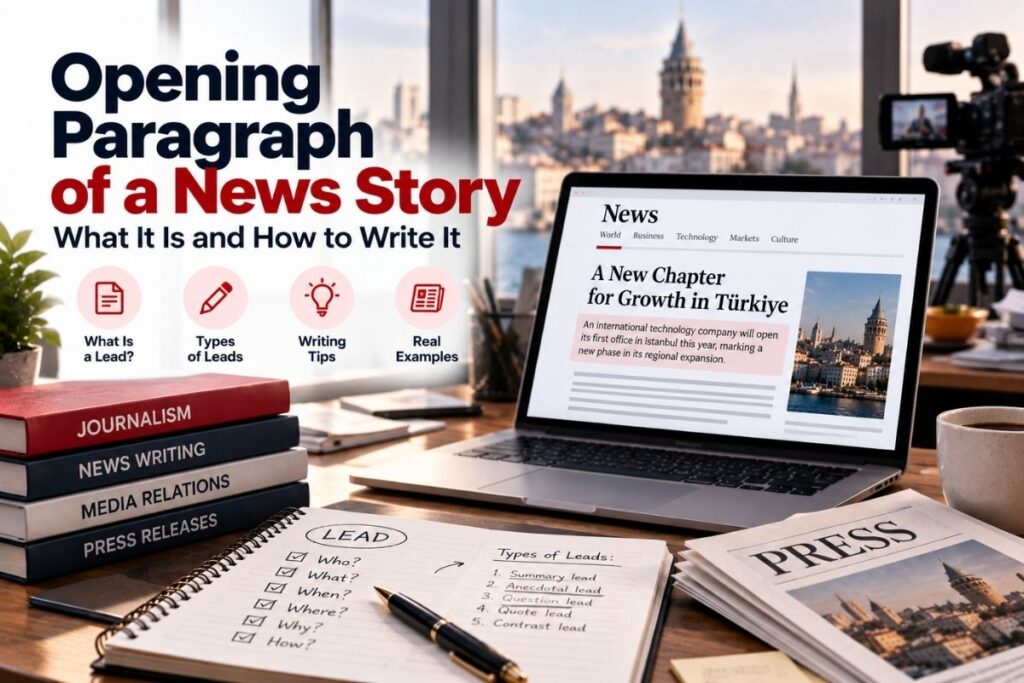
The opening paragraph of a news story is the lead: the first one or two sentences that give readers the most important information and establish why the story matters. A strong lead identifies the central development quickly rather than making readers work through background information before reaching the news.
For journalists, the lead determines how a story begins. For PR professionals, the same discipline can make a press release or journalist pitch clearer, more credible and easier to assess. This guide explains the terminology, 5W1H, common lead formats, a practical writing process, original examples and the difference between a lead and a news hook.
What is the opening paragraph of a news story called?
The opening paragraph of a news story is called the lead, also traditionally spelled lede. It introduces the most newsworthy information and gives readers enough context to understand the central development. In straightforward reporting, the lead usually prioritises the strongest facts rather than background, commentary or promotional language.
When someone asks what is a lead in journalism, the practical answer is therefore not simply “the first paragraph.” A journalistic lead is the editorial entry point into the story. It tells the audience what has happened, who is involved and why the development deserves attention.
The question what is a lead in writing can have broader answers in other forms of writing, but within journalism the term has a specific news function. A lead paragraph should establish the story quickly enough that a reader can understand the essential news even without reading every paragraph that follows.
Consider this fictional development:
A Turkish logistics company will open a new temperature-controlled distribution centre in Ankara in November, expanding its capacity for pharmaceutical deliveries.
That sentence establishes the company action, location, timing and practical significance without starting with company history.
A news lead therefore performs two jobs at once: it informs and prioritises. The writer is not merely deciding what to say first; the writer is deciding which fact is important enough to define the story.
This is the core definition of lead in journalism: the opening that communicates the central news angle as efficiently and accurately as possible.
What is the first paragraph of a news story?
The first paragraph should communicate the strongest available news while answering the most relevant parts of who, what, when, where, why and how, commonly known as 5W1H. It does not need to force all six elements into one sentence. The writer selects the details readers need immediately and moves secondary information lower in the story.
A conventional news story lead is often one or two sentences. For a straightforward hard-news article, roughly 25 to 35 words can be a useful editing target rather than an absolute rule. If a sentence becomes overloaded with names, dates, locations and qualifications, clarity matters more than hitting a particular word count.
For example:
A renewable-energy developer will begin construction of a solar facility near Izmir in September after receiving final project approval this week.
The sentence answers several immediate questions without explaining every project detail. Capacity, executives, project history and additional context can follow.
How the inverted pyramid shapes the first paragraph
Traditional news reporting often follows the inverted pyramid: the most important information comes first, followed by supporting facts, quotations and increasingly detailed background.
That structure makes writing a lead paragraph an exercise in prioritisation. If readers stop after the first paragraph, they should still understand the central event. If editors shorten the article from the bottom, the essential news should remain intact.
The principle is especially useful in PR. A news article lead that starts with the announcement itself is easier to evaluate than one that opens with broad claims about an industry, a company mission or a lengthy executive quotation.
The first paragraph is therefore not a miniature version of the entire article. Effective lead writing selects the fact that earns the rest of the story the right to be read.
Types of leads in journalism
The main types of leads differ according to the story, tone and amount of context a reader needs. A summary lead is usually the safest choice for direct corporate news, while anecdotal, question, quote and contrast openings can work when the format and subject justify a slower or more distinctive entry.
Understanding the main kinds of leads in journalism helps a writer choose a structure because it serves the story—not simply because it sounds creative.
Summary lead
A summary lead presents the central facts immediately. It works particularly well for announcements, breaking developments, appointments, transactions, launches and other stories with a clear factual event.
Original example:
A food manufacturer will open its second production facility in Bursa next month, adding a new export line for frozen products.
This approach is less suitable when the story depends heavily on an individual experience or a scene that needs to be established before the broader issue becomes meaningful.
Anecdotal lead
An anecdotal lead begins with a short scene, person or incident that represents a wider story.
Original example:
At 6 a.m., the first crates arrive at the neighbourhood market already labelled with the farms where their produce was harvested the previous afternoon.
This can work for features, profiles and human-interest stories. It is usually a poor choice for urgent corporate news because it delays the core announcement.
Question lead
A question lead opens by asking something the story will answer.
Original example:
What happens when a retailer can trace every package from the warehouse shelf to the customer’s door?
Questions can suit explanatory or feature content, but they are easy to overuse. If the reader’s immediate response is “I don’t know” or “I don’t care,” the opener has created work rather than interest.
Quote lead
A quote lead begins with someone’s words.
Original example:
“The next stage is not about opening more stores; it is about making each delivery faster,” the company’s operations director said.
Quote openings should be reserved for language that genuinely carries the story. Routine statements such as “we are delighted to announce” rarely justify taking the most valuable position in the article.
Surprise or contrast lead
A contrast lead places two apparently conflicting facts beside each other to reveal the angle.
Original example:
The company’s newest office has twice the meeting space of its previous headquarters but only half as many permanent desks.
Among the different kinds of leads, this approach can make a trend or strategic shift immediately visible. It should not manufacture surprise where none exists.
An example of a lead is useful only when considered alongside the story it serves. Format follows news value.
How to begin a news story: how to write a good lead, step by step
To begin a news story effectively, identify the single most newsworthy development, select only the 5W1H details needed to understand it, and write the clearest version before adding context. Anyone learning how to write a lead should focus first on editorial priority, then on style.
A practical process is:
- Identify what actually changed.
Ask what is new today that was not true before. “Company X operates in technology” is background; “Company X will open its first Istanbul office in June” is news. - Choose the strongest angle.
A story may contain a new product, executive comment, investment and market expansion. The lead should not give all four equal weight. Select the development most relevant to the intended reader. - Answer the essential 5W1H questions.
Decide which of who, what, when, where, why and how are necessary immediately. A useful test for the opening paragraph of a news story is whether removing a detail makes the central event harder to understand. - Write the news before the background.
Avoid opening with the company’s founding date, mission, market philosophy or a broad statement about the sector unless one of those facts is itself the news. - Use specific verbs and concrete nouns.
“Will open,” “acquired,” “appointed,” “launched” and “signed” communicate action. Vague phrases such as “continues its journey” force readers to decode what actually happened. - Cut unnecessary qualifiers.
Once the first draft exists, remove adjectives, corporate slogans and details that belong later. Learning how to write a good lead is often as much about deletion as composition. - Test it without the headline.
Read the paragraph by itself. A reader should understand the main development without depending on the headline for essential context.
When considering how to write a lead paragraph, resist the urge to make the opening carry the entire story. Its purpose is to establish the angle clearly enough for the next paragraph to develop it.
What is a good opening sentence for a news article?
A good opening sentence communicates a specific development in plain language, puts the strongest information early and gives the reader a reason to continue. It should be understandable without promotional claims or unnecessary background and should make the story’s angle visible from the start.
A strong lead sentence usually has four qualities:
- Specific: it identifies an actual event or change.
- Relevant: it prioritises information important to the intended audience.
- Concise: it does not carry details that can wait.
- Independent: it makes sense without requiring the headline or previous context.
The difference becomes clearer through editing.
Weak vs. strong opening
Weak:
Continuing its commitment to innovative solutions and customer-focused growth, fictional company Northline is proud to announce an exciting new development in its ongoing expansion journey.
The sentence contains almost no usable news. Readers still do not know what happened.
Strong:
Fictional logistics company Northline will open its first warehouse in Istanbul in October to support same-day deliveries across the city’s European side.
The second version gives the reader a concrete action, place, timing and purpose.
For an example of a news lead, this illustrates an important distinction: concise does not mean stripped of detail. The goal is to retain the details that explain the news while removing language that merely praises it.
A useful example of a summary lead should pass the “so what?” test quickly. If the reader cannot identify the development after one sentence, the opening probably needs another edit.
Lead vs. news hook: what is the difference?
A news hook is the reason a story is timely, relevant or newsworthy now; a lead is the way the writer presents the story at the beginning. The hook exists at the level of editorial value, while the lead exists at the level of writing and structure.
Imagine a fictional manufacturer announcing a new facility. Its hook might be that the facility marks the company’s entry into Turkey. The lead would be the sentence used to communicate that development.
| Concept | Main question | Example |
|---|---|---|
| News hook | Why does this matter now? | First expansion into Turkey |
| Lead | How should the news begin? | Company will open its first Turkish facility in Ankara in September |
A newspaper hook can come from timing, change, consequence, proximity, relevance, conflict, novelty or another legitimate news factor. It should be identified before the writer decides how to start news coverage.
That distinction matters in PR because polishing a sentence cannot repair a weak underlying story. A well-written opener may be clear, but clarity alone does not create newsworthiness.
For anyone asking how to start a news report, the sequence should therefore be: find the actual news, establish the angle, then write the lead. Style comes after editorial judgment.
What PR professionals can learn from the news lead
PR professionals can apply journalistic lead principles by putting the announcement before company messaging, removing promotional language and making the relevance of the news obvious. A press release or media pitch is easier to assess when a journalist can identify the development without searching through background copy.
Four practices are particularly useful:
- Lead with the change, not the organisation. A launch, appointment, expansion, partnership or other development usually deserves priority over corporate description.
- Separate fact from positioning. Put verifiable information in the opening and reserve executive interpretation or brand messaging for supporting paragraphs.
- Make the pitch angle visible immediately. In a journalist email, the first lines should show why the story is relevant to that journalist’s audience.
- Use supporting material after the core news. Quotes, background, company information and context become more useful once the announcement is clear.
The same approach improves a press release because journalists can scan the opening and assess relevance quickly. It also prevents a common PR problem: a release that reads like advertising before the actual announcement appears.
Original press release opening example
Suppose a fictional software company is entering the Turkish market.
Promotional version:
As part of its commitment to empowering businesses through innovative technology, Novara Cloud is delighted to announce an exciting new chapter in its international journey.
News-led version:
Fictional software company Novara Cloud will enter the Turkish market in May, opening an Istanbul office to support local sales and customer operations.
The second version does not attempt to persuade through adjectives. It gives journalists the factual development first and leaves space for evidence, quotations and context afterward.
The principle also applies to pitches. A journalist does not need a compressed company brochure in the opening lines. The journalist needs to know what happened, why it matters now and why it fits the publication or audience.
For international companies seeking Turkish media attention, that distinction becomes especially important. A global announcement may need a clear local angle—such as a Turkish launch, local partnership, executive appointment, investment or market-specific development—to become relevant to local editors.
Conclusion
The opening paragraph of a news story is where editorial judgment becomes visible: the writer identifies the strongest development, selects the essential facts and presents them before secondary context. Good leads are specific, concise and built around genuine newsworthiness rather than promotional language.
The same discipline strengthens press releases and journalist pitches. PR teams that establish the news hook first and write the lead second give editors a clearer reason to keep vreading. Brands seeking support with press release development, Turkish media relations or communicating news to local journalists can contact PR Turkey for professional PR support.
Frequently asked questions
What is a news stvory’s first paragraph called?
It is called the lead, with “lede” also used as a traditional newsroom spelling. Its purpose is to introduce the most important information, establish the central angle and give readers enough context to understand why the story matters.
What is the first paragraph of a news story?
The first paragraph is the story’s lead. It normally presents the most important news first and may answer the most relevant elements of who, what, when, where, why and how. Supporting details, quotations and background information generally follow.
How to begin a news story?
Begin by identifying what has changed or happened and why it matters. Choose the strongest angle, include only the essential facts, use concrete language and move background information lower in the story. The reader should understand the core development immediately.
What is a good opening sentence for a news article?
A good opening sentence is specific, clear and news-led. It identifies a meaningful development without unnecessary background, promotional adjectives or vague claims. It should tell the reader something concrete and create a logical path into the supporting details that follow.