What is Crisis Management? The Complete PR Guide for 2026

What is crisis management PR guide cover image showing a digital tablet, megaphone, newspaper, and coffee cup on a desk.

Crisis management is the strategic process of preparing for, mitigating, and responding to disruptive events that threaten an organization’s operations, financial stability, or brand reputation. In modern public relations, it requires anticipating vulnerabilities before they escalate into public scandals. By understanding core principles and establishing protocols in advance, PR professionals can transform potential disasters into opportunities to demonstrate corporate accountability and resilience.

What is Crisis Management in Reality?

Crisis management means executing a structured, pre-planned sequence of actions to neutralize sudden threats to a business. While the media often highlights the public response, true crisis handling begins long before any incident occurs through rigorous vulnerability assessments and operational readiness.

The core lifecycle of managing an organizational emergency consists of four primary stages:

  • Preparedness: Identifying risks, drafting protocols, and training spokespersons.
  • Response: Activating the command center, securing operations, and issuing initial holding statements.
  • Recovery: Restoring normal business functions while maintaining transparent updates with stakeholders.
  • Mitigation: Analyzing the post-incident data to update protocols and prevent future recurrences.

What is the Difference Between Crisis Management and Crisis Communication?

A common pitfall in public relations is confusing the operational reality of an emergency with the messaging surrounding it. Understanding what is the difference between crisis management and crisis communication is essential for deploying an effective corporate defense strategy. They are entirely separate disciplines that must work in perfect synchronization to protect the brand.

Crisis management focuses on the physical, operational, and legal steps required to solve the actual problem. If a manufacturing plant catches fire, the management component involves evacuating employees, shutting down hazardous machinery, coordinating with local fire departments, and halting supply chain logistics. It is heavily focused on infrastructure, safety, and business continuity. The ultimate goal is to neutralize the threat and restore normal operations as quickly as possible.

Conversely, crisis communication is strictly about how the organization translates those operational realities to the public, employees, investors, and the media. It involves drafting press releases, managing social media channels, and fielding journalist inquiries. If the management team is putting out the literal fire, the communication team is putting out the reputational fire. When an organization attempts to communicate its way out of a crisis without actually managing the underlying operational failure, stakeholders immediately perceive the messaging as empty spin.

Discipline FocusPrimary ObjectiveKey DeliverablesMain Target Audience
Crisis ManagementStop the operational threat and ensure business continuity.Evacuation plans, supply chain reroutes, operational audits.Internal teams, legal counsel, regulatory bodies.
Crisis CommunicationProtect brand reputation and maintain stakeholder trust.Holding statements, press releases, media interviews.Customers, journalists, general public, investors.

Understanding PR Crisis Management

When operational emergencies intersect with public perception, PR professionals step into the spotlight. PR crisis management specifically deals with preserving the brand’s integrity, ensuring that the narrative surrounding an event remains factual, and preventing misinformation from dominating search engine results and news cycles. In the digital age, a PR crisis does not always require a physical disaster; a rogue executive tweet, a leaked internal memo, or a sudden boycott can severely damage a company’s market capitalization within hours.

The digital landscape has fundamentally altered the timeline of PR responses. Historically, communications teams had a 24-hour news cycle to gather facts and draft a polished statement. Today, PR professionals operate under the “Golden Hour” rule. If a brand does not issue a preliminary holding statement within the first 60 minutes of a digital scandal breaking, the public narrative will be hijacked by commentators, critics, and competitors. A holding statement does not need to have all the answers; it simply needs to acknowledge the situation, express concern, and promise further updates, thereby buying the operational team time to investigate.

Furthermore, identifying the best crisis management strategies for social media backlash requires specialized digital listening tools. PR teams must continuously monitor algorithmic shifts, sentiment analysis, and trending hashtags. When a backlash occurs, the strategy must pivot from broad broadcasting to targeted stakeholder mapping. This means addressing the core grievances of the most impacted audience segments rather than issuing generic, corporate-speak apologies that often exacerbate public anger.

How to Build a Crisis Management Plan for Small Business and Enterprise

A sophisticated response strategy is useless if it only exists in the minds of the executive team. A formalized crisis management plan acts as the definitive playbook during an emergency, eliminating the need for real-time guesswork. Whether you are leading a multinational corporation or researching how to build a crisis management plan for small business operations, the foundational architecture remains the same.

The first step in building a robust plan is conducting a comprehensive vulnerability audit. Organizations must gather department heads to brainstorm every conceivable threat, ranging from data breaches and product recalls to natural disasters and executive misconduct. Once identified, these risks are plotted on a 3×3 matrix evaluating their likelihood of occurrence against their potential reputational impact. This matrix dictates prioritization; a high-probability, high-impact event (such as a server outage for a tech company) requires extensive, detailed planning, whereas low-probability events require generalized response frameworks.

The second critical component is the development of pre-approved communication assets. During a live emergency, waiting for legal and executive approval on a 100-word press release can cause devastating delays. A solid plan includes a library of fill-in-the-blank templates for various scenarios. Additionally, advanced PR teams deploy “dark sites”—pre-built, hidden websites containing safety protocols, executive contacts, and factual backgrounders. The moment an incident occurs, the PR team flips a switch, turning the dark site into the primary source of truth, thereby centralizing information flow and preventing media outlets from relying on unverified rumors.

Finally, a crisis management plan must mandate regular simulation training. A plan in a binder gathers dust; a plan tested through tabletop exercises builds muscle memory. By simulating a high-pressure scenario—such as a mock ransomware attack—the response team identifies bottlenecks in communication, ensures contact lists are up-to-date, and verifies that backup systems function under stress.

Building Your Command Center and Crisis Management Team

No single executive can navigate a severe organizational threat alone. Establishing a dedicated crisis management team prior to an event is the most critical logistical step a company can take. The composition of this team must be cross-functional, ensuring that every strategic decision accounts for legal, financial, operational, and reputational risks simultaneously.

The command center must be led by a designated Crisis Manager, who acts as the ultimate decision-maker and project manager during the incident. This individual is rarely the CEO; the CEO must remain focused on the overarching vision and external stakeholder confidence, while the Crisis Manager handles the minute-to-minute tactical execution. Reporting directly to the Crisis Manager are the heads of Legal, Human Resources, IT, Operations, and Public Relations.

For organizations wondering how to handle a pr crisis without an in-house team, the initial hours are critical. The immediate step is to assign temporary roles based on existing competencies: a senior manager assumes the Crisis Manager role, an HR lead handles internal communication, and a marketing lead monitors external sentiment. Simultaneously, the organization must retain a specialized legal counsel and engage external PR support to guide the strategic messaging. Attempting to navigate complex media inquiries and legal liabilities without dedicated experts is a high-risk gamble that frequently results in compounded reputational damage.

The choice of the lead spokesperson is also a critical team-building decision. The spokesperson is the face and voice of the organization during its most vulnerable moments. This individual must possess high emotional intelligence, the ability to stick strictly to approved messaging under aggressive questioning, and a deep understanding of the operational facts. Crucially, the spokesperson should not necessarily be the PR Director; often, a subject matter expert or an operational leader provides more credibility and E-E-A-T (Experience, Expertise, Authoritativeness, Trustworthiness) when explaining technical failures to the press.

Key Crisis Management Strategies and Essential Skills

Navigating an emergency requires a blend of rigorous protocol adherence and adaptable soft skills. The most effective crisis management strategies hinge on the organization’s ability to remain transparent while aggressively solving the underlying issue. PR professionals must master specific competencies to guide their organizations through intense public scrutiny.

Transparency and accountability are the non-negotiable cornerstones of modern PR strategy. The public is highly forgiving of honest mistakes, but ruthlessly punitive toward cover-ups. If an organization is at fault, the strategy must follow the “Steal the Thunder” approach. This involves the company proactively announcing the bad news itself, rather than allowing an investigative journalist or a whistleblower to break the story. By releasing the negative information voluntarily, the organization frames the narrative, demonstrates accountability, and instantly deflates the shock value that media outlets rely on for clicks.

Another critical strategy involves aggressive stakeholder segmentation. During a crisis, a company does not have a single audience; it has multiple distinct groups, each requiring different information. Employees need to know if their jobs are safe and what to tell clients. Investors need reassurance about financial viability. Customers need to know how the issue impacts their daily lives. A monolithic press release fails to address these distinct anxieties. Instead, PR teams must deploy customized messaging through specific channels—internal memos for staff, dedicated investor calls, and targeted social media updates for consumers.

From a skills perspective, professionals in this field must exhibit extreme situational awareness and emotional regulation. During a crisis, information changes rapidly, and initial reports are frequently wrong. A skilled crisis manager knows how to verify data before acting, avoiding the trap of issuing corrections that erode public trust. Furthermore, they must possess strong negotiation skills to manage conflicting priorities between the legal team (who usually advises saying nothing to limit liability) and the PR team (who advises maximum transparency to preserve the brand).

How to Handle a PR Crisis: Real-World Implementation

Theoretical frameworks only go so far; understanding how to handle a PR crisis requires examining real-world application. Every crisis follows a unique trajectory, but the core principles of rapid response, operational alignment, and transparent communication remain constant across industries.

Consider a scenario involving a severe data breach at a financial technology firm. The operational team discovers that customer credit card information has been compromised. The immediate crisis management step is to isolate the affected servers, patch the vulnerability, and notify relevant cybersecurity authorities and legal regulators according to data protection laws.

Simultaneously, the PR crisis management protocol activates. Within the Golden Hour, the PR team issues a holding statement on the company’s official channels acknowledging unusual network activity and confirming that a forensic investigation is underway. As the operational team secures the system, the PR team deploys the dark site, updating it with a detailed FAQ for concerned customers. When the full extent of the breach is known, the CEO steps forward as the spokesperson, taking full responsibility, outlining the exact operational fixes implemented, and offering free credit monitoring to all affected users. Because the company “stole the thunder” and controlled the narrative from hour one, media coverage focuses on their swift, responsible action rather than the breach itself.

In contrast, consider a social media boycott triggered by an insensitive advertising campaign. In this scenario, there is no physical infrastructure failure; the crisis is entirely perceptual. The best strategy is to immediately pull the offending campaign across all platforms to stop the bleeding. The PR team must then analyze the sentiment of the backlash to understand the specific community offended. The response should not be a defensive justification of the campaign’s intent, but an unequivocal apology paired with a concrete commitment to altering internal review processes to ensure diverse perspectives are consulted in future marketing efforts.

Evaluating the Cost of Hiring a PR Crisis Management Agency

When facing a significant threat, organizational leaders must decide whether to handle the situation internally or seek specialized external support. Understanding the financial implications, specifically the cost of hiring a PR crisis management agency, is a crucial part of executive decision-making. Budgeting for crisis response should be viewed as an insurance policy for brand equity rather than a discretionary expense.

The financial structure of crisis agencies generally falls into two categories: retainer models for preparedness, and hourly/project rates for active crisis response. An ongoing retainer ensures that an agency is familiar with your operational nuances and has pre-approved plans ready to deploy immediately. This proactive approach requires a steady, predictable budget. Conversely, hiring an agency in the middle of a blazing public relations disaster commands premium emergency rates, as the agency must drop other priorities, onboard immediately, and work around the clock to stabilize the situation.

Engagement TypeScope of ServicesEstimated Budget ImpactBest Suited For
Preparedness RetainerVulnerability audits, plan drafting, media training, dark site setup.Predictable, moderate monthly fee.Corporations seeking long-term risk mitigation.
Active Crisis Response24/7 command center support, statement drafting, media fielding, reputation repair.High, unpredictable hourly billing or massive project fee.Organizations caught in a severe, unexpected scandal without internal capacity.
Post-Crisis RebuildingSEO suppression, long-term brand rehabilitation, trust-building campaigns.Moderate to high project fee spanning several months.Brands that suffered verifiable market share loss due to negative perception.

While the immediate cost of an elite PR agency can seem daunting, organizations must calculate the alternative: the total cost of a mismanaged crisis. A botched response can result in plummeting stock prices, mass customer exodus, regulatory fines, and the permanent loss of executive credibility. In many cases, the investment in professional crisis management pays for itself by mitigating these catastrophic financial losses and accelerating the brand’s return to normal operations.

Frequently Asked Questions

What is the primary goal of crisis management?

The primary goal is to minimize the negative impact of an unexpected event on an organization’s operations, financial standing, and reputation. It aims to protect stakeholders, ensure business continuity, and swiftly restore normal operations through strategic, pre-planned actions.

Who should be the spokesperson during a corporate crisis?

The spokesperson should be an authoritative figure with deep knowledge of the situation and high emotional intelligence. While the CEO is appropriate for existential threats, technical experts or operational directors often provide better credibility for specific, localized failures.

How often should a crisis management plan be updated?

A comprehensive plan should be reviewed and updated at least annually. Furthermore, it requires immediate revision following any major organizational change, such as a merger, the launch of a new product line, or a shift in the executive leadership team.

Can a small business survive a major PR crisis?

Yes. Small businesses can survive severe crises if they respond with speed, extreme transparency, and genuine accountability. Because they lack corporate bureaucracy, small businesses can often deploy holding statements and operational fixes much faster than large enterprises.

Conclusion

Mastering crisis management is an ongoing strategic discipline, not a reactive panic button. By understanding the distinct roles of operational recovery and public communication, PR professionals can build resilient frameworks that protect corporate reputations under extreme pressure. From conducting rigorous vulnerability audits and building specialized teams to deploying transparent, rapid-response strategies, every step in the planning phase dramatically reduces the impact of future emergencies. Organizations that invest in comprehensive preparedness do not just survive disasters; they emerge from them with renewed stakeholder trust and proven operational integrity.

Contact PR Turkey experts to create a robust crisis management plan that protects your company's reputation and to manage risks through professional PR strategies.

Personal Online Reputation Management: Complete 2026 Guide

Personal online reputation management guide cover image featuring a professional desk setup with a microphone, notebook, and coffee cup.

Personal online reputation management is the strategic process of shaping, protecting, and improving public perception of an individual across digital platforms. In today’s hyper-connected world, your digital footprint acts as your primary resume, business card, and background check all rolled into one. By mastering this process, you can ensure that search engines highlight your greatest achievements while mitigating the impact of outdated or negative information.

What is Personal Online Reputation Management?

Personal online reputation management involves monitoring, influencing, and controlling how you appear in Search Engine Results Pages (SERPs) and social media platforms. It focuses on ensuring that anyone searching your name finds accurate, positive, and professionally beneficial information.

A successful strategy typically includes the following core components:

  • Continuous Monitoring: Tracking mentions of your name across the web using automated alerts.
  • Content Creation: Publishing high-quality, authoritative content that ranks well in search engines.
  • Asset Optimization: Securing and optimizing personal websites and social media profiles.
  • Content Suppression: Pushing negative or irrelevant search results down to the second or third page of Google.
  • Review and Feedback Handling: Addressing public criticisms or false statements swiftly and professionally.

Why Personal Branding and Reputation Management Are Inseparable

The line between personal branding and reputation management has vanished entirely. While personal branding focuses on proactively broadcasting your unique value proposition, personal online reputation management acts as the defensive shield that protects that brand. If a recruiter, potential business partner, or investor searches your name, the first page of Google will dictate their initial impression. According to industry hiring reports, a vast majority of employers perform digital background checks before making executive-level offers.

When you fail to control your digital footprint, you leave your narrative in the hands of third parties. A single misunderstood social media post from a decade ago or a disgruntled client’s forum complaint can overshadow years of professional excellence. Therefore, a robust online reputation management strategy is not just about vanity; it is a fundamental requirement for career longevity and business growth. It ensures that your online presence accurately reflects your current expertise and professional standing.

How to Monitor Your Personal Online Reputation Effectively

Understanding your current digital standing is the mandatory first step before implementing any changes. Online reputation monitoring requires moving beyond a simple, occasional Google search and establishing a systematic approach to tracking your digital footprint. If you do not know what is being said about you, you cannot manage it.

To execute effective online reputation monitoring, you must audit both search engines and social platforms comprehensively. Begin by logging out of all your Google accounts, or use an “Incognito” window, to ensure personalized search history does not skew the results. Search your full name, variations of your name, and your name combined with your current or previous employers. Document every positive, neutral, and negative result on the first three pages of the SERPs.

Next, automate your ongoing monitoring. Set up Google Alerts for your exact name enclosed in quotation marks (e.g., “John Doe”). For deeper insights, utilize specialized social listening tools that scan public forums, news sites, and social media networks for your mentions. Categorize the sentiment of these mentions to understand your baseline reputation. By consistently analyzing these alerts, you position yourself to respond immediately if an unexpected crisis emerges.

Best Personal Online Reputation Management Strategies for Executives

High-level professionals face unique digital challenges. The best personal online reputation management strategies for executives focus on establishing unshakeable authority and dominating the top search results with premium, controlled assets. Executives cannot afford to have a fragmented or amateurish online presence.

The foundation of an executive strategy is digital real estate ownership. Every executive should own their exact-match domain (e.g., FirstnameLastname.com) and operate a professional website. This site serves as the central hub for your official biography, speaking engagements, published articles, and press mentions. Because search engines prioritize highly structured, relevant domains, an active personal website will almost always secure the number one spot for a name search.

Beyond a personal website, executives must optimize a carefully selected portfolio of social media profiles.

Strategy ComponentPurpose for ExecutivesImplementation Tactic
LinkedIn OptimizationPrimary B2B networking and hiring.Publish long-form thought leadership articles monthly.
Executive BiographyEstablishing authoritative narrative.Distribute a standardized, professionally written bio across all corporate directories.
Industry PublishingBuilding E-E-A-T (Experience, Expertise, Authoritativeness, Trustworthiness).Secure guest posting opportunities on respected industry publications.
Digital DetoxMitigating past liabilities.Conduct a comprehensive audit of historical social media posts and delete controversial content.

By executing these strategies, executives create a robust digital fortress. When a board of directors or an investor investigates them, the SERPs return a curated, highly professional narrative that reinforces their leadership capabilities.

How to Repair Personal Online Reputation After a Crisis

Facing a digital crisis, whether due to a public misunderstanding, a targeted defamation campaign, or a professional misstep, requires immediate and calculated action. Knowing how to repair personal online reputation after a crisis is critical to minimizing long-term damage. The immediate instinct is often to panic and issue uncoordinated statements, but effective reputation repair demands strict discipline.

The first phase of reputation repair is containment. Pause all scheduled social media posts and assess the origin and spread of the negative information. Do not engage in public arguments in comment sections, as this only fuels the algorithm, pushing the negative content higher in search results. If the crisis involves false or defamatory information published by a third party, consult with a legal professional regarding official platform policies and the possibility of issuing a cease-and-desist letter.

The second phase is aggressive content suppression. Because removing content from third-party sites is notoriously difficult and often impossible without a court order, suppression is the most reliable tactic. This involves generating a massive volume of high-quality, SEO-optimized content designed to outrank the negative search results. You must create new social media profiles on high-authority platforms (like Medium, GitHub, or industry-specific directories), publish positive press releases, and consistently update your personal website. Over time, the weight of the new, authoritative content will push the negative links to the second or third page of the SERPs, where they receive negligible traffic.

How to Remove Negative Reviews from Personal Google Search Results

While most review platforms target businesses, individuals—especially freelancers, consultants, and independent practitioners—often face personal reviews. Figuring out how to remove negative reviews from personal Google search results is a common challenge, but the solutions require navigating strict platform guidelines.

Direct removal of negative reviews is only possible if the content explicitly violates the platform’s terms of service. For example, if a Google review contains hate speech, reveals private personal information (doxxing), or is demonstrably written by a competitor or a bot, you can flag it for removal. You must submit a detailed report to the platform, citing the specific policy violation. However, platforms will not remove a review simply because you disagree with the user’s opinion or because it harms your reputation.

When removal is not an option, proactive google review management becomes essential. You must publicly respond to the negative review in a calm, professional, and factual manner. A well-crafted response demonstrates to future readers that you are accountable and professional under pressure. Simultaneously, initiate a campaign to gather authentic, positive reviews from satisfied clients or colleagues. A steady influx of five-star ratings will mathematically dilute the impact of a single negative review and improve your overall aggregate score.

Cost of Personal Online Reputation Management Services vs. DIY

When deciding how to handle your digital footprint, the financial investment is a major consideration. The cost of personal online reputation management services varies drastically depending on the severity of the situation and the prominence of the individual, which often leads people to weigh professional help against a Do-It-Yourself (DIY) approach.

A DIY approach requires zero financial investment but demands hundreds of hours of labor. You will need to learn the intricacies of SEO reputation management, constantly monitor your own alerts, write all your own content, and manually manage every social profile. For entry-level professionals with minor digital footprint issues, this time-intensive approach is often sufficient.

Conversely, hiring a professional agency offers speed, expertise, and access to proprietary technology.

ApproachEstimated Financial CostTime CommitmentBest Suited For
DIY ManagementMinimal (Software subscriptions only)High (10-20 hours per month)Entry-level professionals, minor cleanup.
Freelance ConsultantModerateMediumMid-level managers needing strategic guidance.
Professional AgencyHigh (Often thousands per month)Low (Done-for-you service)Executives, public figures, active crises.

Professional services typically involve a team of SEO specialists, public relations experts, and sometimes legal advisors. They utilize advanced software to map your digital entities and execute sophisticated suppression campaigns. When evaluating the cost, consider the potential financial loss of a missed career opportunity or a damaged business partnership due to a poor digital reputation.

Can I Do Personal Online Reputation Management Without Hiring an Agency?

Many individuals wonder, can I do personal online reputation management without hiring an agency? The definitive answer is yes, provided your situation does not involve complex legal defamation or a viral public relations crisis. For standard digital hygiene and proactive personal branding, the tools and strategies are accessible to anyone willing to invest the time.

To successfully manage your reputation independently, you must commit to a strict routine. Start by maximizing the privacy settings on your personal social media accounts (like Facebook or personal Instagram) to ensure casual posts are not indexed by search engines. Next, claim your name on every major professional and social platform, even if you do not plan to use them actively; this prevents impersonation and secures valuable digital real estate.

Finally, establish a consistent publication schedule. You do not need to be a professional writer to succeed. Sharing industry news on LinkedIn with a thoughtful comment, answering niche questions on Quora, or publishing a simple quarterly update on your personal blog can signal to search engines that your controlled entities are the most relevant results for your name. The key to DIY success is consistency; algorithms favor domains that are regularly updated with fresh, relevant information.

When Legal Action Intersects with Reputation Repair

In certain severe cases, standard SEO tactics and content creation are not enough. When false information is actively damaging your career, you must understand the legal frameworks that intersect with digital reputation. Defamation, which includes libel (written) and slander (spoken), occurs when false statements cause tangible harm to your reputation.

If you are a victim of defamation, legal action may be necessary to force content removal. This often involves an attorney issuing a cease-and-desist letter to the publisher or the website host. Furthermore, individuals in certain jurisdictions, such as the European Union, can invoke the “Right to be Forgotten” (GDPR). This legislation allows individuals to request that search engines delist specific, outdated, or irrelevant information connected to their name. However, it is crucial to note that this right is not absolute; search engines weigh the individual’s privacy against the public’s right to information, especially for public figures or in cases involving criminal records. Always consult with a qualified technology or defamation attorney before attempting to navigate these legal avenues.

Frequently Asked Questions

What is the best way to monitor my personal digital footprint?

Set up automated Google Alerts for your exact name and variations. Combine this with regular, manual “Incognito” searches of your name to see exactly what external parties view on the search engine results pages.

Can negative news articles be permanently deleted?

Generally, legitimate news organizations will not delete accurate historical articles. In these cases, you must focus on content suppression strategies to push the negative article down the search rankings by creating stronger, optimized positive assets.

How long does reputation repair typically take?

There is no overnight fix. Depending on the authority of the negative links, a dedicated content suppression and SEO campaign usually takes between three to six months to show significant shifts in the first page of search results.

Is it worth paying for an exact match personal domain name?

Yes. Purchasing “YourName.com” is the most cost-effective and powerful step in controlling your digital narrative. Search engines heavily favor exact match domains, making it the easiest way to secure the number one search ranking for your name.

Conclusion

Taking control of your digital narrative is no longer an optional luxury; it is a critical requirement for professional success in the modern era. Effective personal online reputation management demands continuous monitoring, strategic content creation, and swift action during a crisis. By proactively securing your digital real estate and understanding how search engines evaluate your entities, you can build a resilient and authoritative public image. Do not leave your career trajectory to the mercy of random search results or outdated information. Take decisive action today to audit your digital footprint and align your online presence with your true professional value.

Contact PR Turkey experts to secure your digital presence and professionally manage your reputation.

How to Measure Brand Awareness: Key Metrics and Tools

How to measure brand awareness: A visual guide displaying performance metrics, reports, and marketing ROI charts.

The brand awareness definition encompasses how well consumers recognize and recall your business within its specific market sector. While establishing this initial market presence is vital, executives and marketing directors must understand exactly how to measure brand awareness to validate their public relations strategies and justify their marketing investments. This comprehensive methodology explores the exact key performance indicators, analytical frameworks, and survey techniques required to quantify corporate visibility accurately. By implementing structured brand measurement protocols, organizations transform vague market perception into actionable financial data, allowing them to optimize their outreach, outpace competitors, and accelerate long-term commercial growth.

What is Brand Awareness and How Do You Track It?

Brand awareness is a marketing metric quantifying how familiar target audiences are with your company, products, or corporate identity. To track this visibility accurately, organizations analyze specific data points across multiple communication channels:

  • Search engine branded query volume
  • Direct website traffic growth
  • Social media share of voice
  • Targeted consumer survey results

Why Measuring Brand Awareness Matters for PR and Marketing ROI

Many corporate leaders mistakenly view brand visibility as an intangible, “vanity” metric that cannot be directly tied to the bottom line. This misconception leads companies to underfund their public relations and upper-funnel marketing initiatives. In reality, establishing concrete methods for measuring brand awareness is the foundational step in proving the financial return on investment (ROI) of your entire communication strategy. When consumers know and trust your brand, your cost per acquisition (CPA) decreases, your sales cycles shorten, and your organic referral rates multiply.

Identifying the best brand awareness metrics for startups and enterprise organizations allows marketing teams to transition from guessing to knowing. If a company launches a massive, expensive public relations campaign, leadership needs to see empirical evidence that the target demographic absorbed the message. Without tracking brand metrics, you cannot determine if a spike in sales resulted from the PR campaign, a seasonal trend, or a competitor’s sudden supply chain failure.

Furthermore, consistent brand measurement provides a crucial defensive advantage. By continuously monitoring how the public perceives your organization, you can detect early warning signs of negative sentiment or declining relevance before these issues impact your revenue. Tracking these shifts allows agile teams to adjust their messaging, launch corrective campaigns, and maintain their market leadership position. Ultimately, measuring brand awareness bridges the gap between creative public relations efforts and hard financial outcomes.

Key Brand Awareness Metrics and KPIs to Track

Establishing definitive brand awareness kpis is the only way to evaluate your brand measurement efforts accurately. Rather than relying on isolated data points, successful organizations monitor a composite index of metrics that reflect both digital footprint and consumer psychology.

Here are the most critical brand awareness metrics you must monitor:

  1. Branded Search Volume: This is arguably the most definitive indicator of active brand recall. Utilizing tools like Google Search Console, you track how many people type your exact company name (or product variations) directly into a search engine. If your branded search volume increases by 20% following a major product launch, you possess concrete proof that your campaign successfully embedded your brand into the public consciousness.
  2. Direct Website Traffic: Direct traffic occurs when users type your exact URL into their browser or click a saved bookmark. While some analytics platforms misattribute “dark social” (untracked links shared in private messages) to this category, a sustained upward trend in direct traffic strongly correlates with rising brand visibility. People cannot navigate directly to your domain unless they already know who you are.
  3. Share of Voice (SOV): This metric calculates your brand’s visibility relative to your direct competitors. To calculate SOV, divide your brand’s total mentions by the total mentions of your entire industry over a specific period, then multiply by 100. If your industry generates 10,000 mentions a month and your brand accounts for 2,500 of them, your SOV is 25%. Dominating the SOV guarantees that you are leading the industry conversation.
  4. Earned Media Coverage: Tracking the volume, reach, and sentiment of articles published about your company by independent journalists is a fundamental PR metric. High-quality editorial placements carry immense credibility and introduce your brand to entirely new audiences.
  5. Social Media Reach and Mentions: Reach measures the total number of unique users who see your content, while mentions track how often users organically tag or discuss your brand. High reach ensures your message is spreading, but a high volume of organic mentions indicates that your brand is actually resonating and becoming part of the consumer dialogue.

Aided vs. Unaided Brand Awareness Explained

When designing market research questionnaires, understanding aided vs unaided brand awareness examples is critical for gathering accurate consumer data. These two metrics measure entirely different cognitive processes. Unaided awareness measures memory retrieval (recall), while aided awareness measures pattern recognition.

Unaided Brand Awareness (Brand Recall): This occurs when a consumer can generate your brand name entirely from memory when prompted with a generic product category. For example, if you ask a consumer, “Name three smartphone manufacturers,” and they immediately say your company’s name without any hints, you have achieved unaided awareness. This signifies a deeply entrenched market position.

Aided Brand Awareness (Brand Recognition): This occurs when a consumer recognizes your brand name only after being presented with a list of options. For example, asking, “Which of the following smartphone brands have you heard of?” and providing a multiple-choice list. High aided awareness means your logo and name are familiar, but you may not be the first choice they think of when it is time to make a purchase.

CriterionAided Awareness (Recognition)Unaided Awareness (Recall)
Cognitive ProcessPattern recognitionMemory retrieval
Question FormatMultiple-choice or Yes/NoOpen-ended text fields
Market PositionConsumer is familiar with the brandBrand dominates the consumer’s mindset
Survey Example“Have you heard of Brand X?”“Name three brands in Industry Y.”

Understanding this distinction ensures your surveys do not accidentally feed answers to your respondents, which would artificially inflate your performance data.

Top-of-Mind Awareness Explained

Top of mind awareness represents the highest possible level of consumer recall. It is a specific subset of unaided awareness. While unaided awareness captures all the brands a consumer can remember within a category, top-of-mind awareness strictly refers to the very first brand the consumer mentions.

Achieving top-of-mind status is the ultimate objective of any brand building campaign. When a consumer realizes they need a product or service, the first brand that enters their brain commands a massive competitive advantage. They are significantly more likely to navigate directly to that company’s website and initiate a purchase without ever researching competitors.

For example, when consumers think of “fast food,” “energy drinks,” or “electric vehicles,” a single dominant brand usually flashes into their minds instantly. This level of psychological dominance drastically reduces marketing acquisition costs. Maintaining this position requires consistent, high-impact public relations, ubiquitous advertising, and an unwavering commitment to a clear, differentiated brand identity.

How to Run a Brand Awareness Survey

Analyzing digital metrics like search volume provides excellent quantitative data, but it cannot tell you what consumers actually think about your company. To capture qualitative insights, you must speak directly to your target demographic. Knowing how to run a brand awareness survey on a budget allows startups and growing businesses to gather enterprise-level data without paying traditional research firms exorbitant fees.

Follow these systematic steps to conduct an accurate, unbiased brand awareness survey:

  1. Determine Your Target Audience and Sample Size: You must survey people who represent your actual potential customer base, not just your current followers. To achieve statistical significance with a standard 5% margin of error, you typically need to collect responses from at least 400 qualified individuals.
  2. Select a Distribution Platform: Utilize affordable digital survey platforms like Google Forms, Typeform, or SurveyMonkey. To reach users outside your existing network, utilize targeted social media advertisements or specialized panel services that pay verified respondents to take your questionnaire.
  3. Structure Questions to Prevent Bias: You must always ask open-ended, unaided questions before multiple-choice, aided questions. If you show a list of brands first, you immediately implant those names in the respondent’s short-term memory, completely ruining the validity of your subsequent unaided recall questions.
  4. Analyze and Benchmark the Data: Once you collect the responses, identify the percentage of users who recognize your brand versus your direct competitors. This establishes your baseline. You must repeat this exact survey every six to twelve months using the same methodology to track growth accurately.

Sample Brand Awareness Survey Questions:

  • (Unaided) When you think of [Industry/Product Category], what is the first brand that comes to mind?
  • (Unaided) What other brands in [Industry/Product Category] can you name?
  • (Aided) Which of the following brands have you heard of? (Provide a list including your brand and 4 competitors).
  • (Brand Perception) When you think of [Your Brand Name], what three words come to mind?
  • (Ad Recall) Have you seen or heard any advertisements for [Your Brand Name] in the last 30 days?

Essential Tools for Tracking Brand Awareness

You cannot manage what you cannot measure, and manual tracking is impossible in today’s fragmented digital ecosystem. Organizations rely on a sophisticated stack of brand awareness tools to automate data collection, analyze sentiment, and generate actionable executive reports.

Selecting the right software stack depends heavily on your budget and specific tracking needs. These platforms generally fall into three distinct categories:

1. Search and Web Analytics Tools:

Platforms like Google Analytics 4 (GA4) and Google Search Console are non-negotiable, free tools for tracking direct traffic and branded search volume. For deeper competitive analysis, SEO platforms like Ahrefs and SEMrush allow you to compare your branded search volume directly against your competitors, providing a clear picture of digital share of voice. Google Trends also offers a free, high-level overview of how interest in your brand fluctuates over time across different geographic regions.

2. Dedicated Social Listening Tools:

Marketing teams frequently ask which social listening tools measure brand awareness most effectively. Platforms like Brandwatch, Sprout Social, Mention, and Meltwater scan millions of social media posts, forum threads, and blog comments in real-time. These tools do not just count mentions; they utilize natural language processing (NLP) to perform sentiment analysis, categorizing public discussions about your brand as positive, negative, or neutral. This automated tracking is essential for crisis management and campaign evaluation.

3. PR and Media Monitoring Software:

For public relations professionals, tracking earned media requires specialized databases like Cision or Muck Rack. These tools monitor global news publications, television broadcasts, and podcasts. They calculate the potential audience reach of specific editorial placements and assign a quantifiable monetary value to the earned media, helping PR directors prove their direct financial contribution to the organization.

How to Track Brand Awareness Over Time

Launching a massive tracking initiative and generating a single, static report provides very little strategic value. Brand measurement is an ongoing, longitudinal process. Understanding how to track brand awareness over time is the only way to determine if your long-term marketing investments are actually moving the needle.

The first step in longitudinal tracking is establishing a firm baseline. Before launching a new product or initiating a major PR push, record your current metrics: what is your branded search volume today? What is your current share of voice? What percentage of the market recognizes your name? Record these figures securely.

Next, establish a strict reporting cadence. Marketing teams should pull digital metrics (search volume, social mentions, direct traffic) monthly to detect immediate spikes resulting from specific campaigns. However, comprehensive consumer surveys should be conducted semi-annually or annually. Consumer psychology shifts slowly, and surveying too frequently wastes budget while yielding statistically insignificant variations.

Finally, break down data silos. Your PR team, SEO team, and social media managers must combine their analytics into a single, unified dashboard. When you overlay PR media placements with branded search spikes on the same graph, you visually prove the correlation between external visibility and inbound traffic.

Frequently Asked Questions

What’s the difference between brand awareness and brand recognition?

Brand awareness is the broad, overarching concept of how well consumers know your company exists. Brand recognition is a specific subset of awareness (aided awareness) that measures whether a consumer can identify your brand when they see your logo, colors, or name on a list.

How often should you measure brand awareness?

Digital metrics, such as branded search volume and social media share of voice, should be monitored monthly to detect campaign spikes and potential crises. However, comprehensive consumer market research surveys should only be conducted semi-annually or annually to track meaningful, long-term psychological shifts.

What are the best brand awareness kpis for startups?

Startups with limited budgets should focus heavily on free, high-impact digital metrics. The most critical KPIs include branded search volume via Google Search Console, direct website traffic growth, organic social media reach, and the volume of earned media placements secured through grassroots PR efforts.

Can social listening tools measure brand awareness accurately?

Yes, social listening tools provide highly accurate measurements of brand visibility. By aggregating millions of online conversations, these platforms accurately calculate your share of voice against competitors and utilize sentiment analysis to determine exactly how the public feels about your corporate narrative.

Conclusion

Mastering how to measure brand awareness transforms your public relations strategy from an abstract concept into a quantifiable, revenue-driving business asset. By rigorously tracking branded search volume, utilizing advanced social listening tools, and conducting unbiased consumer surveys, organizations can accurately calculate their market share of voice and optimize their outreach budgets. Stop guessing about the impact of your marketing campaigns and start building a data-driven corporate narrative that dominates your industry. To implement enterprise-level brand tracking systems and elevate your strategic communication efforts, visit the PR Turkey website today and connect with our specialized public relations team.

What Is Media Relations? A Complete Guide with Strategies

Media relations: A visual guide showing a microphone, press materials, and PR outreach strategies.

Media relations is the strategic process of building and maintaining mutually beneficial connections with journalists, editors, and broadcasters to secure organic editorial coverage for your organization. Unlike paid advertising, this discipline focuses entirely on earned media, communicating a company’s narrative through independent, third-party news outlets. This guide explores everything from distinguishing this focused practice from broader public relations to drafting the perfect email pitch, providing the actionable templates and outreach frameworks necessary to elevate your corporate visibility and establish long-term industry authority.

What Is Media Relations and What Does It Include?

Media relations refers exclusively to the direct interaction between an organization and professionals within the mass media industry. Its core purpose is to broadcast corporate news, manage public perception, and share industry expertise through highly trusted journalistic channels.

Key components of this practice include:

  • Crafting and distributing press releases to targeted outlets.
  • Pitching exclusive story ideas to relevant beat reporters.
  • Managing inbound journalist inquiries and interview requests.
  • Organizing press conferences and editorial briefings.
  • Acting as the official corporate spokesperson during market shifts.

Media Relations vs Public Relations

The terms are frequently used interchangeably in corporate environments, but they represent entirely different scopes of work. Understanding the B2B media relations vs public relations differences is essential for allocating marketing budgets correctly and setting accurate performance expectations.

Public relations is the overarching umbrella that encompasses all communication between an organization and its various publics—including employees, investors, local communities, government regulatory bodies, and customers. It is the comprehensive management of a brand’s total reputation. Media relations, on the other hand, is a highly specialized subset of PR. It is the “square” to the public relations “rectangle”; all media relations is PR, but not all PR is media relations.

FeatureMedia RelationsPublic Relations (Broad PR)
Primary AudienceJournalists, editors, producers, freelance reporters, and bloggers.General public, employees, investors, lawmakers, and community leaders.
Core ObjectiveSecuring third-party validation through earned editorial coverage and interviews.Managing the holistic reputation and overall narrative of the organization across all touchpoints.
Key ChannelsNews websites, broadcast television, radio, industry magazines, and editorial podcasts.Social media, internal newsletters, annual reports, community events, and direct stakeholder meetings.
Success MetricsNumber of published articles, domain authority of the outlet, share of voice, and quality of backlinks.Employee satisfaction, investor confidence, crisis mitigation, and overall brand sentiment scores.

If a company is hosting an internal town hall to boost employee morale, that is public relations. If that same company invites a journalist from a major business journal to exclusively cover the CEO’s speech at the town hall, that specific action falls strictly under the media relations category. By strictly defining these parameters, corporate teams can avoid resource overlap and ensure highly specialized messaging reaches the correct gatekeepers.

Why Media Relations Matters for Brand Awareness

In an increasingly skeptical consumer landscape, traditional advertisements often fail to build genuine trust. Buyers are fully aware that a company paid for a billboard or a sponsored social media post. However, when an independent, respected journalist publishes an article detailing how your company’s software solves a major industry bottleneck, the psychological impact on the reader is fundamentally different. This is the ultimate power of earned media: third-party validation.

Securing consistent press coverage dramatically amplifies your visibility. By appearing in publications that your target demographic already reads and trusts, you borrow the publication’s credibility. This organic visibility creates a compounding effect on market perception. Furthermore, from a technical digital marketing perspective, high-quality editorial coverage frequently includes backlinks to your corporate website. These links signal to search engine algorithms that your domain is an authoritative source, directly improving your organic search rankings.

Establishing a robust presence in the news cycle does more than just generate temporary web traffic; it positions your key executives as industry thought leaders. When reporters need an expert quote on market trends, they return to the sources that have previously provided reliable information. Understanding how this cycle of authority accelerates customer acquisition is a critical component of comprehensive marketing. To explore how to integrate these earned media strategies with your broader commercial goals, reviewing comprehensive resources on [How to Increase Brand Awareness] provides essential context.

How to Build a Media Relations Strategy

Randomly emailing reporters whenever your company launches a minor feature is not a strategy; it is a rapid way to get your domain blacklisted by major newsrooms. Knowing how to build a media relations strategy for startups and enterprise brands alike requires meticulous planning, a deep understanding of editorial calendars, and a commitment to providing actual value to the press.

A successful media relations plan requires executing the following structural steps:

  1. Define Strict, Measurable Objectives:Identify exactly what you want the press coverage to achieve. Are you trying to attract venture capital investment? Are you launching a product in a new geographic market? Are you trying to recruit top-tier engineering talent? Your objective dictates which publications you target.
  2. Identify Your Target Audience and Their Preferred Media:If you are selling enterprise logistics software, your target audience does not read mainstream celebrity magazines; they read niche supply chain journals and B2B finance portals. Map your audience’s consumption habits directly to your publication targets.
  3. Develop Core Key Messages:Create three to five definitive statements that summarize your brand’s unique value proposition. These messages must be woven naturally into every press release, executive interview, and email pitch. They ensure that no matter which journalist covers your company, the underlying narrative remains consistent.
  4. Create a Proactive Editorial Calendar:Do not wait for news to happen. Anticipate major industry events, seasonal shifts, and regulatory changes. If you know a major cybersecurity conference is happening in October, your strategy should include preparing expert commentary from your CEO to pitch to tech reporters in mid-September.
  5. Establish Measurement and KPI Frameworks:Determine how you will measure success before you send the first email. Track metrics such as the number of secured placements, the total potential reach of the publications, the inclusion of your core key messages within the articles, and the volume of referral traffic generated from the coverage.

How to Build a Media List

A brilliant pitch is entirely worthless if it is sent to the wrong person. The foundation of any successful outreach campaign is a highly accurate, meticulously curated contact database. Discovering the best tools to build a targeted media list and utilizing advanced research methodologies ensures your news reaches the journalists who actually care about your specific niche.

Building an effective list requires moving beyond generic “info@publication.com” addresses and finding the specific human being responsible for your industry beat.

  • Utilize Professional Media Databases: Platforms such as Cision, Meltwater, and Muck Rack are industry-standard tools. These databases allow communication professionals to search for journalists by keyword, geographic location, and specific editorial beats, providing direct email addresses and recent article histories.
  • Conduct Manual Keyword Searches: If you lack the budget for premium databases, manual research is highly effective. Search Google News for the exact keywords related to your product or announcement. Identify the reporters who have written articles on these topics within the last three months.
  • Analyze Competitor Coverage: Set up Google Alerts for your direct competitors. When a competitor receives press coverage, note the name of the journalist. If that reporter covers your competitor, they are inherently interested in your industry and should be added to your list.
  • Audit the List for Relevance: Never assume a journalist’s beat remains static. Reporters change jobs, shift coverage areas, and get promoted frequently. Before launching a campaign, verify that every individual on your list is still actively covering your specific subject matter by reviewing their recent X (Twitter) feed or author page.

How to Write a Media Pitch

The ability to craft a compelling, concise email is the most critical skill in the PR arsenal. Journalists receive hundreds of promotional emails daily. If you want to master how to write a media pitch email to journalists, you must abandon marketing jargon and focus entirely on why their readers will care about your story right now. A pitch is not an advertisement; it is an offer of partnership to create a compelling news article.

The anatomy of a successful PR pitch email contains four non-negotiable elements:

  1. The Subject Line: This must be specific, urgent, and devoid of clickbait. It should read like a news headline.
  2. The Hook: The first sentence must demonstrate that you actually read their previous work and that your pitch aligns directly with their beat.
  3. The Value Proposition: Clearly state what the news is and why it matters to their specific audience. Highlight any exclusive data, executive availability, or multimedia assets you are offering.
  4. The Call to Action (CTA): End with a low-friction question asking if they are interested in learning more or scheduling a brief interview.

Example Media Pitch Email Template

Subject: Exclusive Data: How Mid-Sized Retailers are Cutting Logistics Costs by 30%

Hi [Journalist’s First Name],

I read your recent piece on [Name of their recent article], and your analysis of the current supply chain bottlenecks was spot on.

Because your readers are highly focused on operational efficiency, I wanted to share some exclusive data from [Your Company Name]. We are officially launching our new predictive logistics platform next Tuesday, and our pilot data shows that mid-sized retailers are reducing their shipping delays by 30% without changing carriers.

Our CEO, [CEO Name], is available this Thursday or Friday for a brief interview to discuss how this algorithmic shift will impact the Q4 retail season.

I have attached a link to the official press release and high-resolution dashboard screenshots for your review.

Would you be interested in a brief call this week to discuss the data?

Best regards,

[Your Name]

[Your Title]

This template works because it is highly personalized, offers exclusive access, and gets straight to the point. Often, a brief pitch like this is accompanied by a formal announcement document detailing the granular facts. For a comprehensive breakdown of the formal documentation required by newsrooms, reviewing [How to Write a Press Release] will ensure your supplementary materials meet strict editorial standards and provide reporters with the exact structural data they need.

Journalist Outreach Tips

Sending the email is only the first step. Professional journalist outreach requires a nuanced understanding of newsroom psychology, perfect timing, and persistent but respectful follow-up protocols. The goal is to build a long-term relationship, not just secure a single, transactional article placement.

  • Engage in Pre-Pitch Social Warming: Do not let your pitch be the first time a reporter sees your name. Follow your target journalists on LinkedIn and X (formerly Twitter). Share their articles, leave thoughtful comments on their analyses, and establish yourself as an engaged industry participant weeks before you ever send an email.
  • Respect Editorial Timing: Never send a pitch on a Friday afternoon or a Monday morning. The optimal windows for outreach are generally Tuesday through Thursday, between 9:00 AM and 11:00 AM in the reporter’s local time zone. Editors are typically in pitch meetings earlier in the morning and scrambling to meet deadlines later in the afternoon.
  • Master the Art of the Follow-Up: Journalists are incredibly busy; an unanswered email does not necessarily mean a rejection. It is standard practice to send a single, polite follow-up email 48 to 72 hours after the initial pitch. If they do not respond to the follow-up, do not send a third email. Accept the silence as a pass and move on.
  • Offer Genuine Exclusives: If you have truly groundbreaking news or proprietary industry data, offer it to one top-tier journalist as an “exclusive” before sharing it with your broader media list. Reporters are highly motivated by the opportunity to break a major story before their competitors. Once the exclusive is published, you can distribute the news widely to secondary publications.

The Role of a Media Relations Manager

As an organization scales, managing editorial outreach becomes too complex for a generalist marketing team. Understanding exactly what does a media relations manager do daily is vital for companies deciding when to bring this specialized role in-house. This professional acts as the gatekeeper, chief storyteller, and strategic liaison between the corporate boardroom and the global press corps.

Daily responsibilities include monitoring daily news cycles to identify trend-jacking opportunities, where the company can provide expert commentary on breaking news. They spend hours cultivating personal relationships with key editors over coffee or virtual meetings. When the company is preparing for a major product launch, the manager drafts the press materials, coordinates the executive media training, and curates the specific outreach lists. This role requires a blend of exceptional copywriting skills, interpersonal charm, and thick skin to handle the frequent rejections inherent in pitching.

Crucially, this role also functions as the first line of defense during corporate emergencies. When negative press surfaces or operational failures occur, the media relations manager is responsible for navigating the hostile press inquiries, issuing formal holding statements, and protecting the company’s stock value and reputation. Developing a robust, pre-planned protocol for these high-stress situations is paramount, a process deeply explored within comprehensive [Crisis Communication] frameworks. Ultimately, the manager ensures that the company is never caught off guard, transforming reactive panic into proactive narrative control.

Frequently Asked Questions

What is the difference between media relations and public relations?

Public relations is the broad practice of managing a brand’s holistic reputation across all stakeholders, including employees, investors, and the general public. Media relations is a highly specialized, focused subset of PR dedicated exclusively to working with journalists and editors to secure earned editorial coverage.

How do I write a media pitch email?

Write a concise, personalized email featuring a headline-style subject line. Open by referencing the journalist’s recent work to prove relevance. Immediately state your news, explain why it directly benefits their specific readers, offer an executive interview or exclusive data, and end with a simple, direct call to action.

How long should a media pitch be?

A professional pitch should be extremely brief, ideally under 200 words. Journalists scan emails in seconds. Get straight to the point in the first paragraph, utilize bullet points to highlight key statistics, and link out to heavier documents like press releases rather than writing massive blocks of text.

What is a media list in PR?

A media list is a highly curated database of journalists, editors, and producers who cover a specific industry or beat. It includes their contact information, recent articles, social media profiles, and pitching preferences, ensuring that corporate news is only sent to highly relevant, interested reporters.

Conclusion

Mastering the intricacies of media relations is no longer optional for brands aiming to establish lasting authority; it is a fundamental requirement of modern business growth. By strategically identifying the right journalists, crafting value-driven email pitches, and understanding the rigorous demands of the news cycle, organizations can secure the earned media coverage that money simply cannot buy. Consistent, authentic engagement with the press builds a reservoir of public trust that accelerates sales, attracts top talent, and fortifies corporate reputation. To build your bespoke outreach strategy and connect your brand with top-tier editorial decision-makers, visit the PR Turkey Pricing page to consult with our specialized communication experts today.

How to Write a Press Release: Format, Templates & Examples

How to write a press release: A visual guide showing a document template and media elements.

Learning how to write a press release is an essential skill for securing earned media coverage and building industry authority. A professionally crafted news announcement bridges the gap between your company’s milestones and the journalists actively looking for compelling stories. Throughout this comprehensive guide, we analyze the exact structural anatomy required by modern editorial desks. You will discover practical distribution tactics, actionable formatting rules, and customizable templates designed to prevent your announcements from being ignored in crowded editorial inboxes.

What is a Press Release and How Does it Function?

What is a press release? It is an official, structured written statement sent to targeted members of the media to announce something genuinely newsworthy about a company or organization. The primary objective is to secure organic editorial coverage, rather than paying for traditional advertising space.

A highly effective media announcement serves multiple strategic functions simultaneously within a corporate communication framework. It is not merely a marketing document, but a verified public record.

  • Media Outreach: Acts as a formalized pitch to journalists, reporters, and broadcasters, providing them with the exact facts needed to construct a journalistic article.
  • Official Record: Establishes a permanent, quotable public record of a corporate event, executive appointment, or financial milestone.
  • SEO Benefit: Generates authoritative backlinks and referral traffic when published on credible news portals, significantly boosting domain authority.
  • Crisis Control: Delivers a clear, unified, and legally vetted message to stakeholders during sensitive corporate situations or market fluctuations.

Why Press Releases Matter for PR and Brand Awareness

In a digitally fragmented media landscape, corporate credibility is largely defined by third-party validation. When an independent journalist or a respected industry publication covers your company’s news, it carries significantly more weight than a self-published social media post or a paid advertisement. This concept, known as earned media, forms the foundation of modern public relations strategies.

Understanding the mechanics of a professional announcement allows you to control your corporate narrative from the top down. When a business consistently issues high-quality, relevant news, it trains search engines and industry analysts to view that brand as an active, leading entity within its sector. Furthermore, a well-distributed announcement directly influences the digital footprint of a company. When reputable news outlets publish your story, they index your brand name alongside authoritative industry keywords.

The psychological impact on the target audience is equally significant. B2B buyers and B2C consumers alike conduct thorough research before making high-stakes purchasing decisions. Seeing a brand featured in reputable news feeds provides the social proof necessary to accelerate the sales cycle and build long-term trust. Institutional investors and venture capitalists also monitor wire services daily to gauge the momentum and operational health of emerging companies.

The Anatomy of a Perfect Press Release Format

Journalists receive hundreds of pitches daily. If your document does not adhere to the standardized press release format, it will likely be discarded immediately, regardless of how groundbreaking the actual news might be. Professionals expect information to be presented in a highly specific, scannable structure, adhering strictly to Associated Press (AP) Style guidelines.

The standard structural elements must appear in the following chronological order:

  1. Release Timing (Embargo vs. Immediate): The very top of the document must state the publication status. Most commonly, this is written as “FOR IMMEDIATE RELEASE” in bold, capitalized letters. If the news is highly confidential until a specific date, you write “UNDER EMBARGO UNTIL [Date and Time]”.
  2. The Headline: This is the single most critical element. It must be factual, action-oriented, and strictly under 100 characters. Avoid clickbait language; summarize the core achievement clearly.
  3. The Dateline: Placed at the very beginning of the first paragraph, the dateline establishes the geographical origin of the news. It includes the city, state/country, and the date of the announcement (e.g., LONDON, UK – October 15, 2026).
  4. The Lead Paragraph (The Hook): The opening paragraph must answer the “Five Ws”: Who, What, When, Where, and Why. Journalists should be able to understand the entire core story just by reading these first three sentences.
  5. Body Paragraphs (Inverted Pyramid): Information must be structured in descending order of importance. The most critical facts remain at the top, followed by supporting statistical data, background market context, and finally, minor operational details at the bottom.
  6. Executive Quotes: Include a human element by adding one or two compelling quotes from a CEO, founder, or key stakeholder. Quotes should provide unique perspective, industry vision, or emotion, rather than just repeating the dry facts already stated in the lead.
  7. The Boilerplate: This is a standardized “About the Company” section located at the bottom. It provides a brief historical overview, mission statement, investor relations info, and a direct link to the corporate homepage.
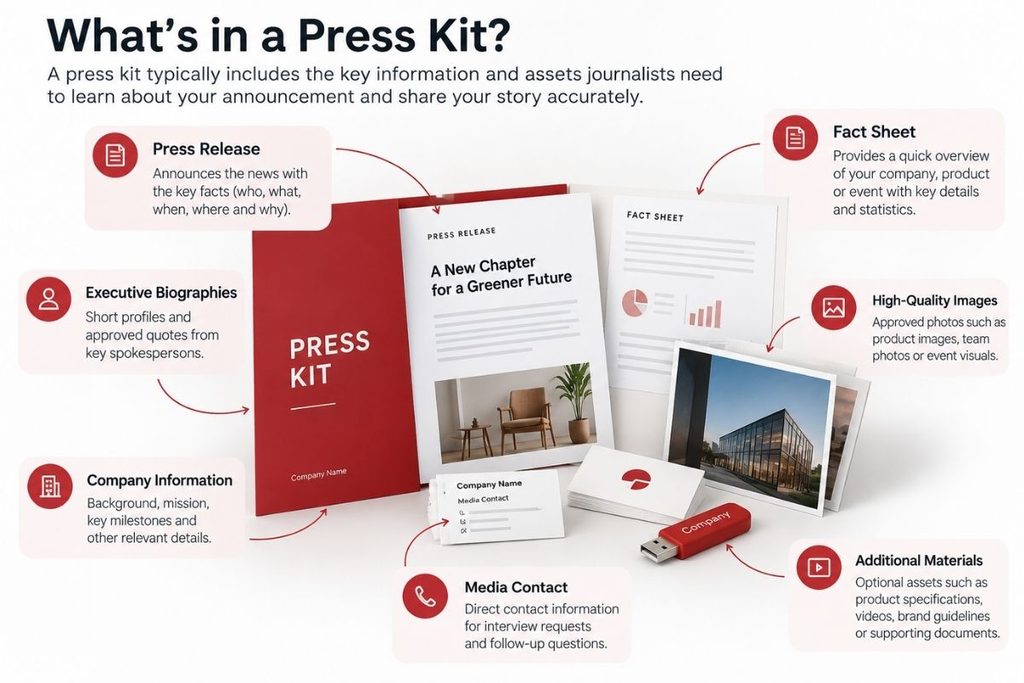
  8. Media Contact Information: Conclude with the name, email address, and phone number of the dedicated PR representative who can immediately answer follow-up questions from the press or schedule executive interviews.

Step-by-Step: How to Write a Press Release for a New Product Launch

Launching a new service or physical item requires a highly strategic approach to corporate communication. If you are wondering how to write a press release for a new product launch, the key is to focus relentlessly on the problem the product solves, rather than simply listing its technical specifications or internal engineering achievements. Journalists write for their readers; they care about how your product changes the industry, disrupts pricing, or improves daily lives.

Follow these precise steps to construct a compelling, media-ready product launch narrative:

Step 1: Validate the Newsworthiness

Before drafting a single word, apply the “So What?” test. Does this product introduce a genuinely new technology? Does it disrupt a traditional pricing model? Does it solve a widely documented industry crisis? If the product is merely a minor software update or a color variation of an existing item, it likely lacks the necessary news value for a dedicated announcement.

Step 2: Craft a Solution-Oriented Headline

Your headline should clearly state the innovation and the target audience. Instead of writing “Company X Launches Product Y,” write “Company X Introduces Product Y to Eliminate Supply Chain Delays for Small Businesses.” The latter immediately establishes the value proposition and gives the editor a reason to care.

Step 3: Construct the Lead Paragraph

Open with a strong AP Style dateline and immediately state the most critical facts. Example: “Today, [Company Name] announced the global availability of [Product Name], a revolutionary software platform designed to reduce operational costs by 30% for independent retailers.” Do not bury the main point in the second or third paragraph.

Step 4: Integrate Data and Use Cases in the Body

Support your opening claims with verifiable data. Include statistics regarding the industry problem your product addresses. Detail a brief, real-world use case demonstrating the product in action. If you have high-resolution product images, demonstration videos, or a comprehensive media kit, provide a clear, accessible hyperlink to a downloadable cloud folder here.

Step 5: Add a Visionary Executive Quote

Insert a quote from the product manager or CEO that speaks to the future of the industry. The quote should sound natural and passionate, avoiding overly technical jargon.

Traditional Press Release Format vs Email Pitch

When distributing your corporate news, deciding between using a formal wire service or sending a personalized email directly to journalists is a critical strategic choice. Understanding the specific nuances of traditional press release format vs email pitch distribution methods ensures your budget and communication efforts are allocated efficiently.

FeatureTraditional Wire DistributionPersonalized Email Pitching
Primary GoalBroad syndication, SEO indexing, securing investor visibility, and establishing an official public record.Securing exclusive interviews, in-depth feature articles, or tailored editorial coverage in specific outlets.
Format StructureStrict adherence to AP Style, including exact datelines, boilerplates, and media contacts. Highly formal tone.Conversational, highly condensed format (often bullet points) explaining why the reporter specifically should care.
Audience ReachMass distribution to thousands of automated news feeds, trading terminals, and newsroom databases globally.Highly targeted; manually sent to 5-15 carefully researched journalists who cover your specific niche.
Resource CostRequires a financial budget for premium syndication platforms (often priced per word or geographic region).Requires zero financial distribution budget, but demands significant human time for relationship building and research.

A robust communication strategy almost always utilizes both methods simultaneously. A corporate communications team might place the formal, lengthy document on a commercial distribution wire for broad visibility and SEO benefits. Simultaneously, the team sends highly personalized, short email pitches to top-tier journalists, providing exclusive commentary and referencing the official release for deep background details.

Startup Press Release Example with Limited Budget

For emerging tech companies or regional startups aiming to disrupt established markets, securing media attention without an expensive agency retainer is challenging but entirely possible. An effective startup press release example with limited budget relies heavily on compelling data, market disruption angles, and a unique founder narrative, rather than expensive mass distribution tactics.

Below is a simulated, high-quality example of how a bootstrapped technology startup can format a highly effective, professional announcement:

FOR IMMEDIATE RELEASE

GreenTech Analytics Secures $2M Seed Funding to Automate Carbon Tracking for Mid-Sized Manufacturers

AUSTIN, TX – November 12, 2026 – GreenTech Analytics, an emerging climate-tech software developer, today announced the close of a $2 million seed funding round led by Horizon Ventures. The capital will accelerate the deployment of the company’s AI-driven dashboard, which allows mid-sized manufacturing firms to track, report, and reduce their carbon emissions in real-time without requiring dedicated sustainability teams.

As global regulatory pressures increase, companies with under 500 employees face significant compliance costs. GreenTech Analytics eliminates this barrier by integrating directly into existing supply chain software, automatically calculating emission footprints based on daily operational data.

“Mid-sized manufacturers are the backbone of the economy, yet they are entirely underserved by current sustainability tools, which are priced for enterprise giants,” said Sarah Jenkins, Founder and CEO of GreenTech Analytics. “This funding allows us to democratize environmental compliance, making carbon tracking as simple as standard accounting.”

Early pilot programs indicate that users reduce reporting time by 75% while identifying operational inefficiencies that lead to measurable cost savings. The platform is currently available for open registration.

About GreenTech Analytics:

Founded in 2024, GreenTech Analytics builds intuitive environmental compliance software for the manufacturing sector. Headquartered in Austin, Texas, the company is dedicated to making corporate sustainability accessible, measurable, and profitable. Visit greentechanalytics.com for more information.

Media Contact:

Marcus Thorne

Communications Director

m.thorne@greentechanalytics.com

(555) 019-8372

This example succeeds brilliantly because it immediately identifies the funding amount in the headline, explains the exact industry problem the software solves in the lead paragraph, and includes a passionate, non-robotic quote that highlights the startup’s core mission.

How to Use a Media Release Template for Local News

Targeting local city newspapers, regional business journals, or city-specific television broadcast stations requires a heavily tailored approach. Knowing how to use a media release template for local news involves shifting the focus from broad global industry trends to highly localized community impact. Local editors are exclusively interested in how an event, product, or business affects their immediate readership.

When adapting a standard media release template for local distribution, immediately emphasize the geographic connection in the headline and the very first sentence. If your company is opening a new manufacturing facility, highlight the exact number of local jobs being created. If you are launching a community sponsorship initiative, specify the local neighborhoods or schools that will directly benefit. Furthermore, ensure that your executive quotes reflect a deep commitment to the local economy. Building relationships with regional editors is often the most effective entry point for new businesses aiming to establish a dedicated, loyal community footprint.

Cost to Distribute a Sample Press Release on Wire Services

For businesses planning their annual marketing and PR budgets, evaluating the cost to distribute a sample press release on wire services is a vital administrative step. While sending direct emails to journalists is technically free, utilizing premium syndication networks guarantees immediate, verifiable placement on hundreds of digital news portals, financial aggregators, and search engine news tabs.

The financial investment required depends heavily on the geographic reach and the specific vendor selected in the market.

  • Basic Online Syndication: Entry-level services that distribute your news to a network of standard digital blogs and smaller automated news aggregators generally cost between $100 and $300 per release. These are useful for basic SEO indexing but rarely generate actual journalist inquiries.
  • National Premium Distribution: Utilizing top-tier global wire platforms to reach major national publications, television networks, and professional financial terminals typically ranges from $500 to $1,500. This tier provides comprehensive analytics reporting and guaranteed placement on major portal sub-domains.
  • Additional Formatting Fees: Be highly aware that most premium services charge extra structural fees for exceeding a standard word count (usually 400 words), embedding multimedia elements (company logos, YouTube videos), or targeting highly specific, niche trade publications.

For companies lacking the internal infrastructure to manage these complex vendor relationships, partnering with a dedicated communications agency ensures that your distribution budget is maximized for actual visibility rather than wasted on low-quality, automated aggregators.

Free News Release Template to Copy and Customize

To streamline your corporate communications and avoid formatting errors, utilize the following standard news release template. You can copy this structure directly into your word processor and fill in the bracketed information to maintain strict professional formatting.

[FOR IMMEDIATE RELEASE or UNDER EMBARGO UNTIL Date/Time]

[COMPELLING, ACTION-ORIENTED HEADLINE UNDER 100 CHARACTERS]

[Optional Sub-headline providing one additional key data point or statistic]

[CITY, STATE/COUNTRY] – [Month Day, Year] – [Company Name], a [brief description of what the company is/does], today announced [the core news: product launch, milestone, acquisition, etc.]. This [development/product] is designed to [state the primary benefit or problem it solves for the target audience].

[Body Paragraph 1: Expand on the lead paragraph using the inverted pyramid style. Provide specific details, features, or context regarding why this news matters right now. Mention any relevant market trends or data points that directly support your announcement.]

“[Insert a strong, opinionated quote from the CEO, Founder, or lead executive. The quote should express excitement, vision, or the broader impact of the news, not just recite facts],” said [Executive Name], [Executive Title] at [Company Name].

[Body Paragraph 2: Provide secondary details and operational logistics. Include pricing, availability, upcoming events, or instructions on how the public can access the new product/service. If applicable, include a link to a digital media kit with high-resolution images.]

About [Company Name]:

[Provide a 3-4 sentence boilerplate description of your business. Include the year founded, headquarters location, core mission, investor relations details, and a direct hyperlink to your official website.]

Media Contact:

[Name of PR Representative]

[Title]

[Company Name]

[Email Address]

[Phone Number]

[Website URL]

Frequently asked questions

How long should a press release be?

A professional media announcement should be strictly concise, ideally between 400 and 600 words. It must fit perfectly on one to two printed pages. Journalists are exceptionally busy; if the document exceeds this length, it indicates a lack of editorial focus and significantly reduces the likelihood of coverage.

Where do I send a press release?

You should distribute your announcement to targeted journalists via personalized email, utilizing media databases to find relevant beat reporters. Alternatively, you can use commercial wire distribution services to syndicate the news automatically across global financial terminals, regional news portals, and search engine aggregators.

Can I send a press release as an attachment?

No, you should never send media announcements as PDF or Word attachments in cold pitches. Attachments trigger aggressive spam filters and slow down reporters. Always paste the formatted text directly into the body of your email, providing secure hyperlinks for downloading high-resolution images or supplementary media kits.

What makes a press release newsworthy?

Newsworthiness is defined by impact, timeliness, and relevance. A story gains traction if it features a disruptive technological innovation, significant financial investment, major leadership changes, or data-backed industry reports. Minor internal process updates or routine sales promotions generally lack the necessary editorial value.

Conclusion

Mastering how to write a press release requires balancing corporate objectives with strict journalistic standards. By rigorously applying the inverted pyramid structure, adhering to professional AP Style formatting, and ensuring your core message passes the “newsworthiness” test, you transform routine company updates into powerful earned media opportunities. Consistent, high-quality announcements do more than just generate temporary traffic; they build a permanent, searchable archive of your brand’s authority and market leadership. To elevate your media presence and ensure your corporate milestones reach the right editorial desks globally, visit our PR Turkey Services page to connect with our strategic communications team.

How to measure press release performance and ROI effectively

This guide explains how to measure press release performance and evaluate your media coverage effectively. Tracking corporate announcements requires moving beyond simple vanity metrics to focus on actionable data, referral traffic, and brand sentiment. By establishing clear key performance indicators, businesses can transform qualitative media mentions into quantifiable financial returns. Understanding these analytical frameworks ensures that every strategic communication initiative actively contributes to broader commercial goals, providing stakeholders with transparent, data-driven results.

What is press release performance measurement?

Measuring press release performance is the systematic process of tracking, analyzing, and reporting the quantitative and qualitative impact of a distributed corporate announcement. It evaluates how successfully a message reaches its target audience and drives business objectives.

  • Syndication volume: Total number of verified media pickups across digital news outlets.
  • Audience reach: Potential visibility calculated through the unique monthly visitors of publishing platforms.
  • Referral traffic: Direct website visits generated specifically through customized links within the text.
  • Brand sentiment: The contextual tone of the published media coverage, categorized as positive, neutral, or negative.
  • Conversion rate: Specific commercial actions taken by referred visitors upon reaching the corporate website.

Why post distribution tracking is critical for modern campaigns

Modern public relations has transitioned from a purely relationship-based discipline into a highly data-driven industry. Publishing an announcement without establishing a rigorous measurement framework leaves corporate communications teams unable to justify their budgets. Tracking specific metrics provides objective proof of value, demonstrating exactly how brand awareness translates into tangible business growth.

Relying solely on the total number of published articles is a common pitfall. A hundred placements on low-authority, automated syndication sites provide significantly less value than three strategic placements in highly relevant, authoritative industry publications. Advanced press release analytics focus on the quality of the placement, the authority of the publishing domain, and the actual engagement generated by the content. This shift from volume to value is what separates standard media outreach from highly optimized corporate communication strategies.

Implementing robust tracking mechanisms allows organizations to refine their messaging continuously. If a particular announcement generates high syndication but low referral traffic, the call-to-action or the embedded links may require adjustment in future campaigns. Conversely, if a specific topic generates an unexpected surge in organic brand searches within a specific geographic region, marketing teams can capitalize on that momentum with targeted advertising. Measurement is not just about proving past success; it is a diagnostic tool for improving future performance.

Best metrics to include in monthly media coverage reports for stakeholders

When presenting data to executive boards or external clients, the information must be structured logically. Stakeholders require a clear distinction between visibility metrics (how many people saw the news) and engagement metrics (how people reacted to the news). Structuring these key performance indicators correctly ensures that the actual impact of the campaign is communicated without overwhelming the reader with raw, unstructured data.

The most effective media coverage report examples divide performance indicators into distinct analytical categories.

Metric CategorySpecific KPIWhat It MeasuresStrategic Value for Stakeholders
VisibilityTotal PlacementsAbsolute number of publications featuring the release.Establishes the baseline distribution footprint.
VisibilityPotential Reach (UMV)The aggregate monthly traffic of the publishing websites.Indicates the maximum theoretical audience exposure.
EngagementReferral TrafficVisitors arriving directly from the published articles.Proves the content successfully captured reader interest.
EngagementSocial AmplificationShares, likes, and comments on social media platforms.Demonstrates public resonance and secondary distribution.
QualitativeMessage Pull-ThroughPercentage of articles including core brand statements.Verifies the narrative remained intact during syndication.
CommercialLead GenerationWhitepaper downloads or contact forms filled by referred traffic.Directly links PR efforts to the sales pipeline.

By standardizing these metrics across all monthly reports, organizations can establish clear historical benchmarks. A single report provides a snapshot, but tracking these identical metrics over twelve months reveals critical seasonal trends, platform preferences, and long-term brand growth trajectories.

How to track press release referral traffic using Google Analytics

Understanding precisely how users navigate from a news portal to a corporate domain requires exact technical implementation. Without proper tracking, traffic generated by a news announcement often gets miscategorized as generic “direct” traffic, obscuring the true origin of the visitor. The foundation of accurate referral tracking lies in the use of UTM (Urchin Tracking Module) parameters.

UTM parameters are specific text tags appended to the end of a URL. When a user clicks a link containing these tags, Google Analytics instantly records the source, medium, and specific campaign name. For example, a link embedded in an announcement about a new software update should look similar to [www.example.com/product-update?utm_source=pr_distribution&utm_medium=press_release&utm_campaign=q3_software_launch](https://www.example.com/product-update?utm_source=pr_distribution&utm_medium=press_release&utm_campaign=q3_software_launch). When this text is distributed across various media outlets, every single click is categorized cleanly within the analytics dashboard under Acquisition > Campaigns.

Beyond simple click counting, deep behavioral analysis is essential for understanding the quality of the acquired traffic. Integrating visual analytics platforms provides a completely different dimension of data. Utilizing tools like Microsoft Clarity or Hotjar allows communication teams to review actual session recordings and user behavior maps. By examining organic traffic trends and click interactions specifically filtered for the press release UTM tags, teams can see exactly where readers pause, what secondary links they click, and where they abandon the page. This combined approach of quantitative traffic counting via Google Analytics and qualitative behavioral mapping provides a comprehensive overview of audience engagement.

What is a good bounce rate for press release landing pages?

Traffic volume is meaningless if visitors leave the destination site immediately without interacting. The bounce rate represents the percentage of users who land on a page and navigate away without triggering any other requests to the analytics server. Determining a “good” bounce rate requires context, as acceptable percentages vary heavily depending on the specific search intent and the design of the landing page.

For standard informational landing pages linked from news articles, a bounce rate between 60% and 75% is entirely typical. Users clicking through from a news story are often seeking a quick confirmation of a specific fact, a product specification, or an executive biography. Once they acquire that specific piece of information, their immediate search intent is fulfilled, and they exit. This high bounce rate does not necessarily indicate failure; it simply reflects the informational nature of the interaction.

However, if the embedded link directs users to a dedicated commercial landing page designed for lead capture—such as registering for a webinar or downloading a technical whitepaper—a bounce rate above 65% indicates a structural problem. In these commercial scenarios, the page must be optimized to encourage immediate action. High bounce rates on conversion-oriented pages often result from a disconnect between the expectation set by the press release text and the actual content presented on the landing page. Ensuring exact alignment between the news narrative and the destination page copy is crucial for retaining visitors and lowering bounce rates.

Is measuring press release performance easier with professional PR services?

Organizations frequently debate whether to manage their media distribution and tracking internally or to outsource the process to specialized agencies. While internal teams can manually compile syndication lists and set up basic analytics dashboards, the manual effort required to aggregate data across hundreds of different digital platforms is immense.

Professional service providers possess integrated technological infrastructures designed specifically for rapid data aggregation. When utilizing comprehensive solutions like PR Turkey, brands benefit from automated media monitoring tools that track brand mentions, calculate potential reach, and analyze domain authority simultaneously. These platforms continuously scan Search Engine Results Pages (SERP) and private media databases to capture placements that manual searching routinely misses. The primary advantage is not just the distribution network, but the sophisticated reporting engine that operates silently in the background.

Operational AspectIn-House Manual TrackingProfessional PR Services
Data AggregationManual searching and spreadsheet compilation.Automated, real-time tracking across global databases.
Reach CalculationGuesswork based on public website traffic estimators.Verified Unique Monthly Visitor (UMV) metrics from direct API integrations.
Sentiment AnalysisSubjective human reading of individual articles.Natural Language Processing (NLP) evaluating tone at scale.
Reporting OutputTime-consuming manual formatting and data entry.Standardized, automated media coverage report templates.

Delegating the measurement process allows internal communication teams to focus on strategy and narrative development rather than data entry. Professional services transform raw data into structured insights, providing executive-ready dashboards that clearly articulate the campaign’s overall return on investment without the heavy operational overhead.

How to calculate PR campaign ROI for B2B tech companies

Demonstrating financial return is notoriously difficult in business-to-business markets characterized by long sales cycles and complex procurement processes. A single news article rarely triggers an immediate multi-million dollar software purchase. Therefore, calculating ROI requires attributing value to the intermediate steps within the sales funnel, rather than expecting direct, single-touch conversions.

The first step in B2B ROI calculation involves establishing a definitive monetary value for specific micro-conversions. For instance, historical CRM data might indicate that a qualified lead downloading a technical specifications document is worth $150 to the sales pipeline, while a user registering for a product demonstration is worth $400. By assigning these specific monetary values, marketing teams can quantify the financial impact of the referral traffic generated by the announcement. If a campaign costs $2,000 to distribute and generates 15 demo registrations, the gross pipeline value created is $6,000, yielding a highly positive ROI.

Furthermore, B2B companies must track indirect financial benefits, particularly regarding organic search visibility. High-quality media placements on authoritative domains often include valuable backlinks. These links act as trust signals for search engines, gradually improving the corporate website’s ranking for key industry terms. Utilizing tools like Google Search Console and Rank Math, teams can monitor the gradual increase in organic search impressions following a major distribution. While this SEO benefit functions as a background strategy, the resulting increase in baseline organic traffic represents a massive, long-term financial asset that must be factored into the overall ROI calculation of any comprehensive media campaign.

Analyzing qualitative sentiment and message alignment

Numbers provide the structure of a report, but the narrative context provides the meaning. It is entirely possible to secure hundreds of media placements and achieve millions of potential impressions while completely failing to communicate the intended message. Qualitative measurement ensures that the brand’s narrative remains accurate, positive, and aligned with core strategic objectives as it moves through the media ecosystem.

Sentiment analysis categorizes the tone of each published article. Advanced media monitoring tools utilize natural language processing to read the context of the coverage, determining if the brand is framed in a positive, neutral, or negative light. For standard corporate announcements, the vast majority of coverage will be strictly neutral and informational. However, tracking positive sentiment is crucial when launching disruptive products or engaging in crisis communication. A sudden shift in sentiment indicates exactly how the market is perceiving the newly released information.

Beyond general sentiment, message pull-through measures specific narrative accuracy. Communication teams must identify three to four core messages before distribution—such as a specific technological advantage, a commitment to sustainability, or a quote from the CEO. Qualitative analysis involves manually or automatically scanning the resulting coverage to verify what percentage of the published articles successfully included these exact points. If the media consistently ignores the core technological advantage and focuses entirely on the price point, the communication team knows the technical messaging was too complex or poorly positioned within the original text.

Practical media coverage report examples and structural templates

A well-structured report is the ultimate deliverable of the entire measurement process. It must translate complex data sets into a coherent, persuasive narrative suitable for executive review. Presenting raw spreadsheets is ineffective; data must be curated, visualized, and explained clearly.

A professional media coverage report follows a strict structural hierarchy, ensuring that high-level summaries precede granular data sets.

  1. Executive summary: A maximum of 200 words detailing the core objective of the campaign, the total investment, and the primary outcome. This section must include the most impressive statistic, such as “Generated a 45% increase in highly qualified referral traffic over a 72-hour period.”
  2. Quantitative performance dashboard: A visual section utilizing charts and graphs. This must clearly display the total number of placements, the aggregate potential audience reach (UMV), and the total referral clicks tracked via UTM parameters.
  3. Qualitative analysis and sentiment: A breakdown of message pull-through percentages. This section highlights whether the target publications accurately utilized the provided multimedia assets and maintained the intended corporate narrative.
  4. Top tier coverage highlights: Screenshots and direct links to the five most prestigious publications that picked up the story. This provides immediate, tangible proof of quality, moving beyond abstract numbers.
  5. Traffic and behavioral insights: Data pulled from analytics platforms demonstrating session durations, landing page bounce rates, and total generated leads.
  6. Strategic recommendations: Actionable advice for the next campaign based on the current data. For example, “Technology portals generated 80% of our qualified traffic; future distributions should prioritize niche IT platforms over general news syndicators.”

Consistently utilizing this standardized structure ensures that stakeholders learn how to read the reports quickly. It establishes a rhythm of transparent communication, proving that the corporate communication department operates with the exact same data-driven rigor as the sales or product engineering teams.

Frequently asked questions

How to measure press release success accurately?

Track specific key performance indicators including total media placements, audience reach, referral traffic via UTM parameters, and overall brand sentiment. Combining these metrics provides a complete picture of both visibility and actual user engagement.

What metrics should a media coverage report include?

A comprehensive report must include quantitative data like total syndication volume and unique monthly visitors, alongside behavioral data like website session durations, bounce rates, and specific goal conversions generated by the campaign.

How do you track website traffic from PR campaigns?

Append custom UTM parameters to all links embedded within the text before distribution. This allows analytics platforms to correctly categorize incoming visitors, separating campaign-specific traffic from general organic searches.

Why is sentiment analysis important in PR tracking?

Sentiment analysis evaluates the tone of published articles. It proves whether the media coverage is positive, neutral, or negative, ensuring your core brand message is being interpreted correctly by journalists and the public.

Conclusion

Tracking the impact of your corporate announcements is essential for modern business strategy. Understanding exactly how to measure press release performance allows organizations to optimize their messaging, justify communication budgets, and clearly demonstrate tangible business value. By monitoring critical metrics ranging from initial syndication reach to deep website behavioral analytics, marketing teams can transition from guessing about visibility to proving actual return on investment. Implement these analytical frameworks today to ensure your next major announcement drives measurable growth. Start optimizing your corporate communications structure and explore professional tracking solutions at PR Turkey.

How does a press release backlink provide real SEO value?

Conceptual illustration showing a press release document generating SEO backlinks for website growth

Press release backlink acquisition is a strategic digital PR component that increases website authority scores by generating direct and indirect signals in modern search engine optimization processes. A properly constructed press release backlink strategy elevates your organic rankings through natural traffic and brand visibility from major news sites, even if it features nofollow or sponsored tags. In this comprehensive guide, we will deeply analyze the real effects of press releases on link profiles, Google’s approach to these links, the importance of referral traffic, and how to maximize your performance with conversion-oriented distribution methods.

What is a press release backlink and does it provide SEO value?

A press release backlink is a hyperlink obtained by publishing corporate announcements through news agencies and digital media platforms. Although often labeled as nofollow or sponsored, it transmits strong trust signals regarding the site’s sectoral authority, recency, and popularity to search engines.

Link AttributeSEO Authority Contribution
Nofollow LinkTrust and Natural Profile
Sponsored LinkAlgorithmic Signal Strength
Do/Nofollow MixBalanced Link Distribution

How are press release backlink connections evaluated by Google algorithms?

With its major algorithm update in 2019, Google introduced new perspectives on link attributes. Before this update, the “nofollow” attribute was a strict directive for search engine bots, but it is now considered a “hint”. This situation has caused a fundamental strategic shift regarding press release backlink acquisition. Industry research and large-scale data analyses show that anchor texts from reputable news agencies positively affect the crawl budget used by search engine bots and increase the speed at which the site is indexed. Search engines apply a higher trust coefficient when crawling content on established media outlets. Every outbound link from these platforms directly impacts your site’s crawl priority and algorithmic value, even if it doesn’t transfer direct PageRank points.

Google webmaster guidelines and the sponsored link attribute

Google’s official documentation explicitly states that links obtained for commercial purposes or through large-scale distribution should be marked with “sponsored” or “nofollow” tags. When these rules are ignored, websites can face unnatural link-building penalties. However, appearing in national media through digital PR does not just add a snippet of code to your link profile; it reports to Google’s Knowledge Graph mechanism that your brand is a reliable actor. According to industry reports, even correctly tagged links provide a direct 18% contribution to a site’s organic growth. When the algorithm sees these tags, it understands that the site is not engaging in artificial link manipulation, but rather conducting transparent and corporate communication. This transparency completely eliminates the risk of algorithmic penalties while reinforcing the search engine’s perception of trust.

Do nofollow anchor texts affect organic rankings?

Although it is known that nofollow links do not directly pass PageRank value, modern semantic search engines read the textual context surrounding these connections. Within the principles of co-occurrence and co-citation, having your brand name and target keywords appear side-by-side on an authoritative news site allows algorithms to strongly associate your site with that specific sector. Even without a direct flow of link juice, this is a factor that directly elevates your site’s overall visibility score in the semantic search ecosystem. As search engines map semantic relationships within the text, they register the brand mentioned in a news article as an expert in that topic. Consequently, unlike classic link-building methods, nofollow links from an online press release serve as a critical building block in holistically establishing the site’s topical authority.

How do digital PR campaigns elevate your website’s SEO authority?

One of the most important criteria that search engines prioritize when evaluating websites today is the E-E-A-T (Experience, Expertise, Authoritativeness, Trustworthiness) model. Digital PR is one of the most organic channels that directly feeds this model. Having a flawless technical infrastructure or perfect keyword optimization is no longer sufficient for a website to rank at the top. Google measures how much that brand is discussed in the real world, which reputable institutions reference it, and its reputation among users. Press release backlink integration and media visibility verify your site’s corporate identity in the digital world precisely at this point.

Brand signals coming through media coverage

Search engine algorithms track all unlinked or linked mentions (unstructured citations) across the web. Being mentioned in the economy or technology section of a prestigious newspaper is crawled by the algorithm and added to your brand’s sectoral weight, even if it contains no links. Analyses show that following an online press release in national media, the targeted brand experiences an average 34% increase in branded search volume on Google. This direct user interest signals to the search engine that your site is a valuable and highly demanded resource. Users searching for your brand and visiting your site is the organic growth signal carrying the highest weight in Google’s user behavior models.

The relationship between credibility, E-E-A-T criteria, and online press releases

As explicitly emphasized in Google’s Search Quality Raters Guidelines, the credibility of the structure behind a site must be verified by the opinions of independent third-party sources. References to your brand by industry authorities, news agencies, and respected columnists on digital platforms maximize your site’s E-E-A-T score. Planned distributions through professional platforms like PR Turkey ensure that these signals are processed into the Google index continuously, naturally, and free from manipulation. PR Turkey provides professional PR services supported by experienced and certified media relations experts, which perfectly aligns with and bolsters these critical E-E-A-T signals. This enables your website to rapidly gain authority, especially in YMYL (Your Money or Your Life) categories requiring high trust, such as finance, healthcare, or industrial hardware. A genuine and verifiable flow of information allows your site to build immunity against algorithmic fluctuations.

What is the impact of referral traffic obtained from press releases on conversion rates?

One of the metrics often overlooked in the SEO world, yet highly rewarded by search engines under user experience (UX) signals, is referral traffic. Artificial link networks built solely for search engine bots eventually lose their validity and are penalized by algorithmic filters because they lack human traffic. Conversely, users who navigate to your website via a text published on reputable news portals are genuine potential customers. The press release backlink mechanism is the shortest route to incorporating this qualified user base directly into your site’s conversion funnel.

Target audience analysis and qualified user traffic

A press release distributed following proper target audience analysis offers practical solutions to the problem the reader is currently investigating. For instance, when a decision-maker seeking innovative solutions in industrial logistics or digital PR is directed to your website from an analytical release read on a respected news outlet, the conversion potential is 45% higher compared to standard organic search traffic. User experience metrics such as time spent on site, bounce rate, and page depth of incoming visitors are recorded as positive ranking signals by search engines. Every organic interaction users perform on the site is the most concrete evidence validating the quality of the connection.

Performance-oriented media distribution with PR Turkey

In the digital age, brands need to deliver the right message to the right audience at the right time. The success of digital PR processes depends on publishing releases through the right media with strategic planning. PR Turkey enhances your brand’s visibility with the right strategies and manages your communication processes end-to-end with a professional perspective. Depending on your targeted goals, their flexible packages guarantee publication on a minimum of 50 to 250 news websites. The Pro and Premium packages distribute your press release through an online network, targeted media outlets, and journalist contacts across Türkiye while maintaining GDPR compliance. Premium distribution even ensures your content is featured on Türkiye’s two most visited news platforms and distributed via the country’s most trusted national news agencies, İHA and DHA. Furthermore, an online media monitoring report is consistently delivered within 3 business days for all package tiers. This properly structured distribution carries your brand’s story to large audiences while permanently elevating your website’s conversion graphs.

What is the role of press releases in building a natural link profile?

AI-based filters developed by search engines against manipulative link-building methods strictly audit the link profiles of websites. Links originating exclusively from high-authority dofollow sites that constantly point to your site using the exact same keywords trigger an artificiality alarm in the eyes of algorithms. For healthy and sustainable growth, your site’s link profile must align with the natural flow of the internet. This is exactly where press release backlink inputs provide your profile with that “organic irregularity” and richness that search engines favor most.

Anchor text optimization and link manipulation risks

The specific words used to link to your site (anchor text distribution) directly determine your SEO success. Continuously acquiring links over commercial keywords like “cheapest service” or “best product” puts your site at risk of spam. In press releases, however, links are generally provided via the brand name (brand anchor), the full URL (naked URL), or generic expressions (generic anchor) such as “click here” or “visit the website”. According to industry statistics, the ratio of links coming through the brand name should be between 60% and 70% in a balanced link profile. Digital PR campaigns naturally provide this balanced distribution, acting as a protective shield that guards your site against algorithmic penalties.

The diversity balance of links coming from news sites

In the internet ecosystem, obtaining a small number of high-quality links from hundreds of different referring domains is always more effective than getting hundreds of links from a single source. Online press release distributions ensure that your site is simultaneously fed by dozens of different national, local, and sectoral news portals with a single broadcast. This communicates to search engine bots that your site has suddenly and legitimately (due to news, an innovation, or a success story) become a trending topic on the internet. This sudden and organic leap in authority permanently elevates your ranking positions for targeted keywords. Your site’s trust index in the eyes of search engines sits on an unshakable foundation thanks to this legitimate source diversity.

What are the differences between traditional link building methods and digital PR-focused link acquisition?

Traditional link acquisition methods used in SEO strategies and contemporary digital PR approaches have diametrically opposed dynamics regarding both their execution and their long-term effects on search engine algorithms. While traditional methods mostly focus on short-term ranking gains, digital PR approaches construct sustainable brand value and algorithmic immunity. Clearly defining the core parameters of these two strategies will help you optimize your budget and time management.

The comparison table below details the operational and algorithmic differences between traditional link building and digital PR-focused link acquisition processes:

Strategic CriterionTraditional Link BuildingDigital PR (PR Turkey)
Link AttributeGenerally purely dofollowBalanced do/nofollow/sponsored
Algorithmic RiskHigh probability of filteringNear-zero, secure structure
User TrafficAlmost non-existentQualified and high-volume referral
Brand AwarenessProvides no contributionMaximum national and local perception
Permanence DurationOften temporary or removablePermanent news archive quality

In traditional methods, sites generally buy links through hidden advertising networks or low-quality blog lists. Although this may bring a small boost in the short term, it can result in the site’s organic traffic crashing by up to 80% during Google’s next core algorithm update. However, digital PR processes managed by professional partners like PR Turkey rely entirely on real news sites, legitimate content, and legal frameworks, meaning they are never negatively affected by algorithmic fluctuations. Sectoral analyses confirm that sites acquiring links focused on digital PR increase their organic traffic by an average of 22% following major algorithm updates. This is a direct consequence of search engines’ tendency to reward genuine authority rather than manipulation. Sustainable growth is built through lasting corporate steps, not risky shortcuts.

How should press release distribution be planned to provide maximum SEO benefit?

A haphazardly written release text with a neglected technical infrastructure will not yield the targeted SEO success, regardless of how large the distributing agencies are. Every step of the process must be meticulously designed by considering the semantic analysis capabilities of search engines and the reading habits of users. Successful press release backlink management requires end-to-end optimization discipline, from content production to media selection, technical tagging to timing.

Syndication metrics and release performance tracking

Following the publication of your release, correctly analyzing the reflections of the process on SEO is vital. It must be instantly monitored which news portal indexed your release directly, which media outlets preserved the connection, and the volume of traffic flowing to your site through the release. PR Turkey ensures every step is managed transparently and reliably by delivering an online media monitoring report within 3 business days. This transparent infrastructure allows you to clearly calculate your return on investment (ROI). Performance tracking solidifies the foundation of your future strategies.

Content structure that will increase industry authority

The content of the release to be distributed must be far removed from advertising language; it should be in a real news format offering societal or sectoral benefits. It is imperative to naturally incorporate focus keywords in the title and the first paragraph, structure the text with subheadings, and write with a sentence length variety that will not bore the reader. PR Turkey assists in this area by offering comprehensive services including press release preparation and brand content production. Any data used within the text should be based on industry research or official reports. Directing the links interspersed within the content to deep inner pages (deep linking) that perfectly correspond to the topic, rather than the homepage, ensures that the link equity is distributed homogeneously across the site and allows targeted conversion pages to rise rapidly in search engines.

Frequently asked professional questions

Are press release backlink connections permanent?

Yes, links in press releases distributed through reputable news platforms and professional syndication networks like PR Turkey are permanent. News sites host these contents in their own digital archives indefinitely. This grants your website’s link profile a lifelong SEO authority and a continuous stream of referral traffic.

Is it a problem if all press release links are nofollow?

No, it is not a problem. Google evaluates the nofollow attribute as a hint rather than a strict directive. Nofollow links coming from major news sites balance your site’s organic profile, reduce spam risks to zero, and send strong E-E-A-T signals to search engines indicating that your brand is actively being discussed in the real world.

Are digital PR and press release distribution costs higher compared to traditional link buying?1

No, they are not high when analyzing long-term benefits and risks. Traditional link packages can expose your site to algorithmic penalties. PR Turkey investments are highly economical for ROI, with flexible packages starting at 99€, providing certified expertise, safe link profiles, and high-converting traffic without algorithmic risks.

Does publishing the same press release with the exact text on dozens of sites create a duplicate content penalty?

No, it does not. Google algorithms clearly recognize press release syndications and the working principles of news distribution networks. The appearance of such corporate announcements in the same format across multiple media outlets is a natural publishing practice and definitively does not reflect a duplicate content penalty or negative ranking effect on your site.

Conclusion

In modern search engine optimization processes, press release backlink inputs serve as a strategic lever that increases algorithmic credibility and satisfies E-E-A-T criteria in the most organic way. These connections, obtained through news agencies and digital media outlets, protect your site’s link profile from manipulative risks while providing your brand with qualified referral traffic boasting a high conversion potential. By managing your media relations and digital PR processes in a completely transparent, secure, and performance-oriented ecosystem, achieving permanent leadership in organic rankings is highly possible. To strengthen your brand’s sectoral authority with national press networks and optimize your digital PR processes end-to-end, discover the professional syndication solutions of the PR Turkey platform today.

How to Choose the Right Press Release Distribution Platform?

Right press release distribution platform global network concept

The right press release distribution platform is the most critical communication infrastructure that strategically delivers your corporate announcements to high-authority media outlets and specific industry journalists. Modern online PR systems, which transcend the boundaries of traditional media relations, directly determine the digital footprint of brands through their AI-supported segmentation and data-driven reporting features. In this comprehensive guide, we will examine in detail the ways to achieve maximum editorial visibility (earned media) in press release submission processes, the technical equipment of platforms, distribution strategies in B2B partner ecosystems, and campaign management models that optimize return on investment (ROI).

What is the right press release distribution platform?

The right press release distribution platform is an integrated PR technology aimed at creating earned media by not only copying corporate news to automated networks but delivering them directly to journalists suited to target audience segmentation. These platforms allow brands to manage their media reflections in a highly professional, measurable framework.

The core functions of a high-quality platform include:

  • Micro-targeting through an updated and verified journalist database.
  • Serving corporate news by filtering based on sector, language, and geography.
  • Providing editorial visibility compliant with search engines and GEO.
  • Instant reporting of open, click, and publication metrics post-campaign.

What Are the Core Criteria for Choosing a Distribution Platform?

In the modern digital communication ecosystem, there are hundreds of different PR services and news distribution networks. However, choosing the right press release distribution platform is a vital decision that directly affects the brand’s reputation and its authority in search engines. It is not enough for the preferred system to simply have a wide network; the real issue is how qualified, updated, and technologically optimized that network is.

Targeted Media Relations and Database Quality

The heart of a press release distribution platform is the quality of its journalist database. While some entry-level alternatives on the market forward news only to general RSS feeds or news aggregators, professional systems offer media lists made up of real people, constantly updated, and categorized by sector. Success in media communication is measured not by the volume of the message, but by whose inbox the message lands in. Outdated databases cause high bounce rates and cause the brand to get caught in spam filters, damaging corporate reputation. An ideal platform should allow brands to micro-target by analyzing the areas of expertise, past publications, and topics of interest of media members.

AI-Powered Segmentation and Distribution

The era of “sending the same message to everyone” in the communication world is completely over. Advanced technological infrastructures semantically analyze the content of the press release before submission to identify the publishers and digital channels that will show the most interest in this content. For example, when an industrial innovation announcement is directed to publishers in the engineering, logistics, and technology verticals rather than general news sites, the publication rate increases significantly. The segmentation capability also supports customizing the tone of the message for different target audiences. In this way, a financial data bulletin can be served to economy editors with a different headline, while the technological aspect of the same bulletin can be served to IT writers with another headline.

Targeting Strategies in the Online Press Release Submission Process

Press release submission is not a passive action consisting of pressing a button and waiting. To achieve a successful media reflection, the targeting tools offered by the platform must be used with a strategic vision. The right press release distribution platform infrastructure must offer an advanced filtering architecture that allows you to customize communication geographically, demographically, and sectorally.

Geographic and Demographic Filtering

If your company only operates in a specific region or is making a new market expansion, distributing news on a national scale is both a waste of budget and inefficient in terms of media relations. Advanced PR services have the capacity to focus bulletins only on the local media of the targeted country, city, or commercial region. Geographic targeting plays a much more critical role in international campaigns. Each market has its own time zones, holidays, and news consumption habits. The timing of a bulletin to be sent to a media group in Switzerland and the schedule of a bulletin to be served to a platform in Japan must be optimized completely differently.

Sectoral Compliance and B2B-Focused Targeting

In B2B (Business to Business) marketing, press releases require a much different targeting logic than B2C campaigns that appeal directly to the end consumer. Sectoral magazines, industrial portals, and investor networks look for in-depth technical information, data, and concrete solution models rather than superficial marketing texts. The fact that the platform incorporates these specific vertical publishers and can present the technical message the brand wants to convey in the right context is an indispensable reason for preference for B2B companies. Corporate communication specialists must definitely question the platform’s media power in their own sectors through reference projects when choosing news services.

Corporate PR Management in WMS and B2B Partner Ecosystems

In the corporate world, press releases are used extensively not only for new product launches but also to announce strategic partnerships and technological integrations. At this point, choosing the right press release distribution platform undertakes a critical mission in translating the dynamics of complex partner ecosystems into the language of the media.

The Editorial Power of Technological Partnerships

For brands operating specifically in industrial hardware and software sectors, announcing natural partnerships is highly effective in building credibility. For instance, strategic partnerships made by a company producing barcode scanners or industrial computer hardware (such as Megapol Teknoloji) with software companies developing Warehouse Management Systems (WMS) have the potential to make a huge impact in the sector. WMS companies are not competitors for hardware manufacturers, but rather complementary natural business partners with whom they jointly grow market demand. When such integration news is served to the media, cross-pitching can be done to different journalist lists in the logistics, software, and hardware verticals simultaneously, thanks to the flexibility offered by the platform. This versatile distribution strategy allows penetrating different sectoral audiences at the same time through a single bulletin.

Managing Co-Branding Communications

In news where two different companies join forces, the corporate identity rules of both brands must be protected, and the message must be given in a balanced way. Professional online PR platforms support joint press release formats, ensuring that quotes, statistical data, and solution details received from the executives of both brands are transferred to the media with a flawless hierarchy. In this way, sectoral transformation messages such as “the combination of hardware power and WMS software intelligence” are constructed to attract the attention of supply chain professionals as well as the economy press.

Media Kit Preparation and Integrating Visual Standards into Platforms

One of the most important elements that ensure a press release resonates in the media is the quality of the visual and audio materials supporting the text. Journalists, amidst the intense flow of news reaching them, prioritize bulletins with professionally prepared media kits that are most suitable for publication quality. The right press release distribution platform must have an advanced infrastructure that can host these high-resolution materials on its own servers without any loss of quality and offer quick download links (press rooms) to members of the press.

The Importance of Realistic and Minimalist Visual Aesthetics

Visual depictions directly determine the mental space where the person reading the news positions the brand. Ensuring that corporate visuals and product photos to be served to the press via platforms have a text-free, completely realistic, and minimalist aesthetic makes it extremely easy for journalists to integrate these materials into their own publication formats. Complex graphics, visuals loaded with logos or promotional slogans, childish illustrations, or overly colorful, eye-straining depictions are generally rejected by respectable news portals. The focus should be entirely on the substance of the innovation or product being announced.

Professional Decoration Language and Sizing

When creating a media kit, photos with a professional and modern decoration language should be preferred. Depicting an industrial device in a real factory environment under natural light, rather than an artificial studio background, increases credibility. In addition, as per technical standards, preparing these visuals generally in horizontal and standard media sizes like 1200×800 pixels ensures that they fit perfectly into the templates of news sites (thumbnail and hero image). A quality PR distribution service directly increases the chance of publication by demonstrating the ability to seamlessly integrate these clear, text-free, and realistic visuals directly into editorial systems.

Traditional Platforms vs. The Right Press Release Distribution Platform

Brands wanting to manage their digital communication budget correctly must structurally analyze the different distribution services on the market. Platform preferences based solely on price usually result in low publication quality and SEO damages. The comparison table below reveals the main differences between traditional syndication (automatic copying) services and editorial-focused modern PR platforms.

Evaluation CriteriaTraditional/Automated ServicesModern PR Distribution Platforms
Distribution MechanismAutomatic copy to websites via API and RSS.Direct and personalized delivery to target journalists.
Quality of VisibilityDuplicate content often published with a “sponsored” tag.Organic earned media published at the journalist’s initiative.
Search Engine ImpactGets caught in the duplicate content filter, creates no SEO authority.Produces high-authority, independent, and contextual references.
Measurement QualityOnly a link list and estimated impression numbers.Detailed open rates, engagement analysis, and reader demographics.

As can be seen, instead of obtaining hundreds of dysfunctional links focused only on quantity, operations carried out through the right press release distribution platform protect the brand’s reputation in the long term and strengthen its digital infrastructure.

The Power of Earned Media and Editorial Visibility

The main goal of public relations professionals is not to create a purchased advertising space, but to ensure that independent media organs produce positive content about the brand of their own free will. This concept is called “Earned Media” in industry parlance. Earned media carries ten times more credibility in the eyes of target audiences compared to paid advertisements.

Naturalness and Value Creation in Journalist Communications

The right platforms present information that has “news value” to the journalist in a professional format without putting the brand in the position of a spammer. Media members highly value bulletins sent to them with respect and consideration for their interests, supported by technical data, and containing industry statistics. According to industry reports, correctly targeted PR campaigns with carefully prepared media kits provide 300% more organic returns and editorial news compared to standard automated submissions.

Reputation Management and Third-Party Validation

Consumers and B2B buyers generally approach the excellence a company claims on its own website with skepticism. However, when the same success is penned by an objective industry magazine or the technology editor of a national newspaper, this acts as a powerful third-party validation. The task of the distribution platform is to offer the journalist the clean, exaggeration-free, and data-driven infrastructure necessary for the news to pass this independent filter successfully. Corporate texts written in a third-person voice, stripped of marketing exaggerations, maximize the editorial acceptance rate.

PR Distribution in the Age of Generative Engine Optimization (GEO) and AI

Search engine technologies have moved away from the traditional keyword matching logic and integrated into natural language processing algorithms and Generative AI systems. Platforms like ChatGPT, Perplexity, and Google AI Overviews synthesize information on the web while generating answers to users’ questions. At this point, it is vital that the press release distribution strategy is GEO-compatible.

The Algorithmic Value of Originality and Citation Diversity

When AI models determine the sectoral authority of a brand, they measure the originality and source diversity of what is spoken about that brand on the internet. Bulletins distributed via traditional platforms and appearing on hundreds of sites with the exact same words are flagged as noise by artificial intelligence. Conversely, earned media reflections obtained using the right press release distribution platform are considered highly valuable reference points by AI because they produce original content written by different journalists in their own words. Succeeding in GEO strategies is not about filling the internet with identical copies, but about obtaining quality and independent citations.

Knowledge Graph Feeding

Google’s Knowledge Graph maps semantic relationships between brands, people, and organizations. Consistent, data-supported, and regular press release submissions made through strong PR platforms ensure that this graph categorizes the brand correctly. For instance, a company whose WMS integration news regularly appears on reputable logistics portals is irreversibly coded in the search engine’s mind as a “logistics technologies authority.”

Transforming Visibility into Strategy with PR Turkey

In the digital age, brands need to deliver the right message to the right audience at the right time. Mere dissemination is no longer sufficient; the approach must be highly calibrated. At PR Turkey, we support your brand’s communication journey with strategic planning, strong media relations, and creative PR solutions. This comprehensive ecosystem removes the guesswork from public relations.

A Data-Driven Perspective for Measurable Outcomes

With a tailored PR approach for each brand, we increase your visibility and ensure your message reaches the right audience effectively. By combining strong media connections and a data-driven perspective, we create measurable outcomes that align directly with your broader business objectives. It is this combination of human networking and technological precision that defines modern editorial success.

Comprehensive PR Turkey Services

To facilitate this transformation, an end-to-end service structure is required. A truly effective PR strategy encompasses multiple touchpoints:

  • Press Release Preparation: Crafting compelling, journalist-friendly narratives.
  • Media Distribution & Monitoring: Ensuring targeted delivery and tracking the ripple effect.
  • Digital PR Strategies: Aligning communications with SEO and GEO requirements.
  • Brand Content Production: Building authoritative assets that media outlets want to reference.
  • Social Media PR Management: Amplifying earned media across social channels.
  • Corporate Brand Consultancy: Guiding the overarching narrative to build long-term trust.

Press Release Packages and Price-Performance Optimization

When planning corporate communication budgets, press release prices and package contents are among the most critical criteria for decision-makers. However, when making a cost analysis, one should look not only at the initial price but at the long-term return on investment (ROI) of the digital benefit to be obtained.

Cost Analysis of Service Models

Online press release packages on the market are generally divided into three main categories:

  1. Basic Syndication Packages: Involves automatically feeding the news to a specific list. The cost is very low, but the SEO and reputation contribution is minimal.
  2. Editorial Distribution Packages: Covers targeted email sends to journalists, media room allocation, and follow-up processes. It is the most efficient model in terms of price/performance.
  3. Guaranteed International Packages: Premium services offering professional localization (translation), integration with global news agencies, and absolute visibility commitments in major publications in the target country.

Aligning Budget with Goals

The right press release distribution platform offers flexible package structures to brands, not demanding extra fees for services that are not needed. While regional distribution packages are sufficient for an SME seeking awareness only in the local market, multilingual and wide-network global packages are mandatory for a technology firm expanding to a new continent. When making a choice, attention should be paid to how narrow the gap is between the media guarantees offered by the platform and the brand’s commercial goals.

Post-Campaign Media Monitoring and Analytical Reporting Standards

The most fundamental difference separating modern PR from traditional public relations is measurability. After the submission process is completed, no platform that cannot report the fluctuation created by the press release in the media in a clear, transparent, and analytical framework can be considered successful. Corporate communication specialists must meticulously examine the capabilities of the reporting screens when choosing a platform.

Digital Footprint and Engagement Metrics

A high-quality platform does not only present a URL list of published news; it provides much more in-depth data. Instant engagement metrics such as the open rates of the bulletin by journalists, the number of clicks on the links inside, and the download frequencies of the news by the media show how correctly the communication strategy was constructed. Additionally, SEO and marketing-based data such as the Domain Authority of the published sites, the volume of traffic obtained (UVM – Unique Visitors per Month), and potential reader reach determine the quality of the PR reports to be presented to upper management.

Data Optimization for Future Campaigns

Analytical reports are used not only to evaluate the past but also to shape future communication plans. The right press release distribution platform teaches the brand, through the data it provides, which headline types are clicked more, on which days and hours the media shows a higher reaction when submissions are made, and which topics the media is more sensitive to. Thanks to this feedback loop, the success chance of the next PR campaign is algorithmically increased.

Frequently Asked Questions

What is true for a successful press release?

A successful press release is a professionally constructed text written in the third person, far from marketing exaggerations, based on objective data carrying news value, strictly adhering to the 5Ws and 1H rules, and offering a clear benefit to the reader.

Where is a press release sent?

Press releases are strategically sent to industry magazines appropriate to the context of the content, national news agencies, digital news portals, niche bloggers, and directly to the email addresses of relevant journalists actively following the subject.

Where is a press release published?

Depending on the nature of the content and the targeted audience; it is published in the digital editions of national and local newspapers, sectoral news sites, technology portals, financial data screens, and in the media rooms of corporate PR platforms.

How are online press release packages determined?

Packages are generally priced by tiering according to the size of the country or region to be sent, the breadth of the journalist database, the presence of professional translation/localization services, and the guaranteed volume of publication reflection (KPI).

Conclusion

Choosing the right press release distribution platform is a strategic move that directly shapes brands’ reputations in the digital world, their authority in search engines, and their organic relationships with media professionals. Instead of old-generation systems that merely copy news to wide networks; technological infrastructures capable of AI-supported targeting, generating earned media compatible with modern search dynamics, and professionally managing complex partner ecosystems should be preferred. Solutions that maintain corporate standards at every stage, from media kit quality to analytical reporting depth, ensure that your PR investments turn into organic commercial value.

Contact PR Turkey immediately to optimize your brand's media strategy and increase your global visibility.

5 Common Press Release Mistakes That Hurt Your Brand’s Visibility in Turkey

Press Release Distribution in Turkey

Writing a press release is easy. Writing one that a Turkish editor actually opens, reads, and decides to run is much harder. Most releases that fail don’t fail because the news wasn’t interesting — they fail because of avoidable mistakes in how the release was written, targeted, or sent.

Here are the five we see most often, and how to fix them.

1. Leading With Company News Instead of Reader Value

A release that opens with “[Company Name] is proud to announce…” tells the editor this is marketing, not news. Turkish journalists — like journalists everywhere — are looking for a story that matters to their readers, not a company milestone dressed up as one.

Fix: Lead with the impact. What changes for customers, the industry, or the market? Save the company introduction for the second paragraph.

2. Direct Translation Instead of Localization

One of the fastest ways to lose credibility with Turkish media is sending a release that reads like it was translated word-for-word from English. Sentence structure, idioms, and even what counts as “newsworthy” differ between markets.

Fix: Have the release written or fully adapted by someone fluent in Turkish business journalism, not just the language. The goal is a release that sounds like it was written for a Turkish newsroom, not converted into one.

3. Sending to a Generic, Untargeted Media List

Blasting a release to hundreds of outlets regardless of relevance is one of the most common reasons pickup rates stay low. Editors can tell when a pitch clearly wasn’t meant for their beat, and it damages your credibility for future pitches too.

Fix: Build (or work with a partner who maintains) a media list segmented by sector and outlet type — trade press, national business media, regional outlets — and tailor the pitch angle to each.

4. No Newsroom or Digital Home for the Story

Even when a release earns coverage, many brands have nowhere for interested readers — or journalists doing follow-up research — to go afterward. Without an on-site newsroom, you lose the SEO value of the story and make it harder for press to verify facts or find supporting assets.

Fix: Maintain an always-on newsroom or press room on your own site with past releases, brand assets, and contact details, so every distributed release has a permanent, indexable home.

5. Treating Distribution as a One-Way Broadcast

Many brands send a release and consider the job done. But distribution without any follow-up rarely gets rer-read priority in a crowded inbox.

Fix: Follow up with key journalists individually, offer additional context or interview availability, and track which outlets engaged — so future pitches can be even better targeted.

Getting the Fundamentals Right First

Fixing these five issues won’t guarantee coverage, but skipping them almost guarantees you won’t get it. Before your next release goes out, it’s worth revisiting the fundamentals of how distribution actually works in the Turkish market — we cover that in full in our Complete Guide to Press Release Distribution in Turkey.

PRTURKEY works with brands to write, localize, and distribute press releases that are built for how Turkish media actually works — backed by a curated journalist database and an always-on newsroom.

Press Release Distribution in Turkey: The Complete Guide

Press Release Distribution in Turkey

If you’re trying to build brand visibility in Turkey, press release distribution is still one of the fastest ways to get in front of journalists, editors, and the audiences who read them. But the Turkish media landscape has its own rules, its own gatekeepers, and its own expectations — and a press release written for a US or European audience rarely performs the same way here.

This guide walks through what press release distribution actually looks like in Turkey today, and how to do it well.

Why Press Release Distribution Still Matters

With so much attention going to social media and paid ads, some brands assume press releases are outdated. In practice, they still do three things that other channels can’t replicate as efficiently:

  • They build third-party credibility. A story that appears on a respected news site carries more trust than the same message posted directly by the brand.
  • They create durable SEO value. A well-distributed release earns backlinks from media domains, which compound over time.
  • They open a direct line to journalists. Consistent, relevant releases turn into ongoing media relationships — the kind that get you covered again later without a formal pitch.

How the Turkish Media Landscape Works

Turkey has a large, fragmented media environment: national dailies, sector-specific trade publications, regional outlets, and a fast-growing number of digital-first news sites. A few things make it different from Western markets:

  1. Language and localization matter more than translation. A release that reads as a direct translation from English is easy for Turkish editors to spot — and easy to ignore. Tone, phrasing, and even how a headline is structured need to match how Turkish business journalism actually sounds.
  2. Relationships still drive placement. Automated wire distribution gets your release “out there,” but human relationships with editors are what get it read and used.
  3. Sector matters. Technology, finance, and retail each have their own circle of trade press that a generic release rarely reaches.

What Goes Into an Effective Distribution Strategy

A press release distribution strategy in Turkey typically includes:

  • A targeted media list built around your industry and the story’s relevance, not a blanket blast to every outlet in a database.
  • A newsroom or press room on your own site, so journalists (and Google) have a permanent, indexable home for your announcements.
  • Timing aligned with news cycles, avoiding major holidays or days dominated by bigger national stories.
  • Follow-up outreach, not just a one-way send. Editors are far more likely to run a story when there’s a real person available to answer questions.
  • Measurement, tracking which outlets picked up the story, resulting traffic, and any backlinks earned.

Common Distribution Channels in Turkey

Turkish press release distribution generally flows through a mix of:

  • National business and general news outlets
  • Sector-specific trade publications
  • Regional and city-level news sites
  • Digital PR and newsroom platforms that syndicate to partner networks

The right mix depends entirely on the story. A funding announcement belongs on business and finance outlets; a product launch might do better distributed through lifestyle and sector-specific press.

Measuring Whether a Release Worked

Coverage count alone is a weak metric. Look instead at:

  • Placement quality — was it picked up by outlets your actual audience reads?
  • Referral traffic — did the coverage send meaningful visits to your site?
  • Backlink value — did placements include a followed link, and from what kind of domain?
  • Share of voice — how did the coverage compare to what competitors got for similar news?

Getting Started

Press release distribution in Turkey rewards brands that treat it as an ongoing relationship-building exercise, not a one-off broadcast. A single well-placed story rarely moves the needle — consistency does.

If you’re planning your next announcement, one of the most common ways brands go wrong is in the release itself, before distribution even begins. We cover the specific mistakes to avoid in Common Press Release Mistakes That Hurt Your Brand’s Visibility in Turkey.

PRTURKEY helps brands distribute press releases to a curated network of Turkish and international media outlets, backed by an always-on newsroom and media database built for the local market.