

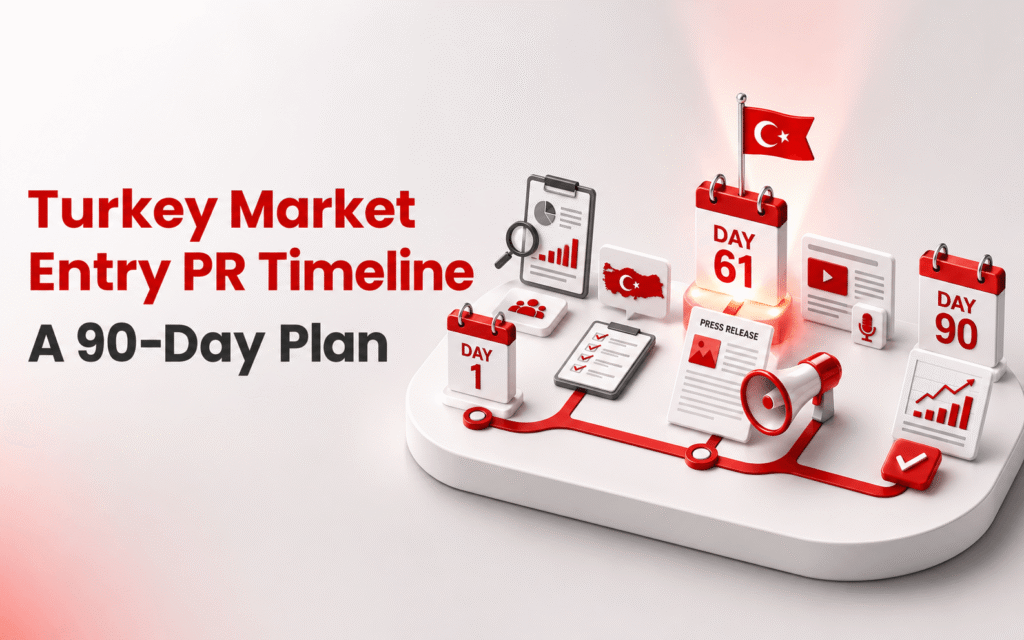
A practical Turkey market entry PR timeline should begin 60 days before launch and continue for 29 days after launch. Use Days 1-30 for research, positioning and localization; Days 31-45 for media infrastructure; Days 46-60 for pre-briefing and launch readiness; Day 61 for the public announcement; and Days 62-90 for follow-up, amplification, monitoring and reporting.
This 90-day plan assumes that Day 1 is T-60, Day 61 is launch day and Day 90 is T+29. Companies can move the launch day, but they should preserve the order of the work.
The central principle is simple: do not create broad attention until the Turkish message, customer experience, spokespersons and evidence are ready.
What does a 90-day Turkey market entry PR plan include?
The plan combines strategy, localization, media relations, launch operations and measurement in one controlled sequence. Each phase must produce an approved output before the next phase begins.
| Period | PR phase | Main output | Approval gate |
|---|---|---|---|
| Days 1-15 | Research and risk mapping | Turkey communications brief | Audience and risk approval |
| Days 16-30 | Positioning and localization | Approved message house | Message approval |
| Days 31-45 | Media infrastructure | Media list, press kit and tracking setup | Asset readiness |
| Days 46-60 | Pre-launch activation | Briefings, content and launch runbook | Go/no-go review |
| Day 61 | Public launch | Coordinated announcement | Live accuracy check |
| Days 62-68 | Immediate follow-up | Responses, interviews and corrections | Issue review |
| Days 69-75 | Amplification | Repurposed proof and stakeholder content | Message consistency check |
| Days 76-90 | Measurement and optimization | Coverage report and next-quarter plan | Executive review |
The schedule is not a promise that every company will receive media coverage in 90 days. It is an operating framework that gives the launch team enough time to prepare credible materials and respond after the announcement.
What must be confirmed before Day 1?
The PR timeline should not start until the business can identify what is launching, who is responsible and which facts are confirmed.
Confirm the following inputs:
- Target launch date or decision window
- Product or service availability in Turkey
- Priority Turkish audience
- Market-entry model, such as distributor, local entity or direct service
- Pricing and commercial status
- Customer support and escalation owner
- Authorized Turkish and global spokespeople
- Legal and regulatory review process
- Approved budget
- Measurable business and communications objectives
If the launch date, availability or local responsibility is still unknown, begin with market research and scenario planning. Do not draft a definitive public announcement around assumptions.
The U.S. International Trade Administration recommends that foreign companies assess their resources and long-term strategy before entering Turkey. It also notes that a Turkish agent, distributor, liaison office or business partner can provide language support, regulatory knowledge and local contacts. PR planning should therefore be connected to the actual entry model.
Days 1-15: Research the Turkish market and map communications risk
The first 15 days should produce a short, evidence-based communications brief. The team should understand the audience, competitive narrative, media environment and launch risks before writing campaign copy.
Days 1-5: Define the objective and audience
Choose one primary communications objective:
- Establish awareness among a defined customer segment
- Build credibility with Turkish business decision-makers
- Introduce a new product category
- Support distributor or retailer conversations
- Explain an investment, office or partnership
- Generate qualified launch inquiries
Then define the priority audience by need, role and context. “Consumers in Turkey” or “Turkish businesses” is too broad for a useful media and message plan.
Days 6-10: Audit competitors, search results and media narratives
Review:
- Turkish search results for the brand and category
- Competitor messages and claims
- Existing coverage of foreign market entrants
- Journalists and outlets covering the sector
- Recurring customer questions
- Sensitive political, economic or category issues
- Possible naming, translation or reputation risks
The objective is not to copy competitors. It is to identify which claims are already crowded, which questions remain unanswered and what may become controversial.
Days 11-15: Create the risk and stakeholder map
List internal and external stakeholders:
- Customers
- Employees
- Distributors and retailers
- Business partners
- Journalists
- Creators and analysts
- Industry associations
- Regulators where relevant
- Local communities
For each stakeholder, record the expected question, supporting fact and responsible spokesperson.
Day 15 deliverable: Turkey communications brief, stakeholder map and initial risk register.
Approval gate: The leadership, Turkish market owner and PR lead agree on the audience, objective and material risks.
Days 16-30: Localize the positioning and build the message house
The second phase converts market evidence into a consistent Turkish narrative. The team should approve meaning before producing large volumes of content.
Days 16-20: Define the localized value proposition
Answer five questions:
- What problem does the brand solve in Turkey?
- Who experiences that problem most clearly?
- What outcome does the brand promise?
- What evidence supports the promise?
- Why is the brand entering Turkey now?
Do not start with a global slogan. Start with the Turkish audience’s decision.
Days 21-25: Create the message house
The message house should contain:
- One-sentence market-entry statement
- Three supporting message pillars
- Proof for each pillar
- Approved company and product facts
- Claims that require qualification
- Terms that must remain in English
- Questions the team should not speculate about
Keep answers short enough for interviews, press materials, sales discussions and AI-generated summaries.
Days 26-30: Localize and validate
Use native Turkish editors to adapt:
- Brand description
- Product or service language
- Executive quotations
- Boilerplate
- Frequently asked questions
- Landing-page copy
- Customer support responses
- Press release outline
Translation should preserve facts, but transcreation should preserve meaning and persuasive effect. Legal and technical reviewers should approve regulated or performance-related claims.
Day 30 deliverable: Approved bilingual message house, terminology guide and Q&A.
Approval gate: Turkish and global teams approve the same factual narrative.
See Brand Localization in Turkey: What Should You Adapt? for the complete localization framework.
Days 31-45: Build the Turkish media and content infrastructure
The third phase creates everything required to make the announcement verifiable, distributable and measurable.
Days 31-35: Build a focused media map
Segment outlets and contacts by relevance:
- National news
- Business and economy
- Trade and sector media
- Technology media
- Consumer and lifestyle media
- Regional media
- News agencies
- Broadcast and podcast opportunities
Record why each contact is relevant. A large unsegmented database encourages generic outreach and weakens journalist relationships.
Days 36-40: Produce the press kit
Prepare:
- Turkish press release draft
- English reference version
- Company fact sheet
- Turkish executive biographies
- Spokesperson headshots
- Product or service images
- Local market Q&A
- Data sources and claim notes
- Contact details
- Approved company boilerplate
Every image should have a descriptive filename and alt text. Every statistic should have a traceable source and date.
Days 41-45: Create owned-media and measurement systems
Publish or stage:
- Turkish launch landing page
- Press room or media page
- Contact and inquiry forms
- Privacy and consent notices
- Analytics events and campaign tags
- Media monitoring queries
- Shared coverage log
- Internal issue-escalation channel
Turkey’s Personal Data Protection Law No. 6698, known as KVKK, requires data controllers to inform people about matters including the controller’s identity, processing purpose, data recipients, collection method and legal basis. Lead forms and media contact processes should receive appropriate review before launch.
Day 45 deliverable: Final media map, near-final press kit, Turkish landing page and tracking plan.
Approval gate: All public facts can be verified and every inbound inquiry has an owner.
Days 46-60: Pre-brief media and complete launch readiness
The final pre-launch phase should create informed interest without releasing the complete announcement too early. It should also expose gaps while there is still time to correct them.
Days 46-50: Conduct selective pre-briefings
Offer a small number of relevant journalists or analysts useful context. Depending on the story, a pre-brief may cover:
- The category problem
- Market data
- Executive background
- Confirmed investment or partnership context
- Product demonstration
- Access to a spokesperson
Do not send the full release to every contact. Pre-briefings should be selective and based on relevance.
If information is provided under embargo, confirm the date, time and time zone in writing. An embargo is a professional agreement, not an enforceable guarantee unless separately contracted.
Days 51-55: Finalize content and spokesperson training
Complete:
- Final Turkish press release
- Subject lines and pitch variants
- Executive talking points
- Difficult-question responses
- Social posts
- Employee communication
- Partner toolkits
- Customer email where appropriate
Run a mock interview. Test whether the spokesperson can answer questions about price, availability, support, local responsibility, privacy and long-term commitment without returning to vague global language.
Days 56-58: Run operational and reputation checks
Test:
- Landing pages and forms
- Mobile experience
- Contact routes
- Turkish support availability
- Media asset downloads
- Tracking links
- Correct launch time across time zones
- Search results for outdated information
- Approval access if a correction is needed
Days 59-60: Hold the go/no-go review
Use a simple gate:
| Question | Required answer |
| Is the product or service status accurate? | Yes |
| Can customers or partners take the promised action? | Yes |
| Are Turkish support and escalation routes working? | Yes |
| Are material claims approved and sourced? | Yes |
| Are spokespeople available? | Yes |
| Can the team monitor and correct coverage? | Yes |
| Are owned channels ready? | Yes |
If a critical answer is no, delay or narrow the announcement. A controlled postponement is usually less damaging than a public promise the company cannot fulfill.
Day 60 deliverable: Signed launch runbook and go/no-go decision.
Day 61: Execute the Turkey market-entry launch
Launch day should follow one shared runbook. Distribution, owned content, media outreach, stakeholder communication and monitoring must use the same approved facts.
Suggested launch-day sequence
| Time | Action | Owner |
| 08:00 | Final factual and link check | PR and web teams |
| 08:30 | Internal and partner briefing | Market lead |
| 09:00 | Publish Turkish landing page and press room assets | Web team |
| 09:15 | Distribute the press release | PR team |
| 09:30 | Send personalized priority pitches | Media relations lead |
| 10:00 | Publish executive and brand social posts | Social team |
| 10:30 onward | Handle interviews and inquiries | Spokespeople and PR |
| Continuous | Monitor coverage, comments and misinformation | Monitoring owner |
| 17:00 | First-day issue and coverage review | Launch team |
Times are illustrative and should be adapted to the news cycle, sector and outlet targets. Avoid simultaneous activity if the support team cannot manage the resulting inquiries.
The launch team should record every published URL, journalist request, factual concern and unanswered question in one shared log.
Days 62-68: Follow up, respond and protect accuracy
The first week after launch is for relevant follow-up, interview support and factual correction. It is not a reason to send repeated identical reminders.
Priority actions:
- Respond quickly to journalist questions
- Provide missing images or data
- Arrange interviews
- Thank contacts who engaged
- Correct material factual errors politely
- Route customer and partner inquiries
- Monitor comments and emerging concerns
- Update the FAQ with recurring questions
Segment follow-up:
- Contacts who opened or responded may receive relevant additional material.
- Priority journalists may receive a new fact, interview or local angle.
- Unresponsive contacts should not receive daily reminders.
- Unrelated outlets should be removed from the campaign list.
Day 68 deliverable: First-week coverage log, inquiry summary and issue report.
Days 69-75: Amplify credible proof
The second post-launch week should turn verified coverage and real audience questions into useful owned and shared content.
Possible amplification assets:
- Coverage highlights
- Executive commentary clips
- Customer or partner FAQs
- Sector-specific summaries
- LinkedIn posts for business audiences
- Turkish email update
- Sales enablement one-pager
- Internal employee briefing
Do not present sponsored coverage as independent editorial endorsement. If creators or partners publish commercial content, the relationship should be disclosed clearly. Turkey’s Ministry of Trade guidance requires influencer advertising to be identifiable and commercial relationships to be stated visibly.
The objective is not to repost every mention. Select evidence that helps the audience understand the offer or verify the launch.
Day 75 deliverable: Approved amplification pack and updated FAQ.
Days 76-90: Measure results and build the next-quarter plan
The final phase should explain what the launch achieved, what the market asked and what the company should do next. A clipping count alone is not a launch evaluation.
Measure output, quality and outcome
| Measurement level | Examples |
| Output | Releases distributed, pitches sent, interviews completed |
| Coverage quality | Outlet relevance, headline accuracy, message inclusion, backlinks |
| Audience response | Branded search, direct traffic, engagement, recurring questions |
| Commercial response | Qualified leads, partner inquiries, demos, waitlist actions |
| Experience | Support volume, response time, complaint themes, conversion barriers |
| Reputation | Sentiment, misinformation, executive visibility, share of relevant voice |
Compare results with the Day 1 baseline. Separate paid placements, syndicated release copies and earned editorial coverage so the report remains transparent.
Convert findings into decisions
The Day 90 review should answer:
- Which message received the strongest response?
- Which media categories produced relevant attention?
- Which questions or objections repeated?
- Did the Turkish customer journey support the public promise?
- Which spokespeople or formats worked best?
- What should continue, stop or change next quarter?
The 2026 Edelman Trust Barometer recommends that multinational businesses invest in long-term local relationships. A 90-day launch can introduce a brand, but trust requires continued local performance and communication.
Day 90 deliverable: Executive PR report, lessons learned and 90-day continuation plan.
Who owns each part of the 90-day PR timeline?
One launch lead should own the complete schedule, while specialists remain accountable for their own approvals and deliverables.
| Role | Main responsibility |
| Executive sponsor | Business decision and final launch authority |
| Turkey market lead | Local commercial accuracy and stakeholder alignment |
| PR lead | Timeline, narrative, media outreach and reporting |
| Native editor | Turkish language, tone and terminology |
| Legal or compliance | Claims, privacy, advertising and sector review |
| Product or operations | Availability, delivery, support and technical facts |
| Spokesperson | Interviews and public representation |
| Web and analytics | Landing pages, tracking and data quality |
| Customer support | Inquiry response and issue escalation |
Avoid approval by an undefined group. Every asset should have one responsible owner and one final approver.
What assets should be ready before launch day?
The essential launch package should allow journalists, partners and customers to verify the same facts without requesting basic information from several teams.
Required assets
- Final Turkish press release
- English reference release
- Localized message house
- Company and product fact sheet
- Turkish Q&A
- Spokesperson biographies and contact details
- Approved high-resolution images
- Turkish landing page
- Press room or downloadable media kit
- Tracking and media monitoring setup
- Internal and partner briefing
- Crisis and correction process
Optional assets
- Original Turkish market research
- Product demonstration video
- Executive opinion article
- Customer or pilot case study
- Partner quotation
- Industry-specific press versions
- Broadcast-ready video or audio
Optional assets should improve the story. They should not delay the launch unless the media strategy depends on them.
How should the plan change for B2B and B2C launches?
B2B launches need more account, trade-media and spokesperson preparation. B2C launches need more customer-experience, creator, retailer and support readiness.
| Area | B2B emphasis | B2C emphasis |
| Audience | Buying committees, partners, analysts | Consumer segment, creators, retailers |
| Proof | Pilots, expertise, ROI, technical validation | Demonstration, reviews, availability, value |
| Media | Business and trade outlets | Consumer, lifestyle and category outlets |
| Action | Meeting, demo, pilot or report | Purchase, waitlist, store visit or trial |
| Launch-day risk | Inconsistent sales answers | Delivery, support and public comments |
| Follow-up | Account-specific content and interviews | FAQ, reviews, creator and service content |
The core 90-day sequence remains the same. The evidence, channels and operational checks change.
What are the most common timeline mistakes?
The most common mistake is beginning PR production before the market-entry facts and local customer experience are stable.
Other frequent failures include:
- Starting Turkish localization after global approval
- Building a media list without outlet segmentation
- Treating the press release as the entire strategy
- Announcing an unconfirmed launch date
- Giving journalists unsourced statistics
- Skipping spokesperson training
- Publishing before Turkish support is ready
- Tracking only total media mentions
- Mixing paid, syndicated and earned coverage in one number
- Ending communication immediately after launch week
The timeline exists to expose these risks early enough to correct them.
Frequently asked questions
Is 90 days enough for a Turkey market-entry PR campaign?
Ninety days is enough for a focused launch when the business decision, product and local operating model are already defined. Regulated, controversial or category-creating launches may require more time.
When should the press release be written?
Create the outline during Days 31-35 and finalize the release during Days 51-55. Writing too early increases revision risk; writing too late weakens localization and approval quality.
When should journalists be contacted?
Selective context briefings can begin during Days 46-50. Personalized launch pitches should normally be sent on Day 61 or according to an agreed embargo. Timing should reflect the outlet and news cycle.
Should the same press release be used in English and Turkish?
The factual core should match, but the Turkish version should be localized for local terminology, news value and reader context. It should not be a mechanical translation.
What happens if the launch date changes?
Pause scheduled distribution, update all affected assets and repeat the go/no-go review. Inform embargoed contacts quickly and accurately. Do not allow old countdowns or pages to remain live.
How many journalists should receive the launch pitch?
There is no universal number. A smaller relevant list usually performs better than a large unsegmented database. Prioritize audience fit, beat relevance and the strength of the news angle.
What should happen after Day 90?
The team should move from launch communication to sustained market communication. Continue media relations, expert content, customer proof, monitoring and quarterly measurement.
Final takeaway
A Turkey market-entry PR launch is a 90-day operating process, not a one-day press release. The first 60 days establish local relevance, proof, media infrastructure and readiness. Launch day coordinates the announcement. The final 29 days convert attention into accurate coverage, useful insight and a longer-term communications program.
The schedule should be flexible, but the quality gates should not be skipped. A brand should launch only when its Turkish message and customer experience can support the same public promise.
PRTurkey helps international brands localize market-entry announcements, reach relevant Turkish media and document coverage through transparent reporting. Explore press release distribution for brands entering Turkey or contact the PRTurkey team to build a launch timeline.
Related PRTurkey guides
- How to Launch a Brand in Turkey
- How to Build Brand Awareness in Turkey Before Launch
- Doing Business in Turkey: PR and Communications Checklist
- Turkish Media Outlets: A Complete Guide
Sources
- Turkey Market Entry Strategy — International Trade Administration
- Türkiye Digital Economy — International Trade Administration
- Personal Data Protection Law No. 6698 — Turkish Personal Data Protection Authority
- Turkey’s Regulation of Social Media Influencers — Turkish Ministry of Trade
- 2026 Edelman Trust Barometer