


To pitch an exclusive story to a journalist, identify a newsworthy angle, choose one relevant reporter, explain why the story matters to their audience, and offer them a clearly defined opportunity to publish it first. Set a reasonable response deadline, clarify what the exclusive includes, and avoid offering the same story to another outlet while the arrangement is active.
An exclusive media pitch can help a story receive more focused editorial consideration. However, exclusivity does not automatically guarantee publication. A successful approach depends on the strength of the story, the journalist’s interests, and clear communication about expectations.
What Is an Exclusive Story in Journalism?
An exclusive story is news, information, an interview, or access offered to a particular journalist or media outlet before it becomes available to competing publications.
In public relations, an exclusive media pitch gives one reporter an opportunity to cover a story ahead of others. This might involve an unpublished research report, a company announcement, an interview with a key executive, or access to information that has not yet been publicly released.
For example, a technology company preparing to announce a significant expansion might offer a business journalist an exclusive interview with its founder and early access to verified market data.
The value of the exclusive is not simply that the information is new. It is that the journalist receives a meaningful reporting opportunity that competitors do not have at the same time.
What Makes a Story Worth Offering as an Exclusive?
Not every announcement deserves exclusive treatment. A story should offer genuine editorial value beyond promoting a company or organization.
A strong exclusive usually has several characteristics:
- Newsworthiness: The information reveals a meaningful development, change, or discovery.
- Relevance: The story fits the journalist’s reporting area and audience.
- Originality: The information or access is not already widely available.
- Evidence: Important claims can be supported with documents, data, or credible sources.
- Timing: The story is relevant to a current development or upcoming announcement.
- Access: The journalist can obtain interviews, images, or additional context that strengthens the reporting.
An exclusive is most useful when the reporting opportunity is genuinely distinctive. A routine promotional announcement may be better suited to broader media outreach.
How to Pitch an Exclusive Story to a Journalist
The process begins before the first email. An effective exclusive pitch requires preparation, careful journalist selection, and a clear understanding of what is being offered.
1. Develop a Newsworthy Story Angle
Start by identifying what makes the announcement interesting to people outside the organization.
A product launch alone may not be compelling. However, a launch supported by original research, a significant industry development, or a measurable change in consumer behavior may provide a stronger editorial angle.
Ask three questions:
- What is genuinely new?
- Why should the journalist’s audience care?
- What evidence makes the story credible?
The answers should be clear enough to summarize in two or three sentences.
2. Choose the Right Journalist
An exclusive should be offered to a reporter whose previous work demonstrates a genuine interest in the subject.
Research the journalist’s recent articles, editorial focus, publication audience, and preferred contact method.
For example, a reporter covering healthcare innovation may be a better match for new medical technology research than a general business correspondent.
Avoid contacting several journalists at the same publication with identical exclusive offers. This can create confusion about who has been offered the story and undermine trust.
If you are unsure how to identify appropriate contacts, start by learning how to build a media list based on relevant publications and reporting areas.
3. Write a Clear Exclusive Pitch Subject Line
The subject line should communicate both the news angle and the exclusive opportunity.
The word exclusive can be useful, but it should not replace a meaningful description of the story.
Consider these examples:
| Weak subject line | Stronger subject line |
|---|---|
| Exciting Exclusive Opportunity | Exclusive: New Research Reveals Changes in Urban Shopping Habits |
| Important Company News | Exclusive Interview: Founder Discusses Regional Expansion |
| Press Release for Your Review | First Look: New Industry Report Ahead of Public Release |
| Big Announcement Coming Soon | Exclusive: Company Announces New Manufacturing Investment |
These are illustrative examples, not tested subject lines with verified performance results.
A strong subject line makes the subject immediately understandable without exaggerating its significance.
4. Explain Why You Chose That Journalist
Personalization should go beyond inserting the reporter’s first name.
Briefly explain how the proposed story connects to their reporting.
For instance, a journalist who recently covered renewable energy investment might be interested in original data showing how investment patterns are changing.
The goal is to demonstrate editorial relevance rather than flatter the journalist.
5. Describe Exactly What Is Exclusive
Be specific about what the journalist will receive.
The offer might include:
- First access to an unpublished announcement
- An exclusive interview with a spokesperson
- Original research or supporting data
- Early access to photographs or video
- An opportunity to publish before broader distribution
These arrangements are not interchangeable.
An exclusive interview does not necessarily mean the journalist owns exclusive rights to every aspect of the announcement. Similarly, early access to information does not automatically establish an agreed publication embargo.
Define the scope before either party makes assumptions.
6. Set a Reasonable Response Deadline
An exclusive offer should not remain open indefinitely.
A clear deadline allows the journalist to evaluate the opportunity while giving the organization enough time to pursue another publication if necessary.
The appropriate response window depends on the story’s urgency, the publication’s workflow, and the amount of reporting required.
A breaking development may require a quick decision. A detailed investigative or feature opportunity may need substantially more time.
Use a specific date, time, and time zone when relevant, particularly for international media outreach.
7. Confirm the Agreement Before Sharing Sensitive Details
If the journalist expresses interest, confirm the essential terms in writing.
Clarify the scope of the exclusive, what information may be used, when publication is permitted, and when the organization may approach other outlets.
Do not assume that a reporter’s initial interest means the story has been accepted for publication.
Editorial decisions may still depend on an editor’s approval, additional reporting, or changing news priorities.
Exclusive Media Pitch Email Examples
An exclusive pitch email should be concise, personalized, and specific about the proposed reporting opportunity.
The following templates illustrate different situations.
Example 1: Offering an Exclusive Company Announcement
Subject: Exclusive: New Industry Expansion Announcement
Hi [Journalist Name],
I noticed your recent reporting on developments in [industry], and I thought an upcoming announcement might be relevant to your readers.
[Company] is preparing to announce [specific development], which could have implications for [audience or industry].
We’re offering you the opportunity to review the news exclusively before its public announcement on [date].
We can provide supporting information, relevant data, and an interview with [spokesperson].
Would you be interested in reviewing the details? We can hold the exclusive opportunity until [date and time].
Best regards,
[Name]
[Title]
[Contact Information]
Example 2: Pitching Exclusive Research
Subject: Exclusive First Look: New Research on [Topic]
Hi [Journalist Name],
Given your coverage of [subject], I wanted to offer you an early look at research we’re preparing to publish.
The findings indicate [specific, verified discovery], with potential implications for [relevant audience].
The research includes [methodology or supporting evidence], and a spokesperson is available to discuss the findings.
We’re approaching you first and can hold the opportunity until [deadline].
Would you like to review a summary of the findings?
Best,
[Name]
Example 3: Offering an Exclusive Interview
Subject: Exclusive Interview Opportunity: [Spokesperson] on [Topic]
Hi [Journalist Name],
I’m reaching out because of your recent reporting on [topic].
We can offer you an exclusive interview with [spokesperson], who can discuss [specific development or insight].
The interview would provide access to [unique perspective, new information, or relevant experience].
If this is of interest, I can share available interview times and confirm the scope of the exclusive.
Would you be interested?
Best regards,
[Name]
Example 4: Following Up on an Exclusive Pitch
Subject: Re: Exclusive: [Original Story Angle]
Hi [Journalist Name],
I’m following up on the exclusive story opportunity I shared regarding [topic].
We’re finalizing our announcement schedule and wanted to check whether this might be relevant to your coverage.
We can hold the opportunity until [specific date and time]. If it isn’t a fit, I completely understand.
Would you like any additional information before making a decision?
Best,
[Name]
These examples should be adapted to the journalist, publication, and actual news. A generic template sent without research is unlikely to provide the same editorial value as a carefully tailored proposal.
Should You Send the Full Press Release When Pitching an Exclusive?
You do not necessarily need to send the full press release in the first email.
A short initial pitch can establish interest without overwhelming the journalist with background material or revealing information before the terms are clear.
The first message should generally explain the news angle, its relevance, what makes the opportunity exclusive, and how the reporter can obtain more information.
Once the journalist expresses interest, you can provide the full press release, supporting documents, data, interview access, or other relevant materials.
If the information is confidential or subject to an embargo, confirm the applicable conditions before disclosing it.
A press release and a media pitch serve different purposes. The release documents the announcement; the pitch explains why a particular journalist should consider covering it.
For additional examples of personalized journalist outreach, see our guide to media pitch examples and templates.
How Long Should You Give a Journalist to Respond?
There is no universal deadline for responding to an exclusive story offer.
The appropriate window depends on the announcement schedule, editorial complexity, and whether the journalist needs approval or additional research.
| Situation | Practical approach |
|---|---|
| Time-sensitive announcement | State a short, specific decision deadline |
| Planned company announcement | Allow time for the journalist to assess relevance |
| Research-led feature | Consider the additional time needed to review findings |
| Exclusive interview | Coordinate the spokesperson’s availability |
| International media pitch | Specify the deadline and time zone |
These are planning considerations, not fixed industry rules.
A useful deadline should reflect a real editorial or organizational constraint. Avoid creating artificial urgency merely to pressure the journalist.
If the reporter requests additional time, evaluate whether extending the exclusive is compatible with the announcement schedule.
What If a Journalist Doesn’t Respond to an Exclusive Pitch?
A lack of response does not necessarily mean the story lacks value.
The journalist may be covering breaking news, working against a deadline, waiting for editorial approval, or simply unable to pursue the opportunity.
If the original message included a clear deadline, wait until that deadline or send one brief, respectful follow-up when appropriate.
If no agreement has been reached and the response window has expired, you can close the offer before approaching another journalist.
For example:
Subject: Update on Exclusive Opportunity: [Topic]
Hi [Journalist Name],
As the response deadline for the exclusive opportunity has passed, we’ll now be exploring other media options for this announcement.
Thank you for considering the story. I hope we can connect on a future opportunity.
Best,
[Name]
This makes the change in status explicit and helps prevent misunderstandings.
However, if the journalist has already accepted the exclusive, the situation is different. Do not assume that a missed email or publication delay automatically cancels an agreed arrangement.
What If a Journalist Accepts an Exclusive but Doesn’t Publish?
A journalist expressing interest, conducting an interview, or requesting materials does not necessarily guarantee publication.
Editorial priorities can change, and an editor may ultimately decide not to run the story.
If publication is delayed, first clarify the status of the arrangement.
Ask whether the story remains under consideration, whether additional material is needed, and whether the original publication timeline is still realistic.
If the exclusive has been formally accepted, discuss releasing or modifying the agreement before offering the same material elsewhere.
A professional message might say:
Subject: Checking the Status of Our Exclusive Story
Hi [Journalist Name],
I wanted to check in regarding the exclusive story on [topic].
As our announcement timeline is approaching, could you let me know whether the story is still under consideration and if the planned publication timing has changed?
If the original arrangement no longer works for your editorial schedule, we’re happy to discuss the next steps.
Best,
[Name]
The purpose is to resolve uncertainty without placing unnecessary pressure on the journalist.
How Long Does an Exclusive Last?
An exclusive lasts for the period agreed upon by the parties.
That period might end when the journalist publishes the story, when a specified deadline expires without acceptance, or when both sides agree to release the arrangement.
The distinction between an offer deadline and an accepted exclusive is important.
An offer deadline determines how long the journalist has to accept the opportunity. An accepted exclusive may involve separate commitments about publication timing and wider distribution.
Before confirming an arrangement, establish:
- What information or access is exclusive
- Which journalist or publication receives it
- When the journalist may publish
- When the organization may contact other outlets
- What happens if publication is delayed or cancelled
A written confirmation can help both parties avoid conflicting interpretations.
Exclusive vs. Embargo: What’s the Difference?
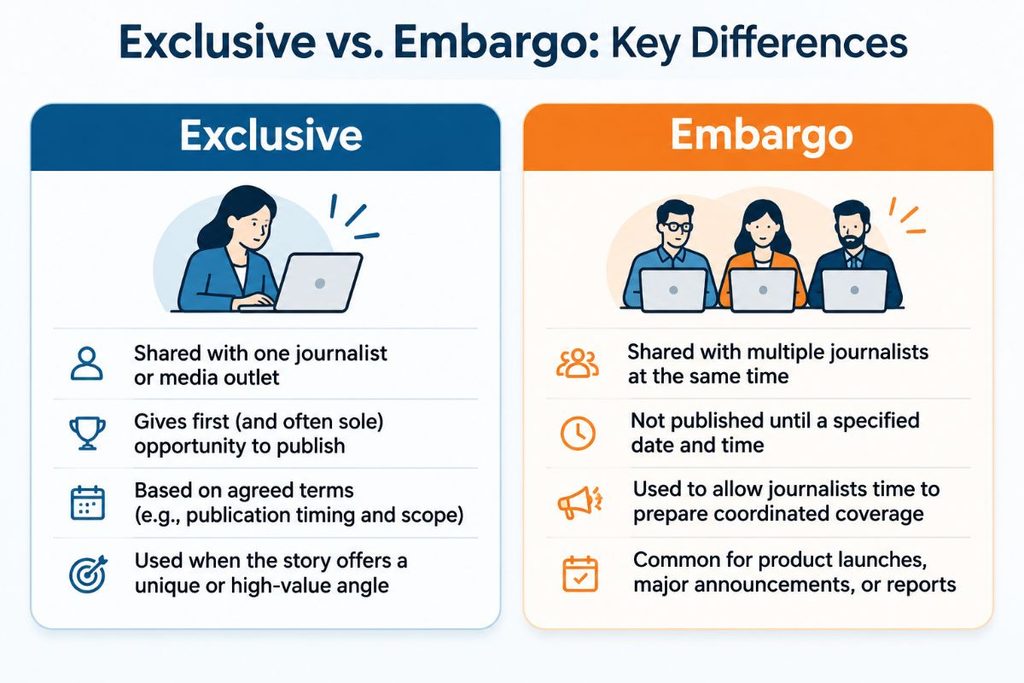
An exclusive and a press embargo are related media relations techniques, but they are not the same.
| Feature | Exclusive story | Embargoed story |
|---|---|---|
| Who receives the information? | Usually one journalist or outlet | Potentially multiple journalists or outlets |
| Main benefit | A distinctive first-reporting opportunity | Preparation time before a coordinated announcement |
| Publication timing | Defined by the agreed arrangement | Restricted until an agreed release time |
| Wider distribution | Depends on the exclusive terms | May occur across multiple outlets after the embargo lifts |
| Main risk | Limiting other media opportunities | Premature disclosure or misunderstanding of the embargo |
An embargo is a request or agreement not to publish specified information before a particular time. Sending an email marked “embargoed” does not, by itself, establish that the recipient has accepted those conditions.
An exclusive may also be subject to an embargo, but the two arrangements should be discussed separately.
For example, a company might give one journalist exclusive access to an executive interview while providing the general announcement to several other reporters under an agreed embargo.
In that situation, the interview is exclusive, but the broader announcement is not.
When Should You Avoid Offering an Exclusive?
An exclusive is not always the best distribution strategy.
It may be unsuitable when an announcement needs to reach a wide range of audiences simultaneously, when the information is already public, or when no single publication is a strong editorial match.
It can also be risky when the organization’s communications schedule cannot accommodate delays.
Before choosing an exclusive, consider the following question:
If this were the only publication to cover the story, would the result still support the communication objective?
If the answer is no, a broader media outreach strategy may be more appropriate.
Some announcements also involve legal, regulatory, or market-disclosure obligations. Organizations should confirm applicable requirements before selectively sharing material information.
Common Mistakes When Pitching Exclusive Stories
Exclusive pitching requires more than adding “EXCLUSIVE” to an email subject line.
Several mistakes can damage the credibility of an otherwise worthwhile story.
Offering the same exclusive to multiple reporters: If journalists discover that the opportunity was not actually exclusive, trust can be damaged.
Failing to define the terms: Unclear publication windows and distribution expectations create unnecessary conflict.
Pitching the wrong journalist: Even strong news may be irrelevant to a reporter’s subject area.
Overpromising publication: Journalists and editors retain editorial independence. A pitch should not promise a particular headline, article length, or publication outcome.
Sharing confidential information too early: Sensitive details should be handled according to the organization’s disclosure obligations and the agreed conditions.
Following up aggressively: Repeated messages without additional value can undermine future media relationships.
Confusing exclusive access with exclusive coverage: Offering one interview does not necessarily make an entire announcement exclusive.
The strongest exclusive pitches are transparent, specific, and respectful of editorial independence.
How to Measure the Success of an Exclusive Media Pitch
The number of articles published is not the only useful measure.
An exclusive strategy often prioritizes editorial relevance and depth over the total volume of coverage.
Depending on the campaign’s objectives, useful indicators include the publication’s audience relevance, the prominence of the resulting story, the accuracy of key information, the quality of spokesperson quotations, and whether the coverage reaches the intended market.
For international campaigns, the publication’s geographic reach and industry relevance may be particularly important.
An exclusive interview in a highly relevant specialist publication may serve a business objective better than several brief mentions in unrelated outlets.
At the same time, exclusive coverage should not automatically be treated as more valuable than broader distribution. The appropriate strategy depends on what the organization is trying to achieve.
Frequently Asked Questions
How do I pitch an exclusive story to a journalist?
Identify a relevant journalist, summarize the newsworthy angle, explain why the story matters to their audience, and describe the exclusive opportunity. Include a clear response deadline and confirm the scope of the arrangement before sharing sensitive information. Keep the email concise and personalized.
Can I pitch an exclusive story to multiple journalists?
You should not offer the same exclusive opportunity to multiple journalists simultaneously without clearly disclosing the arrangement. An exclusive generally means that one journalist or outlet receives a defined opportunity unavailable to others during the agreed period. Once an offer has been declined, expired, or properly released, you can approach another journalist.
Does an exclusive guarantee media coverage?
No. An exclusive can make a story more attractive by offering distinctive information or access, but it does not guarantee publication. A journalist may express interest without obtaining editorial approval, and publication plans can change. Expectations should be discussed clearly without assuming editorial commitments that have not been confirmed.
What happens if a journalist breaks an exclusive agreement?
The consequences depend on the arrangement and the circumstances. A misunderstanding may be resolved through communication, while a serious breach can damage professional trust. Where confidential information, contractual commitments, or regulatory obligations are involved, the organization may need appropriate legal advice.
Can I send a press release after an exclusive story is published?
Often, yes, provided wider distribution is consistent with the agreed exclusive terms. Some arrangements allow a general announcement immediately after the first article appears, while others specify a longer period. Confirm the release conditions before distributing the same information to other outlets.
Final Thoughts
Learning how to pitch an exclusive story to a journalist involves more than writing a persuasive email. The process requires a genuinely newsworthy angle, careful journalist selection, a clear definition of exclusivity, and realistic expectations about editorial decisions.
The most important principle is transparency. Journalists should understand exactly what is being offered, how long the opportunity remains available, and what information they can use.
For organizations planning international announcements, an exclusive may form one part of a broader media relations strategy. PR Turkey can help businesses evaluate their international media outreach approach and plan press communication around relevant markets and audiences.