
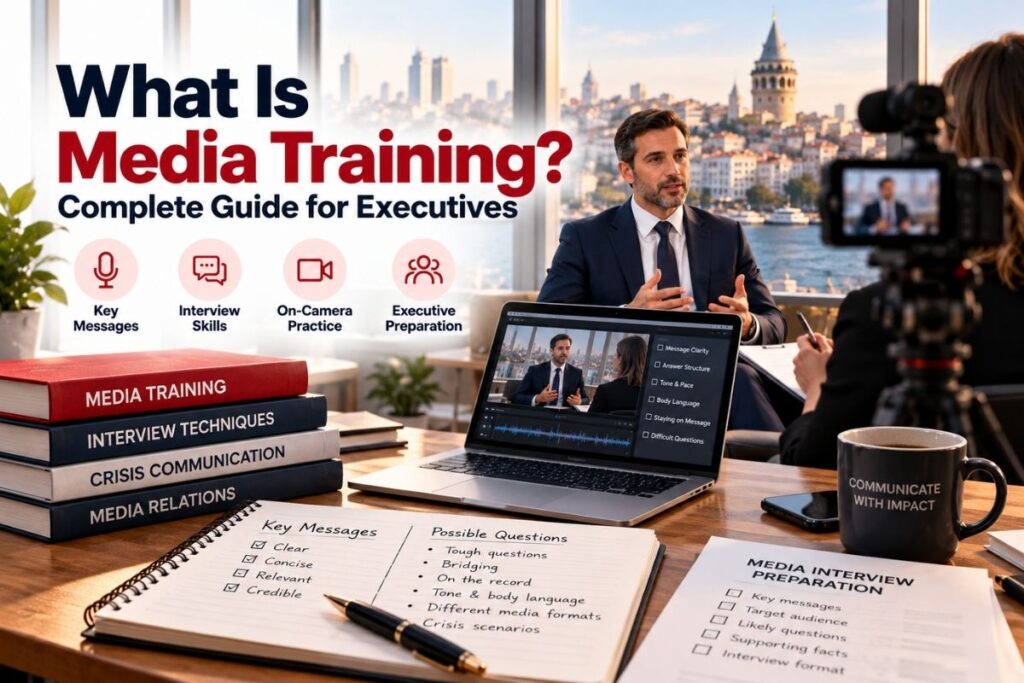
Media training is practical preparation that helps people communicate effectively during journalist interviews, live broadcasts, press appearances, podcasts, and other media interactions. It typically covers message development, difficult questions, tone and body language, interview technique, and adapting answers to different media formats.
For an executive or spokesperson, the objective is not to memorize perfect answers. It is to understand what needs to be communicated, answer questions accurately, and remain clear when an interview becomes unpredictable.
Think of this as media training 101 plus the practical detail that basic definitions often leave out: what happens in a session, what “media trained” actually means, which skills matter, how to practice, and what international executives should consider before speaking with media in Türkiye.
What Is Media Training? (Media Training Meaning)
What is media training? It is structured preparation for communicating with journalists and responding effectively in media interviews. The media training meaning is broader than simply learning how to look comfortable on camera: it combines message development, interview technique, verbal delivery, nonverbal communication, difficult-question practice, and realistic rehearsal.
Training can prepare a spokesperson for television, radio, print interviews, podcasts, virtual interviews, online publications, and situations in which comments may later appear as short digital or social-media excerpts.
The media training basics remain similar across these formats: know what you need to communicate, understand the journalist’s question, answer it clearly, avoid unsupported speculation, and recognize that different formats reward different types of answers.
A live television interview, for example, places greater emphasis on concise delivery, pace, posture, and immediate responses. A print interview may allow more detailed explanations, but anything said on the record may still be condensed into a short quotation. Podcasts can allow longer answers while requiring the speaker to maintain structure across an extended conversation.
Media training is also defined by what it is not.
It is not training in “spin.” It should not teach someone to evade every difficult question. It is not designed to erase a spokesperson’s personality or replace natural speech with corporate language. Nor should it depend on memorizing entire answers word for word.
The goal is more practical: communicate accurate information clearly, protect against avoidable mistakes, and make key messages understandable without sounding scripted.
That distinction becomes clearer when looking at what being media trained actually changes.
What Does It Mean to Be Media Trained?
The media trained meaning is straightforward: someone who is media trained has deliberately practiced the skills required to handle interviews and other press interactions.
If someone asks “what is media trained?”, the phrase does not describe a formal professional status. It describes preparation. A media trained executive or spokesperson has usually practiced messages, interview responses, difficult questions, delivery, and the rules that govern conversations with journalists.
Similarly, what does media trained mean in practice? It means the person is less likely to enter an interview without a message plan or discover interview conventions for the first time while the conversation is already being recorded.
What a media-trained spokesperson does differently
A media-trained spokesperson generally enters an interview knowing the two or three ideas the audience should understand afterward.
That person listens to the full question before responding, distinguishes facts from speculation, and avoids filling silence simply because a pause feels uncomfortable. If a question moves away from the central subject, the spokesperson can acknowledge it and return naturally to relevant information.
Being media trained also changes preparation. Instead of predicting only friendly questions, the speaker considers skeptical, unexpected, technical, repetitive, and potentially sensitive questions.
A trained spokesperson understands that brevity can be useful. A strong answer may be shorter than the executive would use in an internal presentation because journalists need clear statements that remain meaningful when quoted independently.
What media training does not guarantee
Media training does not guarantee positive coverage.
A journalist retains editorial independence. Training cannot determine the questions asked, control which quotation is selected, dictate a headline, or ensure that an interview becomes a favorable story.
It also cannot eliminate every mistake. A person can be thoroughly prepared and still encounter an unexpected question.
The practical value lies in reducing preventable communication errors and increasing the spokesperson’s ability to respond thoughtfully under pressure.
What Do You Learn in Media Training?
Media training teaches the practical skills needed to move from “I know this subject” to “I can explain this subject clearly while someone questions me.”
A subject-matter expert may understand an issue in exceptional detail yet struggle to condense it into an answer suitable for a television segment. Conversely, a confident speaker may sound polished while failing to communicate a meaningful message. Effective training works on both content and delivery.
| Skill | What you practice | Why it matters |
|---|---|---|
| Key messages | Defining a small number of priority ideas | Keeps answers focused |
| Tough questions | Responding under pressure | Reduces reactive answers |
| Bridging | Returning naturally to relevant messages | Prevents interviews from drifting |
| Tone and pace | Speaking clearly without rushing | Improves comprehension |
| Body language | Posture, eye contact and movement | Supports on-camera credibility |
| Format adaptation | TV, radio, print, podcast and virtual interviews | Matches delivery to the medium |
| Crisis interviews | High-pressure and hostile questioning | Tests preparation before risk is real |
Key message development
A key message is the central idea an organization wants its audience to understand. It should be specific enough to communicate meaning and simple enough to express without reading from a script.
Strong interview preparation often starts with the same discipline used when learning how to write a press release: identify what is actually new or relevant, remove unnecessary corporate language, and make the main point understandable early.
A useful message is not an answer to every possible question. It is a reference point that helps the spokesperson decide what information deserves emphasis.
Tough questions and bridging
Bridging is an interview technique in which a speaker answers or acknowledges a question and then connects the response to relevant information.
It should not become a device for ignoring legitimate questions. If every answer abruptly returns to the same slogan, the spokesperson can appear evasive.
The better approach is to address what can responsibly be answered, then bridge to useful context.
Soundbites and concise answers
A soundbite is a short, self-contained statement that can be understood outside the longer interview.
A soundbite does not need to be theatrical. Clear statements with one idea, concrete language, and minimal jargon are easier to quote accurately.
Executives should practice saying the same message in several lengths: a short answer for broadcast, a slightly expanded answer for follow-up questions, and a detailed explanation when context permits.
On the record, off the record and background
On the record generally means information may be published and attributed to the speaker.
Off the record and background can have different working interpretations depending on the journalist, publication, and prior agreement. A spokesperson should not casually assume that a sensitive comment becomes protected simply by saying “off the record” after making it.
A practical rule in training is to clarify the terms of a conversation before discussing sensitive information.
Tone, pace and body language
Delivery influences whether a technically correct answer is understandable.
Training can reveal habits that speakers rarely notice themselves: speaking too quickly, looking away repeatedly, using excessive filler words, giving very long answers, or adopting a defensive tone when a question becomes challenging.
Recorded practice is especially useful because the participant can compare how an answer felt while speaking with how it actually appears to an audience.
Different interview formats
Television rewards concise answers and controlled visual delivery. Radio removes visual cues and places more weight on voice, pace, and verbal clarity. Print may support more detail but still requires quotable statements.
Podcasts can create conversational depth, while virtual interviews add practical considerations such as camera framing, audio, eye line, and interruptions.
Crisis and hostile interviews
Crisis preparation tests what happens when normal interview conditions disappear.
Questions may become repetitive, accusatory, or based on incomplete information. The spokesperson practices distinguishing confirmed facts from unknowns, correcting false premises without becoming combative, and explaining what can be said at that moment.
These exercises prepare the speaker for pressure without pretending that every future question can be predicted.
How Does Media Training Work? A Typical Session Step by Step
How does media training work? A useful session typically moves from objectives and messages into increasingly realistic interview practice. The emphasis should be on active rehearsal rather than spending the entire session listening to communications theory.
A typical process looks like this:
- Define the objective. The trainer identifies who will be interviewed, by which type of media, about what subject, and what risks or opportunities matter.
- Develop key messages. Participants reduce a complex subject to a small number of defensible points supported by facts.
- Review interview techniques. The session covers question types, concise answers, bridging, clarification, and interview terminology.
- Run a mock interview. The participant answers realistic questions under conditions that resemble the expected interview. The exercise may be recorded.
- Review the performance. Feedback focuses on both substance and delivery: clarity, answer length, jargon, unsupported claims, pace, posture, and missed opportunities.
- Repeat difficult sections. The participant answers revised versions of challenging questions and applies the feedback immediately.
- Plan follow-up practice. Messages and likely questions are updated as the actual interview or announcement approaches.
Training format and preparation
Sessions can be one-to-one or group-based, in person or virtual. Some are built around a focused short online rehearsal; others use a broader half-day-style workshop or several hours of preparation. The appropriate structure depends on the objective rather than a universal duration.
Before attending, participants should bring the actual material they expect to discuss whenever possible: the campaign or announcement, key facts, likely sensitive questions, previous interview examples, and existing corporate messages.
| Before training | During training |
|---|---|
| Define the interview objective | Test the key messages |
| Collect likely questions | Run realistic interviews |
| Review previous interviews | Identify communication habits |
| Confirm facts and boundaries | Practice difficult answers |
| Identify sensitive areas | Record and review delivery |
The closer the exercises are to the real interview, the more useful the feedback becomes.
Who Needs Media Training?
Media training is not reserved for professional spokespeople or famous public figures. Anyone who may represent an organization in a journalist interview can benefit when the communication carries reputational, commercial, or operational consequences.
Media Training for Executives
Media training for executives is particularly useful because senior leaders are often asked to speak about subjects broader than their individual technical responsibilities.
CEOs, CFOs, founders, regional directors, and other senior leaders may need to explain strategy, performance, investment, market entry, organizational change, or difficult events. Executive media training helps them translate internal business language into concise external communication.
A senior title does not automatically create interview skill. Executive expertise may actually create a different challenge: knowing so much about the subject that every answer becomes too detailed.
For that reason, media training for executives often emphasizes prioritization as much as confidence.
Media Training for Celebrities and Public Figures
What is media training for celebrities? It is the same core discipline applied to people whose public visibility creates frequent or high-attention interviews.
They may practice concise responses, boundaries around private topics, difficult questions, live interviews, and consistent public messaging.
But media training for celebrities is only one use case. The method is equally relevant to executives, technical specialists, founders, nonprofit spokespeople, and other people speaking publicly on behalf of an organization.
Spokespeople, Subject-Matter Experts and PR Teams
Subject-matter experts often provide the strongest technical knowledge but may need help converting specialist terminology into language a general audience can understand.
A corporate spokesperson may require broader preparation because questions can move beyond one technical subject into organizational policy or reputation.
The PR team supports this process by coordinating messages, identifying likely questions, preparing facts, aligning internal stakeholders, and helping the spokesperson understand the media context.
Do Small Companies and Startups Need It?
A small company does not automatically need a large training program.
Training becomes more valuable when an upcoming interview has meaningful consequences: a product launch, fundraising announcement, market entry, sensitive operational issue, or first major media appearance.
A founder facing one important interview may benefit more from focused preparation than from a broad generic program.
Media Training vs. PR Training vs. Public Speaking vs. Crisis Training
These disciplines overlap, but they solve different communication problems.
| Training type | Main focus | Best for |
|---|---|---|
| Media training | Journalist interviews | Spokespeople and experts |
| PR training | PR strategy and execution | Communications practitioners |
| Public speaking | Speaking to an audience | Events and speeches |
| Crisis training | High-risk communications | Crisis teams and leaders |
| Presentation skills | Structured presentations | Meetings and pitches |
Media training is interview-centered. Public-speaking training generally prepares a speaker to deliver information to an audience with greater control over the structure. A journalist interview reverses that dynamic because another person controls the questions.
Crisis communications training overlaps with media preparation but usually adds broader decision-making, stakeholder communication, escalation, scenario planning, and response coordination.
What Is Media PR Training?
The phrase media PR training can be ambiguous.
The PR training meaning usually relates to developing public-relations skills such as strategy, media relations, campaigns, pitching, communications planning, and measurement. Someone asking “what does PR training mean?” may therefore be looking for practitioner training rather than spokesperson preparation.
Similarly, what does it mean to be PR trained is different from being media trained. The first can refer to professional PR capabilities; the second usually refers specifically to preparation for interviews and media appearances.
Some people nevertheless use “PR training” informally when they mean interview preparation, so the scope should always be clarified before booking a course or service.
What Is Another Name for Media Training?
Media training is also commonly described as media coaching, media interview training, spokesperson training, or media skills training.
The labels overlap, but the service may not. One provider may use “media coaching” for a highly individualized rehearsal, while another uses the same phrase for a general workshop.
Compare the actual exercises and deliverables rather than choosing by title alone.
Types of Media Training and What to Choose
The best format depends on who is being prepared, what interview is expected, and how much individual feedback is required.
| Format | Best use | Trade-off |
|---|---|---|
| One-to-one | Senior spokesperson | Deep individual feedback |
| Group | Multiple spokespeople | Shared standards |
| In-person | Camera and physical delivery | Requires scheduling |
| Virtual | Distributed teams | Easier logistics |
| General | Ongoing readiness | Less event-specific |
| Crisis-focused | High-risk scenarios | Narrower, intensive focus |
| On-camera | Broadcast preparation | Specialized practice |
A media training course can provide structured instruction across common principles. Broader media training courses are useful when several participants need a shared foundation.
By contrast, individualized media training services can be built around one executive, announcement, or anticipated interview. Corporate media training often combines both approaches: shared standards for the organization plus individual rehearsal for designated spokespeople.
Media relations training serves a related but different audience. It often teaches communications professionals how to work with journalists, pitch stories, coordinate interviews, and manage ongoing media relationships rather than teaching only spokesperson performance.
Choosing between a course and personalized media training services therefore depends on whether the need is general capability-building or preparation for a specific media situation.
Benefits and Limits of Media Training
Media training can improve preparation, clarity, consistency, and confidence, but its value should be understood without treating it as a mechanism for controlling journalism.
| Benefits | Limits |
|---|---|
| Clearer key messages | Cannot control questions |
| Better difficult-question preparation | Cannot dictate coverage |
| More concise answers | Cannot predict every scenario |
| Greater format awareness | Does not replace factual preparation |
| More consistent spokesperson communication | Skills weaken without practice |
| Early identification of risky wording | Cannot guarantee favorable outcomes |
The reputational benefit comes largely from reducing avoidable communication problems. A prepared spokesperson is more likely to know what can be confirmed, what requires checking, and which statements could be misunderstood when removed from a longer explanation.
That connects media readiness directly with reputation management. Interview preparation is not the whole of reputation management, but spokesperson behavior can influence how an organization is understood during visible moments.
The same discipline applies to measurement. Organizations should distinguish between simply obtaining coverage and determining whether audiences are actually recognizing or understanding the brand. A broader framework to measure brand awareness can help place media activity in that wider context.
The biggest limitation is that training is perishable. One session can identify habits and teach techniques, but continued rehearsal is what makes those behaviors easier to use under pressure.
Media Training Tips You Can Use Today
The following media training tips can improve preparation even before a formal session.
- Enter with three priority messages. If everything is a priority, the interview has no hierarchy. Decide what the audience should remember before predicting individual questions.
- Listen to the entire question. Starting an answer before the journalist finishes can cause the speaker to answer the wrong question or miss an important qualification.
- Keep the first answer concise. Give the core answer first. The journalist can request detail, and the speaker can expand when context requires it.
- Use pauses deliberately. A short pause before answering is usually less damaging than filling space with speculation or unnecessary qualifiers.
- Do not speculate. If a fact is unknown or cannot be confirmed, separate that uncertainty from what is known.
- Replace “no comment” with useful boundaries. When information cannot be discussed, explain what can be confirmed rather than automatically repeating a phrase that offers no context.
- Remove internal jargon. Terms that are normal inside a company may be meaningless to the public. Replace acronyms and technical shorthand with plain-language explanations.
- Assume attributable comments require care. Do not treat informal conversation as permission to say something that would be problematic if quoted.
- Record a rehearsal. Ask a colleague to conduct a mock interview and watch the recording afterward. Look for long answers, filler words, defensive expressions, and unclear messages.
- Practice hostile versions of ordinary questions. A comfortable rehearsal can create false confidence. Reframe likely questions skeptically and test whether the same facts still support the answer.
Pro tip: Do not rehearse until every sentence sounds identical. Rehearse until the underlying message remains consistent even when the wording changes.
Media Training in Türkiye: What International Executives Should Prepare For
International executives preparing for Turkish media should add a localization layer to normal interview preparation. The goal is not simply to translate global talking points but to make sure the spokesperson can explain why the announcement is relevant to the intended audience in Türkiye.
[VERIFY: The language and format expectations for any specific Turkish outlet should be confirmed directly with the journalist, producer, or local communications team before the interview.]
Decide the interview language early
Confirm whether the interview will take place in Turkish or English and whether interpretation will be required.
If an interpreter is involved, answers should generally be structured in shorter units so the conversation can move naturally. Speakers should avoid unexplained idioms, wordplay, and internal abbreviations that may not translate cleanly.
Key messages should also be adapted rather than mechanically translated. A grammatically correct Turkish version may still need editing to sound natural and preserve the intended meaning.
Prepare for the actual media format
[VERIFY: The editorial format, recording process, expected interview length, live or prerecorded status, and quotation arrangements should be confirmed with the relevant Turkish media contact.]
An international executive might encounter national television, print, digital publications, business media, or specialist industry outlets. The preparation should follow the actual outlet and journalist rather than assumptions about “Turkish media” as one homogeneous category.
Localize market-entry messages
Global corporate messaging often answers “What are we announcing?” A local interview is also likely to require a clear explanation of “Why does this matter here?”
Prepare accurate answers about the company’s reason for entering the market, local availability, customers, operations, partnerships, investment, or other relevant elements—but only where those claims are confirmed and authorized for external communication.
The PR checklist for doing business in Turkey can help connect interview preparation with the wider communications work required for market entry.
Establish boundaries around sensitive subjects
Executives should know in advance which subjects require additional internal approval and who should respond if a question falls outside the spokesperson’s remit.
For political or otherwise sensitive topics, preparation should focus on having a clear organizational communications policy rather than improvising a position during an interview.
[VERIFY: Any Türkiye-specific legal obligations or restrictions relevant to the interview subject should be reviewed by qualified local counsel or the appropriate internal legal team.]
Rehearse with local context
A final rehearsal with people familiar with the intended Turkish audience can expose language that is technically accurate but unclear locally.
It can also identify the obvious follow-up question that a global team overlooked.
This is where local communications coordination adds practical value: the executive arrives with global message consistency without treating localization as simple translation.
How Do I Get Media Training?
If you are asking how to get media training, start with the interview risk rather than the provider.
A founder preparing for one podcast does not necessarily need the same program as a multinational organization training several regional spokespeople. Define the situation first, then evaluate the training format.
Steps to get started
- Identify the interviews or scenarios you need to prepare for.
- Decide which executives or experts may speak publicly.
- Choose between individual, group, virtual, and in-person formats.
- Gather current messages and difficult questions.
- Evaluate potential trainers or providers.
- Schedule training far enough ahead to allow additional practice.
- Rehearse again as the actual interview approaches.
How to choose a media trainer, coach or agency
A media trainer should be able to explain how the session will move beyond presentation theory into realistic interview practice.
A media training coach may be especially useful when one senior spokesperson needs repeated individual feedback. Media training consultants can also support organizations developing broader spokesperson programs.
If evaluating a media training agency or media training company, compare methodology and customization rather than relying on the service label alone.
| Question to ask | What a useful answer looks like |
|---|---|
| Have you worked with journalists or newsroom-style interviews? | Relevant understanding of interview mechanics |
| Is the session customized? | Exercises based on your real issues |
| Do you run mock interviews? | Realistic question-and-answer practice |
| Can sessions be recorded? | Playback and specific feedback |
| Is follow-up available? | A process for continued practice |
| Can training match the interview language? | Practice in the required language |
| Can you provide references? | Verifiable evidence appropriate to the engagement |
| Do you cover crisis scenarios? | Pressure-testing when relevant |
How much does media training cost?
There is no useful universal price because scope varies substantially.
Cost can depend on whether training is individual or group-based, virtual or in person, the length and complexity of the engagement, the trainer’s experience, the number of participants, recording requirements, customized research, crisis scenarios, and follow-up support.
When requesting proposals, ask what the quoted scope includes. A lower fee for generic instruction is not directly comparable with a customized session involving research, recorded interviews, detailed feedback, and follow-up.
Should I hire a media training expert?
Should I hire a media training expert? Professional support is most useful when the consequences of an interview are high, the spokesperson has limited experience, the subject is sensitive, or an executive is preparing for a major one-time media opportunity.
Self-practice can still provide a strong starting point. Learning how to be media trained is partly about repetition: record answers, review them critically, shorten unclear sections, and ask someone else to challenge the message.
A professional trainer adds an external perspective and can create pressure that is difficult to reproduce alone.
Can you practice on your own?
Yes.
Write three key messages, list ten difficult questions, and record yourself answering them without reading from a script. Then review whether each answer begins clearly, remains factual, avoids jargon, and finishes before the central idea becomes buried.
Repeat the exercise with a colleague who is instructed to interrupt, challenge assumptions, and ask follow-up questions.
That simple process will not reproduce every benefit of professional training, but it reveals communication habits that silent preparation misses.
When Is the Right Time for Media Training?
The best time to train is before media attention becomes urgent.
Before a product launch: spokesperson preparation can be coordinated with the product launch message so interviews and written communications use consistent facts without sounding mechanically identical.
Before market entry: regional and global executives can rehearse how they will explain the local relevance of the expansion.
Before a funding announcement: founders and executives can prepare for questions that go beyond the headline announcement.
Before a merger or major organizational change: leadership can identify what is confirmed, what cannot yet be discussed, and which questions require additional internal coordination.
Before an executive transition: incoming or outgoing leaders may face questions about strategy, continuity, culture, and performance.
Before a crisis: this is often more useful than introducing interview techniques after pressure has already escalated. Crisis-focused simulations expose weaknesses while there is still time to correct them.
Regular refreshers can also be useful for spokespeople whose roles change or who speak to different types of media over time.
Frequently Asked Questions
What is media training?
Media training is practical preparation for journalist interviews and media appearances. Participants typically practice key messages, difficult questions, concise answers, interview techniques, tone, body language, and format-specific delivery. The purpose is to communicate accurately and clearly under realistic interview conditions rather than memorize scripted answers.
What does it mean to be media trained?
Being media trained means a person has practiced how to prepare for and participate in media interviews. A trained spokesperson understands key messages, interview conventions, difficult-question techniques, concise delivery, and communication boundaries. The term describes preparation and capability rather than a universal formal qualification.
What do you learn in media training?
You typically learn message development, difficult-question handling, bridging, concise answers, tone, pace, body language, on-camera behavior, and adaptation to television, radio, print, podcasts, and virtual interviews. More advanced preparation can include crisis scenarios and hostile interview simulations.
What is media training for celebrities?
Media training for public figures uses the same core interview principles applied to situations involving high public visibility. It can include message preparation, boundaries around personal topics, difficult questions, and live interviews. Media training is not exclusive to celebrities; executives, founders, experts, and corporate spokespeople also use it.
What is media PR training?
“Media PR training” is sometimes used loosely for media interview preparation, while PR training can refer more broadly to public-relations skills such as strategy, campaigns, pitching, and media relations. Before choosing a program, confirm whether it trains spokespeople for interviews or PR professionals for communications work.
What is another name for media training?
Common alternatives include media coaching, media interview training, spokesperson training, and media skills training. These terms often overlap, but providers may structure them differently. Compare whether the program includes customized message work, realistic mock interviews, recorded practice, and individual feedback rather than relying on the name alone.
How do I get media training?
Start by defining the interview or communication situation you need to prepare for. Decide who requires training and whether individual, group, virtual, or in-person preparation fits the need. Then compare a media trainer, course, coach, consultant, or agency based on customization, mock interviews, feedback, relevant experience, and follow-up.
How much does media training cost?
Costs vary according to format, duration, participant count, trainer experience, customization, recording, crisis simulations, travel, and follow-up. Instead of comparing price alone, request a clear scope showing what preparation, exercises, feedback, materials, and post-session support are included.
How long does a media training session take?
There is no single standard duration. A focused rehearsal for one spokesperson may be shorter than a broader program involving message development, multiple mock interviews, group exercises, and detailed feedback. Choose the length according to the interview risk, participant experience, and amount of realistic practice required.
Is there a certification for media trainers?
There is not one universally applicable credential that, by itself, establishes the quality of every media trainer. When evaluating a provider, examine relevant professional experience, methodology, customization, realistic interview practice, references where available, and the quality of feedback rather than relying only on a certificate or course title.
Conclusion
Media training works best when it turns communications theory into realistic practice. A well-prepared spokesperson knows the message, understands how interviews work, can answer difficult questions without unnecessary speculation, and adapts delivery to the medium while remaining natural.
For an international executive preparing to speak with Turkish media, that preparation should also account for language, local relevance, message adaptation, and coordination with people who understand the intended audience. Organizations planning broader communications activity in Türkiye can explore PR Turkey to understand its current PR capabilities and determine what support fits their needs.