
An event press release example should do more than show where to place a headline, date, and contact details. It should demonstrate how to turn an upcoming event into a newsworthy story that journalists can understand, verify, and potentially cover.
Whether you are announcing a product launch, industry conference, charity event, corporate opening, or press conference, the goal is the same: explain what is happening, why it matters, and what journalists need to report on it.
How do you write a press release for an event? Start with a factual headline and an opening paragraph that answers who, what, when, where, and why. Follow with supporting information, a meaningful spokesperson quote, complete event logistics, a short company description, and media contact details. Then distribute the announcement to journalists whose audiences have a genuine interest in the story.
This guide includes two complete event press release examples, a copyable template, practical writing instructions, and advice on media outreach in the US, UK, and international markets.
What Is an Event Press Release?
An event press release is a formal news announcement sent to journalists and media organizations to communicate an upcoming event or a newsworthy development connected to it.
Unlike a public event invitation, a press release explains the significance of the announcement. It provides enough information for a journalist to assess the story without having to contact the organizer for every basic detail.
Event press releases are commonly used for:
- Product launches and technology demonstrations
- Business conferences and industry summits
- Corporate openings and expansion announcements
- Charity fundraisers and community events
- Exhibitions, festivals, and cultural programs
- Press conferences and research presentations
An event does not automatically become news simply because it is taking place. Its editorial value may come from a new product, original research, a significant investment, an important public issue, a notable participant, or a measurable community impact.
For example, “Company Hosts Annual Conference” is a routine announcement. “Industry Conference to Release New Research on AI Adoption Among Small Businesses” gives journalists a more specific reason to investigate the story.
How to Write a Press Release for an Event: Step by Step
A strong press release for an event follows a recognizable editorial structure while adapting the message to the announcement.
1. Identify the Newsworthy Angle
Before writing, ask what makes the event relevant to people beyond the organization hosting it.
The strongest angle is not always the event itself. It might be a new research finding being announced, a product being demonstrated for the first time, an investment affecting local employment, or an initiative addressing a significant community need.
Compare these headlines:
Weak: Company X Announces Exciting Technology Event
Stronger: Company X to Demonstrate New Battery Platform at London Mobility Summit
The second headline identifies the company, development, subject, and event. It gives the journalist a clearer starting point.
Avoid claims such as “revolutionary,” “world-leading,” or “first-ever” unless they are supported by reliable evidence.
2. Write a Clear, Specific Headline
An effective event press release headline should communicate the main development immediately.
Include the event name when useful, but do not force it into the headline if the announcement itself is more important.
A practical headline formula is:
[Organization] + [Newsworthy Action] + [Event or Relevant Context]
Examples:
- Technology Company to Launch Industrial Energy Platform at London Summit
- University Researchers to Present New Climate Findings at Boston Conference
- Community Foundation Announces Fundraising Gala Supporting Local Health Programs
The headline should read like news, not an advertisement.
3. Answer the 5Ws in the Opening Paragraph
The opening paragraph, also called the lede, should establish the essential facts.
| Question | Information to include |
|---|---|
| Who? | The organization, speakers, or participants |
| What? | The event and the main announcement |
| When? | The confirmed event date and time |
| Where? | The venue, city, or online platform |
| Why? | The event’s significance or news value |
When necessary, explain how the event will work, particularly if journalists need accreditation, remote access, or special arrangements.
For example:
LONDON, Nov. 13, 2026 — Northbridge Energy will demonstrate its new industrial battery monitoring platform at the London Mobility Summit on Dec. 3, offering manufacturers and fleet operators a first look at the company’s approach to monitoring commercial battery performance.
This example establishes the announcement, location, timing, and intended audience without relying on promotional language.
4. Add Supporting Facts and Context
The next paragraphs should explain why the announcement matters.
Depending on the event, useful information might include:
- New research or verified industry data
- Product capabilities and availability
- Confirmed speakers and program highlights
- Partnerships or investment details
- Community or economic relevance
- Interview and demonstration opportunities
Prioritize facts that a journalist can verify.
Do not add statistics simply to make the announcement appear more impressive. Every number should have a source, date, and appropriate context.
5. Include a Meaningful Spokesperson Quote
A useful quote adds interpretation, insight, or a perspective that cannot be conveyed as effectively through factual description alone.
Weak quote:
“We are incredibly excited to host this amazing event.”
Stronger quote:
“Manufacturers need a clearer understanding of how battery performance changes under everyday operating conditions. The demonstration will show how our monitoring platform is designed to make that information easier to interpret.”
The stronger version provides context about the problem and the purpose of the event.
Use genuine, approved statements attributed to real spokespeople in an actual release. Do not invent quotations or present AI-generated statements as if someone has said them.
6. Make Event Logistics Easy to Find
Journalists should not have to search through several paragraphs to locate practical information.
Include a clearly labeled section containing:
Event name: [Official name]
Date: [Month, day, year]
Time: [Time and time zone]
Venue: [Confirmed location and full address]
Format: [In person, virtual, or hybrid]
Media access: [Registration or accreditation instructions]
Interview availability: [Relevant spokespersons]
Media contact: [Name, email, and telephone number]
For US and UK distribution, pay particular attention to time zones, date formatting, and venue information. International announcements should avoid ambiguous dates such as 05/06/2027.
7. Add a Company Boilerplate and Media Contact
The boilerplate is a short factual description of the organization.
It should explain what the organization does, where it operates, and any relevant background that helps journalists understand the announcement.
Finish with a named media contact who can answer questions, arrange interviews, or provide additional materials.
A press release without a working contact route creates unnecessary obstacles for coverage.
Event Press Release Format: Essential Components
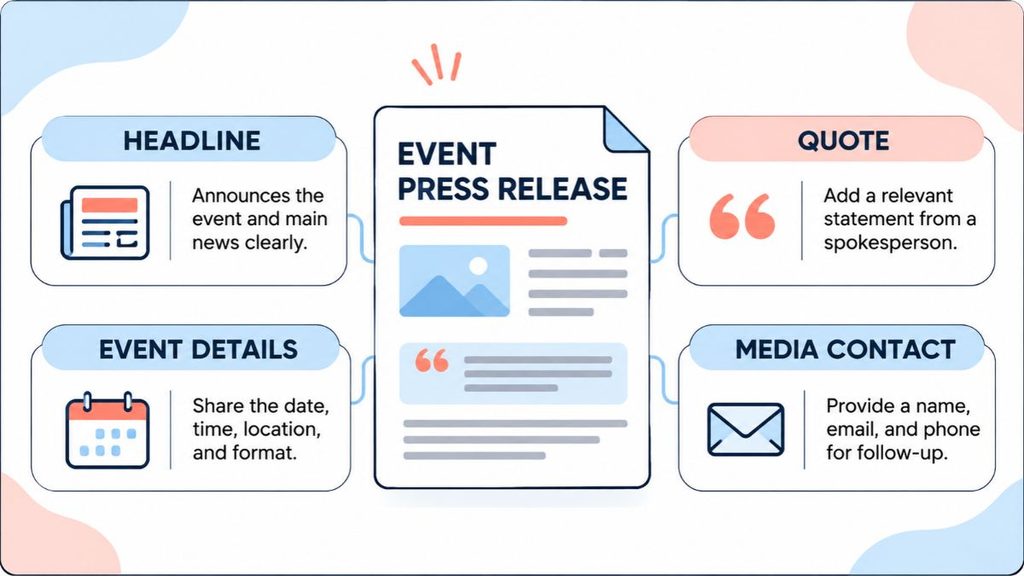
A standard event press release format usually contains the following elements.
| Component | Purpose |
|---|---|
| Release status | Indicates whether the announcement is for immediate release or subject to an agreed embargo |
| Headline | Communicates the main news |
| Subheadline | Adds context when needed |
| Dateline | Identifies the release location and date |
| Opening paragraph | Answers the 5Ws |
| Supporting paragraphs | Provide evidence and context |
| Spokesperson quote | Adds an attributable perspective |
| Event details | Clarify attendance and logistics |
| Boilerplate | Introduces the organization |
| Media contact | Enables journalist follow-up |
The format is useful because it makes the announcement easier to scan, but formatting alone does not create news value.
The most important information should appear first. Background details and general company information should come later.
For broader writing conventions, see How to Write a Press Release.
Event Press Release Example 1: Product Launch
The following event press release sample demonstrates how a technology company could announce a product demonstration.
Illustrative example: The organization, event, spokesperson, and product details below are fictional.
FOR IMMEDIATE RELEASE
Northbridge Energy to Demonstrate New Battery Monitoring Platform at London Mobility Summit
Company will introduce its monitoring platform for commercial fleet operators during a Dec. 3 industry event.
LONDON, Nov. 13, 2026 — Northbridge Energy, a fictional industrial energy technology company, will demonstrate its new battery monitoring platform at the London Mobility Summit on Dec. 3, giving fleet operators and manufacturing specialists an opportunity to review the platform’s reporting and monitoring capabilities.
The platform is designed to help commercial operators organize battery performance information across connected equipment and vehicles. During the demonstration, Northbridge specialists will explain the reporting interface, data collection process, and intended operational applications.
The presentation will focus on the challenges organizations face when interpreting battery performance across different operating environments.
“Fleet operators need information they can connect to everyday decisions,” said Emma Collins, fictional Chief Product Officer at Northbridge Energy. “Our demonstration will focus on how monitoring data can be organized and reviewed by operational teams.”
Event Details
Date: Dec. 3, 2026
Time: 10 a.m.–1 p.m. GMT
Location: London, United Kingdom — venue to be confirmed
Format: Product presentation, live demonstration, and Q&A
Media access: Advance accreditation required
Journalists may request interviews with the product team and access approved demonstration imagery and background materials.
About Northbridge Energy
Northbridge Energy is a fictional technology company used in this example to demonstrate professional press release structure. It represents a business developing industrial energy monitoring software.
Media Contact
[Name]
[Position]
[Verified email address]
[Telephone number]
###
Why This Event Press Release Example Works
This press release example for an event leads with a specific product demonstration rather than a generic invitation.
It explains what will be shown, who may find the development relevant, and how journalists can access additional information.
For an actual announcement, all product claims, speaker details, venue information, and contact details must be verified before distribution.
Event Press Release Example 2: Industry Conference and Press Conference
An industry conference requires a different editorial approach. The event may be relevant because of research, expert access, a new policy discussion, or an important announcement.
The following news release example about an event also demonstrates how a press conference can fit into a larger event announcement.
Illustrative example: All organizations, speakers, and event details are fictional.
FOR IMMEDIATE RELEASE
Boston AI Governance Forum to Present New Research on Business Adoption Challenges
Industry experts will discuss organizational oversight and implementation practices during a Jan. 21 conference.
BOSTON, Nov. 13, 2026 — The fictional Boston AI Governance Forum will host a one-day industry conference on Jan. 21, 2027, bringing together business leaders, researchers, and technology specialists to examine how organizations are approaching artificial intelligence governance.
The event will feature panel discussions, practical implementation sessions, and a presentation of new research on the challenges businesses face when assigning responsibility for AI systems.
Organizers plan to present the research methodology and findings during the opening session. A press conference will follow, allowing accredited journalists to ask questions and request interviews with participating experts.
“Organizations are increasingly focused on how AI decisions are reviewed and who is responsible for the outcomes,” said fictional Program Director Daniel Hart. “The forum is designed to examine those operational questions through research and practical discussion.”
Event Details
Date: Jan. 21, 2027
Time: 9 a.m.–5 p.m. EST
Location: Boston, Massachusetts — venue to be confirmed
Research presentation: 10 a.m.
Press conference: 11:30 a.m.
Media access: Accreditation required
Accredited journalists will be able to request the research materials, speaker biographies, approved event images, and interviews with participating experts.
About the Boston AI Governance Forum
The Boston AI Governance Forum is a fictional industry event created for this writing example. It represents a conference focused on organizational approaches to artificial intelligence governance.
Media Contact
[Name]
[Position]
[Verified email address]
[Telephone number]
###
What Makes This Press Conference Example Different?
An example of a press conference should clarify more than the fact that journalists are invited.
It should explain:
- What will be announced or discussed
- Who will answer questions
- Why the subject matters now
- When the press conference will take place
- What supporting documents will be available
The release above gives journalists several potential angles: research findings, expert interviews, and a timely business issue.
If the only objective is to invite reporters to attend a briefing, a shorter media advisory may be more appropriate.
What Information Do You Need Before Writing an Event Press Release?
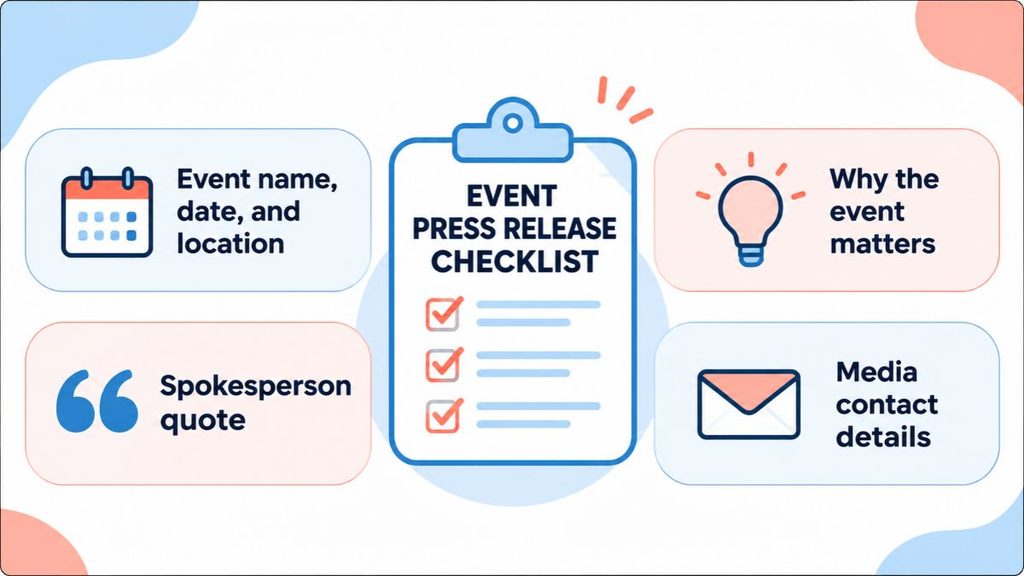
Before drafting an announcement, collect the information that would otherwise generate follow-up questions from journalists.
Start by confirming the event’s purpose and the specific development being announced.
Then ask the organizers:
- What is genuinely new or significant about the event?
- Which audience is affected by the announcement?
- Who can provide an informed, attributable comment?
- Are the date, venue, schedule, and media arrangements confirmed?
- Will journalists have access to interviews, demonstrations, research, or images?
- Are any claims, figures, or expected outcomes independently verifiable?
- Is there a relevant local angle for the publications being contacted?
This preparation is particularly important when the person writing the release is not directly involved in organizing the event.
A complete briefing reduces the risk of producing a polished announcement that lacks the information journalists actually need.
What Makes an Event Newsworthy to Journalists?
A well-written release can still receive little attention if the underlying announcement has limited editorial relevance.
Journalists typically assess whether a story is timely, relevant to their audience, supported by evidence, and meaningfully different from routine promotional activity.
For example:
Routine announcement: A company will hold a networking event next month.
Stronger potential story: A regional business association will release new survey findings on manufacturing investment during next month’s conference.
The second version gives journalists a development to examine.
A newsworthy angle may involve a new finding, significant local impact, public interest, a notable milestone, or an announcement that affects a defined group of people.
It should not be manufactured through exaggerated language.
For event organizers, the central question is:
If the company name were removed, would the development still be relevant to the publication’s readers?
If the answer is no, the story may need a clearer editorial angle—or a different promotional channel.
Pre-Event vs. Post-Event Press Release: Examples and Differences
An event press release can be distributed before or after an event, but the purpose and content should change.
| Pre-event press release | Post-event press release | |
|---|---|---|
| Primary purpose | Announce an upcoming development | Report confirmed outcomes |
| Main focus | What will happen and why it matters | What happened and what was learned |
| Essential details | Date, location, access, speakers | Results, announcements, verified figures |
| Media opportunities | Attendance, interviews, demonstrations | Follow-up interviews, images, findings |
| Main risk | Reading like an invitation | Repeating information without new news |
Pre-Event Press Release Example
Headline: Technology Forum to Present New Research on Industrial Automation in Manchester
Opening: MANCHESTER, [Date] — The fictional Northern Technology Forum will present new research on industrial automation at its upcoming conference on [Event Date], bringing together researchers and manufacturing executives to discuss implementation challenges.
This version emphasizes what will be announced and why journalists may want to plan coverage.
Post-Event Press Release Example
Headline: Manchester Technology Forum Releases Findings on Industrial Automation Challenges
Opening: MANCHESTER, [Date] — The fictional Northern Technology Forum has released findings from its industrial automation research following a conference held on [Event Date], highlighting the implementation challenges identified by participating manufacturers.
This version leads with a completed development.
An effective post-event release should contain verified outcomes rather than simply announcing that the event was successful.
Possible post-event news includes newly published research, confirmed partnerships, fundraising totals, awards, policy commitments, or product availability.
Attendance figures should be included only when accurate and relevant.
When Should You Send an Event Press Release?
There is no universal best day or hour for distributing an event press release.
The appropriate schedule depends on the type of event, the journalists being contacted, the publication’s planning cycle, and whether the announcement is intended to secure attendance or communicate news.
For a major conference or product launch, advance outreach may begin several weeks before the event, particularly when journalists need to arrange travel, accreditation, or interviews.
A smaller local event may require a shorter planning period.
A practical sequence is:
| Stage | Recommended action |
|---|---|
| Several weeks before | Confirm the news angle, speakers, and media targets |
| Before the event | Distribute the release when journalists have enough planning time |
| Closer to the event | Send a concise advisory with confirmed attendance details when appropriate |
| During the event | Make spokespeople, images, and supporting materials available |
| After the event | Share verified outcomes if there is a new development worth reporting |
These are planning principles, not guaranteed publication windows.
Avoid repeatedly sending the same announcement without new information. A follow-up should be relevant, brief, and respectful of a journalist’s workload.
How to Email an Event Press Release to Journalists
The accompanying email matters because it may be the first—and only—part of the announcement a journalist reads.
A strong media email should quickly communicate the story, explain its relevance to the journalist’s coverage area, and make the full release accessible.
Event Press Release Email Example
Subject: Research Announcement: New AI Governance Findings at Boston Forum
Hi [Journalist Name],
I’m reaching out because you cover business technology and AI governance.
The Boston AI Governance Forum will present new research on how organizations are approaching AI oversight during its Jan. 21 event.
The findings may be relevant to your coverage of AI adoption and corporate accountability.
The full press release and research background are available here: [Link].
We can also arrange an interview with the research team ahead of the event.
Best regards,
[Name]
[Position]
[Organization]
[Contact details]
This example is fictional and should be adapted to a genuine announcement.
Should You Paste the Press Release Into the Email?
There is no single format preferred by every journalist.
A short personalized introduction with a link to the complete release is often practical. Some media contacts may prefer the full release in the email body, while others may request specific attachments or materials.
Follow the publication’s submission guidance where available.
Avoid large unsolicited attachments, inaccessible cloud folders, and links requiring unnecessary permissions.
If an event has visual or interview opportunities, mention them clearly rather than assuming the journalist will discover them in the full release.
Event Press Release vs. Media Advisory
A media advisory is a concise notice designed primarily to help journalists decide whether to attend or cover an event.
An event press release provides the broader news and supporting context.
| Event press release | Media advisory |
|---|---|
| Explains a newsworthy announcement | Emphasizes attendance logistics |
| Includes background and evidence | Focuses on who, what, when, and where |
| May include substantive quotes | Usually brief and operational |
| Can support a standalone news story | Helps journalists plan coverage |
| May be distributed more broadly | Often targeted to relevant assignment editors and reporters |
For example, a company opening a manufacturing facility might issue a press release explaining the investment and operational significance.
It could also send a media advisory specifying the opening ceremony’s time, address, parking arrangements, photo opportunities, and interview availability.
The two documents can complement one another, but they should not be treated as interchangeable.
For a detailed comparison and ready-to-use formats, read Media Advisory vs. Press Release: Examples & Templates.
Press Release, Media Release, and Press Statement: What’s the Difference?
The terms press release and media release are frequently used interchangeably, although terminology can vary by country, organization, and industry.
A media release example may therefore follow the same general structure as a press release: headline, opening paragraph, supporting facts, quotes, boilerplate, and media contact.
A press statement is different. It is typically a concise official position or response attributed to an organization or spokesperson. It may address a developing issue, clarify a situation, or communicate an institutional position without announcing an event.
For example:
Event press release: A company announces a technology conference and explains what will be presented.
Media release: Another term that may describe the same announcement, depending on the market.
Press statement: The company issues an official response to questions about an event cancellation.
An example of a press statement might begin:
“Following the cancellation of the scheduled conference, the organizing team is contacting registered attendees and reviewing alternative dates. Further information will be provided through the event’s official channels.”
This is an illustrative statement, not a real organizational announcement.
A press statement should not be used as a substitute for a complete event press release when journalists need detailed context, logistics, and supporting information.
Event Press Release Template: Copy and Customize
The following event press release template can be adapted for conferences, launches, exhibitions, corporate events, and other newsworthy announcements.
FOR IMMEDIATE RELEASE
[Organization] to [Announce or Demonstrate Newsworthy Development] at [Event Name]
[Optional subheadline explaining the significance of the announcement]
[CITY, DATE] — [Organization] will [main announcement] during [Event Name] on [Event Date] at [Location]. The event will [explain the development] and bring together [relevant participants or audiences].
[Second paragraph: Explain why the announcement matters. Include relevant facts, research, business context, or the issue being addressed.]
[Third paragraph: Add confirmed speakers, demonstrations, program details, supporting evidence, or other information that strengthens the story.]
“[Approved spokesperson quote providing meaningful context or interpretation],” said [Full Name], [Job Title] at [Organization].
Event Details
Date: [Month, day, year]
Time: [Start and end time, including time zone]
Location: [Confirmed venue and address]
Format: [In person, virtual, or hybrid]
Media access: [Registration or accreditation instructions]
Interview opportunities: [Available spokespersons and arrangements]
[Optional paragraph describing media assets, photography opportunities, demonstrations, or research materials.]
About [Organization]
[Two or three factual sentences describing the organization, its activities, and relevant background.]
Media Contact
[Name]
[Position]
[Email]
[Telephone]
###
Before distributing the finished document, remove every placeholder and confirm all dates, names, claims, and contact details.
For additional formats across different announcement types, explore 15 Press Release Examples & Free Templates.
Why Do Journalists Ignore Event Press Releases?
Not every event announcement will receive coverage, even when it is professionally written.
The most common problems involve editorial relevance, incomplete information, or ineffective outreach.
The Announcement Has No Clear News Value
A routine event invitation may be useful for attendees but uninteresting to a journalist’s audience.
Explain what is changing, being introduced, discovered, or achieved.
The Release Is Sent to the Wrong Journalist
A technology conference announcement may be relevant to a technology reporter but not to someone covering an unrelated subject.
Research the journalist’s reporting area and the publication’s audience before contacting them.
Important Event Details Are Missing
Missing dates, venue information, time zones, or accreditation instructions create additional work.
For time-sensitive coverage, that friction can make the announcement less useful.
The Release Sounds Like Advertising
Promotional adjectives, exaggerated claims, and repetitive slogans make it difficult to identify the actual news.
Replace promotional language with verifiable information.
Interview and Media Materials Are Unavailable
A journalist may be interested in the story but need a spokesperson, approved image, research document, or additional background.
Prepare these resources before outreach.
A well-organized press kit can make those materials easier to access.
The Follow-Up Becomes Excessive
Sending repeated emails without new information can damage media relationships.
A follow-up should have a clear purpose, such as offering an interview, confirming an important update, or sharing newly available materials.
The objective is to make the journalist’s work easier—not to increase the number of messages sent.
How to Adapt an Event Press Release for US and UK Media
The core principles of press release writing apply across English-speaking markets, but localization should account for differences in terminology, spelling, editorial priorities, and practical details.
Writing for US Media
For American publications, consider:
- US English spelling and appropriate house style
- Clear city and state identification where relevant
- Accurate time zones across different US regions
- Local or industry-specific relevance
- Confirmed interview access and supporting documentation
For example, a Boston event should not automatically be pitched to national outlets unless its significance extends beyond the local audience.
A regional business development may be more relevant to local business reporters than to a national general-news desk.
Writing for UK Media
For British publications, consider:
- UK English spelling and the publication’s preferred style
- Accurate references to British Summer Time or Greenwich Mean Time
- Clear venue and regional information
- Relevance to the publication’s readership
- Whether the announcement concerns a national issue, local community, or specialist industry
For example, a Manchester business event may have stronger relevance to regional business media unless it involves a development with broader national implications.
Neither market should be treated as a single undifferentiated media list.
A strong international campaign considers the story, audience, publication, and journalist before distribution.
How Should an International Event Press Release Be Localized for Turkish Media?
For international organizations hosting events or announcing developments in Turkey, translation alone is not enough.
A release written for US or UK journalists may emphasize information that does not establish the announcement’s relevance to Turkish readers.
Localization should preserve the facts while making the local significance clear.
Useful considerations include:
- Why the event matters to businesses or audiences in Turkey
- Whether the company is launching a product or service locally
- Confirmed Turkish partners, speakers, or representatives
- Relevant investment or employment information
- Local availability and operational details
- Turkish-language press materials and interview access
- Appropriate national, regional, or sector-specific media targeting
For example, an international product demonstration in Istanbul may be more relevant to Turkish business journalists if the release explains local availability, partnerships, or applications in the Turkish market.
These details should only be included when verified.
PRTURKEY supports international communication through press release writing, market-specific distribution, media monitoring, and reporting. Organizations planning cross-border announcements can explore its International Press Release Service.
The goal is not simply to distribute the same English-language announcement in another country. It is to make the story accurate, understandable, and relevant to the intended media audience.
Frequently Asked Questions About Event Press Releases
How do I write a press release for an event?
Begin with a headline identifying the main announcement. Write a lead paragraph answering who, what, when, where, and why. Add verified supporting information, an approved spokesperson quote, complete event logistics, a company boilerplate, and media contact details.
What are the 5 W’s in a press release?
The five W’s are who, what, when, where, and why. Together, they establish the essential facts of the announcement. Event releases should also explain how journalists can attend, request interviews, or access additional materials when relevant.
What is the best event press release format?
A practical format includes a headline, dateline, news-focused opening, supporting paragraphs, quote, event information, boilerplate, and media contact. The order should prioritize news value and make the announcement easy to scan.
How long should an event press release be?
There is no universal required length. A release should be concise enough to read efficiently while containing the information journalists need to evaluate the announcement. Avoid padding the text to reach an arbitrary word count.
Can ChatGPT write an event press release?
ChatGPT can help create an outline, organize event information, suggest headlines, and draft a press release. However, a human editor should verify every fact, quotation, date, and claim before publication. AI-generated text should not be presented as a verified news announcement without appropriate review.
Should you send a press release before or after an event?
Both can be appropriate. A pre-event release announces an upcoming development and may support advance coverage or attendance. A post-event release should communicate confirmed outcomes or new information that emerged from the event.
What is the difference between a press conference and a press release?
A press conference is an organized opportunity for journalists to hear from speakers and ask questions. A press release is a written announcement. A press release may announce a press conference, summarize its outcomes, or communicate the same news independently.
Is a media release the same as a press release?
In many professional contexts, yes. The terms are often used interchangeably. The intended audience, editorial purpose, and contents are more important than the label.
Does distributing a press release guarantee media coverage?
No. Distribution and independent editorial coverage are different outcomes. Journalists and editors make their own publication decisions. Distribution services should be evaluated according to their actual scope, relevant media targeting, reporting, and any clearly defined publication commitments.
Conclusion
A successful event press release example demonstrates more than professional formatting. It shows how to communicate a genuinely newsworthy development, provide journalists with usable information, and make follow-up reporting straightforward.
Whether you are preparing a product launch, industry conference, community initiative, or press conference, begin with the editorial significance of the announcement. Support it with verified facts, clear logistics, substantive quotes, and accessible media materials.
Use the examples and template above as a starting point, then adapt the final release to your organization, event, and target publications.
For international brands seeking to reach Turkish media, PRTURKEY’s press release writing and distribution services can support localization, targeted distribution, and media reporting as part of a coordinated communications strategy.