
A press statement example shows how an organization can communicate its official position clearly, accurately, and professionally. Whether responding to a crisis, addressing media questions, correcting misinformation, or announcing an important decision, a strong statement explains what is known, what action is being taken, and what happens next.
Unlike a full press release, a press statement is often brief and focused on one specific issue. It may be issued as a written response to journalists, published on an organization’s website, or shared through official communication channels.
Below, you’ll find practical press statement examples for different situations, a step-by-step writing guide, and customizable templates.
What Is a Press Statement?
A press statement is an official written or spoken communication that expresses an organization’s position, response, or decision on a particular matter.
It is commonly used when journalists request a comment, a situation requires public clarification, or an organization needs to communicate verified information without preparing a full news announcement.
A press statement can be issued by a company, government agency, nonprofit organization, university, or authorized spokesperson.
For example, if a company experiences a temporary service interruption, it might release a statement acknowledging the issue, explaining what is currently known, and outlining the steps being taken to resolve it.
Example of a short press statement:
“We are aware of the service disruption affecting some customers and are working to restore normal operations. Our technical team is investigating the issue, and we will provide further updates through our official support channels as information becomes available.”
This example communicates a verified position without speculating about the cause or promising an unconfirmed resolution time.
How to Write a Press Statement
To write a press statement, identify the issue, confirm the available facts, establish the organization’s position, explain relevant actions, and provide an appropriate contact or update channel.
The language should be direct, factual, and proportionate to the situation.
1. Identify the Purpose of the Statement
Before drafting, determine exactly why the statement is being issued.
Is the organization responding to a journalist’s question, addressing a developing situation, announcing a decision, or correcting an inaccurate claim?
Each purpose requires a different emphasis.
A statement responding to a safety incident should prioritize the people affected and verified information. A statement about an executive appointment may focus on the decision and its implications.
Trying to address several unrelated issues in one statement can weaken the message.
2. Verify the Facts Before Publishing
Separate confirmed information from details that remain under investigation.
Check dates, names, locations, operational impacts, and any figures included in the statement. If an important fact has not been established, do not present it as certain.
When the situation is developing, it is appropriate to explain that an investigation is ongoing.
For example:
Avoid: “The issue was caused by a third-party system failure.”
Use when the cause is unconfirmed: “We are investigating the cause of the disruption and will share verified findings when available.”
Accuracy matters more than appearing to have every answer immediately.
3. Lead With the Main Message
The first sentence should address the central issue rather than beginning with a lengthy corporate introduction.
For example:
“We have temporarily suspended operations at the affected facility while an independent safety assessment is conducted.”
This gives readers the organization’s current position and action immediately.
Supporting information can follow.
4. Explain the Action Being Taken
A useful press statement goes beyond acknowledging an issue.
Where appropriate, explain what the organization is doing, who is responsible for the next steps, and how affected people can obtain assistance.
Avoid vague phrases such as “appropriate measures are being taken” when more specific, verified information can be shared.
5. Use an Appropriate Tone
A serious incident requires a different tone from a routine corporate clarification.
Statements concerning injuries, service disruptions, employee concerns, or community impacts should acknowledge the people affected without making assumptions or unsupported claims.
Avoid defensive language, promotional slogans, and unnecessary jargon.
6. Include Attribution and Contact Information
Identify the organization or authorized spokesperson responsible for the statement.
For a formal media response, include the date and a verified media contact or official information channel.
If the situation is ongoing, explain where updates will be published.
Before release, obtain the appropriate internal approvals, including legal or regulatory review when the subject requires it.
Press Statement Format: Essential Elements
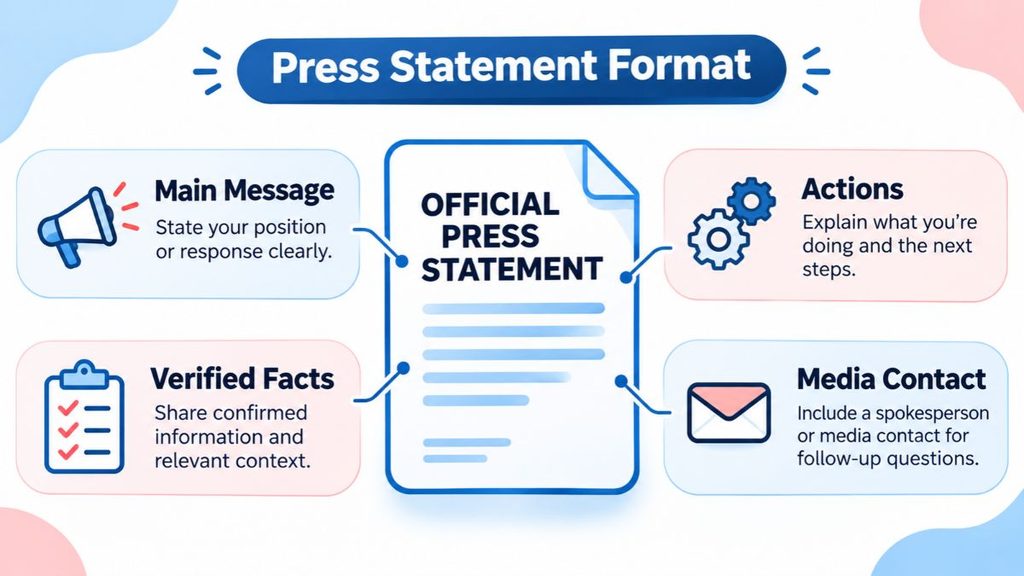
A professional press statement format is flexible. It does not always require the longer structure associated with a traditional press release.
| Element | What to include |
|---|---|
| Heading | “Official Statement” or a specific subject line |
| Date | The date of publication |
| Organization | The name of the issuing organization |
| Opening | The main position, decision, or response |
| Supporting information | Confirmed facts and necessary context |
| Action or next steps | Measures taken, planned updates, or relevant instructions |
| Attribution | An authorized spokesperson or the organization |
| Media contact | A verified email address or official contact channel |
A short response to a journalist may consist of only one or two paragraphs. A more complex public statement may require several paragraphs and supporting information.
The format should match the communication need, not an arbitrary word count.
Press Statement Examples for Different Situations
The following examples of press statements demonstrate how tone, structure, and information change depending on the circumstances.
All examples below are fictional and provided for educational purposes. They are not verified statements from real organizations.
1. Crisis Communication Press Statement Example
OFFICIAL STATEMENT
Regarding the Temporary Suspension of Operations
November 13, 2026
Northfield Manufacturing is aware of an equipment-related incident at its fictional Birmingham facility earlier today.
Operations in the affected area have been temporarily suspended while the circumstances are assessed. The company is cooperating with the relevant authorities and conducting an internal review.
The safety and well-being of everyone at the facility remain our immediate priorities. We are contacting those directly affected and will provide verified updates as additional information becomes available.
Media inquiries may be directed to the company’s designated communications team.
Northfield Manufacturing
Fictional example
Why this works: The statement acknowledges the situation, identifies an immediate action, and avoids guessing about the cause or outcome.
It does not make unsupported claims about injuries, responsibility, or the duration of the suspension.
2. Holding Statement Example for an Ongoing Incident
A holding statement is a short initial response issued when a situation requires acknowledgment but the organization does not yet have enough verified information for a complete explanation.
It should not be used to conceal known facts or delay essential safety information.
INITIAL HOLDING STATEMENT
Regarding Reports of a Service Disruption
November 13, 2026
“We are aware that some customers are experiencing difficulties accessing our online services.
Our technical teams are investigating the issue, and we are working to determine its scope and cause.
We understand the disruption may affect customers who rely on these services. Updates will be shared through our official status page as soon as verified information is available.”
Alder Digital Services
Fictional example
Why this works: The statement acknowledges the problem, identifies what is being investigated, and directs customers to an update channel.
It does not invent a technical explanation or promise a resolution deadline.
3. Official Company Statement Example
Not every press statement concerns a crisis. Organizations also issue statements to explain business decisions, changes in policy, or matters attracting public attention.
OFFICIAL COMPANY STATEMENT
Regarding Changes to Our Customer Support Operations
November 13, 2026
“Westbridge Solutions is updating its customer support operations to provide more consistent assistance across its service channels.
The changes will be introduced in phases, beginning with revised support hours and a consolidated online help center.
Existing customers will receive direct communication about any changes affecting their accounts. Further details will be published on our official website before the new arrangements take effect.”
Westbridge Solutions
Fictional example
Why this works: The organization states its decision, explains the implementation approach, and identifies how affected customers will receive information.
The message remains focused on the operational change.
4. Event Cancellation Press Statement Example
An event cancellation statement should prioritize clarity and practical instructions for attendees.
OFFICIAL STATEMENT
Regarding the Cancellation of the Regional Innovation Forum
November 13, 2026
“We regret to confirm that the Regional Innovation Forum scheduled for November 20 has been cancelled due to circumstances affecting the event venue.
Registered attendees and participating organizations are being contacted directly.
Information about ticket refunds and alternative arrangements will be provided through the event’s official registration platform.
We apologize for the disruption and appreciate the understanding of everyone who planned to participate.”
Regional Innovation Forum Organizing Team
Fictional example
Why this works: The statement confirms the cancellation, identifies the affected event, and explains where attendees can find practical information.
For a real cancellation, organizers should provide confirmed refund arrangements and any relevant contractual information.
For announcements designed to attract media coverage before an event, a separate event press release example may be more appropriate.
5. Press Statement Example Responding to Media Allegations
When responding to allegations or disputed information, organizations should avoid unsupported denials, personal attacks, and claims that could mislead the public.
OFFICIAL STATEMENT
Regarding Recent Media Reports
November 13, 2026
“We are aware of recent reports concerning procurement practices at Eastbrook Technologies.
The matters raised are being reviewed through the company’s established compliance procedures. We have also engaged an independent adviser to assess the relevant documentation.
It would be inappropriate to speculate on the findings before the review is complete. We will communicate any material, verified developments through our official channels.”
Eastbrook Technologies
Fictional example
Why this works: The organization acknowledges the reporting and describes a review process without declaring an unverified outcome.
For real allegations, the final wording should be based on established facts and reviewed by qualified advisers where necessary.
Initial Holding Statement vs. Follow-Up Press Statement
One of the most important distinctions in crisis communication is the difference between an initial acknowledgment and a later statement containing verified developments.
| Initial holding statement | Follow-up press statement |
|---|---|
| Acknowledges the situation | Explains confirmed developments |
| Identifies immediate actions | Reports progress and completed actions |
| Separates known and unknown facts | Adds newly verified information |
| Provides an update channel | Clarifies next steps and ongoing responsibilities |
| Avoids speculation | Avoids overstating preliminary findings |
Example: Initial Statement
“We are investigating a service interruption affecting some customers. Our teams are working to identify the cause and restore access. We will share updates through our official status page.”
Example: Follow-Up Statement
“Service has been restored for the customers affected by yesterday’s interruption. Our investigation identified a configuration error during a scheduled system update. The change has been reversed, and additional monitoring is in place. Customers who continue to experience difficulties can contact our support team.”
Both examples are fictional.
The second statement provides more detail because the scenario assumes that the cause has been verified.
In a real incident, those facts must be established before publication.
Press Statement vs. Press Release: What’s the Difference?
Although the terms sometimes overlap, a press statement and a press release often serve different communication purposes.
| Press statement | Press release |
|---|---|
| Communicates an official position or response | Announces a newsworthy development |
| Often focuses on one specific issue | Usually provides broader news context |
| Can be a brief quotation or written response | Typically follows a fuller news format |
| Common in crisis response and clarification | Common for launches, partnerships, and major announcements |
| May be issued in response to media inquiries | Often distributed proactively to journalists |
For example, a company launching a new product may distribute a press release describing the product, its availability, and its significance.
If journalists later ask the company to respond to concerns about the product, the organization may issue a press statement addressing those questions.
The distinction is functional rather than absolute. Some organizations use the terms differently, and a statement can itself contain newsworthy information.
For a broader explanation of news announcements, see How to Write a Press Release.
Press Statement vs. Press Conference
A press statement is a communication. A press conference is an organized event at which representatives address journalists, often with an opportunity for questions.
A statement can be issued without holding a press conference.
A press conference may include a prepared opening statement, followed by questions from reporters.
Organizations should consider a press conference when the issue warrants direct interaction, multiple speakers, or a detailed public explanation.
A written statement may be more appropriate when the facts can be communicated clearly without a live briefing.
Free Press Statement Template
This press statement template can be copied and adapted for a company, nonprofit organization, public institution, or event organizer.
OFFICIAL STATEMENT
Subject: [Specific issue or announcement]
Date: [Month Day, Year]
Issued by: [Organization Name]
“[Organization Name] is [acknowledging, confirming, or responding to] [specific situation or issue].
[Explain the verified facts and necessary background. Clearly distinguish information that has been confirmed from matters still under review.]
[Describe the action being taken, any relevant support available, and the organization’s current position.]
[Explain the next steps, where updates will be published, or how affected individuals can obtain further information.]”
[Authorized Spokesperson Name, if applicable]
[Job Title]
[Organization Name]
Media Contact
[Name]
[Email]
[Telephone or official contact channel]
Short Holding Statement Template
“We are aware of [confirmed issue] affecting [relevant audience or service].
Our immediate priority is [verified action or responsibility].
We are currently [investigating, assessing, or addressing the situation] and will provide further information through [official update channel] when it is confirmed.”
This shorter version is particularly useful when the organization must respond promptly but cannot yet provide a complete account.
Before publication, replace all placeholders, verify the facts, and obtain the appropriate approvals.
When Should You Issue a Press Statement?
A press statement is appropriate when an organization needs to communicate an official position or verified response to an issue of public, stakeholder, or media interest.
Common situations include a developing crisis, a significant operational disruption, a request for comment, a policy decision, or an inaccurate public claim that requires clarification.
However, not every question requires a public statement.
Before publishing, consider the following:
Is there a legitimate need to respond? Determine whether the issue affects stakeholders, involves material information, or requires an official clarification.
Are the facts sufficiently verified? If not, a limited holding statement may be appropriate, provided it does not omit essential safety information.
Who needs the information? A direct customer notice, regulatory communication, internal update, or public statement may each serve different purposes.
Who must approve the wording? Sensitive matters may require input from leadership, legal counsel, compliance teams, or operational specialists.
How will updates be handled? If the situation is ongoing, establish a reliable communication channel and a process for providing verified developments.
For safety incidents and legally regulated disclosures, applicable notification duties take priority over ordinary public relations preferences.
How to Make a Press Statement Clear and Credible
Journalists and readers need to understand what the organization is saying and how much confidence they can place in the information.
A credible statement should be specific about the issue, transparent about what is not yet known, and consistent with other verified communications.
Use Specific Language
Instead of saying:
“We are taking all necessary measures.”
Explain the actual measure when it is confirmed:
“The affected system has been taken offline while the technical team investigates the incident.”
Distinguish Facts From Expectations
Do not present an expected outcome as if it has already occurred.
“We expect service to resume this afternoon” is different from “Service has been restored.”
Both statements should be used only when supported by the information available.
Avoid Unsupported Reassurance
Statements such as “There is no risk” or “No customer information was affected” should not be issued unless the organization has a reliable basis for making those claims.
Provide a Reliable Update Channel
For developing incidents, identify where journalists and affected stakeholders can find current information.
This reduces confusion caused by multiple, inconsistent versions of the same message.
Common Press Statement Mistakes to Avoid
A statement can create additional confusion when it is unclear, defensive, or inconsistent with verified facts.
Using generic corporate language: Phrases such as “We take this matter very seriously” provide little information unless supported by specific action.
Speculating about causes or responsibility: An early explanation may become inaccurate as an investigation progresses.
Ignoring affected people: A statement that focuses exclusively on reputation can appear disconnected from the consequences of the situation.
Overpromising: Avoid guaranteeing outcomes or timelines that have not been confirmed.
Publishing inconsistent messages: Public statements, customer communications, and spokesperson responses should be based on the same verified information.
Failing to update the public: When a situation remains active, unexplained silence can leave stakeholders relying on outdated information.
Treating a press statement as advertising: A serious public response is not an appropriate place for unrelated promotional messaging.
The objective is not to make every statement sound reassuring. It is to communicate accurately, responsibly, and usefully.
How to Share a Press Statement With the Media
Once a statement is approved, choose distribution channels based on who needs to receive the information.
For a direct media inquiry, send the statement to the requesting journalist with clear attribution and contact information.
For a broader public issue, publication on the organization’s official website can provide a consistent reference point.
When several relevant publications need the statement, targeted distribution may be appropriate.
A simple media response could read:
Subject: Official Statement from [Organization] Regarding [Issue]
Hello [Journalist Name],
Please find below the official statement from [Organization] regarding [specific issue].
[Approved statement]
For further information or clarification, please contact [verified media contact].
Best regards,
[Name]
[Position]
[Organization]
The distribution approach should reflect the urgency and sensitivity of the issue. Avoid sending a crisis statement to unrelated media contacts simply to maximize reach.
Organizations communicating across multiple countries should also consider language, local context, publication requirements, and the availability of authorized spokespeople.
PRTURKEY’s international press release service may be relevant for organizations planning broader media distribution, subject to the service’s actual scope and suitability for the announcement.
Frequently Asked Questions About Press Statements
What is an example of a press statement?
An example of a press statement is an official company response to a service disruption: “We are aware of the interruption affecting some customers. Our team is investigating the issue, and we will share verified updates through our official channels.” It communicates the organization’s position and immediate action without speculating.
How do you start a press statement?
Begin with the central fact, decision, or position. For example, “We confirm that the scheduled event has been cancelled” or “We are aware of reports concerning the incident.” Avoid lengthy introductions that delay the information readers need.
How long should a press statement be?
A press statement may be a few sentences or several paragraphs, depending on the issue. The appropriate length is the shortest version that communicates the essential facts, organizational position, necessary actions, and next steps without omitting important context.
Can ChatGPT write a press statement?
ChatGPT can assist with structure, clarity, and draft wording. However, the organization must verify all facts, approve quotations, assess legal or regulatory implications, and authorize the final statement. AI-generated text should not substitute for responsible decision-making during a crisis.
Is a press statement the same as a press note?
Not always. The term press note varies by organization and country. It may refer to a short media notice, an official briefing document, or a concise announcement. The intended purpose and required format should be established before treating it as equivalent to a press statement.
Conclusion
An effective press statement example demonstrates how an organization can communicate a clear position while respecting the limits of verified information.
The best statement is not necessarily the longest or most polished. It is the one that addresses the issue directly, provides accurate context, identifies appropriate actions, and makes the next steps understandable.
Use the examples and templates above to establish a structure, then adapt the language to the circumstances and obtain the necessary approvals before publication.
For organizations preparing international media communications, PRTURKEY provides information about its press release and distribution services, including options for reaching relevant audiences across markets.