

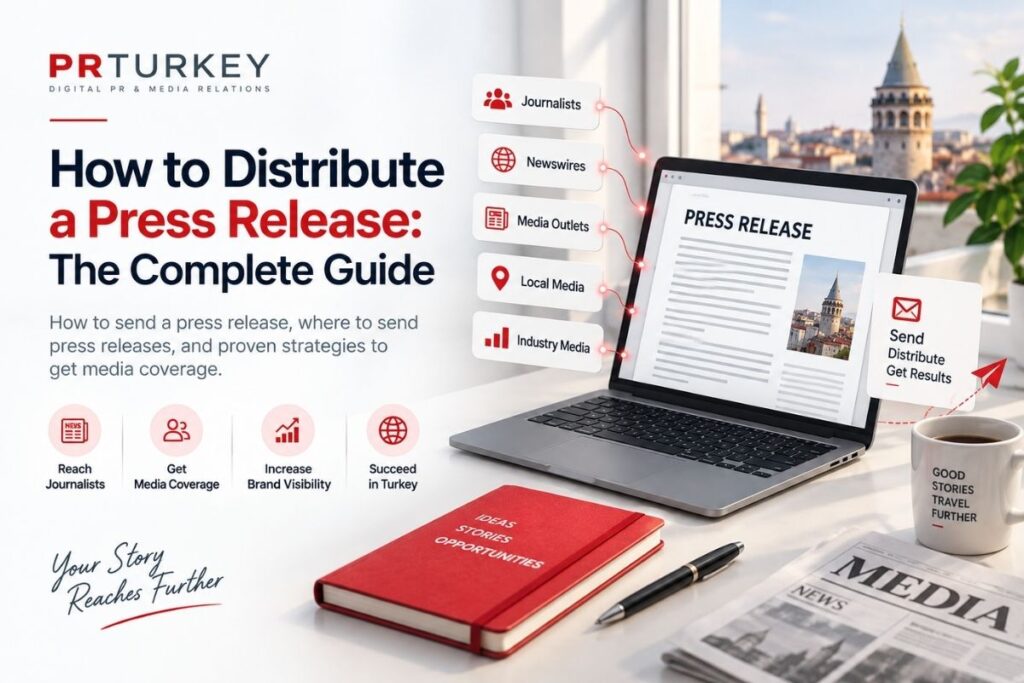
Knowing how to distribute a press release, how to send a press release, and where to send press releases determines whether a strong announcement reaches relevant journalists or disappears into crowded inboxes. Writing is only the first half of press release execution; distribution connects the story with editors, newswires, trade publications, local media and owned channels. An effective strategy combines distribution readiness, targeted media selection, concise email pitching, appropriate timing and disciplined follow-up.
How to distribute a press release: prepare a publication-ready release, identify journalists and outlets covering the subject, choose between direct outreach and broader distribution, personalize priority pitches, provide accessible media assets, follow up selectively and track both publication volume and editorial coverage.
- Prepare the release for immediate editorial use.
- Build a relevant media list rather than the largest possible list.
- Combine direct outreach, newswire distribution and owned channels where appropriate.
- Personalize pitches for priority journalists.
- Monitor coverage and use the results to improve future campaigns.
How Do I Structure a Press Release?
A distributable press release should give an editor the essential story quickly. A clear headline, dateline, lead paragraph, supporting evidence, quotation, boilerplate and media contact information make the announcement easier to evaluate and reduce the amount of clarification required before publication.
A practical structure is:
| Element | Purpose |
|---|---|
| Headline | States the news clearly |
| Dateline | Establishes place and date |
| Lead | Delivers the main news |
| Body | Adds evidence and context |
| Quote | Adds attributable perspective |
| Boilerplate | Explains the organization |
| Contact | Enables media follow-up |
The lead should answer the most important questions without making the journalist search through promotional language. Statistics should have identifiable sources, claims should be supportable, and links should lead to relevant information rather than a generic homepage.
Distribution readiness also includes assets. If the story depends on a product, executive, location or event, prepare high-resolution images, captions and any supporting fact sheet before outreach begins. Journalists should not have to wait for basic materials after expressing interest.
Brands that still need to prepare the announcement should first follow PRTURKEY’s How to Write a Press Release guide. A strong distribution strategy cannot compensate for a release that lacks news value or basic editorial structure.
What Are the 5 W’s in a Press Release?
The 5 W’s — Who, What, Where, When and Why — form the factual foundation of a press release that can be distributed confidently. A journalist should understand these elements within the headline and opening paragraphs rather than having to reconstruct the story from marketing copy.
| Question | Release must establish |
|---|---|
| Who? | Company, organization or people involved |
| What? | Actual announcement |
| Where? | Relevant market or location |
| When? | Timing of the development |
| Why? | Why the news matters now |
For example, “Company X launches in Turkey” establishes the who, what and where, but leaves the strongest editorial question unanswered: why should a Turkish reader care?
The “Why” is therefore especially important when distributing a press release internationally. A global announcement may be factually correct yet still lack a local editorial angle. Market entry, investment, local partnerships, Turkish availability, employment, customer impact or category-specific evidence may provide that relevance.
A distribution team should run a simple test before sending: could an editor identify all five W’s after reading only the headline and lead? If not, the release should be strengthened before the media list is activated.
Who Can I Send a Press Release To?
The answer to who to send press releases to depends on who actually covers the subject and serves the audience the announcement is intended to reach. Relevant journalists and editors should come first; newswires, trade publications, local media and owned channels can then extend distribution.
The main options differ substantially:
| Channel | Best use |
|---|---|
| Journalists | Earned editorial opportunities |
| Newswires | Broad structured distribution |
| Trade media | Industry-specific authority |
| Local media | Geographic relevance |
| Owned media | Controlled source information |
Journalists and editors
Direct outreach works best when a journalist has a clear editorial reason to care. Build lists by beat, recent coverage, publication type and audience rather than sending the same email to every newsroom.
This answers a common version of the question, “where do you send a press release?” The destination is not simply “the media”; it is the relevant technology reporter, retail editor, business journalist, healthcare trade publication or regional newsroom for that particular story.
Newswire services
A newswire distributes an announcement through an established network and can provide broader reach than manual pitching alone. However, syndication and earned editorial coverage should not be treated as identical outcomes. PRTURKEY’s guide to what a newswire is and how it works explains this distribution infrastructure in more detail.
Local and trade media
Local outlets are useful when geography itself creates news value: a store opening, local investment, regional partnership or event. Trade publications become more important when the story matters to a professional niche rather than a mass audience.
The strongest plan often combines these channels instead of relying on a single destination.
How to Send a Press Release: Distribution Methods
The best way to send out a press release depends on the objective. Direct journalist outreach prioritizes editorial relevance; newswire distribution prioritizes scalable reach; local submission emphasizes geographic relevance; owned channels establish an authoritative source that journalists and readers can verify.
Direct journalist outreach
For teams asking how do you send a press release directly to the media, the process should begin with segmentation. Group journalists by subject, outlet type, geography and priority.
A practical workflow is:
- Identify the story’s primary audience.
- Find journalists who genuinely cover that subject.
- Review recent coverage to confirm relevance.
- Prioritize a smaller high-value group.
- Send a concise personalized pitch.
- Make the full release easy to access.
- Follow up only when there is a useful reason.
How to distribute a press release to journalists is therefore less about sending volume and more about editorial fit.
Email distribution
Sending a press release via email remains practical because it allows direct communication with journalists. The email should not become a second press release. Its job is to establish the news angle quickly and make the complete material accessible.
Paid newswire distribution
A newswire can send out press releases across a broader network, particularly when geographic reach, publication infrastructure or reporting is important.
Newswire distribution and direct outreach solve different problems. A campaign may use both: distribution creates broad availability while targeted media relations focuses attention on journalists most likely to develop the story editorially.
Local media submission
How to send a press release to local media starts with localization. A national corporate announcement rarely becomes locally relevant simply because a city name is inserted.
Explain the geographic consequence: jobs, investment, store openings, events, local partnerships, community impact or availability. When deciding how to submit a press release to local media, check the publication’s preferred submission route and pitch the journalist or desk whose coverage matches the announcement.
How to Send a Press Release via Email: Step-by-Step
How to send a press release via email without attachments is an important execution question because journalists need immediate access to the story without unnecessary friction. A concise pitch in the email body, accompanied by a link or clearly accessible release and media assets, is usually easier to evaluate than an unexplained attachment.
Use this workflow:
- Write a factual subject line. Identify the actual announcement instead of using vague language such as “exciting news.”
- Personalize the opening. One relevant sentence explaining why the story fits the journalist’s beat is more useful than generic praise.
- State the news immediately. The first paragraph should explain what happened and why it matters.
- Add essential evidence. Include one or two facts that strengthen the angle.
- Provide the release and assets. Make the complete announcement, images and supporting information easy to reach.
- Offer a useful next step. Interview access, additional data, imagery or local context can create a reason to respond.
- Follow up selectively. A follow-up should add value or clarify availability, not simply ask whether the first email was seen.
This same framework applies to searches such as how to email a press release, how to send press release through email, and how to send a press release by email. The operational principle is consistent: reduce the journalist’s work.
How Much Does It Cost to Distribute a Press Release?
Press release distribution costs vary from essentially free owned-channel publication to paid distribution and fully managed media relations. The relevant question is not simply which method costs less, but what level of targeting, localization, editorial outreach, publication reach and reporting the campaign requires.
| Method | Cost level | Best fit |
|---|---|---|
| Owned channels | Low | Source publication |
| Manual outreach | Low–medium | Focused media lists |
| Newswire | Medium–high | Scalable distribution |
| Agency-managed | Variable | End-to-end execution |
A company learning how to distribute a press release on a small business budget may prioritize a tightly researched journalist list, relevant local or trade outlets and owned publication before expanding into paid distribution.
International campaigns have additional variables: language adaptation, market-specific media mapping, local journalist relationships, distribution territory, multimedia requirements and monitoring. These factors make fixed generic price assumptions unreliable.
PRTURKEY’s Press Release Distribution & Digital PR in Turkey service is structured around Turkish media distribution and broader PR support, with distribution scope varying by campaign needs. For brands entering a new market, the useful comparison is therefore cost versus relevant reach and execution, not cost versus raw recipient count.
How to Get Your Press Release Noticed
Getting a release noticed requires more than successful delivery. How to get press coverage depends on whether the announcement gives a journalist a timely, credible story for a specific audience.
The strongest press release distribution tips focus on editorial utility:
- Lead with a concrete development rather than company enthusiasm.
- Match the pitch to the journalist’s actual beat.
- Use credible data and clearly attributable evidence.
- Provide useful images or multimedia when they improve the story.
- Time outreach around the relevant news cycle.
- Offer priority journalists meaningful access where appropriate.
- Avoid sending identical follow-ups repeatedly.
An exclusive or early briefing can work when the journalist receives something genuinely useful: executive access, original data, a product demonstration or meaningful context. Exclusivity should not be offered simultaneously to several journalists.
Another important distinction is measurement. Publication through a distribution network, journalist engagement and independently developed editorial coverage are different outcomes. Tracking them separately gives communications teams a clearer picture of what actually worked.
Press Release Distribution for Small Businesses
Press releases for small businesses should prioritize relevance before scale. A smaller company rarely needs to reach every major publication; it needs to reach the publications whose readers have a reason to care about its announcement.
Budget-conscious distribution can follow a three-layer model:
| Priority | Action |
|---|---|
| First | Target relevant journalists |
| Second | Approach niche/local outlets |
| Third | Expand distribution selectively |
A local opening may justify regional media outreach. A B2B product launch may perform better with a handful of respected trade publications. A funding announcement may require business and technology journalists rather than consumer media.
Small businesses should also avoid paying for reach before establishing news value. A weak announcement does not become stronger because it is distributed more widely.
When budget becomes available, paid distribution is most defensible when it adds something the internal team cannot efficiently reproduce: geographic reach, established distribution infrastructure, localization, monitoring or professional media relations.
Press Release Distribution in Turkey: What’s Different?
How to send a press release to Turkish media requires more than translating an English announcement. International brands need to establish why the development matters in Turkey, communicate in natural Turkish where appropriate, map the correct national and sector media, and coordinate distribution with local media relations.
Localization begins with editorial relevance. Product names and corporate facts may remain unchanged, but headlines, quotations, market context and supporting evidence often need adaptation. PRTURKEY’s Brand Localization in Turkey guide provides the broader framework for adapting global brand communication to the Turkish market.
Media selection also needs local knowledge. Turkish campaigns can involve national news outlets, business and economy publications, sector media, technology titles, consumer publications, regional outlets and news agencies. A market-entry announcement should not automatically be sent to all of them. The audience and news angle determine the appropriate mix.
Relationships matter alongside infrastructure. Effective media relations require understanding what individual journalists cover, supplying usable information and remaining available for clarification. The What Is a PR Team? guide provides additional context on the role of PR professionals in managing these relationships.
International brands should therefore think in two layers:
| Layer | Function |
|---|---|
| Distribution | Creates structured market reach |
| Media relations | Builds targeted editorial opportunity |
This distinction is particularly important during market entry. A translated release may technically reach Turkey without answering the questions Turkish journalists will ask: Why Turkey? Why now? What changes for customers? Is the product locally available? Is there a Turkish partner, investment or operational commitment?
PRTURKEY states that its model combines Turkish media access, press release management, distribution and monitoring for brands seeking visibility in the market. That local execution layer is where international distribution becomes a Turkish media strategy rather than a simple cross-border send.
Frequently asked questions
Where should I send a press release for the best chance of coverage?
Send it to journalists, editors and publications whose audience and beat directly match the announcement. Trade or local media may be more valuable than a larger unrelated outlet. Newswire distribution can complement direct outreach when broader reach is required.
Should I email journalists directly or use a newswire?
Neither method universally replaces the other. Direct pitching is suited to targeted editorial outreach; newswires provide scalable distribution infrastructure. Campaigns that need both broad availability and priority journalist engagement can combine the two methods.
How many journalists should receive a press release?
There is no universal target. A focused list of relevant journalists is generally more useful than an unsegmented database. Each recipient should have a defensible reason to receive the announcement based on beat, audience, geography or recent coverage.
Is paid press release distribution worth the cost for a small business?
It can be when paid distribution provides reach, targeting or reporting the business cannot efficiently achieve itself. Small businesses should first confirm genuine news value and audience fit, then compare paid distribution against focused journalist and local-media outreach.
Conclusion
Knowing how to distribute a press release means treating distribution as a complete media workflow: prepare a publication-ready story, determine where to send press releases, select the right distribution method, personalize priority outreach and measure what happens after sending. Brands entering Turkey have an additional requirement: the story must be localized for Turkish audiences and connected to the media ecosystem that actually covers the subject.
For international companies that prefer to manage localization, media targeting, distribution and reporting through one coordinated process, PRTURKEY can handle press release distribution as part of a broader Turkish market-entry PR strategy.
Related PRTurkey guides
- How to Launch a Brand in Turkey
- How to Build Brand Awareness in Turkey Before Launch
- What Makes Turkish Consumers Trust a Foreign Brand?
- Turkey Market Entry PR Timeline: A 90-Day Plan