

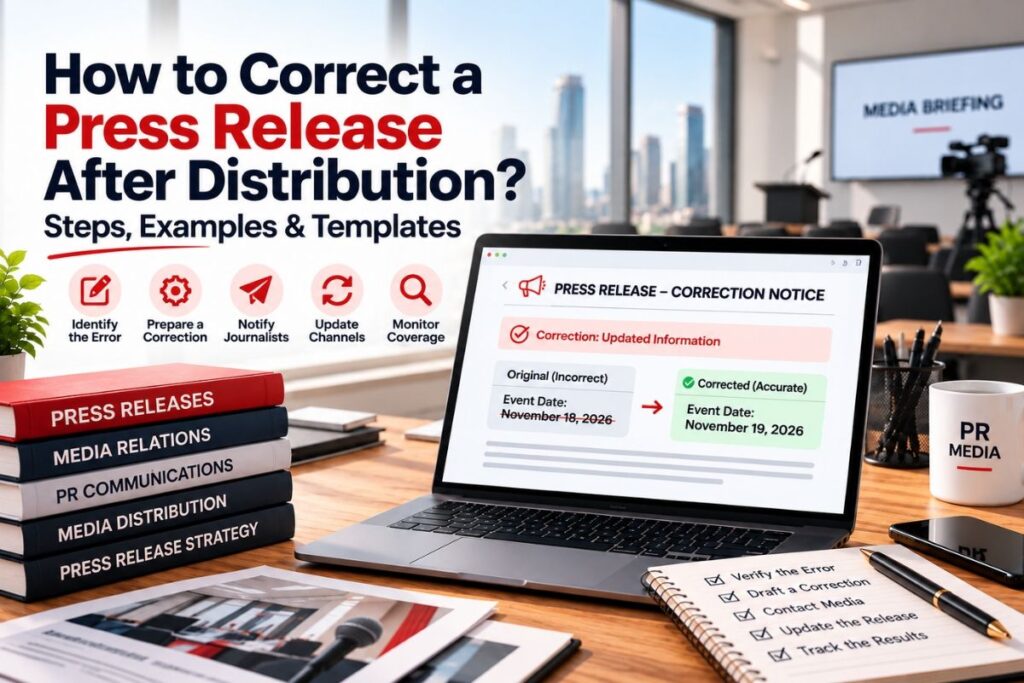
A press release correction is an official amendment issued when a distributed announcement contains inaccurate information. If a press release has already been sent to journalists, published on a newswire, or republished by media outlets, correcting it requires more than editing the original document.
The appropriate response depends on the seriousness of the error, where the announcement has appeared, and the distribution provider’s correction policies. A minor mistake may require an update, while a significant factual error may call for a formal correction notice or, in some cases, a retraction.
The goal is to make accurate information available, notify affected recipients, and prevent the original error from continuing to circulate.
Can You Correct a Press Release After It Has Been Published?
Yes, you can correct a press release after distribution, but you may not be able to change every published copy. Newswire platforms, corporate newsrooms, independent publishers, and journalists operate under different editorial policies.
For example, a company may be able to update the announcement on its own website immediately. However, an article published by an independent news outlet generally requires a separate correction request.
The process typically involves five actions:
- Verify the inaccurate information and its correct replacement.
- Contact the original press release distribution provider.
- Prepare a correction notice or revised announcement.
- Notify journalists and other relevant recipients.
- Monitor published coverage for outdated information.
The first step is determining whether the announcement needs a correction, an update, or a complete retraction.
Press Release Correction vs. Retraction vs. Update
These terms describe different editorial actions. Using the correct one helps journalists understand whether the original announcement remains reliable.
| Action | Meaning | Typical situation |
|---|---|---|
| Correction | Replaces inaccurate information while preserving the valid announcement. | Incorrect event date, executive title, or company statistic. |
| Update | Adds or changes information because circumstances have evolved. | A confirmed venue change or new product availability date. |
| Retraction | Withdraws an announcement that should no longer be relied upon. | A release based on fundamentally incorrect or unsupported claims. |
A correction is generally appropriate when the central announcement remains true. A retraction may be necessary when the underlying information is invalid.
For example, incorrectly identifying a company’s Chief Operating Officer as its Chief Executive Officer may require a correction. Announcing a partnership that was never finalized could require a more substantial response.
A significant error should not be concealed through an unannounced edit. Transparent communication is especially important when the original information may have influenced reporting, investment decisions, or public understanding.
How to Issue a Press Release Correction: Step by Step
Correcting a distributed announcement is both an editorial and a communication task. The following process helps organizations respond consistently.
Step 1: Identify and Verify the Error
Before issuing a correction, confirm precisely what is wrong.
Compare the published announcement with approved source documents, official records, or information supplied by the responsible department.
Record the original statement, the verified replacement, the publication date, and the locations where the incorrect information appeared.
For numerical errors, verify the underlying calculation rather than changing a figure based on an informal message. For executive statements, confirm the corrected wording with the authorized spokesperson.
Do not distribute a correction containing information that has not been independently checked within the organization.
Step 2: Determine How Serious the Error Is
Not every mistake requires the same response.
A spelling error that does not change meaning may be handled through a straightforward amendment. An incorrect product specification, event date, financial result, or safety statement may require broader notification.
Ask whether the error:
- Changes the meaning of the announcement.
- Could mislead journalists, customers, or other stakeholders.
- Has already appeared in published news coverage.
- Affects legal, financial, regulatory, or safety-related claims.
- Requires approval from senior management or legal counsel.
For sensitive disclosures, the organization’s legal or compliance team should review the response before publication.
Step 3: Contact the Original Distribution Provider
If the announcement was distributed through a newswire or PR agency, contact the provider before submitting a replacement.
Different providers have different policies for editing, correcting, withdrawing, and redistributing releases.
Ask whether the original announcement can be amended, whether a separate correction notice is required, and whether an additional distribution fee applies.
Organizations using an international press release service should also consider which countries, publications, and language versions received the original announcement.
A correction distributed only in English may not reach audiences who encountered a translated version. When the error affects multiple markets, each relevant version should be reviewed.
Step 4: Prepare a Clear Correction Notice
A correction notice should identify the original announcement and explain the exact change.
Include the original headline, publication date, incorrect information, verified replacement, and a media contact.
Avoid vague wording such as “some information has been updated.” A journalist should be able to understand the correction without comparing two lengthy documents.
If the original release remains valid, explain whether the rest of the announcement is unchanged.
Step 5: Notify Journalists and Media Contacts
A corrected press release does not automatically reach everyone who received the original version.
Contact journalists, editors, and media partners who were sent the inaccurate announcement, particularly those who have already published coverage.
Use a subject line that clearly identifies the message as a correction.
For example:
Subject: Correction to Press Release Issued October 15 — Event Date
The message should state what was wrong, provide the accurate information, and link to the corrected announcement.
When contacting journalists, prioritize relevance rather than sending repeated messages to an entire media database. The principles outlined in how to distribute a press release also apply to corrections: accurate targeting, clear communication, and appropriate follow-up are more useful than indiscriminate mass outreach.
Step 6: Update Company-Owned Channels
Review every channel under the organization’s control.
This may include the corporate newsroom, website, investor relations pages, downloadable PDFs, email newsletters, social media accounts, and online media kits.
For a material factual error, consider adding a visible correction note that identifies the change and its date.
If the original announcement is still accessible, readers should not be left with two contradictory versions and no explanation.
Step 7: Monitor Published Coverage
The correction process should continue after the revised announcement has been issued.
Review which publications used the original information, which have updated their articles, and which still display outdated details.
A structured media monitoring and reporting process can help organizations identify relevant coverage and prioritize follow-up requests.
Keep a record of contacted journalists, publication URLs, correction dates, and outstanding issues.
Independent publishers control their own editorial content, so a correction request does not guarantee that every article will be changed or removed.
How to Write a Press Release Correction Notice
A professional press release correction notice should be concise, factual, and transparent.
It should make the corrected information immediately identifiable while providing enough context to connect the notice to the original announcement.
Press Release Correction Notice Template
CORRECTION: [Original Press Release Headline]
[City, Date] — [Company Name] is issuing a correction to its press release titled “[Original Headline],” originally distributed on [Original Publication Date].
The original announcement incorrectly stated:
“[Incorrect Information]”
The correct information is:
“[Verified Correct Information]”
[Explain whether the correction affects any other information in the announcement.]
The corrected press release is available at: [Verified URL]
Media Contact:
[Contact Name]
[Company Name]
[Email Address]
[Telephone Number, if applicable]
This template can be adapted to the relevant newswire’s formatting requirements.
A correction notice should not introduce unsupported claims, unnecessary promotional language, or explanations that obscure the original mistake.
Press Release Correction Examples
The following fictional examples demonstrate how different errors can be corrected.
Example 1: Incorrect Event Date
Original information:
“The Global Business Conference will take place on November 18, 2026.”
Corrected information:
“The Global Business Conference will take place on November 19, 2026.”
Correction notice:
CORRECTION: Global Business Conference Event Date
The press release distributed on October 20, 2026, incorrectly stated that the Global Business Conference would take place on November 18, 2026.
The correct event date is November 19, 2026. All other event details remain unchanged.
In this situation, the organization should also review registration pages, invitations, event listings, and related social media announcements.
Example 2: Incorrect Financial Figure
Original information:
“The company reported annual revenue of $25 million.”
Corrected information:
“The company reported annual revenue of $15 million.”
Correction notice:
CORRECTION: Annual Revenue Figure
The previously distributed announcement contained an incorrect annual revenue figure.
The verified annual revenue is $15 million, not $25 million.
The corrected announcement reflects this change.
Financial errors require particular attention because the inaccurate information may have been used in business reporting or investment-related analysis.
If the organization is subject to securities disclosure requirements, it should obtain appropriate legal and financial guidance before deciding how the correction must be communicated.
Example 3: Incorrect Executive Title
Original information:
“Sarah Mitchell, Chief Executive Officer, announced the partnership.”
Corrected information:
“Sarah Mitchell, Chief Operating Officer, announced the partnership.”
Correction notice:
CORRECTION: Executive Title in Partnership Announcement
The original press release incorrectly identified Sarah Mitchell as Chief Executive Officer.
Her correct title is Chief Operating Officer.
The partnership announcement and its other details remain unchanged.
Although the underlying news remains accurate, correcting the attribution helps prevent the wrong title from appearing in subsequent reporting.
How to Email a Press Release Correction to Journalists
When journalists have already received the original announcement, a direct correction email may be necessary.
The message should be brief enough to read quickly and specific enough to support an accurate editorial update.
Press Release Correction Email Template
Subject: Correction Request — [Original Announcement Headline]
Hello [Journalist Name],
I’m contacting you regarding the press release titled “[Original Headline],” distributed on [Date].
We identified an error concerning [specific detail].
The original announcement stated:
“[Incorrect Information]”
The correct information is:
“[Verified Correct Information]”
We have updated our official materials here: [Corrected URL].
If you have already published coverage containing the original information, we would appreciate your reviewing the relevant detail.
Please let me know if you need additional documentation or clarification.
Best regards,
[Name]
[Company]
[Contact Information]
A professional correction email should not pressure a journalist to remove accurate independent reporting or change editorial conclusions.
Its purpose is to provide verified information and request a factual review.
What If the Incorrect Press Release Has Already Been Published by News Outlets?
If the inaccurate information has appeared in news coverage, identify the affected publications and contact the appropriate editorial representatives.
Provide the article URL, the precise error, the corrected information, and supporting documentation when necessary.
A journalist may update the article, add a correction note, or refer the request to an editor. The response depends on the publication’s editorial standards.
Distinguish between three situations:
Syndicated press release: A website may have republished the announcement through a distribution feed. Ask the original provider whether updates can be passed to its syndication partners.
Independent news article: A journalist has written original coverage using information from the release. Contact the publication directly with a documented correction request.
Company-owned publication: The organization controls the page and can make the necessary change, ideally with a transparent correction note when the error is material.
The distinction matters because distribution does not provide editorial control over independent newsrooms.
Does It Cost Money to Correct a Distributed Press Release?
The cost of a press release correction depends on the distribution provider and the type of change required.
Some providers may permit certain edits to hosted content, while others may require a new submission or charge for redistribution.
Potential cost factors include the distribution region, number of markets, multimedia attachments, and whether a new release must be sent through the network.
Before approving a correction, ask the provider:
- Can the existing release be edited?
- Is a separate correction announcement necessary?
- Will the correction reach the original distribution network?
- Are additional fees involved?
- Can the provider identify which outlets received the original version?
There is no universal correction fee across newswire services.
For international campaigns, organizations should also check whether translated versions require separate correction notices.
Can a Corrected Press Release Replace the Original in Google Search?
Updating a press release does not guarantee that the original version will immediately disappear from Google Search.
Search engines may have indexed the original page, while other websites may host independent copies of the announcement.
Correcting the company’s own webpage is an important first step, but it does not automatically change third-party content.
For a substantial correction, the organization should keep the official announcement accurate, use clear correction language, and contact relevant publishers.
Avoid creating multiple near-identical press release pages solely to influence search results. A transparent and accessible official version is generally more useful to readers than a collection of conflicting announcements.
The distinction between syndicated content and independent editorial coverage is also important for search visibility. As explained in PR Turkey’s press release SEO guide, distribution and organic search performance should be evaluated separately rather than assuming that widespread republication automatically improves rankings.
How to Prevent Press Release Errors Before Distribution
The best correction strategy begins before publication.
A structured approval process reduces the risk of releasing inaccurate information and makes it easier to identify who is responsible for verifying each claim.
Press Release Accuracy Checklist
Before distributing an announcement, confirm that:
- Company names, executive names, and job titles are correct.
- Dates, times, locations, and time zones have been verified.
- Financial figures and percentages match approved source documents.
- Product specifications and availability claims are accurate.
- Quotations have been approved by the relevant spokesperson.
- Links, email addresses, and telephone numbers work.
- The final version has received the required internal approvals.
- All language versions communicate the same verified facts.
For organizations preparing announcements across several countries, localization adds another layer of review.
An English-language announcement may require adjustments to dates, terminology, regulatory references, and market context before distribution in another country.
PR Turkey’s international press release service covers release preparation, country- and sector-targeted distribution, and media monitoring. These stages are relevant when coordinating accurate communications across markets.
Organizations should also establish an internal correction protocol before a mistake occurs.
That protocol should identify who verifies disputed information, who approves a correction, who contacts the distribution provider, and who handles follow-up with journalists.
Frequently Asked Questions
How do you correct a press release after distribution?
First, verify the inaccurate information and determine whether the announcement requires a correction, update, or retraction. Contact the original distribution provider, prepare a clear correction notice, and notify journalists who received or published the inaccurate information. Update company-owned channels and monitor remaining coverage.
Can you edit a press release after it has been sent?
You may be able to edit the version hosted on your own website or by the distribution provider, depending on its policies. However, copies already received by journalists or published by independent outlets cannot necessarily be changed directly. Those recipients may need a separate correction notification.
Should a corrected press release be redistributed?
Redistribution may be appropriate when the original error is significant or has reached a broad audience. Minor errors may require a simpler amendment or direct notification. The decision should reflect the seriousness of the mistake, the original distribution channels, and the provider’s correction procedures.
What is the difference between a correction notice and a retraction?
A correction notice identifies inaccurate details and supplies verified replacements while preserving the valid announcement. A retraction withdraws an announcement that should no longer be relied upon. Retractions are generally reserved for more fundamental problems with the original claims.
How do you ask a journalist to correct an article?
Contact the journalist or publication with the article URL, a clear explanation of the factual error, and verified replacement information. Provide supporting documentation when relevant. Keep the request professional and focused on accuracy, recognizing that independent publications control their editorial decisions.
Conclusion
A press release correction is not simply a revised document. It is a coordinated process of verifying information, communicating the change, and addressing inaccurate copies that may already be circulating.
The appropriate response depends on the significance of the error and how widely the announcement has been distributed. A transparent correction notice, direct journalist communication, and consistent updates across owned channels can help prevent confusion and maintain credible media relationships.
For brands communicating across international markets, accurate distribution and reliable follow-up are particularly important. PR Turkey supports international brands with press release preparation, targeted distribution, and media monitoring, helping organizations coordinate their announcements across relevant media channels.