

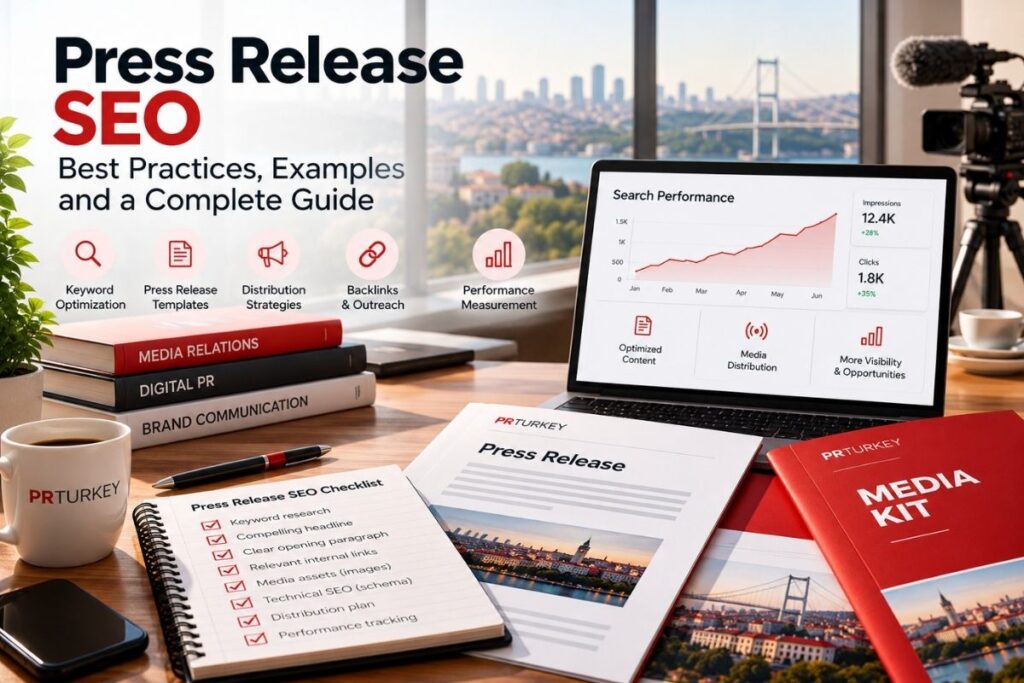
Press release SEO is the process of making a news announcement easier for search engines to discover, understand, and display to relevant audiences. It combines clear editorial writing, natural keyword usage, technical optimization, and strategic distribution.
An SEO-friendly press release can strengthen the visibility of an official announcement, support branded searches, and help journalists find reliable information. However, distributing the same press release across hundreds of websites does not automatically improve search rankings or generate valuable backlinks.
The most effective approach combines search optimization with genuine news value.
What Is Press Release SEO?
Press release SEO refers to optimizing the content, structure, publication, and discoverability of a press release so that search engines and readers can identify its subject and relevance.
Unlike traditional SEO content, which may target an evergreen topic, a press release communicates a specific development. This could include a product launch, company expansion, partnership, research publication, executive appointment, or industry announcement.
Search optimization helps that information reach people actively looking for it.
For example, a company announcing a new manufacturing facility in Türkiye may want its official announcement to appear when users search for the company’s name, the facility location, or the investment.
The objective is not simply to increase keyword rankings. It is to create a reliable, accessible source of information that supports the organization’s wider communication strategy.
Press Release SEO vs. Traditional SEO
| Feature | Press Release SEO | Traditional Website SEO |
|---|---|---|
| Primary purpose | Improve announcement discoverability | Build ongoing organic visibility |
| Content focus | Specific news or development | Products, services, and informational topics |
| Search demand | Often branded, timely, or event-specific | Often recurring and evergreen |
| Typical content | News release or newsroom announcement | Service page, guide, category, or article |
| Distribution | Newsroom, media outreach, relevant channels | Search visibility and ongoing content promotion |
| Measurement | Announcement searches, coverage, referrals | Organic traffic, rankings, conversions |
A press release should complement a broader SEO strategy rather than replace evergreen website content.
Do Press Releases Help SEO?
Yes, press releases can help SEO indirectly and, in some cases, directly by making an organization’s own announcement discoverable in search results. Their value comes from relevant content, accessible publication, referral traffic, and the possibility of independent editorial coverage—not from automatically generated backlinks.
There are four main ways press releases can contribute to search visibility.
1. Improving Branded Search Visibility
A published announcement can provide an official result for searches involving a company, product, executive, event, or partnership.
For example, when a company announces an international expansion, potential customers and journalists may search for its name alongside the destination market.
An optimized newsroom page gives search engines a clear source of information about that development.
2. Creating Opportunities for Earned Media
A journalist may discover a press release, investigate the announcement, and publish an original article.
If the journalist independently chooses to reference the organization’s website, research, or supporting material, the resulting editorial link may provide referral traffic and potential SEO value.
This is different from a link automatically reproduced through press release syndication.
3. Supporting Referral Traffic
A press release distributed through relevant publications or industry platforms may direct interested readers to the organization’s website.
Those visitors might explore a product, download a report, register for an event, or contact the company.
Referral traffic is valuable when it reaches an appropriate audience and contributes to meaningful business outcomes.
4. Strengthening the Online Newsroom
Publishing announcements on a company’s own website creates a searchable archive of verified developments.
A well-organized newsroom can help journalists, investors, customers, and other stakeholders locate official information without relying on third-party copies.
The distinction is important: press releases can support SEO, but distribution volume alone is not a reliable ranking strategy.
How to Write an SEO-Friendly Press Release
Writing an effective SEO press release requires balancing search visibility with the conventions of professional news writing.
A press release must communicate real news first. Keywords and technical optimization should make that news easier to find, not overwhelm the announcement.
Step 1: Identify a Newsworthy Announcement
Before selecting keywords, establish what makes the announcement relevant.
Ask:
- What has happened?
- Who is affected?
- Why does the development matter?
- Why is the announcement timely?
- What facts or evidence support it?
- Which audience would actively search for this information?
A routine internal update may not justify a press release. A significant product launch, research finding, market expansion, or partnership may offer a stronger editorial angle.
The format also matters. An announcement designed for publication serves a different purpose from an invitation encouraging journalists to attend an event. Our guide to media advisory vs. press release explains when each format is appropriate.
Step 2: Choose Relevant Press Release Keywords
Effective press release keywords describe the actual announcement in terms readers recognize.
Consider a fictional technology company introducing a warehouse automation system in Istanbul.
Potential keyword themes include:
- The company name
- The product or system name
- Warehouse automation technology
- Istanbul technology launch
- Logistics automation
- The specific industry application
The best keyword is not necessarily the phrase with the highest search volume.
A specific term that accurately describes the news may be more useful than a broad, competitive keyword.
How Many Keywords Should a Press Release Include?
There is no universal number of keywords that guarantees SEO performance.
Select one primary topic and include closely related terms when they clarify the announcement.
Avoid inserting multiple unrelated keywords simply because they have search volume.
Where Should Press Release Keywords Appear?
When relevant and natural, include the primary topic in:
- The SEO title and visible headline.
- The opening paragraph.
- An informative subheading, if appropriate.
- The page URL.
- The meta description.
- Descriptive image filenames or alt text when they accurately reflect the image.
Keywords should never interfere with readability or factual accuracy.
Step 3: Write a Clear, Search-Friendly Headline
An effective press release headline communicates the announcement immediately.
It should identify the organization, development, and relevant context without relying on exaggerated promotional language.
Weak headline:
A Revolutionary New Era of Business Innovation Begins
Improved headline:
Atlas Technology Launches Warehouse Automation Platform in Istanbul
The second version explains what happened, who announced it, and where the development is relevant.
It also uses descriptive language that readers might naturally search for.
Step 4: Answer the Essential Questions in the Opening
The opening paragraph should communicate the most important information without requiring readers to work through several paragraphs of company background.
A useful press release opening addresses the traditional journalistic questions:
Who, what, when, where, why, and how?
For example:
Istanbul, Türkiye — Atlas Technology has introduced a warehouse automation platform designed to help logistics operators coordinate inventory movement and warehouse workflows. The company announced the platform on [date], with initial availability planned for [verified markets].
This opening is specific, understandable, and focused on the announcement.
The actual publication must replace placeholders with verified details.
Step 5: Add Credible Supporting Information
Search-friendly content should also be trustworthy.
Support important claims with evidence such as:
- Original research and documented methodology.
- Verified company or product information.
- Official statements from authorized representatives.
- Relevant customer experiences with permission.
- Technical specifications supported by documentation.
- Accurate dates, locations, and availability details.
Avoid unsupported statements such as “the world’s leading platform” or “the industry’s most innovative solution.”
Specific evidence is more useful than promotional adjectives.
Step 6: Use Contextual Links Naturally
Links within a press release should help readers verify information or explore the announcement.
Relevant destinations may include a research report, product page, event registration page, official company information, or a previous announcement.
For example:
The company has published additional technical information in its product documentation.
A descriptive link to that documentation is useful because it provides supporting context.
Avoid repeating commercial keyword phrases as anchor text throughout the release.
Step 7: Include a Relevant Call to Action
A press release can guide readers toward additional information without becoming a sales page.
Appropriate calls to action include:
- View the complete research report.
- Explore the product specifications.
- Access the official media kit.
- Register for the event.
- Contact the media relations team.
Choose the action that best matches the announcement and intended audience.
Press Release SEO Example: Before and After
A practical press release SEO example shows how editorial clarity and search optimization can work together.
The following scenario is fictional and illustrates writing principles rather than an actual PR campaign.
Before Optimization
Headline:
Atlas Technology Announces an Exciting New Chapter
Opening paragraph:
Atlas Technology, a forward-thinking company committed to innovation and excellence, is delighted to unveil a revolutionary solution that will transform the future of business operations.
Problems:
The headline does not identify the product or industry. The introduction contains promotional language but little factual information. Readers cannot immediately determine what has been announced.
After Optimization
Headline:
Atlas Technology Launches Warehouse Automation Platform in Istanbul
Opening paragraph:
Istanbul, Türkiye — Atlas Technology has launched a warehouse automation platform for logistics and distribution businesses. The system is designed to coordinate inventory movement, monitor warehouse activity, and provide operational reporting through a centralized interface.
Supporting paragraph:
The company plans to introduce the platform to selected logistics operators and provide demonstrations for organizations evaluating warehouse management technology. Additional product specifications and availability information are accessible through its official website.
Why the Improved Version Works
The revised announcement identifies the organization, product category, target industry, and geographical context.
It also describes the product’s intended function without inventing performance results.
Search engines receive clearer topical signals, while readers receive useful information.
Example SEO Metadata
SEO Title: Atlas Technology Launches Warehouse Automation Platform
URL Slug: atlas-warehouse-automation-istanbul
Meta Description: Atlas Technology announces a warehouse automation platform in Istanbul, designed to support inventory coordination and operational reporting.
This is an illustrative example. Metadata for a real announcement should reflect the verified facts and search intent.
Press Release Distribution and SEO: Which Channels Matter?
Press release distribution can expand the reach of an announcement, but different distribution channels contribute different forms of value.
An organization’s own newsroom, a commercial newswire, and independent editorial coverage should not be treated as equivalent.
| Distribution channel | Primary benefit | SEO consideration |
|---|---|---|
| Owned newsroom | Official, accessible announcement | Can establish an indexable source page |
| Newswire distribution | Wider announcement circulation | Syndicated links do not guarantee ranking value |
| Targeted journalist outreach | Potential original reporting | Independent coverage may earn editorial citations |
| Industry publications | Relevant professional audience | Can generate qualified referral traffic |
| Social media | Audience discovery and engagement | Does not automatically create ranking authority |
| Email distribution | Direct communication with contacts | Useful for engagement and referral measurement |
Publishing on Your Own Website
The organization’s newsroom should ideally contain a complete and accurate version of the announcement.
A stable URL allows journalists and other readers to return to the official source.
The page should include the announcement date, supporting information, relevant media assets, and appropriate contact details.
Using Newswire Distribution
Newswire services can circulate announcements to publications, platforms, and other recipients.
However, broader distribution does not mean every syndicated copy will rank or that every reproduced link will contribute SEO value.
Distribution should be evaluated according to audience reach, relevance, referral traffic, and communication objectives.
Reaching Journalists Directly
Targeted journalist outreach can generate opportunities that automated distribution alone may not provide.
A personalized message explains why an announcement is relevant to a journalist’s particular audience.
The process begins with accurate contact research. Our guide on how to build a media list explains how to identify and organize relevant media contacts.
A strong media list prioritizes editorial fit over the number of contacts.
Do Press Release Backlinks Help SEO?
Press release backlinks do not automatically improve search rankings. Their potential value depends on how they are created, whether they are editorially justified, and how search engines interpret them.
Google’s link spam policies specifically address optimized anchor text in widely distributed press releases.
This means using mass distribution to place keyword-rich backlinks across many websites is not a sound SEO strategy.
Syndicated Links vs. Earned Editorial Links
A syndicated link appears when another website republishes the original press release, often with the same embedded links.
An earned editorial link occurs when a journalist, publisher, or industry author independently decides that a source is useful enough to cite.
For example, a journalist may read a research announcement, interview the researchers, and link to the complete study.
That independent editorial decision is different from automatically reproducing a link in syndicated content.
Should Press Release Links Be Nofollow?
There is no single rule that every link in every press release must use the same attribute.
Link qualification depends on the relationship and purpose of the placement.
Paid or sponsored placements should use appropriate link attributes, such as rel="sponsored", in accordance with Google’s guidance.
The safest approach is to avoid treating press release distribution as a system for manufacturing ranking signals.
Instead, publish useful information that other websites may independently choose to reference.
For official guidance, consult Google Search Central’s spam policies.
Technical SEO Best Practices for Press Releases
A well-written announcement may still struggle to appear in search results if the publishing page has technical problems.
Technical optimization should ensure that the official release is accessible, understandable, and eligible for indexing.
Use a Stable, Descriptive URL
A press release should have a unique URL that accurately describes the announcement.
For example:
example.com/news/warehouse-automation-platform-istanbul
Avoid unnecessary URL parameters or vague identifiers when a descriptive slug is practical.
Check Indexability
The official release should be accessible to search-engine crawlers if organic discovery is an objective.
Check that the page:
- Returns an appropriate successful HTTP response.
- Is not unintentionally blocked by robots.txt.
- Does not contain an unintended
noindexdirective. - Is accessible without authentication.
- Uses a stable HTTPS URL.
Indexability does not guarantee indexing or ranking, but technical restrictions can prevent discovery.
Configure Canonical URLs Correctly
A canonical URL helps communicate which version of a page is preferred when similar or duplicate URLs exist.
For an owned press release, a self-referencing canonical is commonly appropriate when that URL is intended to be the preferred version.
However, a canonical tag is a signal rather than a guarantee that Google will select the specified page.
If a release appears on multiple websites, the organization cannot assume that every third-party publisher will implement canonicalization in the same way.
Include the Page in the XML Sitemap
An XML sitemap can help search engines discover important URLs.
A newsroom should include eligible press release pages in its sitemap where appropriate.
Sitemaps support discovery but do not guarantee indexing.
Optimize Images and Media Assets
Images should provide genuine context.
For a product announcement, relevant assets might include a product photograph, interface screenshot, authorized spokesperson image, or technical diagram.
Use descriptive filenames, accurate alt text, appropriate captions, and clear usage information.
For example:
Filename: atlas-warehouse-automation-platform.webp
Alt Text: Warehouse automation dashboard showing inventory monitoring and operational reporting interfaces
The alt text should describe the actual image rather than repeat keywords unnecessarily.
Add Article Structured Data When Appropriate
Article or BlogPosting structured data can help search engines understand information such as the headline, author, publication date, and representative images.
For a newsroom announcement, relevant properties may include:
headlinedatePublisheddateModifiedauthorimagepublisher
Structured data must match the visible page content.
It does not guarantee a rich result or improved ranking.
Refer to Google’s Article structured data documentation for implementation guidance.
International Press Release SEO: Reaching Different Markets
International press release SEO requires adapting announcements to the search behavior, editorial expectations, and information needs of different markets.
Simply translating a press release does not necessarily make it relevant to a new audience.
For example, a European company announcing expansion into Türkiye may need to explain the local market significance rather than focusing exclusively on its global business strategy.
Localize the News Angle
Different audiences may care about different aspects of the same announcement.
A global business publication may focus on expansion strategy.
A Turkish business publication may prioritize local investment, partnerships, employment, or market implications.
These angles should be supported by verified information.
Research Local Search Terminology
Industry terminology may differ across markets and languages.
A phrase commonly used in English may not reflect how Turkish audiences search for the same service or development.
Keyword research should account for local terminology, spelling, and audience intent.
Consider Language and Regional SEO
If a company publishes genuinely localized versions of an announcement, each version should use appropriate language and technical implementation.
Where applicable, hreflang can help indicate language or regional alternatives.
However, hreflang should not be added without corresponding, valid alternate pages.
Coordinate International Media Outreach
International visibility depends on more than technical optimization.
Organizations should identify relevant publications, prepare authorized spokesperson information, and adapt supporting materials for local journalists.
This is where public relations strategy and SEO planning can reinforce one another.
How to Measure Press Release SEO Performance
Measuring press release SEO requires distinguishing search visibility, distribution reach, editorial coverage, and business outcomes.
A successful announcement does not necessarily need to rank for a broad industry keyword.
Its primary objective may be to provide an official result for a specific development, attract relevant visitors, or support journalist research.
1. Google Search Console
Google Search Console can help evaluate the owned press release’s search performance.
Relevant metrics include:
- Search impressions.
- Organic clicks.
- Click-through rate.
- Search queries.
- Average position.
- Indexing status.
Review queries related to the company, announcement, product, location, and relevant industry terminology.
2. Google Analytics 4
GA4 can help show how users interact with the release after arriving on the website.
Depending on the site’s configuration, useful measurements may include organic sessions, referral sessions, engagement, downloads, form submissions, and visits to related service pages.
3. Earned Media Coverage
Track original articles, interviews, and relevant editorial mentions generated by the announcement.
Consider the publication’s audience, relevance, and the quality of the coverage.
A placement in a highly relevant industry publication may be more useful than numerous unrelated syndicated copies.
4. Referral Traffic
Identify visits arriving from publications, industry websites, and distribution partners.
Use UTM parameters on links controlled by the organization where appropriate.
5. Conversion and Business Impact
Depending on the campaign, meaningful actions may include report downloads, event registrations, partnership inquiries, product demonstrations, or contact requests.
These outcomes should be connected to the original communication objective.
Example Performance Framework
| Campaign objective | Primary metric | Supporting metric |
|---|---|---|
| Official announcement visibility | Relevant search impressions | Organic clicks |
| Media awareness | Original editorial coverage | Journalist inquiries |
| Research promotion | Report downloads | Referral sessions |
| Event promotion | Registrations | Landing-page engagement |
| Product announcement | Qualified inquiries | Product-page visits |
| International visibility | Relevant regional coverage | Market-specific traffic |
Avoid combining unrelated metrics into a single performance figure that obscures actual results.
Press Release SEO Checklist
Use this checklist before and after publishing an announcement.
Before Writing
- Confirm the announcement is newsworthy.
- Identify the primary audience.
- Define the announcement’s search topic.
- Review relevant search results.
- Check whether an existing website page already covers the subject.
- Collect verified facts, quotes, and supporting materials.
During Writing
- Include the news in the headline.
- Answer the essential questions in the opening paragraph.
- Use keywords naturally.
- Add supporting evidence.
- Include useful contextual links.
- Avoid unsupported promotional claims.
- Provide appropriate media contact information.
Before Publishing
- Create a descriptive URL.
- Write a unique SEO title and meta description.
- Check indexability.
- Review canonical settings.
- Confirm sitemap inclusion where appropriate.
- Optimize images and alt text.
- Verify publication dates.
- Validate structured data if implemented.
- Test links and mobile presentation.
After Publishing
- Share the official announcement with relevant journalists.
- Monitor indexing and search queries.
- Track referral traffic.
- Record original editorial coverage.
- Measure campaign-specific conversions.
- Correct factual errors when necessary.
- Review results against the campaign objective.
Common Press Release SEO Mistakes to Avoid
Keyword Stuffing
Repeating the same phrase throughout a press release does not make it more useful.
Use relevant terminology naturally and prioritize readability.
Treating Syndication as Guaranteed Link Building
Mass distribution should not be presented as a reliable method for generating ranking authority.
Focus on relevant distribution and independent editorial interest.
Publishing Duplicate Announcements on Multiple Owned URLs
Creating several near-identical pages on the same website can make it harder to establish a clear preferred source.
Use a coherent newsroom structure and avoid unnecessary duplication.
Ignoring Search Intent
A press release about a new product may not satisfy someone looking for a detailed buying guide.
Match the announcement to relevant searches rather than forcing it to compete with unrelated evergreen content.
Neglecting Technical SEO
A useful release can still be difficult to discover if the page is blocked, inaccessible, or poorly configured.
Technical checks should be part of the publishing process.
Measuring Success Only Through Backlinks
A press release may achieve its communication objective through relevant coverage, branded visibility, referral traffic, or qualified inquiries.
Evaluate the results that matter to the campaign.
Frequently Asked Questions About Press Release SEO
What is a press release in SEO?
A press release in SEO is an official news announcement published and optimized so that search engines can discover and understand it. Optimization may involve descriptive headlines, relevant keywords, accessible URLs, supporting links, and appropriate technical settings.
Do press releases work for SEO?
Press releases can support SEO by creating discoverable official announcements, generating relevant referral traffic, and attracting independent editorial coverage. However, mass distribution and automatically reproduced backlinks do not guarantee ranking improvements.
Do press release backlinks help SEO?
Independent editorial links may provide SEO value when publishers choose to cite useful information. Automatically syndicated links are different and should not be relied upon as a link-building strategy. Google’s policies caution against manipulative keyword-rich links in widely distributed press releases.
How do you optimize a press release for Google?
Start with a genuine announcement, select relevant search terminology, write a descriptive headline, provide verified facts, publish on an accessible URL, optimize supporting assets, and review technical settings. Measure performance through Search Console, analytics, and relevant media outcomes.
Should a press release be longer for SEO?
Not necessarily. A press release should be long enough to communicate the announcement accurately and provide useful supporting information. Adding unnecessary paragraphs solely to increase word count does not make the announcement more relevant.
Conclusion: Make Press Release SEO Part of a Stronger PR Strategy
Effective press release SEO makes genuine company news easier to discover, understand, and reference.
The strongest results come from combining clear editorial writing, relevant keywords, reliable evidence, technically accessible newsroom pages, and targeted media outreach.
Rather than treating press release distribution as an automated backlink strategy, organizations should focus on meaningful visibility, credible coverage, and measurable communication outcomes.
For brands communicating across markets, SEO and public relations should work together to ensure the right stories reach the right audiences.
PR Turkey supports strategic public relations and media communication. Explore PR Turkey to learn more about developing communication strategies for your organization.