


The best time to send a press release is generally during your target journalists’ working hours, with Tuesday through Thursday mornings serving as a practical starting point. For many business and general news announcements, 9 a.m. to 11 a.m. in the recipient’s local time zone is a reasonable window to test. Some PR platforms recommend Thursday between 10 a.m. and 2 p.m., while other datasets favor Tuesday mornings.
There is no universally proven best day or hour for every announcement. The right timing depends on the news, the publication’s editorial schedule, the audience’s location, and whether the release is being sent directly to journalists or through a distribution service.
The most effective strategy combines a relevant story, a targeted media list, a clear publication schedule, and a delivery time that gives journalists enough opportunity to act.
What Is the Best Time to Send a Press Release?
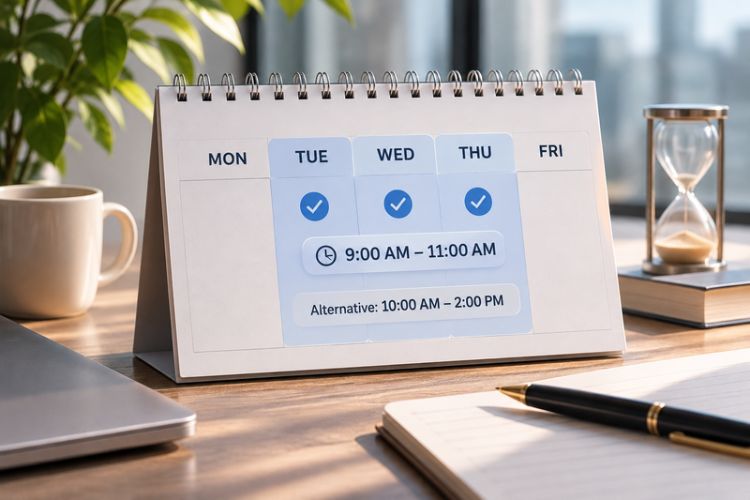
For a planned, non-urgent announcement, start by testing Tuesday, Wednesday, or Thursday between 9 a.m. and 11 a.m. in the target market’s local time. This is a practical recommendation rather than a guaranteed formula.
Mid-morning can be useful because many journalists have begun reviewing their assignments and inboxes but may still have time to evaluate new story opportunities. However, newsroom routines vary considerably between daily newspapers, television stations, trade publications, and online news outlets.
Research and recommendations from PR platforms also differ. Prezly’s 2026 guide favors Thursday from 10 a.m. to 2 p.m., while Presscloud’s analysis of releases distributed through its platform identifies Tuesday mornings as a strong option.
These findings are not necessarily contradictory. They may reflect different audiences, distribution methods, datasets, and definitions of success.
A useful starting framework is:
| Timing factor | Practical recommendation |
|---|---|
| Best days to test | Tuesday, Wednesday, Thursday |
| Best starting window | 9 a.m.–11 a.m. local time |
| Alternative window | 10 a.m.–2 p.m. |
| International campaigns | Schedule separately for each target market |
| Urgent announcements | Publish when accuracy and public interest require it |
| Major events | Coordinate timing with the event and editorial deadlines |
The best time to send a press release is ultimately the time that allows the intended media contacts to receive, understand, and use the announcement.
What Is the Best Day to Send a Press Release?
Tuesday, Wednesday, and Thursday are commonly recommended for planned press release distribution because they fall within the standard working week. Nevertheless, the best day depends on the type of announcement and the media organizations being targeted.
Tuesday: A Strong Starting Point for Business Announcements
Tuesday can work well for company announcements, partnerships, product developments, and other planned business news.
By Tuesday, some journalists have moved beyond the backlog that may accumulate over the weekend and are working through their weekly editorial priorities.
However, Tuesday is not automatically the best day for every publication. A journalist preparing a Wednesday print edition may have different deadlines from a reporter publishing digital stories throughout the day.
Wednesday: Useful for Midweek Media Outreach
Wednesday offers another practical opportunity for announcements that are not tied to a specific event or deadline.
It can be particularly useful when a PR team wants time to answer questions, provide supporting materials, or arrange interviews before the weekend.
For a story requiring substantial background research, contacting journalists earlier and providing the release on Wednesday may be more effective than relying on a single last-minute email.
Thursday: A Frequently Recommended Distribution Day
Thursday is prominent in several industry recommendations. Prezly’s 2026 timing guide identifies Thursday between 10 a.m. and 2 p.m. as its preferred window.
This can be a reasonable option for announcements intended for publication before the weekend or for editorial planning that extends into the following week.
The limitation is competition: if many organizations follow the same advice, journalists may receive more pitches during the supposedly optimal period.
The quality and relevance of the announcement still matter more than choosing Thursday simply because it appears in an industry guide.
Monday and Friday: Are They Bad Days?
Neither Monday nor Friday should be ruled out completely.
Monday can work for announcements connected to the beginning of a business week, scheduled financial events, or stories that journalists already expect.
Friday may be appropriate for weekend events, entertainment coverage, sports news, or time-sensitive developments. However, late Friday afternoon is often a less attractive option for routine corporate announcements requiring follow-up.
For general business news, Tuesday through Thursday is a sensible default. For event-driven or urgent news, the announcement itself should determine the schedule.
What Time of Day Should You Send a Press Release?
The best time of day depends on when the target journalist is available to assess the story and whether the announcement can still fit the publication’s editorial schedule.
Early Morning: Before 9 a.m.
Sending a release early may place it in a journalist’s inbox before the working day begins.
The disadvantage is that it may arrive alongside overnight emails, automated alerts, and other announcements.
Early morning distribution can be useful for financial news, scheduled corporate disclosures, or announcements that need to be available when markets and newsrooms open.
For ordinary media outreach, an extremely early send time offers no automatic advantage.
Mid-Morning: 9 a.m. to 11 a.m.
Mid-morning is a practical starting window for many planned press releases.
It allows time for journalists to review the announcement, request additional information, and potentially develop a story during the working day.
For PR teams without historical campaign data, this is a reasonable window for initial testing.
It should still be adjusted to the recipient’s time zone, publication schedule, and editorial responsibilities.
Late Morning to Early Afternoon: 11 a.m. to 2 p.m.
Late morning and early afternoon can also be effective, particularly for journalists working on digital publications with continuous publishing schedules.
This window overlaps with Prezly’s broader Thursday recommendation of 10 a.m. to 2 p.m.
However, a release arriving shortly before a publication’s editorial deadline may receive less attention than one delivered earlier.
Late Afternoon and Evening
Late-afternoon distribution is generally less suitable for routine announcements requiring immediate responses.
Journalists may be completing stories, preparing for the next day’s coverage, or leaving work.
Evening distribution may still be appropriate for breaking news, live events, entertainment announcements, or international campaigns targeting a different time zone.
The key distinction is whether the timing serves the news or simply reflects the sender’s convenience.
Best Time to Send a Press Release by Announcement Type
Different announcements require different distribution strategies. A product launch scheduled months in advance should not follow the same timeline as an urgent public safety statement.
| Announcement type | Recommended approach | Main consideration |
|---|---|---|
| Product launch | Planned weekday distribution, coordinated with launch date | Product availability and embargoes |
| Company partnership | Tuesday–Thursday as a starting point | Both parties’ approval and availability |
| Funding announcement | Coordinate with official disclosure and stakeholder communications | Accuracy, confidentiality, legal requirements |
| Conference or event | Send advance information before the event, then relevant updates | Editorial lead time |
| Research report | Offer advance access to relevant journalists when appropriate | Data verification and expert availability |
| Executive appointment | Publish after necessary internal and regulatory approvals | Accurate appointment details |
| Crisis or urgent statement | Release promptly once information is verified and approved | Public interest and timeliness |
These are planning recommendations, not universal publication rules.
Product Launches
For a product launch, the most important factor is alignment between the public announcement and the product’s actual availability.
If the product will launch on Thursday, distributing the release on Tuesday simply because Tuesday is considered a favorable media day may create confusion.
Instead, coordinate the announcement with the launch date and consider providing selected journalists with advance information under an agreed embargo.
Events and Conferences
Event announcements require additional lead time because journalists may need to arrange attendance, interviews, photography, or editorial coverage.
A useful distinction is between a press release and a media advisory.
A press release communicates news, while a media advisory primarily helps journalists understand the logistics of an upcoming event. Our guide to media advisory vs. press release explains when each format is appropriate.
Breaking News and Crisis Communications
Urgent news should not be delayed until a preferred weekday or morning window.
When an announcement concerns public safety, a major operational disruption, or another time-sensitive matter, accuracy and timely communication take priority.
The organization should confirm essential facts, coordinate approvals, and release verified information as promptly as the situation requires.
How Far in Advance Should You Send a Press Release?
The ideal lead time depends on whether the release announces an upcoming event, a scheduled launch, or news that has already occurred.
A journalist covering an event may need several days or weeks to prepare. A reporter covering a breaking development may need information immediately.
The following schedule is a practical planning framework:
| Situation | Suggested planning window | Why it matters |
|---|---|---|
| Major conference or industry event | Begin targeted outreach several weeks ahead | Supports travel, interviews, and editorial planning |
| Local event or media opportunity | Often several days to two weeks ahead | Gives local journalists time to schedule coverage |
| Product launch | Coordinate advance pitching with the launch schedule | Allows preparation without premature disclosure |
| Research publication | Consider advance access under embargo | Gives reporters time to examine findings |
| Routine company announcement | Distribute when the information is confirmed and relevant | Avoids unnecessary delays |
| Breaking announcement | As soon as verified and authorized | Preserves timeliness |
These are suggested ranges, not requirements imposed by news organizations.
Should You Send a Press Release Before an Event?
Yes, when advance publicity or media attendance is the objective.
For example, a company hosting a technology conference may contact relevant journalists several weeks before the event, share practical details closer to the date, and distribute a separate news release when an important announcement is made.
This approach creates distinct opportunities for advance coverage and reporting on the actual news.
What Is a News Embargo?
A news embargo is an arrangement in which information is shared with journalists before a specified publication time, with the expectation that they will not publish it before that time.
Embargoes can help journalists prepare accurate coverage of research findings, product launches, or major corporate announcements.
However, an embargo should never be assumed to be binding simply because the sender labels an email “embargoed.”
Journalists should agree to the arrangement before receiving sensitive information. Organizations should also establish a clear publication date, time, and time zone.
Does Timing Matter for Press Release Distribution Services?
Yes, but press release distribution services and direct journalist outreach should not be evaluated in exactly the same way.
A distribution service may publish a release across participating platforms and syndication networks. Direct outreach involves sending a relevant story to specific journalists or editors.
The distribution process, potential outcomes, and performance measurements are different.
Press Release Distribution vs. Direct Media Outreach
| Factor | Distribution service | Direct journalist outreach |
|---|---|---|
| Primary activity | Distributing a release through a service or network | Pitching selected media contacts |
| Timing priority | Scheduled publication and target-market availability | Individual newsroom schedules and deadlines |
| Typical measurement | Distribution reports, publication links, referral traffic | Responses, interviews, original editorial coverage |
| Main limitation | Distribution does not guarantee independent reporting | Journalists may decline or ignore the pitch |
| Best use | Broad, structured dissemination | Targeted relationship-building and story development |
For a broader explanation of these methods, see our guide on how to distribute a press release.
A successful distribution strategy often combines an accessible public announcement with carefully targeted outreach to journalists who cover the relevant industry.
Should You Schedule a Press Release for the Exact Same Time Everywhere?
Not necessarily.
A simultaneous global announcement may be necessary for certain financial, legal, or coordinated corporate communications.
For an ordinary international marketing announcement, distributing at different local times can be more practical.
The correct approach depends on whether the announcement must become public everywhere at once or whether regional publication can be staggered.
When selecting a provider, consider its scheduling capabilities, geographic reach, reporting methods, and editorial requirements. Our guide to choosing the right press release distribution platform provides additional criteria.
Best Time to Send an International Press Release
For international press release distribution, use the recipient’s local time zone rather than the sender’s location as the starting point.
A release sent at 10 a.m. in London does not arrive at 10 a.m. in Istanbul or New York.
For example, during November, when the United Kingdom observes GMT and Türkiye uses UTC+3, a release sent at 10 a.m. in London reaches Türkiye at 1 p.m.
During British Summer Time, the difference changes. Therefore, international campaigns should use date-specific time zone conversions rather than a fixed year-round assumption.
Sending Press Releases to the United States
The United States spans several time zones, making one national send time less suitable for some campaigns.
A company targeting New York-based financial journalists may prioritize Eastern Time, while a technology announcement focused on California may need to account for Pacific Time.
For nationwide distribution, decide whether simultaneous release or region-specific scheduling better serves the announcement.
Sending Press Releases to the United Kingdom
For UK-focused campaigns, use the publication schedules and working hours of the relevant British journalists.
Remember that the UK changes between GMT and British Summer Time, so the time difference with other countries can vary during the year.
Sending Press Releases to Türkiye
For announcements targeting Turkish media, consider the working hours of journalists and editors in Türkiye.
Türkiye operates on UTC+3 throughout the year, making it important to adjust international schedules when coordinating with countries that observe daylight saving time.
A company based in London or New York should not assume that its own mid-morning distribution time is appropriate for Turkish newsrooms.
Understanding the media landscape in Türkiye can also help organizations select relevant publications and adapt their outreach to local editorial practices.
Should International Press Releases Be Translated?
Translation may improve accessibility when targeting journalists who primarily publish in another language.
However, translation alone is not enough. Effective localization may also require adapting headlines, terminology, statistics, contact details, and background information to the target market.
The release should preserve the same verified facts across all language versions.
When Should You Avoid Sending a Press Release?
There is no universally prohibited day or hour, but some situations create unnecessary obstacles for planned announcements.
Late Friday Afternoon
For routine corporate news, late Friday afternoon may leave limited time for journalists to request information or arrange interviews before the weekend.
If the announcement is not time-sensitive, an earlier weekday may provide more flexibility.
Public Holidays
Before scheduling a release, check holidays in the target country.
A normal working day in one market may be a national holiday in another, reducing newsroom staffing or changing editorial priorities.
During Major Competing News Events
A major election, natural disaster, economic announcement, or breaking international development may dominate the news cycle.
If the release is not urgent, postponing distribution can help avoid competing for attention with more consequential news.
However, organizations should not delay legally required disclosures or important public information merely for marketing visibility.
Before Supporting Materials Are Ready
Sending a release before the spokesperson, images, product details, supporting data, or media contacts are ready can undermine an otherwise well-timed announcement.
A well-written release should also provide journalists with enough verified information to evaluate the story. For guidance on structure and essential details, see how to write a press release.
How to Test the Best Press Release Timing for Your Organization
Industry recommendations provide a starting point. Your own campaign results are more useful for determining which timing works with your particular audience.
A simple testing process can help.
Step 1: Define the Outcome
Decide what success means before distributing the release.
Possible outcomes include journalist responses, original media coverage, qualified referral traffic, or relevant inquiries.
Do not treat automated syndication, email opens, and independent editorial coverage as interchangeable results.
Step 2: Segment Your Media Contacts
Separate journalists by geography, publication type, subject area, and editorial schedule.
A national business newspaper, a specialist technology publication, and a local events website may respond differently to the same distribution window.
Step 3: Compare Similar Campaigns
Test different sending days or times across reasonably comparable announcements.
Avoid drawing strong conclusions from one campaign, particularly if the newsworthiness, media list, or subject line differs substantially.
Step 4: Record the Results
Track meaningful outcomes consistently.
| Metric | What it helps evaluate |
|---|---|
| Journalist responses | Whether outreach generated engagement |
| Original editorial coverage | Whether publications independently developed the story |
| Relevant publication links | Where the announcement appeared |
| Referral traffic | Whether published coverage generated visits |
| Qualified inquiries | Whether the campaign contributed to business objectives |
| Email opens, where measurable | A limited engagement signal, not proof of readership |
Email open tracking can be unreliable because privacy protections and automated systems may affect the data.
Step 5: Improve the Entire Distribution Process
If a release performs poorly, timing may not be the primary issue.
Review whether the story is newsworthy, the headline communicates the announcement clearly, the journalists are relevant, and the supporting information is complete.
The same principle applies to search visibility. Our guide to press release SEO explains how to make press release content clearer and more accessible to search engines.
Frequently Asked Questions
Is Tuesday or Thursday the best day to send a press release?
Both are reasonable days to test. Prezly’s 2026 guidance favors Thursday, while Presscloud’s platform-specific findings favor Tuesday mornings. Neither establishes a universal rule. Choose based on the target journalists, announcement type, editorial deadlines, and results from previous campaigns.
What is the best time to send a press release to journalists?
For a planned business announcement, 9 a.m. to 11 a.m. in the journalist’s local time zone is a practical starting window. Some industry guidance recommends a broader period extending to 2 p.m. The best time depends on the journalist’s publication schedule and the relevance of the story.
Can you send a press release on a weekend?
Yes. Weekend distribution may be appropriate for breaking news, sports, entertainment, or events taking place on Saturday or Sunday. For routine corporate announcements, weekday distribution is often easier to coordinate because relevant spokespeople and media contacts may be more readily available.
How far in advance should you send a press release?
Send advance information early enough for journalists to prepare coverage, particularly for events, major product launches, or research announcements. Lead time may range from several days to several weeks depending on the story. Breaking news should be released when verified and authorized rather than held for a preferred date.
Should you follow up after sending a press release?
A relevant, concise follow-up may be appropriate when a journalist has had reasonable time to review the announcement. Avoid repeated generic reminders or contacting journalists who have declined. The follow-up should offer something useful, such as an interview opportunity, clarification, additional data, or a relevant visual asset.
Does sending a press release at the right time guarantee media coverage?
No. Timing can improve the practical opportunity for journalists to consider a story, but it cannot guarantee publication. Editorial coverage depends on newsworthiness, relevance, credibility, available resources, and the publication’s independent editorial decisions.
Final Thoughts: Timing Matters, but Relevance Comes First
The best time to send a press release in 2026 is not a single hour that works for every organization. For planned announcements, Tuesday through Thursday mornings offer a sensible starting point, while urgent news and scheduled events require their own timelines.
Successful media outreach also depends on reaching appropriate journalists, providing accurate information, and making the story genuinely relevant to their audiences.
For international campaigns, time zones, language, regional news cycles, and distribution methods introduce additional considerations.
PR Turkey helps organizations explore press release distribution opportunities for reaching relevant markets. To review available services and plan your next announcement, visit PR Turkey.