

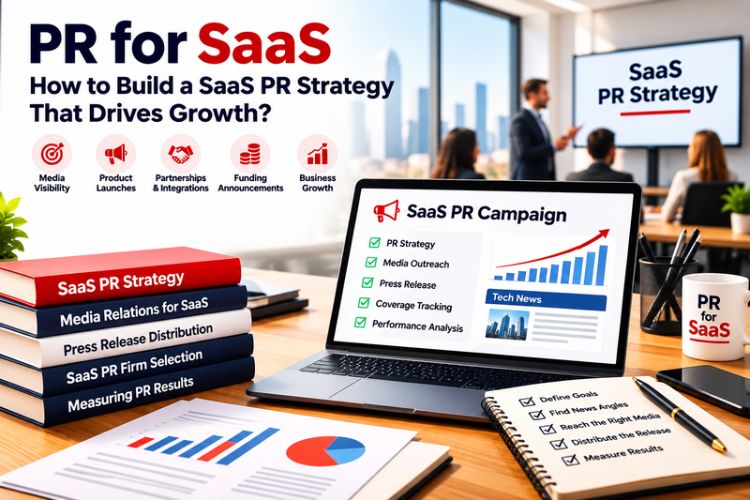
PR for SaaS is the process of building visibility, credibility, and meaningful media relationships for software-as-a-service companies. Unlike traditional product publicity, SaaS public relations must communicate ongoing innovation, complex product benefits, customer outcomes, and market expertise.
A successful SaaS PR strategy connects newsworthy company developments with journalists, industry publications, and potential buyers. It can support brand awareness, product launches, market expansion, and trust throughout the B2B buying journey.
For SaaS companies entering new markets, public relations also provides a way to introduce their expertise to audiences who may not yet recognize the brand.
What Is SaaS PR?
SaaS PR (Software-as-a-Service Public Relations) is a specialized approach to public relations that helps cloud-based software companies communicate their value, establish industry credibility, and earn relevant media coverage.
It includes activities such as press release distribution, journalist outreach, executive thought leadership, product announcements, and media monitoring.
Unlike one-time promotional campaigns, SaaS public relations often supports a continuous communication cycle. Software companies regularly release features, enter new markets, announce integrations, publish research, and share customer success stories.
These developments can become opportunities for media engagement when they offer genuine value to a publication’s audience.
How Is SaaS PR Different From Traditional PR?
Traditional PR and SaaS PR share the same foundations: clear messaging, relevant stories, credible information, and professional media relationships.
The difference lies primarily in the audience, subject matter, and business context.
| Factor | Traditional PR | SaaS PR |
|---|---|---|
| Typical announcements | Corporate news, events, product launches | Software releases, integrations, funding, research |
| Target audiences | Consumers, stakeholders, general media | B2B buyers, technology professionals, investors |
| Media targets | General news and lifestyle publications | Technology, business, startup, and industry media |
| Communication challenges | Brand positioning and reputation | Explaining technical value and business impact |
| Performance indicators | Coverage, reach, sentiment | Coverage, referral traffic, demo interest, brand visibility |
SaaS PR does not necessarily require a completely different communications model. It requires adapting established PR practices to the expectations of software buyers and technology journalists.
Why Do SaaS Companies Need Public Relations?
SaaS companies need public relations because software purchasing decisions frequently involve evaluating unfamiliar vendors, comparing technical capabilities, and assessing long-term reliability.
Advertising can introduce a product to potential customers. Public relations can provide additional context through independent reporting, expert commentary, and credible industry discussions.
Building Credibility in Competitive Software Markets
A SaaS website can explain its own features, pricing, and benefits. Independent media coverage serves a different purpose: it allows external publications to evaluate or report on a company’s developments.
For example, a cybersecurity SaaS provider may publish a report on emerging security risks. If the research is relevant, properly documented, and newsworthy, technology journalists may consider covering its findings.
This type of visibility can help audiences understand the company’s expertise beyond its promotional messaging.
However, media coverage should not be presented as an endorsement unless the publication explicitly provides one.
Supporting Product Launches and Market Expansion
Launching a SaaS product involves more than announcing that a platform is available.
Potential customers need to understand what the software does, who it serves, which problem it solves, and how it differs from existing alternatives.
A well-structured product announcement can communicate these details to relevant media outlets.
International SaaS companies may also need localized messaging when entering markets with different business cultures, languages, and media environments.
Strengthening Executive Thought Leadership
Founders, CEOs, and technical executives often possess knowledge that is useful to journalists and industry audiences.
Thought leadership can involve contributing expert commentary, interpreting industry developments, or sharing original research.
The goal is not simply to promote executives. It is to make their expertise useful and accessible to audiences researching important business or technology questions.
How to Build a SaaS PR Strategy in 6 Steps
An effective SaaS PR strategy begins with business objectives and develops into a repeatable process for identifying stories, reaching journalists, and evaluating results.
The following six-step framework can be adapted to early-stage startups, established B2B SaaS providers, and international software companies.
Step 1: Define Your PR Goals and Target Audience
Before contacting journalists, determine what the campaign should accomplish.
A SaaS startup preparing for a funding round may prioritize investor awareness. A mature software provider entering a new market may focus on introducing its brand to relevant business publications.
Common objectives include increasing awareness among enterprise buyers, communicating a product launch, supporting market expansion, and establishing executive expertise.
Define the audience alongside the objective. A developer-focused SaaS product may require a different media strategy from a human resources platform designed for corporate decision-makers.
Step 2: Identify Newsworthy SaaS Stories
Not every product update deserves a press release.
Journalists generally look for developments that matter to their readers. A new feature becomes more compelling when it addresses a significant industry problem, introduces a meaningful capability, or reflects a broader market trend.
Potential SaaS news angles include:
- A major product launch or significant software update.
- A funding round or substantial company expansion.
- A strategic integration or business partnership.
- Original research revealing an industry trend.
- A notable market entry or regional expansion.
- A documented customer outcome with permission to disclose it.
The strongest story is not necessarily the most promotional one. It is the development with the clearest relevance, evidence, and audience value.
Step 3: Select the Right Media Outlets
A successful media outreach campaign prioritizes relevance over the total number of publications contacted.
For SaaS companies, potential media categories include technology news websites, startup publications, business media, specialist trade journals, and regional publications.
A cloud infrastructure provider, for example, may find greater value in reaching IT decision-makers through specialist publications than appearing in unrelated general-interest outlets.
Before building a media list, evaluate each publication’s editorial focus, geographic audience, language, and recent coverage.
Journalist outreach should be personalized to the reporter’s subject area rather than relying on indiscriminate mass emails.
Step 4: Prepare a Professional SaaS Press Release
A SaaS press release should explain the announcement in language that a journalist can quickly understand.
Its essential elements typically include a factual headline, a concise opening paragraph, the significance of the announcement, supporting details, relevant quotes, and company background information.
Technical terminology should be explained when necessary. Product claims should be specific and verifiable.
For example, instead of describing a new platform as revolutionary, explain the capability it introduces, the problem it addresses, and the evidence supporting its value.
Supporting assets may include product screenshots, approved executive photographs, a media contact, and links to additional technical documentation.
Step 5: Distribute the Announcement and Manage Media Outreach
Once the press release is ready, the next step is selecting appropriate distribution channels and coordinating media communication.
Press release distribution and personalized journalist outreach are complementary, but they are not identical.
Distribution makes the announcement available through selected channels or networks. Personalized outreach involves approaching relevant journalists with a specific story angle.
A SaaS company expanding internationally should also consider local language requirements, regional news priorities, and differences in how publications handle corporate announcements.
Distribution does not guarantee editorial coverage. Journalists and publishers retain control over whether and how they report a story.
Step 6: Monitor Coverage and Improve the Strategy
After distribution, monitor where the announcement appears, how the company is described, and whether the coverage reaches relevant audiences.
Evaluate both quantitative and qualitative outcomes.
A large number of low-relevance mentions may be less valuable than a smaller number of articles in publications read by the company’s target customers.
Use the findings to improve future story selection, media targeting, messaging, and campaign timing.
What Types of SaaS Announcements Attract Media Attention?
SaaS companies can develop newsworthy stories throughout the product and business lifecycle.
The appropriate announcement depends on the significance of the development and the audience a company wants to reach.
| SaaS announcement | Potential news angle | Relevant media |
|---|---|---|
| Product launch | A new solution to an identifiable business problem | Technology and industry publications |
| Funding announcement | Investment supporting expansion or product development | Startup, investment, and business media |
| Strategic partnership | New integration or expanded customer capabilities | Technology and sector-specific media |
| Original research | New findings about an industry challenge | Business and specialist publications |
| International expansion | Entry into a new geographic market | Regional business and technology media |
| Customer success story | Documented results from a real implementation | Relevant industry publications |
For example, a SaaS company launching an AI-powered accounting feature may have several possible story angles.
A technology publication may be interested in how the feature works. A finance publication may focus on its relevance to accounting workflows. A business publication may consider the wider implications for small and medium-sized enterprises.
The underlying announcement remains the same, but the editorial angle changes according to the audience.
This is why effective SaaS public relations requires more than distributing identical promotional copy to every outlet.
SaaS PR Firm vs. Press Release Distribution: Which Do You Need?
A SaaS PR firm and a press release distribution service can both support media visibility, but they serve different communication needs.
A SaaS PR firm typically provides broader strategic support, including messaging, media relations, campaign planning, and reputation management.
A press release distribution service focuses primarily on delivering company announcements through selected media distribution channels.
Understanding this distinction helps software companies choose services that match their resources, objectives, and stage of growth.
| Evaluation criteria | SaaS PR firm | Press release distribution |
|---|---|---|
| Primary purpose | Ongoing PR strategy and media relations | Distribution of specific announcements |
| Strategic planning | Typically included | Depends on provider |
| Media outreach | May include personalized journalist engagement | Varies by service |
| Best suited for | Long-term positioning and communications | Product launches and company announcements |
| Typical engagement | Campaign-based or ongoing | Often announcement-based |
| Reporting | Depends on agency agreement | Depends on distribution package |
| Cost structure | Often project fees or retainers | Often per release or package |
When Should You Work With a SaaS PR Firm?
A SaaS PR firm may be suitable when a company needs a sustained communication strategy across multiple campaigns.
This can be particularly relevant for companies managing executive visibility, industry relationships, fundraising announcements, or communications across several markets.
Before selecting an agency, clarify which services are included. Not every firm offers the same level of strategic consulting, journalist outreach, or international media access.
When Is Press Release Distribution a Better Fit?
Press release distribution can be an appropriate choice when a SaaS company already has a clear announcement and needs help reaching relevant publications or distribution channels.
For example, a software company announcing a new integration may have an internal marketing team capable of preparing the release but require external support for international distribution.
In that situation, a focused distribution service may be more aligned with the immediate objective than a broad, ongoing PR engagement.
Neither approach guarantees editorial publication. The quality of the announcement, relevance to the target audience, and editorial decisions remain important.
How Much Does SaaS PR Cost?
SaaS PR costs depend on the scope of services, target markets, campaign duration, and level of media outreach required. There is no single price that accurately represents every SaaS PR campaign.
A one-time press release distribution project generally involves a different scope of work from a long-term international PR strategy.
The following factors commonly influence pricing:
| Cost factor | Why it matters |
|---|---|
| Target countries | Multi-market campaigns may require additional localization and coordination |
| Number of announcements | More releases increase content preparation and distribution requirements |
| Media outreach | Personalized journalist engagement involves additional research and communication |
| Content preparation | Writing, editing, translation, and supporting assets affect project scope |
| Campaign duration | Ongoing communications require sustained planning and monitoring |
| Reporting requirements | Detailed monitoring and analysis may involve additional work |
SaaS companies comparing providers should request a clear breakdown of deliverables rather than relying only on the lowest quoted price.
It is particularly important to distinguish between distribution access, paid placements, and independent editorial coverage.
A service package that includes distribution does not necessarily include guaranteed publication in specific news outlets.
How to Choose the Right SaaS PR Firm
Choosing a SaaS PR firm requires evaluating whether the provider understands software businesses and can support the company’s specific communications objectives.
The best fit depends on the company’s industry, target audience, geographic markets, and available internal resources.
1. Evaluate SaaS and Technology Experience
Ask whether the provider has experience communicating technical products, B2B software solutions, or technology industry developments.
Experience with relevant subject matter can help a PR team recognize meaningful product differentiators and communicate them accurately.
2. Review Geographic and Media Coverage
A SaaS company entering multiple countries should examine the provider’s ability to support the intended markets.
Consider publication relevance, language capabilities, regional knowledge, and the distinction between international distribution and direct journalist relationships.
A broad media network is not automatically more valuable than a targeted network aligned with the company’s customers.
3. Understand the Editorial Process
Ask how announcements are reviewed, edited, localized, and prepared for distribution.
A reliable process should prioritize factual accuracy, clear messaging, and the newsworthiness of each announcement.
4. Clarify Reporting and Deliverables
Before purchasing a service, determine what the provider will report.
Useful deliverables may include publication URLs, coverage summaries, publication types, campaign dates, and available audience or referral metrics.
Providers should explain which outcomes they can directly control and which depend on independent editorial decisions.
5. Compare the Service Model With Your Needs
A company preparing one major announcement may not need the same engagement model as a SaaS business seeking year-round media relations.
Choose a provider based on the communication problem you need to solve, not simply the number of services listed in its proposal.
How to Measure SaaS PR Results
Measuring SaaS PR requires examining both media coverage and its potential contribution to business objectives.
Publication counts alone cannot explain whether a campaign reached the intended audience or influenced meaningful customer behavior.
A useful measurement framework separates PR activity, audience response, and business outcomes.
| KPI | What it measures | How to evaluate it |
|---|---|---|
| Media placements | Number of published mentions or articles | Review publication URLs and coverage relevance |
| Coverage quality | How accurately and prominently the company is presented | Analyze context, messaging, and publication fit |
| Referral traffic | Visitors arriving from media websites | Use GA4 and available referral data |
| Branded search interest | Changes in searches for the company or product | Monitor Google Search Console trends |
| Qualified leads | Relevant inquiries or demo requests | Compare CRM records and available attribution data |
| Share of Voice | Brand mentions relative to selected competitors | Use a consistent media sample and methodology |
| AI search visibility | Brand mentions or citations in selected AI answers | Repeat documented queries and compare results over time |
Connecting PR to SaaS Business Metrics
SaaS businesses often track metrics such as monthly recurring revenue (MRR), annual recurring revenue (ARR), customer acquisition cost (CAC), and qualified pipeline.
PR may contribute to these outcomes, but establishing direct causation is difficult.
For example, a prospect might encounter a company in a technology publication, later search for its product, and eventually request a demo.
The final conversion may be attributed to organic search even though media exposure contributed to the buyer’s awareness.
For more reliable evaluation, combine website analytics, CRM data, branded search trends, and qualitative customer feedback.
Avoid claiming that every increase in leads or revenue resulted from a PR campaign without sufficient evidence.
Does SaaS PR Help With AI Search Visibility?
Media coverage can contribute to the public information available about a SaaS company. Relevant, independently published reporting may also provide material that AI-powered search systems can discover or reference.
However, press release distribution does not guarantee mentions in ChatGPT, Google AI Overviews, or other AI-generated answers.
AI search visibility depends on multiple factors, including source availability, query context, retrieval systems, and the platform’s response-generation process.
SaaS companies can monitor selected industry questions to understand whether their brand appears, how it is described, and whether the cited information is accurate.
These observations should be treated as directional measurements rather than guaranteed performance indicators.
SaaS PR for International Market Expansion
International expansion introduces additional communication challenges for SaaS businesses.
A product announcement that resonates with customers in one country may require a different editorial angle in another market.
Differences in language, business terminology, competitive conditions, and local media priorities can influence how an announcement is received.
Why Localization Matters
Press release localization involves more than translating words.
It may require adapting product descriptions, market context, executive statements, terminology, and supporting information for a specific audience.
For example, an international SaaS company entering Türkiye may need to explain how its product addresses challenges faced by local businesses rather than relying entirely on messaging developed for another market.
The objective is to preserve factual accuracy while making the announcement understandable and relevant.
Planning International Press Release Distribution
Before distributing an international SaaS announcement, companies should establish which markets matter most, what audiences they want to reach, and whether the news is relevant to local publications.
The announcement should clearly identify the company, its product, the significance of the development, and the availability of supporting information.
For companies exploring international media communication, PR Turkey is a starting point for reviewing available press release distribution and PR support options.
The final service scope, target markets, and deliverables should be confirmed directly with the provider.
Frequently Asked Questions About SaaS PR
What is PR for SaaS?
PR for SaaS refers to public relations activities designed for software-as-a-service companies. It includes media relations, press release distribution, product announcements, thought leadership, and reputation management. The objective is to communicate relevant company developments, establish credibility, and improve visibility among customers, industry professionals, and other stakeholders.
Do early-stage SaaS startups need PR?
Early-stage SaaS startups can benefit from PR when they have a meaningful story and a clearly defined audience. A product launch, funding announcement, original research, or significant partnership may provide an appropriate opportunity. However, startups should consider their readiness, resources, and business objectives before investing in a large PR campaign.
How long does SaaS PR take to show results?
The timeline depends on the campaign, announcement, media targets, and objectives. Distribution activity may be completed within an agreed campaign schedule, while independent editorial coverage and long-term reputation development can take longer. Companies should establish realistic expectations and distinguish immediate publication reporting from broader business outcomes.
Is a SaaS PR agency necessary for press release distribution?
Not necessarily. A SaaS company with an internal communications team may use a dedicated distribution service for individual announcements. A broader PR agency engagement can be more suitable when the company requires ongoing strategy, personalized media relations, executive positioning, or communications across multiple markets.
Can SaaS PR generate leads?
SaaS PR can contribute to lead generation by increasing awareness and helping potential customers discover a company through relevant publications. However, media coverage does not automatically produce qualified leads. Outcomes depend on audience relevance, the company’s offering, website experience, and the wider marketing and sales process.
Build a SaaS Media Visibility Strategy
An effective PR for SaaS strategy combines relevant stories, credible information, targeted media communication, and consistent performance evaluation.
For software companies, the most useful PR activities are those connected to real business developments: product innovation, research, partnerships, market expansion, and demonstrable customer value.
Companies should also distinguish between strategic PR consulting, personalized media outreach, and press release distribution when selecting a provider.
Whether preparing a product launch or entering an international market, a clear announcement and an appropriate distribution strategy can provide a foundation for meaningful media visibility.
To explore press release distribution options for your next SaaS announcement, visit PR Turkey and review the available services.