

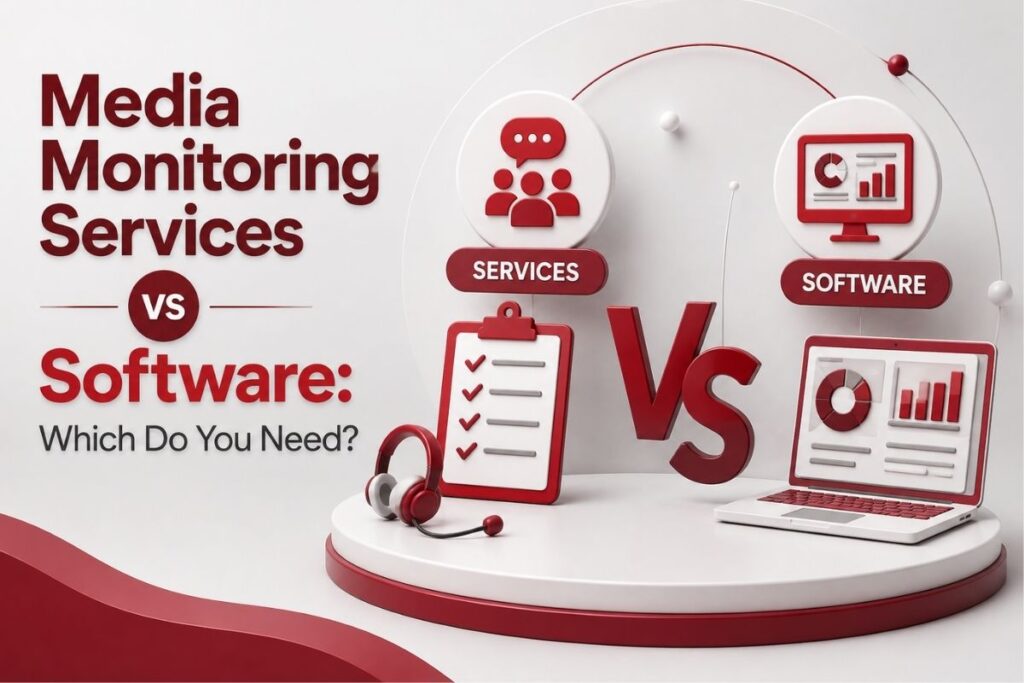
Modern communications teams face a critical operational crossroads: licensing self-service software or partnering with a managed service provider. Relying solely on automated software platforms often leads to unverified data noise, missed crisis signals, and misallocated staff hours. Choosing the right path depends on internal analytical bandwidth, regional media complexity, and tolerance for false positives. Media monitoring services bridge this gap by pairing advanced tracking technologies with human expertise to deliver actionable reputational intelligence.
What Are Media Monitoring Services?
Media monitoring services combine enterprise-grade tracking software with dedicated media analysts who curate, verify, and translate media mentions into strategic business intelligence. Unlike standalone software, managed services deliver human-checked reporting tailored to corporate goals.
Key capabilities include:
- Custom Boolean query construction and ongoing keyword tuning
- Human-verified sentiment analysis and false-positive filtering
- Real-time crisis alerts issued by human analyst teams
- Executive-ready media analytics and Share of Voice (SOV) reporting
What Are Media Monitoring Tools and How Do They Work?
Media monitoring tools are self-service software platforms that scan online news, print publications, broadcast channels, and social networks for specific keywords. These systems rely on Application Programming Interfaces (APIs), RSS feeds, and automated web scrapers to gather data into a single web dashboard. When configured properly, they collect vast quantities of public content in real time.
Operating these tools effectively requires technical setup. Users must build complex Boolean search strings using operators like AND, OR, and NOT to narrow down mentions. A typical enterprise search string looks like this: (“Brand Name” OR “Executive Name”) AND (“Crisis” OR “Lawsuit” OR “Earnings”) NOT (“Sponsorship” OR “Job Posting”).
While automated media monitoring tools offer raw speed and broad reach, their primary weakness is a lack of contextual understanding. Software detects word occurrences but cannot evaluate tone, sarcasm, or brand relevance. Without dedicated internal personnel to clean and filter incoming data, communication teams quickly suffer from alert fatigue. Utilizing a self-service media monitoring platform means your internal staff must manage this entire parsing and filtering layer themselves.
What Are Managed Media Monitoring Services?
Managed media monitoring services pair software scraping capabilities with human analyst oversight. Instead of logging into a raw software dashboard every morning, communications leaders receive pre-filtered briefs containing verified mentions and contextual executive summaries.
The core value of managed media monitoring services lies in human judgment. For instance, brands with generic names—such as “Summit,” “Pinnacle,” or “Horizon”—generate thousands of irrelevant mentions daily. Automated tools struggle to separate a company named “Summit Logistics” from news about a mountain summit or a political summit meeting. Human analysts review incoming mentions every morning, stripping away up to 80% of irrelevant data before generating reports.
Furthermore, managed services deliver qualitative context that software algorithms cannot replicate. Analysts synthesize coverage trends, assess journalist influence, and evaluate message delivery across Tier-1 publications. This human oversight transforms raw media mentions into strategic advisory reports for C-suite leaders.
Cost Difference Between Media Monitoring Software and Agencies
Evaluating media tracking investments requires calculating the Total Cost of Ownership (TCO) rather than comparing software license fees against agency invoices. The cost difference between media monitoring software and agencies becomes clear when factoring in internal labor, training, and configuration overhead.
When we look at the upfront software cost, self-service software (SaaS) typically ranges from $5,000 to $30,000 per year, whereas this cost is completely included in the service retainer for managed media monitoring services.
In terms of internal labor overhead, self-service tools require a high commitment, often demanding 10 to 20 hours per week from a team member just to manage the platform. Managed services, on the other hand, require a very low time commitment of only 1 to 2 hours per week for reviewing the finished reports.
Data cleanup and triage also differ drastically. With a software platform, manual internal effort is constantly required to weed out irrelevant data. With a managed service, this is fully handled by external analysts. Sentiment accuracy similarly heavily favors managed services, which boast a 95%+ human-verified accuracy rate, compared to the 60% to 75% machine learning average seen in SaaS products.
Finally, setup and maintenance for self-service software require an in-house Boolean expert to constantly tweak queries. Managed services offer a turnkey onboarding experience with ongoing, proactive optimization. Adding internal salary costs to software licensing often pushes the true expense of self-service software beyond the price of an outsourced managed service contract.
In-House Social Media Monitoring vs Outsourced Agency
Social networks generate vast volumes of uncoordinated public conversation, making real-time tracking complex. Deciding between in-house social media monitoring vs outsourced agency setups comes down to your primary operational objective: customer engagement or reputational risk management.
Handling social media monitoring internally works well for frontline community managers responding to customer service inquiries or product feedback. In-house teams excel at real-time brand engagement. However, relying solely on internal teams for macro-level reputation tracking often leads to blind spots during off-hours or sudden viral spikes.
Outsourcing high-volume social monitoring transfers the burden of data triaging to an external partner. Experienced service providers deploy dedicated analysts who monitor conversations around the clock, filtering out bot spam and isolated complaints. When a genuine crisis pattern emerges, the agency escalates verified intelligence to leadership, protecting internal teams from continuous notification fatigue.
Can Media Analytics Be Fully Automated Without Human Review?
Artificial Intelligence and Natural Language Processing (NLP) engines have advanced significantly, yet asking whether can media analytics be fully automated without human review yields a clear answer: full automation creates significant reporting errors.
Automated sentiment classification routinely misinterprets nuanced language, sarcasm, and regional expressions. Consider a public comment such as: “Great job taking two weeks to respond to my urgent support ticket!” Automated software flags words like “Great” and “job” as positive sentiment, logging this severe complaint as a favorable brand mention and corrupting your overall sentiment score. A human analyst instantly detects the sarcasm and delay, accurately categorizing it as a negative sentiment.
Automated media analytics also struggle with calculating true Share of Voice (SOV). Software treats a brief mention in a low-tier blog equally with an exclusive interview in a major national financial newspaper. Human analysts weight media coverage by publication authority, journalist beat alignment, and message retention, delivering accurate metrics that accurately reflect brand equity.
Best Setup for Local News Monitoring in the Turkish Market
Global enterprise software platforms often fail when deployed in regional markets with unique linguistic and media structures. Implementing the best setup for local news monitoring in the turkish market requires local media access and language-specific processing models.
Tracking media in Turkey presents distinct technical and operational challenges. First, there is agglutinative grammar complexity. Turkish relies on extensive suffix attachments added to root words. Global NLP models trained primarily on English fail to recognize stemmed keyword variations, causing missed mentions or inaccurate Boolean matches.
Second, the regional print and digital outlets present a major hurdle. Hundreds of influential regional newspapers and industry portals across Turkey operate behind local paywalls or lack standard RSS infrastructures. Global scrapers miss these sources entirely, whereas local managed services actively monitor them.
Third, cultural and political nuance is critical. Evaluating brand sentiment in Turkish news requires an understanding of regional political contexts, local idioms, and subtle editorial stances. Achieving complete local news monitoring across Turkish print, broadcast, and digital platforms requires an agency with direct relationships with regional publishers and native language analysts who review coverage daily.
How to Choose Media Monitoring Services for Crisis Management
Reputational threats spread rapidly across modern digital media ecosystems. Knowing how to choose media monitoring services for crisis management ensures your organization receives actionable warnings when early risk signals appear.
When evaluating potential service providers for crisis preparedness, demand specific operational guarantees:
- Alert Escalation SLA: Require explicit Service Level Agreements (SLAs) defining how quickly analysts verify and escalate emerging threats outside regular business hours.
- Human-in-the-Loop Filtering: Ensure alerts are reviewed by a human analyst before delivery to eliminate false alarms caused by trending pop-culture keywords or irrelevant bot activity.
- Post-Crisis Impact Auditing: Verify that the service provider delivers post-crisis reports analyzing root causes, message retention rates, and long-term SOV recovery metrics.
Partnering with a provider that combines automated tracking tools with real-time human verification protects your brand from unexpected reputational damage.
Frequently Asked Questions
Are automated media tracking tools accurate for non-English content?
No. Most automated tools struggle with non-English grammar, idioms, and sarcasm. Agglutinative languages like Turkish require native human review to ensure accurate sentiment classification and query coverage.
What is the main difference between media tracking software and a managed service?
Software provides a self-service dashboard requiring internal staff to build queries and clean raw data. A managed service provides human analysts who filter data, verify sentiment, and deliver finished reports.
How do managed services prevent false-positive mentions?
Human analysts manually review daily media clips before reports are issued. They strip out irrelevant matches caused by generic company names, homonyms, or unaligned search terms.
Can a managed media service integrate with our internal PR team?
Yes. Managed services function as an extension of internal teams, handling data triaging, media clip preparation, and analytical reporting so internal PR managers can focus on strategy and journalist outreach.
Conclusion
Navigating corporate reputation management requires balancing raw technological reach with human analytical accuracy. While self-service software offers speed for internal teams, managed media monitoring services provide the context, accuracy, and noise reduction necessary for executive decision-making. By eliminating false positives, managing language nuances, and providing human-verified crisis alerts, dedicated services turn raw data into strategic advantage. Ready to upgrade your media intelligence with human-verified insights? Contact Us → /media-monitoring-reporting to speak with our experts today.