

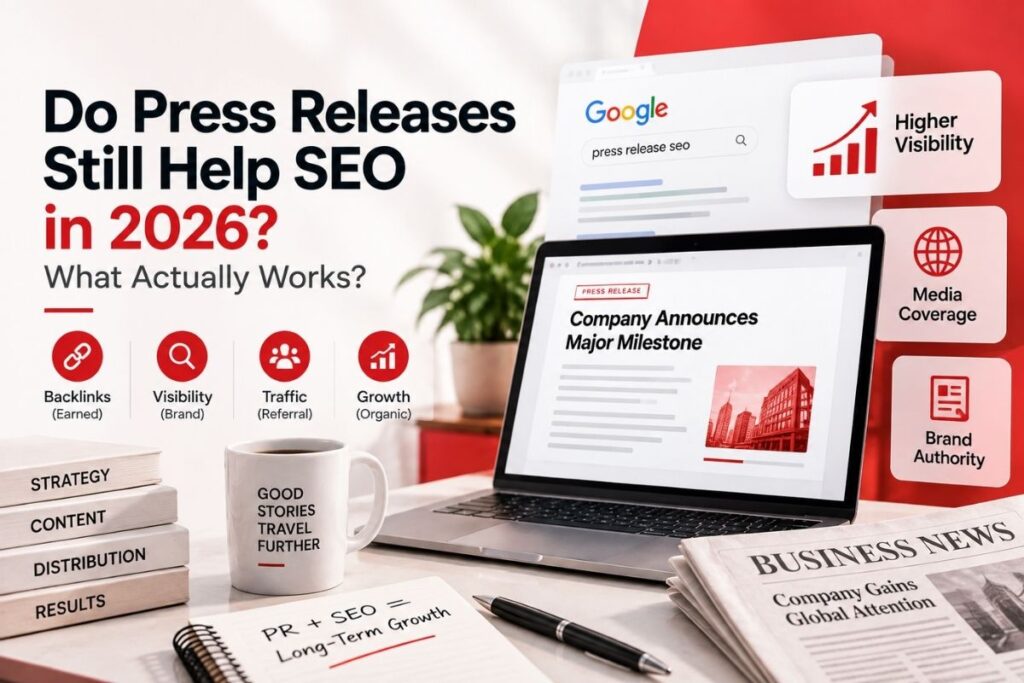
Yes, do press releases help SEO in 2026? They can—but mostly indirectly. A press release should not be expected to improve rankings simply because the same announcement appears across dozens of websites with links. Its real value comes from creating opportunities for journalist coverage, editorial backlinks, referral traffic, brand visibility and faster discovery of relevant content. For marketers, the important distinction is between mass syndication and genuine earned-media pickup.
Do press releases still help SEO in 2026?
Press releases still work for SEO when they function as news distribution and discovery assets rather than link-building shortcuts. Their strongest organic-search value comes when a legitimate announcement reaches journalists, generates independent coverage, sends qualified visitors to the company’s website and earns editorial links that exist because a publisher considered the story worth covering.
| Outcome | SEO value |
|---|---|
| Syndicated link | Limited/direct value uncertain |
| Editorial backlink | Potentially valuable |
| Brand exposure | Indirect value |
| Referral traffic | Indirect value |
| Content discovery | Supporting value |
That distinction explains why both extreme positions—“press releases are useless for SEO” and “press releases generate easy backlinks”—miss the point.
Google’s spam policies specifically discourage creating low-value content or distributed links primarily to manipulate ranking signals. Google also states that paid or sponsored links should be appropriately qualified, including with rel="nofollow" or rel="sponsored" where applicable.
So a release replicated across a large syndication network should not be evaluated by counting every resulting URL as a new SEO backlink.
The better question is: what happens after the announcement reaches the right audience?
That is where modern press release SEO begins.
How do press releases actually help SEO today?
The benefits of press release submission in SEO are primarily downstream effects. A strong announcement creates a discoverable source journalists can reference, sends relevant users to a destination page and can lead to independent coverage. The distribution itself is the starting mechanism; what publishers, journalists and audiences do afterward creates much of the potential value.
Editorial backlinks matter more than syndication links
A release may appear on multiple distribution or publishing endpoints. Those copies should not be treated as dozens of independent editorial endorsements.
A more valuable scenario occurs when a journalist discovers the announcement, verifies the story, writes an original article and independently links to the company, research, report, product page or source material.
Consider the difference:
| Distribution | Editorial pickup |
|---|---|
| Republished release | Independently written story |
| Same announcement | Original editorial context |
| Automated/scaled | Human selection |
| Link may be qualified | Link chosen editorially |
| Distribution metric | Earned-media outcome |
This is why SEO press release distribution should prioritize relevant media reach rather than the largest possible syndication count.
The gap between a press release that gets ignored and one that earns real coverage usually comes down to distribution quality — working with a press release distribution service that has direct relationships with journalists, rather than relying on mass syndication alone, is what turns a release into an actual backlink opportunity.
The release still needs a real story. Distribution cannot manufacture newsworthiness.
Brand and entity visibility create secondary search benefits
Press releases can also put a company name, product, executive, research project or event into a wider public context. That can increase the number of places where audiences encounter the brand and may subsequently lead to branded searches, citations and independent coverage.
This should not be simplified into “brand mentions automatically improve rankings.” Google does not provide a formula saying that every unlinked mention produces a ranking increase.
The practical benefit is broader: repeated legitimate media exposure makes the organization easier for users and publishers to discover, understand and reference.
A launch, funding announcement, international expansion, research finding or significant partnership can therefore support organic visibility even when the initial release itself is not the page expected to rank.
Referral traffic can introduce qualified audiences
A publisher or journalist who references the announcement can send readers directly to the company’s site.
Referral traffic is not equivalent to a guaranteed ranking boost. Its commercial value is that the visitors arrive from contextually relevant coverage and can continue into product pages, reports, booking pages or other conversion paths.
For a marketing manager, this means press release submission in SEO should not be evaluated solely inside a backlink tool. Analytics should also track referral sessions, engaged visits, conversions and which publishers generated useful audiences.
Press releases can support content discovery
A release can create additional crawlable paths toward a newly published destination page. However, marketers should be precise with the claim that press releases “make Google index pages faster.”
Google’s own documentation notes that crawling and indexing take time and are not guaranteed immediately. For pages a site directly controls, Google recommends mechanisms such as accessible internal links, sitemaps and URL Inspection as part of crawl and indexing management.
A press release can therefore support discovery, but it should not replace sound technical indexing practices.
That distinction matters when designing the destination page.
What makes a search engine optimized press release?
A search engine optimized press release is written primarily for journalists and readers while giving search systems clear contextual signals about the announcement. Optimization should improve clarity and discovery; it should never turn the release into a keyword-heavy document designed mainly to manufacture links.
For marketers asking how to use press releases for SEO without link spam, four principles matter most.
1. Use the primary topic naturally
The main subject should appear clearly near the beginning so journalists and readers immediately understand what happened.
If a cybersecurity company launches a fraud-prevention platform, the release should naturally explain the product category, company and announcement. Repeating “fraud prevention software” unnaturally throughout the copy does not make the release more useful.
A practical structure is:
- Clear announcement and entity
- Essential facts in the opening paragraph
- Supporting context and evidence
- Relevant spokesperson quotation
- One logical destination for deeper information
This is search engine optimization for press releases in its useful form: clarity, relevance and strong information architecture.
2. Link to the page that deserves the visit
One of the most common press release SEO mistakes is sending every link to the homepage.
The destination should match the announcement. A research release might link to the complete report. A product announcement can point to the product page. A new market entry might lead to a dedicated regional page.
This matters for users first. Someone reading about a specific report should not have to land on a generic homepage and search for it again.
It also creates a cleaner relationship between the announcement and the page the company wants audiences, journalists and search engines to discover.
3. Add useful multimedia
Original images, charts, executive photography or video can make an announcement easier for publishers to understand and reuse.
Multimedia should add evidence or context. A chart showing a research finding has more editorial utility than a generic stock photograph.
Where the company hosts supporting content on its own website, appropriate structured data can help search engines understand page elements. Google states that Article structured data can provide information such as the article headline, images, dates and author, while VideoObject markup can help Google understand eligible video content.
Structured data supports understanding; it does not make an unnewsworthy release rank.
4. Keep the release technically clean
A press release should have one clear purpose and a consistent canonical destination on the company’s site when relevant. Duplicate or near-duplicate pages created solely to capture slightly different keywords create unnecessary fragmentation.
Google explains that when substantially similar pages exist, its systems select a canonical version based on multiple signals; explicit canonical annotations and sitemap inclusion can help communicate preferences.
That principle leads directly to the most important press release SEO best practices.
Press release SEO best practices that matter in 2026
Modern press release SEO best practices prioritize story quality, destination-page quality and relevant distribution over keyword repetition or link volume. A release should make the news easy to understand, provide journalists with usable information and direct interested readers toward the strongest page for the subject.
A practical checklist looks like this:
- Start with actual news. A weak corporate update does not become link-worthy because keywords were added.
- Define one primary topic. Keep terminology natural and consistent.
- Answer the essential facts early. Journalists should understand what happened without reading the entire release.
- Choose a relevant destination URL. Avoid defaulting to the homepage when a stronger page exists.
- Provide original evidence. Data, reports, images and useful quotes increase editorial utility.
- Distribute by relevance. Industry and business journalists with a genuine reason to cover the story matter more than raw network size.
- Measure downstream results. Track earned stories, editorial links, referral sessions, branded demand and conversions.
For a press release SEO strategy for a new product launch, for example, the destination might be a complete product page containing specifications, original visuals, FAQs and supporting information. The release announces the news; the destination page satisfies deeper search and commercial intent.
This division of labor is important. The press release does not need to become the company’s permanent ranking page for every product-related query.
Instead, it should make the underlying asset easier to discover and easier for journalists to cite.
What should marketers not expect from press release SEO?
A press release alone will not reliably rank a weak page for a competitive commercial query. It cannot substitute for useful content, technical accessibility, internal linking, relevant authority or a destination page that actually satisfies search intent.
This is the most important expectation to set when asking do press release affect my SEO.
Press releases should not be purchased with these assumptions:
- Every syndicated copy equals a valuable backlink.
- A high distribution count guarantees higher rankings.
- Repeating target keywords increases the release’s authority.
- One release can compensate for a weak destination page.
- Indexation or ranking improvements are guaranteed.
Google’s spam policies explicitly target attempts to manipulate rankings through artificial linking practices and low-value content created primarily for ranking manipulation.
That makes the old “submit a release to hundreds of sites for backlinks” mindset particularly weak as a modern strategy.
Press release distribution or link building for SEO?
Press release distribution or link building for SEO is also a false choice when the activities are properly defined.
| Press release | Link earning |
|---|---|
| Starts with news | Starts with linkable value |
| Targets journalists | Targets relevant publishers |
| Seeks coverage | Seeks citations |
| Time-sensitive | Can be evergreen |
| PR-led | Content/outreach-led |
A genuinely newsworthy release can lead to link earning when reporters create independent stories. But buying distribution should not be treated as buying ranking authority.
This also answers the budget question.
Is paid press release distribution worth it for SEO?
Is paid press release distribution worth it for SEO? It can be when there is real news, a strong destination page and access to journalists who cover the relevant market. It is a poor investment when the primary objective is simply to manufacture large numbers of links.
Marketing managers should evaluate distribution against four questions:
| Question | Good signal |
|---|---|
| Is it newsworthy? | Clear external relevance |
| Who receives it? | Relevant journalists |
| Where does it lead? | Strong destination page |
| What is measured? | Coverage + traffic + links |
A release announcing original research, a significant international expansion, a material product development or another genuinely reportable event has more potential than routine internal news presented as a major story.
Measurement should also distinguish syndication from earned coverage. If a dashboard reports hundreds of placements but none generates meaningful referral traffic, independent reporting or relevant citations, the headline number may say little about actual organic-search value.
Conversely, one respected publication independently covering the story can matter more strategically than dozens of automated reproductions.
That is why the benefits of press release submission in SEO should be evaluated as part of a wider earned-media system rather than isolated as a backlink tactic.
Sık sorulan sorular
Do press releases still work for SEO?
Yes, but mainly indirectly. Press releases can generate editorial coverage, referral traffic, brand visibility and opportunities for independently earned backlinks. Mass-syndicated links themselves should not be treated as guaranteed ranking signals.
What is press release in SEO?
A press release in SEO is a news announcement used to increase discovery and media exposure around a company, product, report or event. Its organic-search value usually comes from subsequent coverage, referral traffic, citations and editorial links rather than the release alone.
What is the 80/20 rule in SEO?
For press releases, a useful 80/20 framework is to spend roughly 80% of the effort on newsworthiness and destination-page quality and 20% on optimizing the release itself. This is a strategic rule of thumb, not a Google formula; most durable value comes from the story and the asset journalists can cite.
Are press releases worth it?
Yes, when there is genuine news and distribution reaches relevant journalists. They are less compelling when purchased only for mass backlinks. Evaluate value through earned coverage, relevant referral traffic, editorial links and commercial outcomes rather than syndication volume alone.
Sonuç
The answer to do press releases help SEO in 2026 is yes—but not in the simplistic sense of distributing a release and collecting ranking power from every syndicated link. The strongest results come from combining genuine newsworthiness, a high-quality destination page and relevant journalist distribution so that a release can generate earned coverage, referral traffic, brand visibility and editorial backlinks. Marketing managers should therefore judge a campaign by what happens after distribution, not by the number of copies published. When the story deserves media attention, targeted distribution can turn the press release from a publishing task into a broader earned-media and organic-visibility asset.