


Sending a press release does not automatically result in media coverage. Journalists receive numerous story proposals, work under editorial deadlines, and prioritize information that is relevant to their audiences. Without a clear outreach strategy, even a significant company announcement can go unnoticed.
Media relations helps organizations bridge this gap by developing professional relationships with journalists, identifying newsworthy opportunities, and communicating information in formats that support editorial work.
For startups, established companies, and international brands entering new markets, it can contribute to brand awareness, credibility, and long-term visibility.
This guide explains how the process works, which activities and tools are involved, how to develop an effective strategy, and when working with an external agency makes sense. It also examines the local considerations international brands should understand when approaching the Turkish media.
What Is Media Relations?
Media relations is the practice of establishing and maintaining professional relationships with journalists, editors, producers, and other media professionals to communicate newsworthy information and create opportunities for independent editorial coverage.
The definition extends beyond sending press releases. It includes identifying relevant journalists, developing story angles, arranging interviews, providing supporting materials, and responding to editorial inquiries.
To understand the meaning of media relations in public relations, consider it a specialized function within a broader communications discipline. Public relations manages relationships with multiple stakeholder groups, while media outreach focuses specifically on communication with the press.
Successful relations with media professionals depend on relevance, accuracy, accessibility, and mutual professional respect.
Media Relations vs. Press Release Distribution vs. Advertising
Although these activities can support similar business objectives, their methods and outcomes differ.
| Comparison | Media relations | Press release distribution | Advertising |
|---|---|---|---|
| Primary goal | Earn editorial attention | Deliver an announcement to relevant media outlets | Purchase audience exposure |
| Cost model | Internal resources or agency fees | Distribution fees or service packages | Paid media budget |
| Control over message | Limited by editorial independence | Control over the original release, not independent reporting | Greater control over approved advertising content |
| Credibility | Independent editorial validation when coverage is earned | Depends on the publication format and editorial treatment | Commercial communication identified as advertising |
Press release distribution is one tool within a wider outreach program. A release delivers information efficiently, while targeted journalist engagement can help develop interview opportunities, features, and expert commentary.
Social media PR is another related activity, but it often involves communicating directly with online audiences rather than working through journalists.
Why Media Relations Matters for Businesses
Builds Credibility Through Independent Coverage
Consumers, investors, and business partners encounter promotional messages throughout the buying process. Independent reporting provides a different perspective because editorial decisions are made by publishers rather than advertisers.
Positive coverage may strengthen credibility, although its impact depends on the publication, the subject, and the audience’s perception.
Expands Brand Awareness
Relevant media coverage can introduce a company to audiences that may not encounter its advertising or owned content.
For smaller businesses and startups, appearing in a respected industry publication may be more valuable than receiving broad exposure in an outlet unrelated to their market.
Supports Search Visibility
Online news articles, interviews, and expert contributions can create additional opportunities for people to discover a company through search engines.
Editorial backlinks and brand mentions may also contribute to a broader digital presence. However, coverage does not automatically improve search rankings, and publishers independently determine whether to include links.
Creates Long-Term Communication Opportunities
Consistent, useful interactions can establish a company as an accessible source of industry information.
Rather than approaching journalists only when launching a product, organizations can share relevant expertise throughout the year. This approach can support future interview requests, commentary opportunities, and editorial inquiries.
What Are the Core Activities of Media Outreach?
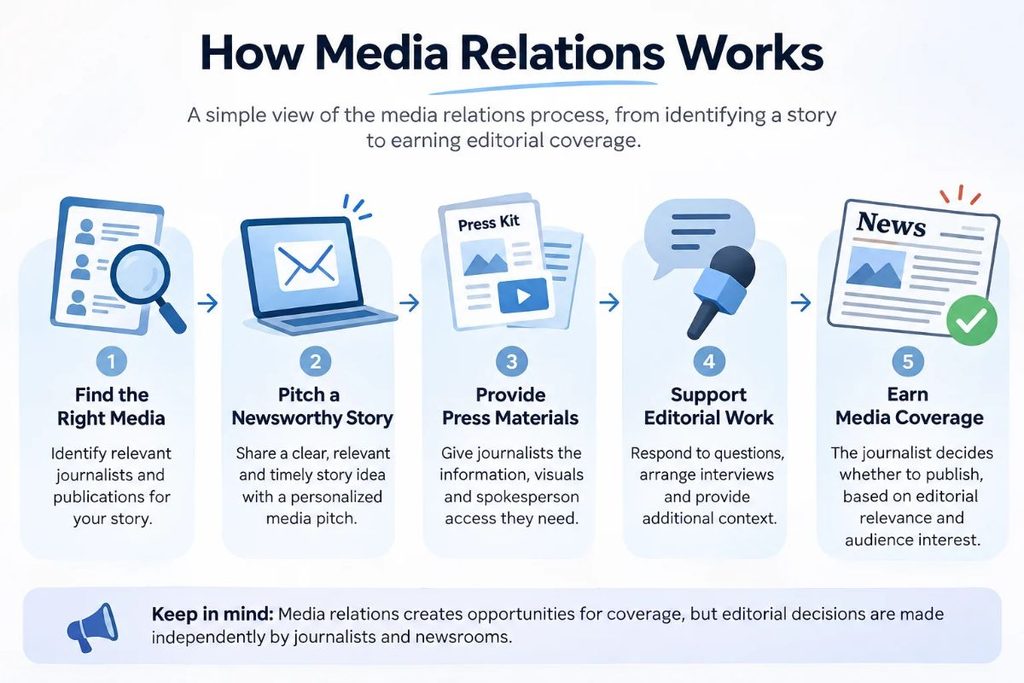
An effective program combines proactive communication with responsive support. Its activities should address both the organization’s objectives and the practical requirements of journalists.
Building and Maintaining a Media List
A media list organizes relevant publications, journalists, editorial contacts, and communication preferences.
Instead of collecting as many email addresses as possible, focus on professionals who actively cover your industry, geographic market, or announcement category.
A useful database should record editorial beats, recent articles, contact details, and previous interactions. Follow this guide on how to build a media list to develop a more structured outreach process.
Pitching Newsworthy Stories
A media pitch explains why a particular story deserves editorial attention.
Effective pitching connects a company announcement, expert perspective, or emerging industry development to the interests of a journalist’s audience. It should make the editorial opportunity clear without requiring the recipient to search through lengthy promotional materials.
These media pitch examples and email templates provide practical starting points for different outreach situations.
For significant announcements that suit a particular publication, consider whether pitching an exclusive story to a journalist would be more appropriate than contacting multiple outlets simultaneously.
Preparing Press Materials
Journalists need reliable information that can be accessed and verified efficiently.
Supporting materials may include company fact sheets, executive biographies, approved photographs, product specifications, research findings, and official statements.
A well-organized press kit example can help your team determine which assets to prepare before starting a campaign.
It is also useful to understand the difference between a press kit and a media kit, since these resources may serve different editorial and commercial purposes.
Organizing Press Events and Interviews
Product launches, press conferences, demonstrations, and executive interviews allow journalists to gather information directly from a company.
An event should provide a genuine editorial reason to attend, such as access to a new product, an expert, or a significant business announcement.
When inviting reporters, understanding the distinction between a media advisory and a press release helps ensure that the communication format matches its purpose.
Responding to Journalist Requests
Journalists may contact organizations for expert opinions, background information, interviews, or clarification on existing stories.
Establishing an internal process for handling these requests can reduce delays. The process should identify who verifies information, who approves statements, and which spokesperson is available to respond.
When information cannot be confirmed, communicate that limitation rather than offering speculation.
Maintaining Professional Relationships
Journalist relationships require consistency beyond individual campaigns.
Respect editorial deadlines, provide accurate information, and avoid unnecessary follow-ups. A company that consistently offers relevant material and responds professionally is better positioned to maintain productive working relationships over time.
How to Build a Media Relations Strategy in 7 Steps
A structured strategy connects business objectives with relevant audiences, editorial opportunities, and measurable communications activities.
The following seven steps can help organizations turn occasional outreach into a coordinated program.
Step 1: Define Your Communication Goals
Start by identifying what the organization wants to achieve.
Possible objectives include introducing a new brand to a market, increasing awareness among industry decision-makers, establishing executive credibility, or communicating a significant company development.
Your objectives should align with the organization’s broader public relations strategies rather than operate as isolated publicity activities.
Step 2: Identify Your Target Audiences
Determine who needs to receive your message before selecting publications.
A technology company targeting enterprise buyers may prioritize specialist business and technology outlets. A consumer brand may focus on lifestyle publications, regional news, or product-focused editorial content.
Audience relevance should guide publication selection, not simply the size of an outlet’s readership.
Step 3: Develop Newsworthy Story Angles
Company announcements become more useful to journalists when they address a wider editorial subject.
Consider whether the story involves an industry trend, new product capability, investment, research finding, local development, or expert perspective.
For example, a hypothetical technology company entering Turkey could connect its announcement to local business needs and explain how its offering addresses them. The story should be supported by verifiable information rather than promotional claims.
This approach is particularly important for businesses looking to get media coverage without relying entirely on paid placements.
Step 4: Segment Your Target Media List
Organize contacts according to industry, audience, geography, publication type, and editorial interests.
A segmented list allows you to adapt pitches without changing the underlying facts. It also helps prevent irrelevant outreach and unnecessary duplication.
Review recent reporting before contacting journalists, especially when approaching a publication for the first time.
Step 5: Create an Outreach Calendar
A media relations plan should establish when announcements, interviews, editorial pitches, and follow-ups will take place.
Consider relevant industry events, seasonal developments, publication deadlines, product launches, and internal approval requirements.
Leave flexibility for unexpected opportunities. A rigid calendar may prevent your organization from contributing timely commentary when an important industry story develops.
Step 6: Prepare Spokespeople and Supporting Assets
Identify who can speak on behalf of the organization and which subjects each person is qualified to address.
Prepare relevant photographs, biographies, background documents, verified data, and interview talking points before contacting journalists.
A shared internal approval process helps ensure that communications remain consistent across departments and markets.
Step 7: Measure Results and Refine Your Approach
Evaluate outcomes against the original communication objectives rather than counting every mention as equally valuable.
Review publication relevance, editorial coverage, interview opportunities, message inclusion, referral traffic, and audience alignment where measurable.
PRTURKEY’s Media Monitoring & Reporting service supports the tracking and analysis of published coverage and brand visibility.
Use the findings to refine your next campaign, identify stronger story angles, and focus resources on relevant outlets.
Executive and Spokesperson Outreach Strategies
Executive outreach positions qualified company leaders as sources of informed industry commentary.
Identify subjects where an executive has genuine expertise, prepare concise perspectives, and approach journalists whose reporting aligns with those topics.
Effective spokesperson engagement should prioritize useful insights over repeated promotion of the company or its products.
B2B and Corporate Media Relations
Business-to-business outreach differs from consumer-facing PR because it frequently targets smaller, more specialized audiences involved in purchasing, investment, and industry decisions.
B2B media relations may focus on trade publications, sector-specific developments, technical innovations, partnerships, and expert analysis. A relevant article in a specialist publication can be valuable even when its audience is comparatively small.
Corporate media relations often addresses organizational reputation, leadership announcements, financial developments, sustainability initiatives, and institutional communication.
Consumer campaigns, by comparison, may emphasize product experiences, lifestyle relevance, availability, and recognizable brand stories.
Some sectors require additional specialist knowledge. For example, life science media relations involves technical and scientific editorial beats that benefit from accurate terminology and appropriate professional expertise.
Essential Media Relations Tools
Technology supports outreach by helping teams organize information, identify relevant contacts, and evaluate communication outcomes.
The most useful tool categories include:
- Media databases: Identify journalists, editors, publications, and relevant editorial beats.
- Media monitoring platforms: Track news coverage, brand mentions, and emerging industry developments.
- Digital press rooms: Provide centralized access to approved company information and press assets.
- Email outreach tools: Organize personalized communication, contact history, and appropriate follow-ups.
- Reporting platforms: Consolidate coverage data, campaign activity, and measurable outcomes.
PRTURKEY’s Media Database provides access to segmented journalist and editorial contacts across different sectors.
Tools should improve the relevance and organization of outreach. They cannot replace editorial judgment, professional relationships, or a genuinely newsworthy story.
Media Relations Services: What an Agency Actually Does
A media relations agency helps organizations plan and execute communication with relevant journalists and publications.
Depending on the engagement, its responsibilities may include campaign planning, editorial research, media list development, content preparation, pitching, interview coordination, monitoring, and reporting.
What Does a Media Relations Specialist Do?
A media relations specialist identifies editorial opportunities, develops relevant pitches, coordinates communication with journalists, and supports organizational spokespeople.
The role requires research, writing, communication, and an understanding of publication workflows. Its focus is on developing professional outreach that serves both organizational objectives and editorial needs.
What Can Businesses Manage In-House?
Organizations with experienced communications teams may already have the resources to manage routine announcements, maintain existing journalist contacts, and prepare press materials internally.
External support can become useful when entering unfamiliar markets, launching complex campaigns, requiring additional outreach capacity, or seeking specialist industry knowledge.
A combined approach allows internal teams to retain control over business messaging while external partners contribute research, local expertise, and operational support.
Retainer vs. Project-Based Services
A retainer typically provides ongoing support under an agreed scope of work. It may suit businesses with regular announcements, executive commentary opportunities, or continuous communication needs.
Project-based engagements focus on defined activities, such as a product launch, company announcement, press event, or market entry campaign.
Ask providers to clarify deliverables, exclusions, additional charges, reporting frequency, and how changes to the original scope will be managed.
How to Evaluate an Agency
When comparing providers, assess their understanding of your target market and the quality of their proposed approach.
Startups evaluating potential partners should prioritize relevant experience, realistic expectations, transparent deliverables, and an ability to explain why a particular story would interest journalists.
Ask how the provider selects publications, distinguishes paid placements from independent editorial coverage, and measures campaign performance.
This guide on how to choose a PR agency provides additional criteria for evaluating external communications partners.
No agency can guarantee independent editorial coverage. Publication decisions remain with journalists, editors, and media organizations.
Media Relations in Turkey: What International Brands Should Know
Entering the Turkish market requires more than translating existing press materials into Turkish.
International companies should consider local editorial interests, language conventions, regional audiences, and the relevance of their announcements to readers in Turkey.
Understand National and Regional Publications
Turkey’s media landscape includes national newspapers, digital news platforms, television broadcasters, specialist trade publications, and regional outlets.
Businesses should consider relevant local and regional media across the country’s provinces rather than concentrating exclusively on Istanbul or national publications.
A company opening a regional facility, for example, may have a stronger story for local business and community publications than for a general national outlet.
Develop Relationships With Turkish Journalists
Local journalists should be approached according to their editorial interests and preferred communication methods.
Research the publications covering your sector, provide accessible Turkish-language materials when appropriate, and make relevant spokespeople available for follow-up questions.
Understanding how to get featured in Turkish media can help international brands develop a more locally relevant approach.
Localize Global Announcements
A translated announcement communicates the original message in another language. Localization goes further by explaining why that message matters to the local audience.
A global product launch may need additional context about availability in Turkey, local partnerships, distribution channels, or market-specific applications.
International brands should ensure that localized materials preserve verified facts and approved company messaging.
How to Measure Outreach Performance
Measurement should connect editorial outcomes with communication objectives.
Relevant indicators may include the quality and relevance of coverage, interview opportunities, key message inclusion, referral traffic, editorial backlinks, share of voice, and coverage tone.
Distinguish confirmed results from estimated measures such as potential reach. An outlet’s total readership does not establish how many people read a particular article.
A structured PR reporting guide can help communications teams organize campaign results and identify improvements for subsequent activity.
6 Common Media Outreach Mistakes
- Sending generic pitches: Identical messages may overlook the editorial interests of individual journalists.
- Treating every announcement as newsworthy: Internal business developments do not always offer sufficient relevance to external audiences.
- Targeting publications based only on size: Audience alignment can matter more than broad reach.
- Following up excessively: Repeated messages without additional value can damage professional relationships.
- Failing to prepare supporting materials: Missing information, images, or spokesperson availability can delay editorial work.
- Confusing paid placements with earned coverage: Sponsored content and independent reporting serve different purposes and should be evaluated separately.
Frequently Asked Questions
What Is Media Relations?
It is a specialized communications practice focused on developing professional relationships with journalists, editors, producers, and publications. Its activities include identifying newsworthy stories, pitching relevant information, preparing press materials, coordinating interviews, and responding to editorial requests. It aims to create opportunities for independent coverage while respecting the media’s editorial decisions.
What Is the Difference Between Media Relations and Public Relations?
Public relations is a broader discipline that manages an organization’s communication with customers, employees, investors, communities, and other stakeholders. Media outreach is one function within that discipline, concentrating specifically on journalists and publications. An organization’s wider PR strategy may also include internal communications, events, reputation management, and stakeholder engagement.
What Is the Difference Between Media Relations and Press Release Distribution?
Press release distribution involves delivering an official announcement to selected media contacts or publication networks. Media outreach encompasses a wider range of activities, including personalized pitching, interview coordination, expert commentary, and relationship development. Distribution can support this broader process, but it does not replace targeted journalist engagement or guarantee independent editorial coverage.
Does Media Relations Guarantee Coverage?
No. Journalists and editors independently decide which stories to publish based on editorial relevance, available resources, audience interests, and other considerations. Professional outreach can improve how information is presented and delivered, but it cannot guarantee publication, favorable reporting, specific headlines, backlinks, or placement in a particular independent media outlet.
How Do You Measure Media Relations?
Performance can be evaluated through relevant editorial coverage, interview opportunities, publication quality, key message inclusion, referral traffic, and other indicators aligned with communication objectives. Reporting should distinguish independent coverage from sponsored placements and estimated reach from confirmed engagement. The most useful metrics depend on the organization’s original goals and available measurement data.
Conclusion
Effective journalist engagement depends on newsworthy information, targeted outreach, reliable press materials, and consistent professional communication. International brands seeking to strengthen their visibility in Turkey can explore PRTURKEY’s Digital PR services for support with locally relevant communication and media outreach.