


Getting media coverage starts with a story that matters to a publication’s audience—not simply a press release announcing what your company has done. Businesses can earn attention from journalists by identifying a newsworthy angle, targeting relevant reporters, presenting credible information, and making it easy for newsrooms to investigate the story.
Whether you run a small business, organize an event, or represent an established company, the objective is the same: give journalists a compelling reason to cover your news independently.
This guide explains how to get media coverage, approach journalists, develop stronger story ideas, and measure the results of your outreach.
What Is Media Coverage?
Media coverage is the attention a person, organization, event, or subject receives through news articles, interviews, television reports, radio broadcasts, podcasts, and other media publications.
For businesses, media coverage can introduce products, highlight research, communicate important developments, and establish visibility among relevant audiences.
Not all media exposure is the same.
| Type of coverage | How it works | Example |
|---|---|---|
| Earned media | A journalist independently decides to cover a story | A newspaper interviews a founder about an industry development |
| Paid media | An organization pays for advertising or sponsored placement | A sponsored article on a news website |
| Owned media | An organization publishes content through its own channels | A company blog announcement |
| Press release syndication | A release is republished through distribution networks or participating websites | The same announcement appears on multiple news aggregation pages |
Earned media coverage is not guaranteed. A journalist or editor decides whether a story deserves publication, which information to include, and how to present it.
This distinction matters when evaluating results. A press release appearing on multiple websites does not necessarily mean independent journalists have reported on the announcement.
How to Get Media Coverage: 10 Practical Ways
The most effective approach combines a relevant story, careful journalist research, timely outreach, and credible supporting material.
1. Identify What Makes Your Story Newsworthy
Before contacting a journalist, ask why the publication’s audience should care.
A business announcement is not automatically a news story. Journalists generally look for developments that are timely, relevant, consequential, unusual, or supported by meaningful evidence.
Consider two possible announcements:
Weak angle: A company launches a new inventory management platform.
Stronger angle: A company introduces an inventory management platform designed to address a documented operational problem affecting independent retailers.
The second angle offers a clearer editorial direction, provided the problem and product claims can be substantiated.
Potential newsworthy developments include original research, significant investments, new partnerships with measurable implications, industry changes, community initiatives, and products addressing identifiable problems.
Start with the impact on people or an industry rather than the company’s desire for publicity.
2. Understand Your Target Audience
Media coverage is valuable when it reaches people who have a reason to be interested in your story.
A technology company selling software to manufacturers may benefit more from a specialized industry publication than a general entertainment website with a much larger readership.
Identify your target audience by considering:
- The industries or communities affected by the announcement
- The geographic markets where the story matters
- The questions your audience is already asking
- The publications and journalists covering those subjects
This audience-first approach helps prevent outreach that generates visibility without meaningful relevance.
3. Find Journalists Who Cover Your Industry
Sending an announcement to hundreds of unrelated journalists is not a substitute for targeted media outreach.
Research reporters who have recently written about the subject. Review their published articles, editorial responsibilities, and the audiences their publications serve.
A journalist who regularly covers renewable energy investment may be interested in a verified funding announcement involving energy technology. The same journalist is unlikely to find an unrelated consumer product launch relevant.
Build a shortlist that records each journalist’s publication, editorial beat, recent relevant work, professional contact information, and reason for inclusion.
For a more detailed process, see PR Turkey’s guide on how to build a media list.
4. Create a Story Angle Instead of a Sales Pitch
A media pitch should explain the potential story, not read like an advertisement.
Compare these approaches:
Promotional: Our company is excited to announce an innovative service that will transform the market.
Editorial: A new service is entering the market to address a specific challenge faced by independent businesses, with supporting data and an available industry spokesperson.
The second approach gives a reporter something to investigate.
A useful story angle answers four questions:
- What has happened or changed?
- Why does it matter to this publication’s readers?
- Why is the story relevant now?
- What evidence or sources can verify the information?
Avoid exaggerated descriptions such as revolutionary, world-leading, or industry-changing unless those claims can be supported.
5. Write a Concise, Personalized Media Pitch
Journalists need to understand the relevance of a potential story quickly.
A strong pitch usually includes a specific subject line, a short explanation of the development, the most important supporting facts, and a clear next step.
Personalization should demonstrate genuine editorial relevance rather than inserting a journalist’s name into a generic message.
For example, referring to a recent article on a closely related industry issue can establish why the proposed story belongs in that reporter’s coverage.
Keep the email focused. If additional background is needed, provide a link to supporting material rather than overwhelming the initial message.
PR Turkey’s media pitch examples and templates provide more detailed formats for different announcement types.
6. Prepare Supporting Materials Before Outreach
A promising story can lose momentum if essential information is difficult to obtain.
Before contacting journalists, prepare the materials they may need to assess and report the announcement.
Depending on the subject, these may include verified facts, relevant research, spokesperson biographies, approved photographs, product information, supporting documents, and a reliable media contact.
For research-based announcements, explain the methodology, sample size, research period, and important limitations.
For product announcements, provide accurate specifications and make demonstrations available when appropriate.
For corporate developments, confirm that figures, dates, partnerships, and executive statements have been approved for publication.
Good preparation helps journalists evaluate the story independently. It does not require them to use the supplied material.
7. Choose the Right Timing
The best time to approach a journalist depends on the type of story, publication, editorial schedule, and urgency.
Breaking news requires a different approach from a planned product launch or a feature story for a monthly publication.
For an event, journalists may need advance notice to arrange attendance, interviews, or filming. A specialized magazine may require considerably more lead time than a digital news outlet.
Before sending your pitch, consider whether:
- The information is ready for public release.
- The announcement is connected to a timely development.
- The journalist has sufficient time to investigate it.
- The proposed publication date conflicts with a major news event.
- Any embargo has been explicitly agreed upon.
There is no universal day or hour that guarantees higher media pickup.
If an announcement is time-sensitive, state the relevant deadline clearly and accurately.
8. Use Press Releases Strategically
A press release is useful when an organization has a factual announcement that journalists may need to reference.
It can provide a structured summary of a development, including essential facts, relevant quotations, background information, and contact details.
However, a press release and a media pitch serve different purposes.
A press release documents the announcement. A media pitch explains why a particular journalist might want to cover it.
For significant announcements, the two can complement each other. A company might distribute its official release while separately offering relevant journalists interviews, research, or a tailored editorial angle.
Press release distribution can broaden access to an announcement, but it should not be confused with guaranteed independent reporting.
9. Follow Up Without Pressuring Journalists
A journalist may miss an email, be working on another assignment, or decide that the story does not fit the publication.
If you have not received a response, one concise follow-up after a reasonable interval may be appropriate.
Refer to the original message, restate the central news value, and mention any genuinely new information.
Avoid repeatedly forwarding the same email, demanding a response, or contacting someone through private channels without an appropriate professional reason.
If the journalist declines the story or asks not to receive further pitches, respect that decision.
Sometimes the better next step is to refine the angle or approach a more relevant publication rather than send another reminder.
10. Build Media Relationships Beyond Announcements
Consistent media relations involves more than contacting reporters when a company wants publicity.
Organizations can become useful sources by providing accurate information, responding promptly to relevant requests, and connecting journalists with knowledgeable spokespeople.
For example, a manufacturing specialist may offer informed commentary on a significant industry development even when the company has no product announcement.
That contribution can be valuable to a reporter covering the subject.
The objective is to become a reliable source of information—not to expect favorable coverage in exchange for assistance.
How to Know If Your Story Is Newsworthy
Before sending a pitch, evaluate the proposed story using a simple editorial checklist.
| Newsworthiness factor | Question to ask |
|---|---|
| Timeliness | Has something important happened recently, or is a relevant development approaching? |
| Relevance | Does the story matter to the publication’s audience? |
| Impact | Does it affect customers, communities, businesses, or an industry in a meaningful way? |
| Originality | Does the announcement provide information that is genuinely new? |
| Evidence | Can the central claims be independently checked? |
| Human interest | Is there a credible personal or community dimension? |
This is an editorial planning tool, not an official journalist scoring system.
A story does not need to satisfy every criterion. Its strongest qualities should determine the angle and the publications approached.
Example scenario: A small business opens a second location.
The opening itself may have limited national appeal. However, a regional journalist might be interested if it involves a documented investment, creates local employment, or addresses a clearly established community need.
The same underlying event can have different editorial relevance depending on the audience.
How to Ask a Journalist for Media Coverage
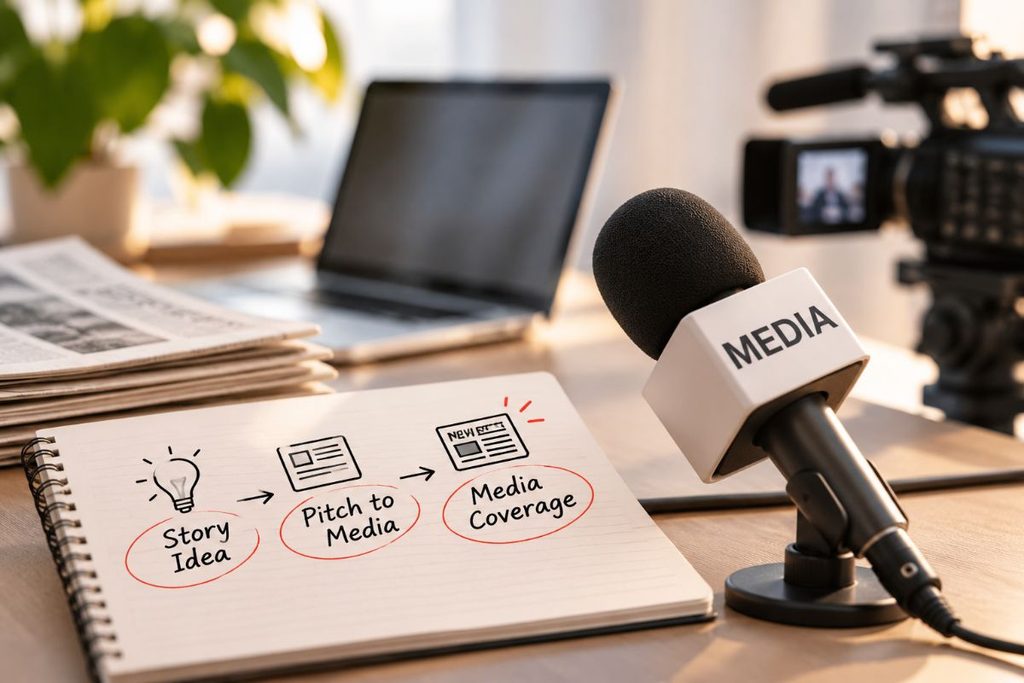
To ask for media coverage, send a short, relevant story proposal to a journalist who covers your subject. Explain the news, establish why it matters to their readers, and offer credible information or an interview.
Here is an adaptable example.
Subject: Story Idea: Local Business Expansion and New Employment Opportunities
Hi [Journalist’s Name],
I noticed your recent reporting on business development in [Location].
[Company Name] is preparing to open a new facility in the area on [Confirmed Date]. The expansion includes [Verified Investment or Operational Details] and is expected to create [Confirmed Number] positions.
The development may be relevant to your coverage of local business activity and employment.
We can provide further details, approved photographs, and an interview with [Spokesperson Name and Title].
Would you be interested in reviewing the announcement?
Best regards,
[Your Name]
[Organization]
[Professional Contact Information]
This is a fictional template. Replace the placeholders with verified information before sending.
The email is effective as a structure because it presents a specific development, connects it to the journalist’s coverage, and offers a practical next step without demanding publication.
How to Get Media Coverage for a Small Business
Small businesses do not necessarily need major funding announcements or nationally recognized executives to attract media interest.
They do, however, need a story that extends beyond routine self-promotion.
Potential angles include a documented local expansion, a distinctive solution to a community problem, original industry insights, a meaningful partnership, or an unusual customer need supported by evidence.
For example, a neighborhood business could approach regional media about a new training initiative that provides documented opportunities for local residents.
The relevant story is not simply that the company has launched a program. It is what the program changes, who benefits, and why the development matters locally.
Small businesses should prioritize publications whose audiences are aligned with their activities rather than treating national coverage as the only valuable outcome.
How to Get Local Media Coverage
Local media coverage is most achievable when a story has a clear connection to the people, businesses, or institutions within a publication’s geographic area.
Start by identifying regional newspapers, local broadcasters, community news websites, and relevant specialist publications.
Then establish the local significance of the announcement.
A national company opening a regional office may offer a local angle through verified investment, employment, infrastructure, or partnerships.
A nonprofit organization may have a story involving a community initiative, public event, or documented local need.
Provide accurate location details, accessible spokespeople, relevant photographs, and information that a reporter can verify.
When possible, identify the journalist responsible for the subject rather than sending every announcement to a general newsroom address.
How to Get Media Coverage for an Event
Events can generate several editorial opportunities, but an invitation alone does not establish news value.
To get media coverage for an event, explain what makes it relevant to the publication’s audience and what journalists can report beyond the event’s existence.
Potential angles include important research findings, a significant industry discussion, a relevant public announcement, an unusual demonstration, or access to knowledgeable speakers.
A practical approach has three stages.
Before the event: Share the confirmed purpose, date, location, key participants, and editorial opportunities. Give journalists enough notice to assess attendance or arrange interviews.
During the event: Make approved speakers, accurate information, and relevant visual material accessible. Ensure the media contact can respond promptly.
After the event: Share substantive outcomes, verified announcements, photographs with appropriate usage permissions, or newly available research.
For example, a technology conference might be more relevant to industry reporters if it releases original research than if it simply promotes its attendance figures.
What to Do When Journalists Don’t Respond
A lack of response does not necessarily mean the announcement is unimportant. It may reflect editorial priorities, workload, timing, or a mismatch between the story and the journalist’s coverage.
Before sending additional messages, review the original pitch.
Was the subject line specific? Did the email explain why the audience should care? Was the journalist relevant to the topic? Were the claims verifiable?
If the message was too promotional, rewrite it around the strongest newsworthy fact.
If the journalist covers a different subject, research a more appropriate contact.
If the story lacks a meaningful development, consider waiting until there is genuinely new information.
Avoid interpreting silence as permission for unlimited follow-ups.
How to Measure Media Coverage
Media coverage should be evaluated by its relevance and contribution to communication objectives—not just the number of published mentions.
Useful measures include:
| Metric | What it tells you |
|---|---|
| Editorial placements | How many independent articles or interviews resulted from outreach |
| Publication relevance | Whether coverage appeared in outlets serving the intended audience |
| Message accuracy | Whether important facts and context were communicated correctly |
| Referral traffic | Whether published coverage generated visits to your website |
| Relevant backlinks | Whether publications linked to useful resources on your site |
| Audience engagement | Whether coverage generated meaningful inquiries or discussion |
| Spokesperson opportunities | Whether the campaign led to relevant interviews or future requests |
Separate independent editorial coverage from syndicated press releases and paid placements in reporting.
A high number of duplicated announcements may demonstrate distribution reach, but it does not establish the same editorial impact as independently reported stories.
Similarly, backlinks and website visits can be useful outcomes, but they are not guaranteed.
The appropriate measures depend on whether the campaign aims to build awareness, explain an industry issue, reach a particular audience, or support another communication objective.
Frequently Asked Questions
How do I ask for media coverage?
Identify a journalist who covers your subject and send a concise, personalized pitch explaining what has happened, why it matters to the publication’s audience, and what evidence is available. Offer a relevant interview, supporting information, or another clear next step. Avoid generic requests for publicity without a newsworthy development.
What is an example of media coverage?
An example of media coverage is a newspaper publishing an independently reported article about a company’s expansion, including interviews and verified details. Other examples include a television report about a community initiative, a radio interview with an industry expert, or a specialist publication covering new research.
Can you get media coverage for free?
Yes. Independent journalists may cover a story without charging the organization featured in it. However, preparing a strong story and conducting outreach can still require time and resources. Free editorial coverage is not guaranteed, and it should be distinguished from sponsored content or paid distribution services.
How long does it take to get media coverage?
The timeline varies according to the publication, story, and editorial schedule. Breaking news may be covered quickly, while planned features or magazine articles can require substantially more preparation. Organizations should allow appropriate lead time and avoid assuming that every publication operates on the same deadline.
Is a press release enough to get media coverage?
Not necessarily. A press release provides structured information about an announcement, but journalists still decide whether the subject deserves independent coverage. Targeted pitches, relevant evidence, accessible spokespeople, and a strong editorial angle can make the announcement more useful to reporters.
Conclusion
Learning how to get media coverage begins with understanding what journalists need: relevant stories, credible information, timely communication, and access to useful sources.
For businesses, the strongest opportunities often come from identifying developments that matter beyond the organization itself. A targeted pitch, supported by accurate facts and appropriate media contacts, is generally more useful than a broad promotional announcement.
Whether the objective is local visibility, industry recognition, or international awareness, media outreach should be planned around the audience and evaluated through meaningful results.
For organizations that need support coordinating press announcements and reaching relevant publications across markets, PR Turkey’s international press release service provides a starting point for exploring professional communication support.