
A strong press release email subject line tells journalists what is newsworthy before they open your message. It should communicate the central story, highlight its relevance, and give the recipient a clear reason to read further.
Journalists receive pitches covering everything from product launches to research findings. An unclear subject line can make a relevant story easy to overlook, while a well-written one helps the journalist quickly assess whether the announcement fits their audience.
The most effective subject lines are specific, accurate, timely, and easy to scan. Below, you’ll find practical writing guidelines, more than 30 adaptable examples, and common mistakes to avoid when pitching the media.
What Is a Press Release Email Subject Line?
A press release email subject line is the short text displayed in a journalist’s inbox when a company or PR professional sends a news announcement.
Its purpose is to summarize the most relevant part of the announcement and encourage the recipient to consider the story.
Unlike a marketing email subject line, which may focus on promotions or customer benefits, a press release subject line should prioritize editorial relevance and newsworthiness.
For example:
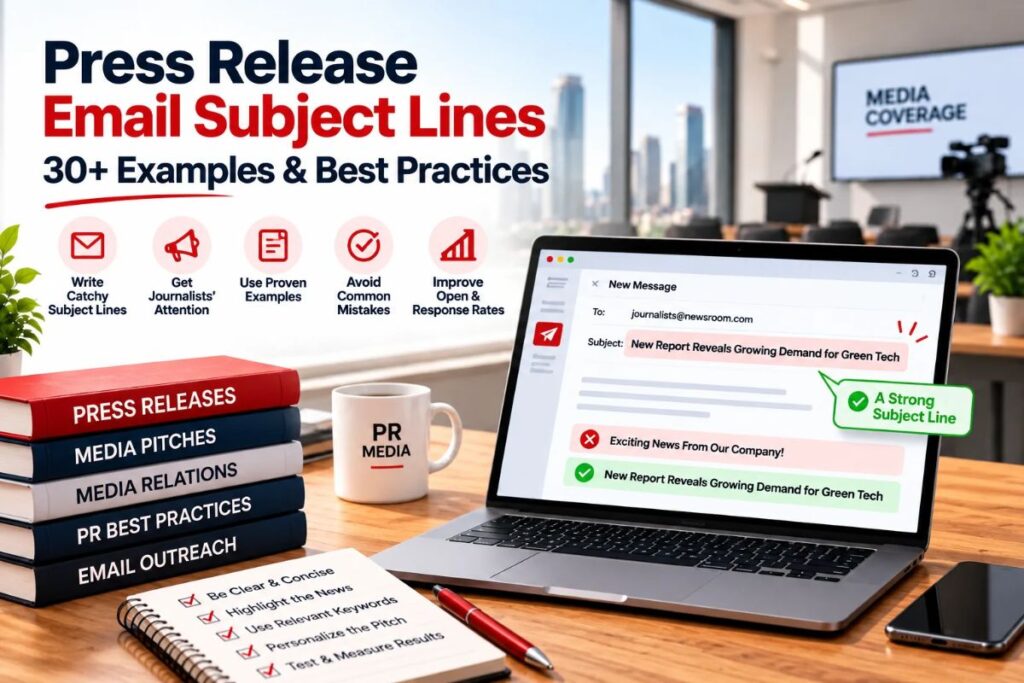
Weak: Exciting News From Our Company!
Better: Fintech Startup Launches Payment Platform for Small Businesses
The second example identifies the organization type, the announcement, and the intended audience without relying on promotional language.
A successful subject line does not guarantee media coverage. However, it can help journalists recognize a relevant story and decide whether to examine the accompanying press release.
How to Write a Press Release Subject Line That Gets Noticed
1. Lead With the Most Newsworthy Information
Start with the information that makes the announcement relevant.
A journalist should not have to open the email to discover whether the story concerns a product launch, new research, a major partnership, or a significant industry development.
Consider these examples:
Weak: We Have an Important Announcement to Share
Better: New Report Identifies Changing Consumer Spending Habits
The stronger version communicates a clear editorial angle.
Before writing the subject line, identify the central news hook:
- What happened?
- Who is affected?
- Why does it matter?
- Why is the announcement relevant now?
The subject line should reflect the strongest answer rather than simply repeating the company’s name.
2. Keep It Clear and Concise
Journalists often scan their inboxes quickly, including on mobile devices where long subject lines may be truncated.
A useful starting point is approximately six to ten words, although there is no universally correct length.
Clarity matters more than meeting a fixed character count.
For example:
Too vague: Important Information Regarding Our Latest Business Development
Clearer: Retail Brand Opens 15 New Stores Across Europe
Place the most important information near the beginning so the subject remains understandable even when only part of it is visible.
3. Use Specific Details When They Add News Value
Specific information can make an announcement more useful to journalists.
Relevant details may include:
- A confirmed research finding
- A geographic market
- A measurable business development
- A new technology or product category
- A significant partnership
- An event date or location
For example:
Generic: Technology Company Announces Expansion
Specific: Software Company Opens First UK Office in Manchester
Use numbers only when they are accurate, verifiable, and genuinely relevant to the announcement.
4. Match the Journalist’s Coverage Area
A compelling subject line cannot compensate for pitching an irrelevant story.
Before sending a press release, review the journalist’s recent work, publication audience, and editorial interests.
A business journalist may be interested in a funding announcement, while a technology reporter may prefer a product innovation angle.
The same announcement can sometimes support different legitimate editorial angles.
For example, a company launching an energy-efficient manufacturing process could use:
Business publication: Manufacturer Invests in Energy-Efficient Production Expansion
Sustainability publication: New Manufacturing Process Targets Lower Industrial Energy Use
Both versions must accurately represent the underlying announcement.
For a broader approach to identifying relevant contacts, see PRTURKEY’s guide to building a media list.
5. Use Active Verbs and Natural Language
Active verbs make subject lines easier to understand.
Useful verbs include launches, announces, introduces, expands, publishes, reveals, acquires, and partners.
Compare:
Passive: New Research Findings Have Been Announced by the Company
Active: Research Team Reveals New Findings on Remote Work
Avoid excessive adjectives such as revolutionary, incredible, groundbreaking, or game-changing unless the claim can be substantiated and is editorially relevant.
Journalists generally need facts, not advertising language.
6. Use Embargo and Exclusive Labels Correctly
Certain labels help journalists understand the conditions attached to a story.
Examples include:
Embargoed: [EMBARGOED UNTIL 10:00 GMT, 12 MAY] New Industry Report Released
Exclusive: EXCLUSIVE: Startup Shares Findings From New Consumer Study
Invitation: MEDIA INVITATION: Technology Summit Opens in London
An embargo is a request not to publish information before a specified time. It is not automatically binding on a journalist unless the terms have been accepted.
Similarly, use exclusive only when the story is genuinely being offered under exclusive conditions.
Do not use urgency labels simply to attract attention.
7. Avoid Misleading or Spam-Like Language
A professional media pitch should not resemble a promotional email.
Avoid:
- Excessive capitalization
- Repeated exclamation marks
- Misleading claims
- Artificial urgency
- Unexplained abbreviations
- Overly promotional language
For example:
Avoid: HUGE BREAKING NEWS!!! YOU MUST READ THIS!!!
Use: New Study Examines Rising Costs for Small Businesses
Professional formatting supports credibility and helps the recipient understand the story.
30+ Press Release Email Subject Line Examples
The following examples are illustrative templates, not claims about real companies or verified announcements. Replace the bracketed details with accurate information before sending.
Product Launch Subject Line Examples
- [Company] Launches New AI Tool for Small Businesses
- New Skincare Brand Introduces Refillable Product Range
- [Company] Unveils Smart Home Device at [Event]
- New Payment App Targets Independent Retailers
- [Brand] Introduces Sustainable Packaging Across Product Line
These examples work best when the product has a meaningful point of difference, a relevant market impact, or another clear news angle.
Partnership Announcement Examples
- [Company A] Partners With [Company B] to Expand Digital Services
- Two Healthcare Companies Announce Research Partnership
- [Brand] and [Organization] Launch Joint Sustainability Initiative
- New University Partnership Supports Local Technology Startups
- [Company] Signs Distribution Agreement for UK Market
A partnership subject line should explain what the collaboration will accomplish rather than merely announcing that two organizations have signed an agreement.
Research and Survey Announcement Examples
- New Survey Reveals Changing Shopping Habits Among UK Consumers
- [Organization] Publishes Report on Workplace Technology Adoption
- Research Finds Growing Demand for Flexible Office Spaces
- New Industry Study Examines Challenges Facing Small Businesses
- [Company] Releases Annual Consumer Trends Report
Research-based subject lines should reflect the study’s actual methodology and findings. Avoid presenting a small or unrepresentative survey as evidence of a universal trend.
Event and Media Invitation Examples
- MEDIA INVITATION: [Conference] Opens in London on [Date]
- [Company] Announces Speakers for Annual Technology Summit
- Journalists Invited to Preview New Product at [Venue]
- [Organization] Hosts Industry Briefing on Renewable Energy
- [Event Name] Announces Programme for [Year]
Include the date, location, or relevant speakers when these details help journalists decide whether to attend or cover the event.
Funding and Business Expansion Examples
- [Startup] Raises [Amount] to Expand European Operations
- [Company] Opens New Manufacturing Facility in [Location]
- Technology Startup Announces Series A Funding Round
- [Brand] Enters US Market Following International Expansion
- [Company] Creates [Number] Jobs With New Regional Office
Funding amounts, employment figures, and expansion claims must be confirmed before distribution.
Exclusive Media Pitch Examples
- EXCLUSIVE: CEO Discusses Company’s International Expansion
- EXCLUSIVE INTERVIEW: Founder Explains New Market Strategy
- EARLY ACCESS: New Report on Consumer Technology Trends
- INTERVIEW OPPORTUNITY: Researcher Discusses Industry Findings
- EXPERT COMMENTARY: Economist Responds to New Market Data
These subject lines communicate the type of editorial opportunity available.
Embargoed Press Release Examples
- [EMBARGOED UNTIL DATE/TIME] New Market Research Findings
- EMBARGOED: [Company] Announces New International Partnership
- [EMBARGOED UNTIL DATE/TIME] Annual Industry Report Released
Follow-Up Email Subject Line Examples
- Follow-Up: Research Findings on Consumer Spending
- Additional Data Available: [Report Name]
- Interview Availability: [Expert Name] on [Topic]
For follow-ups, replying within the original email thread is often preferable because it preserves the journalist’s context.
Press Release Subject Line vs. Media Pitch Subject Line
Although the terms are sometimes used interchangeably, a press release email subject line and a media pitch subject line may serve slightly different purposes.
| Feature | Press release subject line | Media pitch subject line |
|---|---|---|
| Main purpose | Introduce a news announcement | Propose an editorial story or opportunity |
| Typical content | Company news, launch, research, expansion | Story angle, interview, exclusive, expert insight |
| Audience | Relevant journalists and editors | Carefully selected journalists |
| Supporting material | Press release and media assets | Personalized pitch, sources, supporting evidence |
| Example | Company Launches New Recycling Technology | Story Idea: How New Recycling Technology Could Affect Retailers |
A press release can support a personalized media pitch, but the email subject line should reflect what the journalist is actually being offered.
For complete outreach formats, explore PRTURKEY’s media pitch examples.
Bad vs. Good PR Pitch Subject Line Examples
Improving a subject line often involves removing promotional language and making the story more specific.
| Weak subject line | Improved subject line | Why it works better |
|---|---|---|
| Big News From Our Company! | Startup Launches Digital Banking Service for Freelancers | Identifies the announcement and audience |
| Please Read Our Press Release | New Report Examines Rising Costs for UK Retailers | Highlights the news angle |
| Amazing Partnership Announcement | Two Technology Firms Partner on Cybersecurity Research | Explains the collaboration |
| Important Event Next Week | MEDIA INVITATION: Sustainability Forum Opens Tuesday | Clarifies the opportunity |
| Revolutionary New Product | Manufacturer Introduces Battery-Free Tracking Device | Describes the product |
| Exclusive Opportunity for You | EXCLUSIVE INTERVIEW: Founder Discusses Expansion Plans | Specifies the offer |
The best version is not necessarily the most dramatic. It is the one that accurately communicates the strongest relevant news angle.
Should You Put “Press Release” in the Email Subject Line?
You can include press release in the subject line, but it is not always necessary.
Some journalists appreciate clear labels that distinguish a news announcement from a commercial email. Others prefer the headline or story angle to appear first.
For example:
With label: Press Release: [Company] Opens New Research Centre
Without label: [Company] Opens New Research Centre in Cambridge
Both can be appropriate.
If the announcement has a strong news hook, placing that information first may make the subject easier to scan.
For a personalized pitch, labels such as exclusive interview, expert comment, or media invitation may be more useful when they accurately describe the offer.
The decision should depend on the journalist, publication, and type of announcement rather than a universal rule.
How Long Should a Media Pitch Subject Line Be?
A media pitch subject line should be long enough to communicate the story and short enough to remain readable.
Six to ten words is a practical editorial guideline, not a guaranteed performance threshold.
For example:
Short but unclear: Important Company Update
Long but informative: New Research From [Organization] Examines How Independent Retailers Are Adapting to Changing Consumer Payment Preferences
More focused: New Research Reveals Payment Trends Among Independent Retailers
When editing, remove unnecessary introductory phrases and place the central news angle at the beginning.
Always check how the subject appears on mobile as well as desktop.
Common Press Release Subject Line Mistakes
Making the Company More Important Than the Story
An unfamiliar company name may not communicate why the announcement matters.
Instead of starting with a lengthy company description, lead with the development that affects the publication’s readers.
Using Clickbait
Subject lines that promise shocking revelations or extraordinary results without supporting evidence can damage credibility.
The subject should accurately represent the press release.
Sending the Same Angle to Every Journalist
A generic subject line sent to unrelated publications rarely addresses their individual editorial priorities.
Segment your media list and adapt the story angle where appropriate.
Writing a Subject Line That Does Not Match the Email
If the subject promises exclusive research, the email must provide that research or clearly explain how the journalist can access it.
Misleading subject lines can undermine future relationships.
Overlooking Timing
An event invitation without a date or a time-sensitive announcement without relevant context may be difficult to evaluate.
Include timing details when they influence the journalist’s decision.
Repeating the Entire Press Release Headline
A press release headline may work as an email subject line, but not always.
If the headline is too long or contains unnecessary corporate wording, adapt it for the inbox while preserving the factual meaning.
How to Test and Measure Subject Line Performance
Subject line performance should be evaluated alongside the overall quality of media outreach.
Useful indicators include:
| Metric | What it tells you | Important limitation |
|---|---|---|
| Email delivery | Whether messages reached the receiving mail system | Does not prove inbox placement |
| Open rate | Whether tracking registered an open | Privacy features and image loading can distort results |
| Click-through rate | Whether tracked links were clicked | Not every journalist clicks before responding |
| Reply rate | Whether journalists responded | A reply may be positive, neutral, or negative |
| Qualified media interest | Whether relevant journalists requested more information | Requires accurate outreach records |
| Earned media coverage | Whether independent editorial coverage was secured | Coverage depends on more than the subject line |
Open rate alone is not a reliable measure of PR success.
Some email clients automatically load tracking pixels, while other environments restrict tracking. As a result, recorded opens may not accurately represent human attention.
For smaller, personalized outreach campaigns, journalist responses, interview requests, and relevant editorial coverage can provide more meaningful evidence.
If you test different subject lines, keep the underlying announcement and recipient groups reasonably comparable. Otherwise, differences in audience relevance may be mistaken for differences in subject line quality.
How to Write a Complete Press Release Email
A strong subject line is only the beginning of an effective journalist outreach email.
The message itself should quickly explain:
- What the announcement is about.
- Why it matters to the publication’s audience.
- Which facts or sources support the story.
- Whether interviews, images, or additional materials are available.
- How the journalist can contact the sender.
Here is a practical example.
Subject: New Report Examines Digital Payment Trends Among UK Retailers
Hi [Journalist Name],
I noticed your recent coverage of payment technology and wanted to share a new report examining how independent UK retailers are adapting to digital payment methods.
The report covers [verified key finding] and includes insights from [qualified spokesperson or research team].
I’ve included the press release and supporting information below. If the findings are relevant to your coverage, I can arrange an interview or provide additional research details.
Best regards,
[Name]
[Role / Organization]
[Contact Information]
The email should be adapted to the journalist’s interests rather than sent as a generic mass message.
If the announcement itself needs improvement, PRTURKEY’s press release writing guide explains how to structure the supporting release.
How to Improve International Press Release Outreach
Companies pitching journalists across multiple countries should consider more than translation.
A subject line that works for one market may need a different angle for another because of differences in:
- Publication audiences
- Industry terminology
- Local news priorities
- Geographic relevance
- Date and time conventions
- Language and editorial expectations
For example, a company entering the United Kingdom may emphasize its UK expansion when contacting British business journalists, while a US publication may be more interested in the company’s international growth strategy.
The underlying facts must remain consistent, even when the editorial angle changes.
For businesses distributing announcements across markets, PRTURKEY’s international press release service provides a relevant next step for exploring international distribution.
Frequently Asked Questions
What is the best subject line for a press release email?
The best press release email subject line clearly identifies the newsworthy development and explains its relevance without exaggeration. A strong example is “New Study Reveals Changing Shopping Habits Among UK Consumers,” provided the study genuinely supports that finding. The right wording depends on the announcement and the journalist’s coverage area.
Should I write “press release” in the subject line?
Including “press release” is optional. It can help identify the message type, but it also occupies space that could be used for the news angle. For some announcements, starting with the actual development is clearer. Labels such as “embargoed” or “media invitation” should be used when they accurately describe the message.
How many words should a PR pitch subject line contain?
Approximately six to ten words is a useful starting point, but there is no universally ideal word count. The subject should be concise enough to scan quickly while containing sufficient information to communicate the story. Prioritize clarity and relevance over an arbitrary length limit.
Can I use the same subject line for every journalist?
You can use a consistent subject line for journalists covering the same relevant topic, but personalization may improve the usefulness of the pitch. Different publications may need different angles. Any variation should remain accurate and reflect the same underlying announcement.
Should I include the company name in the subject line?
Include the company name when it helps establish relevance or recognition. If the organization is unfamiliar to the journalist, leading with the newsworthy development may be more useful. A specific product category, research finding, or market impact can sometimes communicate more than the brand name alone.
Final Thoughts
An effective press release email subject line combines editorial relevance, clarity, and accuracy. It tells journalists what happened, why the story matters, and whether the announcement deserves closer attention.
The strongest approach is to begin with a genuine news hook, adapt the subject to the recipient, and support it with a well-structured press release and credible information.
Subject lines can help a story get noticed, but meaningful media coverage also depends on the quality of the announcement, journalist targeting, timing, and professional follow-up.
For organizations planning broader media outreach, PRTURKEY offers a starting point for exploring press release and public relations services.