

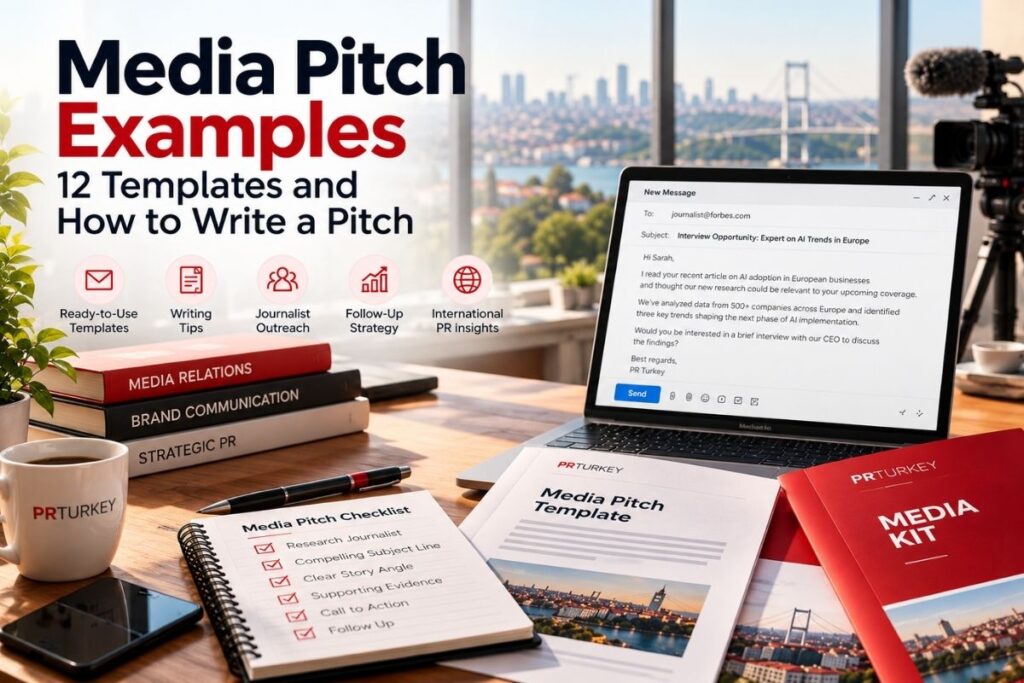
A successful media pitch is more than an email introducing a company, product, or announcement. It is a carefully developed story proposal that explains why a journalist should care, why the topic matters to their audience, and why the story deserves attention now.
Journalists receive competing story ideas from brands, agencies, researchers, and industry experts. A generic announcement rarely stands out. An effective pitch connects a relevant development with a journalist’s editorial interests, supports the story with credible information, and makes the next step easy.
If you are looking for media pitch examples, the most useful approach is to understand the structure behind them rather than simply copying an email template.
In this guide, you will learn how to write a media pitch, discover 12 adaptable PR pitch templates, understand the difference between pitching and press release distribution, and explore practical strategies for improving journalist outreach.
What Is a Media Pitch?
A media pitch is a personalized message sent to a journalist, editor, producer, or media outlet to propose a potential news story, interview, expert contribution, or editorial opportunity.
Its primary objective is to convince the recipient that the proposed topic is relevant, timely, credible, and valuable to their audience.
Media pitches are most commonly delivered through email, although the appropriate channel depends on the journalist’s preferences and the nature of the relationship.
For example, a technology company launching a new product might send a pitch to a journalist who regularly covers emerging technologies. Rather than simply announcing the launch, the company could explain how the product addresses an industry challenge, provide independently verifiable evidence, and offer access to an expert or customer.
A strong pitch answers five essential questions:
- What is the story? Clearly identify the news, insight, or development.
- Why does it matter? Explain its significance beyond the organization.
- Why now? Establish a timely reason for coverage.
- Why this journalist? Connect the story to the recipient’s editorial focus.
- What is the next step? Offer a specific interview, source, dataset, demonstration, or briefing.
The strongest pitches prioritize editorial value over promotional language.
Media Pitch vs. Press Release: What’s the Difference?
Although media pitches and press releases are closely connected, they serve different purposes within a public relations strategy.
A press release is a structured announcement designed to communicate news to media organizations and other stakeholders. A media pitch is a targeted message explaining why a particular journalist should consider covering that news.
| Feature | Media Pitch | Press Release |
|---|---|---|
| Primary purpose | Secure editorial interest | Communicate an official announcement |
| Target audience | Specific journalist or editor | Media outlets and broader stakeholders |
| Writing style | Personalized and conversational | Formal and factual |
| Typical length | Usually brief, often 100–200 words | Often several hundred words |
| Main focus | Story relevance and editorial angle | Complete announcement details |
| Distribution | Targeted outreach | Direct outreach or broader distribution |
| Call to action | Interview, briefing, coverage consideration | Access to further information or media contacts |
When Should You Use a Media Pitch?
Use a media pitch when you have a compelling story that fits a specific journalist’s interests.
Common situations include product launches, original research, executive interviews, industry developments, company milestones, and expert commentary.
When Should You Use a Press Release?
A press release is appropriate when an organization needs to communicate a formal announcement with verified details, official statements, and supporting information.
The two formats can work together.
For example, a company may publish a press release announcing a major partnership and then send personalized pitches to selected journalists explaining how that partnership affects their particular industries.
The press release supplies the facts. The media pitch communicates the editorial opportunity.
Why Media Pitching Matters in Public Relations
Media pitching is a central component of media relations because it connects organizations with journalists who can independently evaluate and report relevant stories.
Effective pitching can support several public relations objectives.
Building Media Relationships
Relevant, well-researched outreach demonstrates that a PR professional understands a journalist’s work.
Over time, consistently useful communication can help establish trust and create opportunities for future collaboration.
Increasing Earned Media Opportunities
A compelling story proposal may result in interviews, expert quotations, news articles, industry features, or other forms of editorial coverage.
However, sending a pitch does not guarantee publication. Editorial decisions remain with the journalist or media organization.
Strengthening Brand Credibility
Independent editorial coverage can introduce an organization to audiences that may not engage with its owned marketing channels.
The value of that coverage depends on the publication, the accuracy of the reporting, and the relevance of the story.
Supporting International Market Visibility
For organizations entering new markets, localized media pitching can help communicate business developments to journalists who understand regional audiences.
A successful international pitch requires more than translating an existing announcement. It requires adapting the story angle, evidence, terminology, and spokesperson availability to the target market.
How to Write a Media Pitch in 7 Steps
Writing a successful media pitch begins before the email itself.
The most important preparation involves selecting a credible story, identifying relevant journalists, and understanding what would make the proposed topic valuable to their audiences.
Step 1: Identify a Newsworthy Story
Not every company announcement is automatically newsworthy.
Before writing, consider whether the story includes one or more of the following elements:
- Timeliness: Is the topic connected to a recent or upcoming development?
- Impact: Does it affect customers, businesses, communities, or an industry?
- Novelty: Does it introduce something meaningfully different?
- Evidence: Can the central claim be verified?
- Human interest: Does it reveal a compelling personal or organizational experience?
- Relevance: Does it address a subject the target publication already covers?
For example, “Our company has launched a new platform” is primarily a promotional statement.
“New platform helps manufacturers identify energy waste using verified facility-level data” offers a more specific potential story, provided the supporting evidence is available.
Step 2: Research the Right Journalists
Journalist targeting is one of the most important elements of effective outreach.
A journalist covering financial technology may not be interested in a general lifestyle product announcement, even if the publication itself has a large audience.
Research the journalist’s recent articles, editorial beat, geographical focus, preferred topics, and publication format.
A relevant media list should contain more than names and email addresses. It should document why each contact is suitable for a particular story.
For a practical framework, explore our guide on how to build a media list.
Step 3: Write a Compelling Subject Line
The subject line should communicate the story’s main value immediately.
Avoid vague phrases such as:
- Exciting News From Our Company
- Important Announcement
- Great Collaboration Opportunity
- Revolutionary Product Launch
Instead, use specific, factual headlines.
Better media pitch subject line examples:
- New Survey Reveals Changing Consumer Spending Priorities
- Interview Opportunity: CEO Discusses European Market Expansion
- Research: How Manufacturers Are Responding to Energy Costs
- Expert Available to Explain New Industry Regulations
- Exclusive Preview: Technology Launch Ahead of Industry Event
An effective subject line should be informative without exaggerating the significance of the announcement.
Step 4: Personalize the Opening
Personalization should demonstrate a genuine connection between the journalist’s editorial interests and the proposed story.
A useful opening might read:
“Hi Sarah, I read your recent coverage of supply chain automation and thought this new industry research could be relevant to your manufacturing audience.”
This works better than a generic greeting because it explains the reason for contacting that journalist.
Personalization does not require lengthy compliments. One accurate, relevant reference is usually sufficient.
Step 5: Present the Story Angle
The main paragraph should answer what happened, why it matters, and what makes the development worth covering.
Avoid introducing the organization with several sentences of corporate background.
Lead with the news.
For example:
“An upcoming industry report examines how small manufacturers are adapting to rising operational costs, based on interviews with production managers across multiple markets.”
This gives the journalist a clearer starting point than a description of the company that commissioned the report.
Step 6: Include Supporting Evidence
Journalists need information they can evaluate and verify.
Depending on the story, useful supporting material may include:
- Original research and methodology
- Verified business figures
- Expert credentials
- Customer interviews with permission
- Product demonstrations
- Official documents
- Relevant images or charts
- Case studies with attributable results
Avoid unsupported superlatives such as “market-leading,” “revolutionary,” or “the first of its kind.”
If a claim cannot be substantiated, revise or remove it.
Step 7: End With a Clear Call to Action
A media pitch should make the next step simple.
Examples include:
“Would you be interested in speaking with our research director about the findings?”
“Can I share the full report and methodology for your review?”
“Would a short product demonstration be useful for your upcoming coverage?”
One focused request is usually more effective than several unrelated options.
Media Pitch Email Template: The Essential Structure
Before exploring different media pitch examples, it helps to establish a reusable structure.
Subject: [Specific news angle or story opportunity]
Hi [Journalist’s Name],
I noticed your recent coverage of [relevant topic or article].
I’m reaching out with a story about [specific development] that may be relevant to your readers because [clear editorial significance].
[Provide two or three sentences with the strongest facts, evidence, or supporting context.]
We can offer [interview, original data, demonstration, expert commentary, or other relevant material].
Would you be interested in [one specific next step]?
Best regards,
[Name]
[Title / Organization]
[Contact Information]
[Relevant Media Resources]
This format is adaptable. A breaking-news expert pitch may be significantly shorter, while a research-based pitch may require additional methodological context.
12 Media Pitch Examples for Different PR Scenarios
The following media pitch examples illustrate how to adapt your approach to different stories and communication objectives.
All organizations, individuals, and scenarios in these templates are fictional examples created for educational purposes. Replace placeholders and illustrative claims with accurate, approved information before sending.
1. Product Launch Media Pitch Example
Best for: Introducing a product with a meaningful customer benefit or industry application.
Subject: New Platform Helps Retailers Simplify Inventory Planning
Hi Emma,
I noticed your recent coverage of digital transformation in retail operations.
We’re preparing to launch a new inventory planning platform designed to help independent retailers identify stock discrepancies and improve purchasing decisions.
The platform brings sales and inventory information into a single dashboard. We can share a product demonstration, explain its development process, and arrange an interview with the team behind it.
Would you be interested in a preview ahead of the public launch?
Best regards,
[Name]
[Company]
Why this pitch works: It connects the product to an existing editorial topic and offers direct access to information the journalist can assess.
How to improve it: Add verified pilot results, named customer references, or comparative data when available.
2. Company Announcement Media Pitch Example
Best for: Major organizational developments, partnerships, or strategic changes.
Subject: Technology Company Announces New European Partnership
Hi Daniel,
Your reporting on cross-border technology partnerships caught my attention.
[Company] is announcing a partnership with [Partner Organization] to expand its services into selected European markets.
The agreement includes [verified details about the partnership], with the first implementation phase scheduled for [date].
We can provide an official announcement, background information, and an interview with the executive responsible for the expansion.
Would this development be relevant to your international business coverage?
Best,
[Name]
[Title]
Why this pitch works: It identifies the business development and explains its relevance to a specific editorial beat.
3. Research Report Media Pitch Example
Best for: Original surveys, industry reports, and data-driven stories.
Subject: New Research Examines Consumer Trust in AI-Powered Services
Hi Olivia,
I enjoyed your recent article about consumer attitudes toward artificial intelligence.
Our research team has completed a study examining how consumers evaluate AI-powered services across different industries.
The report includes [sample size], [research dates], and findings related to [verified key insight].
We can provide the complete methodology, supporting charts, and an interview with the research lead.
Would you like to review the findings for a potential feature?
Best regards,
[Name]
[Organization]
Why this pitch works: It presents an editorially relevant research opportunity while making supporting evidence available.
Important: Always disclose the research methodology, sample limitations, and commissioning organization.
4. Executive Interview Pitch Example
Best for: Offering access to a business leader with relevant expertise.
Subject: Interview Opportunity: CEO on the Future of Sustainable Manufacturing
Hi James,
I noticed your recent reporting on sustainability challenges facing manufacturers.
[Executive Name], CEO of [Company], is available to discuss how manufacturers are balancing sustainability goals with operational costs.
The conversation could explore practical implementation challenges, investment decisions, and the technologies companies are evaluating.
We can share the executive’s background and proposed discussion points in advance.
Would an interview be useful for your upcoming industry coverage?
Best,
[Name]
[Company]
Why this pitch works: It focuses on the journalist’s subject area rather than simply promoting the executive.
5. B2B Media Pitch Example
Best for: Industry publications covering specialized business audiences.
Subject: How Industrial Buyers Are Rethinking Procurement Technology
Hi Michael,
Your recent articles on industrial procurement trends align with a topic our team has been examining.
[Company] has developed a technology solution designed to address [specific procurement challenge].
We can provide a demonstration and introduce you to a participating business customer who can discuss its implementation experience, subject to their approval.
Would you be interested in exploring the operational challenges behind this development?
Best regards,
[Name]
[Organization]
Why this pitch works: It focuses on business relevance, operational challenges, and the availability of an independent customer perspective.
For additional context on industry-specific communication, explore our guide to B2B public relations.
6. International Market Entry Pitch Example
Best for: Companies entering Türkiye, Europe, or another international market.
Subject: International Technology Brand Prepares to Enter the Turkish Market
Hi [Journalist’s Name],
I follow your reporting on international companies expanding into Türkiye.
[Company], a [country]-based business operating in [industry], is preparing to enter the Turkish market through [verified market-entry model].
The expansion is connected to [specific market opportunity, partnership, or investment].
We can provide information about the company’s market strategy and arrange an interview with its regional representative.
Would this be relevant to your coverage of international investment and business expansion?
Best regards,
[Name]
[Company]
Why this pitch works: It localizes an international development for a journalist covering the target market.
How to improve it: Include verified local investment, employment, partnership, or operational details when available.
7. Expert Commentary Pitch Example
Best for: Providing timely analysis of regulations, industry developments, or breaking news.
Subject: Industry Expert Available to Discuss New Digital Regulations
Hi Rebecca,
Following the recent announcement regarding [specific regulation], I wanted to offer an expert perspective for your coverage.
[Expert Name], [verified title and credentials], can explain how the proposed changes may affect [specific industry or audience].
The expert can address implementation challenges, likely business considerations, and questions organizations should be asking.
Would a short interview or written comment be useful for your reporting?
Best,
[Name]
[Organization]
Why this pitch works: It connects an available expert to an existing news development.
Important: The expert’s qualifications and the regulatory details must be verified before outreach.
8. Event Media Pitch Example
Best for: Conferences, exhibitions, launches, and industry events.
Subject: Industry Leaders to Discuss Emerging Technology Trends at Upcoming Event
Hi Sophia,
I’m reaching out with a potential story opportunity related to [Event Name], taking place on [Date] in [Location].
The event will bring together [verified participants or organizations] to discuss [specific industry topic].
We can offer access to selected speakers, event materials, and interview opportunities during the program.
Would you be interested in attending or arranging a conversation with one of the speakers?
Best regards,
[Name]
[Event / Organization]
Why this pitch works: It offers concrete access and explains the editorial subject beyond the event announcement.
9. Customer Success Story Pitch Example
Best for: Case studies involving measurable outcomes and willing customer sources.
Subject: How a Manufacturer Improved Production Planning With New Technology
Hi Thomas,
Your reporting on operational efficiency in manufacturing made me think this customer story might be relevant.
[Customer Company] recently implemented [Solution] to address [specific operational challenge].
The implementation produced [verified result], measured over [time period] using [measurement method].
With the customer’s approval, we can arrange an interview with the project lead and share supporting documentation.
Would you be interested in exploring the case?
Best,
[Name]
[Organization]
Why this pitch works: It puts the customer experience and measurable business outcome ahead of vendor promotion.
10. Thought Leadership Pitch Example
Best for: Offering an expert-authored opinion article or analysis.
Subject: Opinion Article Proposal: Why Businesses Need a New Approach to AI Adoption
Hi [Editor’s Name],
I’m writing to propose an opinion article examining a challenge facing organizations adopting artificial intelligence.
The proposed argument is that successful AI adoption depends not only on technology investment but also on governance, employee training, and operational readiness.
The article would be written by [Expert Name], whose relevant experience includes [verified credentials].
We can provide a concise outline and an original draft tailored to your publication’s editorial guidelines.
Would you be open to reviewing the proposal?
Best regards,
[Name]
[Organization]
Why this pitch works: It offers a defined editorial argument rather than a generic request to publish company commentary.
11. Crisis Communication or Correction Pitch Example
Best for: Providing verifiable clarification after inaccurate or incomplete reporting.
Subject: Factual Clarification Regarding Your Recent Article on [Topic]
Hi [Journalist’s Name],
I’m contacting you regarding your article published on [Date] about [Topic].
We would like to clarify one factual point concerning [specific statement].
The article states [published claim], while the verified documentation indicates [accurate information].
We can provide the supporting records and make an authorized spokesperson available if additional context would be helpful.
Would you be willing to review the documentation?
Best regards,
[Name]
[Organization]
Why this pitch works: It focuses on a specific, documentable issue rather than challenging the journalist’s editorial independence.
For broader guidance on protecting organizational trust, see our article on reputation management in PR.
12. Podcast Guest Media Pitch Example
Best for: Securing expert interviews with podcast hosts and producers.
Subject: Podcast Guest Proposal: Practical Lessons From International Business Expansion
Hi Alex,
I’ve been following your podcast conversations about entrepreneurship and international growth.
I’d like to suggest [Guest Name], [Verified Role], as a potential guest for an episode about the practical challenges of entering new markets.
The discussion could cover three areas:
- Common mistakes businesses make when evaluating international markets.
- How organizations adapt their communication strategies to local audiences.
- Lessons learned from actual expansion projects.
We can share the guest’s biography, previous speaking appearances, and proposed discussion topics.
Would this be a suitable topic for an upcoming episode?
Best,
[Name]
[Organization]
Why this pitch works: It provides a clear episode concept and demonstrates the guest’s potential value to listeners.
How to Personalize Media Pitch Examples Without Sounding Generic
Using a media pitch template can save time, but sending the same message to every journalist reduces its relevance.
Effective personalization goes beyond inserting a first name.
Match the Journalist’s Editorial Beat
Identify the subjects the journalist regularly covers.
For example, an automotive technology announcement may require different angles for technology journalists, automotive trade publications, business reporters, and sustainability editors.
Each audience has different editorial priorities.
Reference Relevant Previous Coverage
Mention a recent article only when there is a meaningful connection.
Avoid generic statements such as “I love your work.”
Instead, explain how the proposed story expands on an issue the journalist has already explored.
Adapt the Evidence
A financial journalist may prioritize investment figures and business performance.
A technology journalist may want product architecture, technical demonstrations, and expert access.
A consumer journalist may focus on everyday impact, affordability, and customer experience.
The underlying facts should remain consistent, but the most relevant evidence can differ.
Respect Geographical Context
International PR campaigns should consider local market conditions, language preferences, cultural expectations, and the publication’s geographical audience.
A story relevant in one country may require a different angle to become newsworthy elsewhere.
Good vs. Bad Media Pitch: A Practical Comparison
Consider a fictional software company launching a new analytics product.
Weak Media Pitch
Subject: Exciting News From Our Innovative Company
Hello,
We are thrilled to announce our revolutionary new product. Our company is a leading provider of cutting-edge solutions and we believe this announcement deserves media coverage.
Please publish our news and let us know if you need anything.
Best,
Marketing Team
Why it underperforms:
- The subject line contains no specific news.
- The recipient is not identified.
- The message provides no evidence.
- The story’s relevance is unclear.
- The request assumes publication rather than inviting editorial consideration.
Improved Media Pitch
Subject: New Analytics Tool Targets Inventory Reporting Challenges for Small Retailers
Hi [Journalist’s Name],
I noticed your recent coverage of inventory management challenges among independent retailers.
[Company] is launching an analytics tool designed to help smaller retail businesses consolidate inventory reporting across sales channels.
We can provide a demonstration, product documentation, and an interview with the development team to explain the problem the tool addresses.
Would you be interested in reviewing the product for your retail technology coverage?
Best regards,
[Name]
[Company]
Why it is stronger:
The improved version identifies a relevant audience, presents a specific story angle, avoids unsupported claims, and offers a clear next step.
How to Follow Up on a Media Pitch
A journalist may not respond immediately, even when a story is relevant.
Deadlines, editorial priorities, inbox volume, and publication schedules all influence response times.
A follow-up should be brief, respectful, and useful.
For non-urgent pitches, waiting a few business days before sending one follow-up is a reasonable starting point. However, journalist preferences and story deadlines should take priority.
Media Pitch Follow-Up Email Example
Subject: Re: New Research on Consumer Trust in AI Services
Hi [Journalist’s Name],
I wanted to briefly follow up on the research findings I shared earlier this week.
If the topic is relevant to your upcoming coverage, I can send the full report and arrange a conversation with the research lead.
Happy to provide additional context if helpful.
Best regards,
[Name]
Avoid repeatedly sending the same message or implying that a journalist is obligated to respond.
If the story is no longer timely, reconsider the angle before approaching other relevant contacts.
Common Media Pitching Mistakes to Avoid
Even a strong announcement can fail to generate interest when the outreach is poorly planned.
1. Sending the Same Pitch to Everyone
Mass personalization, where only the journalist’s name changes, often produces weak editorial alignment.
Segment outreach by subject area, audience, geography, and publication type.
2. Focusing Too Much on the Brand
A journalist’s responsibility is to their audience, not to the organization sending the pitch.
Explain the wider relevance of the story rather than filling the email with promotional descriptions.
3. Making Unsupported Claims
Statements such as “industry first” or “fastest-growing” require credible evidence.
If verification is unavailable, use accurate and narrower language.
4. Writing Overly Long Emails
An introductory pitch should be easy to scan.
As a practical editorial guideline, many pitches can be communicated in approximately 100–200 words, although complex stories may require more context.
5. Ignoring Journalist Preferences
Some journalists prefer concise emails, others request complete research material, and some specify that they do not accept unsolicited pitches.
Respect publicly stated contact and submission preferences.
6. Sending Irrelevant Attachments
Large unsolicited attachments may create technical or security concerns.
When appropriate, provide accessible links to relevant materials instead. Follow the recipient’s specific requirements if they request attachments.
7. Following Up Too Frequently
Repeated reminders without new information can damage professional relationships.
A limited, respectful follow-up approach is generally more appropriate.
How to Build a Media List for Effective Journalist Outreach
A media list is a structured database of journalists, editors, producers, and publications relevant to a communication campaign.
Its quality has a direct impact on the relevance of outreach.
An effective media list may include:
| Field | Purpose |
|---|---|
| Journalist name | Identifies the intended recipient |
| Publication | Establishes the media outlet |
| Editorial beat | Confirms subject relevance |
| Country or region | Supports geographical targeting |
| Recent coverage | Provides personalization context |
| Contact preference | Helps select the appropriate outreach method |
| Pitch date | Tracks communication history |
| Response status | Supports follow-up management |
| Notes | Records relevant professional preferences |
Rather than prioritizing the largest possible contact database, focus on identifying journalists whose recent reporting demonstrates a genuine connection to the proposed story.
This is particularly important in international media relations, where publication audiences and editorial expectations can vary significantly across markets.
How to Measure Media Pitch Performance
Sending pitches is an activity. Securing meaningful editorial interest is an outcome.
To evaluate a campaign, PR teams should track more than the number of emails distributed.
Media Pitch Response Rate
Response rate measures the percentage of delivered pitches that receive a reply.
Formula:
Response Rate = (Number of Replies ÷ Number of Delivered Pitches) × 100
For example, if 50 delivered pitches receive 8 replies, the response rate is 16%.
Not every reply represents positive interest, so responses should also be categorized.
Positive Response Rate
This metric measures the percentage of journalists who express interest in the story, request further information, or agree to an interview.
It provides a clearer indication of editorial relevance than total replies alone.
Pitch-to-Coverage Conversion Rate
This measures the proportion of pitches that result in published editorial coverage.
Formula:
Pitch-to-Coverage Rate = (Published Placements ÷ Delivered Pitches) × 100
For example, if 40 delivered pitches generate 4 published articles, the pitch-to-coverage conversion rate is 10%.
Quality of Earned Media Coverage
Not all coverage delivers the same communication value.
Evaluate whether the placement reaches the intended audience, accurately represents the story, includes relevant organizational information, and supports the campaign’s objectives.
Journalist Relationship Development
Track whether outreach leads to repeat conversations, future source requests, interview opportunities, and constructive professional relationships.
These outcomes may be valuable even when an individual pitch does not immediately generate coverage.
How PR Agencies Support Media Pitching
Developing an effective media pitch requires research, editorial judgment, relevant contacts, and consistent follow-through.
A public relations team or agency can support this process by identifying newsworthy angles, researching journalists, preparing spokesperson materials, and coordinating media outreach.
A structured approach typically includes:
- Reviewing the organization’s communication objectives.
- Identifying relevant stories and supporting evidence.
- Researching suitable media outlets and journalists.
- Developing publication-specific pitch angles.
- Preparing press materials and spokesperson information.
- Coordinating outreach and responding to media requests.
- Monitoring coverage and evaluating campaign outcomes.
For businesses operating across multiple countries, additional considerations include localization, media market knowledge, spokesperson availability, and regional communication expectations.
To understand how these responsibilities fit into a broader communications function, read our guide on what a PR team does.
Frequently Asked Questions About Media Pitching
What is a media pitch in public relations?
A media pitch is a personalized story proposal sent to a journalist or editor. Its purpose is to explain why a development, expert, research finding, or announcement may be relevant to the publication’s audience.
How do you write a good media pitch?
Start with a newsworthy story, research the journalist, write a specific subject line, explain the editorial relevance, provide credible evidence, and end with a clear request. Keep the message concise and tailored to the recipient.
How long should a media pitch be?
Many introductory media pitches can be written in approximately 100–200 words. However, the ideal length depends on the story’s complexity, the journalist’s preferences, and the information required to evaluate the proposal.
What should a media pitch email include?
A media pitch email should include a relevant subject line, personalized introduction, clear story angle, supporting facts, a specific call to action, and professional contact details.
What are some examples of media pitches?
Common media pitch examples include product launch announcements, research findings, executive interview proposals, industry commentary, company partnerships, customer success stories, event invitations, and podcast guest proposals.
What is the difference between a PR pitch and a press release?
A PR pitch is a targeted message proposing a story to a journalist. A press release is a formal announcement that presents verified information about an organization or development. A pitch may accompany a press release, but the two formats serve different purposes.
How do you pitch a story to a journalist?
Identify a journalist who covers the topic, review their recent work, develop a relevant story angle, and send a concise message explaining the news value. Offer supporting materials or an appropriate source and respect the journalist’s contact preferences.
What is the best subject line for a media pitch?
The best subject line clearly communicates the story’s most relevant fact or angle. It should be specific, accurate, and appropriate for the recipient’s editorial interests rather than promotional or exaggerated.
When should you send a media pitch?
Timing depends on the publication, the journalist’s schedule, and the story’s urgency. For planned announcements, allow enough time for editorial review. For breaking news, contact relevant journalists while the development is still timely.
How many times should you follow up on a media pitch?
For routine outreach, one concise follow-up after a few business days is often a reasonable approach unless the journalist specifies otherwise. Avoid repeated reminders that add no new information.
Can you send the same media pitch to multiple journalists?
You can approach multiple relevant journalists with the same underlying story, but the message should be adapted to each recipient. If you have promised an exclusive opportunity, respect the agreed terms before contacting others.
How do you measure media pitching success?
Useful metrics include response rate, positive response rate, pitch-to-coverage conversion rate, quality of earned media placements, and the development of ongoing journalist relationships.
Conclusion: Turn Media Pitch Examples Into Stronger Media Relationships
The most effective media pitch examples share a common principle: they prioritize the journalist’s audience rather than the organization’s promotional objectives.
A successful pitch presents a relevant story, explains its significance, supports its claims with credible evidence, and offers a practical next step.
Templates provide a useful starting point, but personalization, editorial research, and accurate information determine whether the message is genuinely valuable.
For organizations seeking visibility across different markets, media pitching should form part of a broader public relations strategy that connects compelling stories with appropriate publications and audiences.
PR Turkey helps organizations approach public relations through strategic communication, media relations, and market-focused storytelling.
If your organization is planning a product launch, international expansion, research announcement, or corporate communications campaign, explore how PR Turkey can support your media relations objectives.