Turkey’s media landscape cannot be understood through a simple list of newspapers, television channels and websites. It is a connected system in which television still shapes mass awareness, news agencies feed hundreds of outlets, digital publishers compete for speed, social platforms accelerate discovery and local media retain influence in cities beyond Istanbul.
For international brands, this structure creates both opportunity and complexity. A story can move quickly across multiple publications, but broad distribution does not guarantee relevance. The brands that perform best are those that understand how Turkish audiences discover news, how editors source material and how national, sector and regional media interact.
A Hybrid Media Market
Turkey is a hybrid market: traditional and digital media do not operate as separate worlds. Television clips are republished on news websites. Newspaper columnists build audiences on social platforms. News agency copy appears on both national portals and local publications. A press conference can produce live video, short social clips, web articles and next-day commentary from the same event.
This means PR teams should not design campaigns for a single channel. A launch needs a core story that can be expressed in several formats without losing accuracy:
A concise written release for news desks
Quotes and data for business or sector editors
Photography and video for digital and broadcast use
Short facts for mobile and social discovery
A spokesperson for interviews and follow-up questions
A monitored press room where assets remain available
The objective is not to repeat the same message everywhere. It is to give each newsroom the material needed to tell the story in its own format.
Television Still Matters
Television remains important for broad public awareness, breaking news and national discussion. RTUK’s MediaMeter research continues to examine television, radio and digital consumption together, reflecting how audience habits increasingly move across screens.
Broadcast coverage has a different production logic from online publication. Producers work with strict time limits and need a clear visual or human element. A press release alone will rarely create a strong television segment. A credible spokesperson, access to a location, original footage or a timely expert view can make the difference.
Brands should also prepare for speed. A producer may request a comment with little notice. Approval chains designed for a global headquarters can cause the opportunity to disappear before the response arrives. Pre-approved facts, trained spokespeople and a clear escalation process are therefore essential.
Digital News Is the Daily Battleground
Turkey has a highly connected population. TurkStat reported that the share of individuals using the internet reached 92.3 percent in 2026. That level of adoption helps explain why digital news sites, mobile notifications, video platforms and social networks are central to daily media consumption.
Digital newsrooms publish continuously. They value usable material that can be verified and processed quickly: clear headlines, a strong first paragraph, high-resolution images, source links and direct contact with someone who can confirm details.
Speed, however, should not be confused with low standards. Reuters’ journalistic standards emphasize accurate attribution so audiences can judge where information originated. For brands, the practical lesson is simple: every statistic, claim, quotation and image should have an identifiable source.
News Agencies Connect the Market
News agencies play a structural role in Turkey because their reporting is used by subscriber publications, broadcasters and digital platforms. Anadolu Agency produces content in multiple languages and operates internationally. Demiroren News Agency and Ihlas News Agency maintain extensive national reporting operations, including regional coverage, photography and video.
When an agency covers a story, the content may travel beyond the agency’s own website. This creates reach, but it also means that inaccuracies can travel just as quickly. Brands should provide confirmed names, titles, figures, dates and visual captions from the beginning. Corrections made after distribution may not be reflected consistently across every republishing outlet.
Business and Sector Media Create Authority
General news delivers scale; specialist media delivers context. Turkey’s business and trade publications speak to investors, executives, buyers and professional communities. Their coverage can have a greater commercial effect than a high-volume general-news placement.
These publications expect substance. A company entering Turkey should be ready to discuss market rationale, investment, local partners, jobs, distribution, pricing context and long-term plans. Sector editors may also request technical explanations or data that global corporate materials do not include.
This is why localization should begin before the press release is drafted. The communication team should identify what the Turkish audience needs to know, not simply what headquarters wants to announce.
The Importance of Regional Media
Istanbul is the center of much of Turkey’s national media industry, while Ankara is crucial for public policy and institutional news. But commercial activity and media influence extend across all 81 provinces.
Regional outlets are especially important for manufacturing, tourism, retail, logistics, agriculture, education, healthcare and local investment stories. A factory expansion in Kocaeli, a tourism project in Antalya or an export initiative in Gaziantep requires different local context and media targeting.
Regional communication also benefits from local spokespeople. A city manager, facility director, chamber representative or community partner can often make the story more credible than a distant global executive.
Social Media Changes Discovery, Not Editorial Responsibility
Journalists use social platforms to monitor trends, discover sources and distribute their work. Audiences also encounter news through short video, commentary and reposted headlines. This makes social listening an important part of media monitoring.
However, visibility on a social platform does not automatically equal verified media coverage. Brands should distinguish between owned posts, influencer content, sponsored publication, journalist commentary and earned newsroom coverage. Each has a different level of editorial control and should be measured separately.
A successful digital PR strategy connects these channels. Earned coverage can be amplified through the brand’s owned platforms, while social listening can identify questions, criticism or misinformation that require a response.
Regulation and Reputation
Media and communication campaigns in Turkey operate within a wider regulatory environment. Broadcast organizations are supervised by RTUK. Marketing teams handling personal information must consider Turkey’s Personal Data Protection Law, known as KVKK. Sector-specific rules may also affect healthcare, finance, food, consumer claims and promotional activity.
PR teams do not replace legal counsel. Their role is to identify risk early, verify claims and ensure that approved language remains consistent across press materials, interviews, visuals and digital distribution.
Reputation risk is also shaped by cultural context. Humor, historical references, national occasions and sensitive social issues can carry meanings that are not obvious to a global team. Local review should therefore cover more than grammar.
What the Turkish Media Landscape Means for PR Strategy
Five principles should guide international brands:
Localize the story, not only the language. Connect the announcement to Turkish audiences, industries or cities.
Segment the media list. Separate national, business, sector, broadcast and regional targets.
Prepare multiple formats. Give editors text, data, visuals, quotes and spokesperson access.
Move quickly without sacrificing verification. Confirm facts before distribution and simplify approval routes.
Measure quality as well as volume. Track relevance, message inclusion, tone and business outcomes.
PRTURKEY combines Turkish media relationships with press release distribution, digital PR and post-campaign monitoring. For international companies, this provides one coordinated route from localization to publication and reporting.
Frequently Asked Questions
Is television still influential in Turkey?
Yes. Television remains important for national awareness and breaking news, although audiences increasingly move between television, digital news and social platforms.
What role do news agencies play in Turkey?
News agencies produce text, photography, video and live coverage that can be used by subscriber outlets. Agency coverage may therefore generate wider secondary pickup.
Why is sector media important for B2B brands?
Sector publications reach professionals and decision-makers. Their smaller but more relevant audiences can provide stronger authority and commercial value than broad general coverage.
Does a global press release need to be rewritten for Turkey?
Usually, yes. The central facts can remain consistent, but the headline, lead, quotations and evidence should be adapted to Turkish editorial priorities and audience needs.
How should media coverage in Turkey be measured?
Measure the number and type of placements, potential audience, message inclusion, sentiment, backlinks, referral traffic and performance against competitors or campaign objectives.
Editorial Sources
TurkStat, internet usage announcement: https://www.tuik.gov.tr/
RTUK, MediaMeter and broadcasting information: https://www.rtuk.gov.tr/
Reaching the Turkish market requires more than translating a global press release and sending it to a long list of publications. Turkey has a layered media ecosystem in which national newsrooms, business publications, sector-specific titles, television networks, news agencies and local outlets serve different audiences and follow different editorial priorities.
For an international brand, the most valuable publication is not always the one with the largest audience. A technology announcement may perform better in a respected technology or business title than on a general news site. A tourism investment may need national business coverage, travel publications and strong regional media at the same time. Effective media relations therefore begins with understanding what each type of Turkish media outlet is designed to cover.
This guide explains the main categories of media outlets in Turkey, how they operate and how brands can build a more focused media list.
The Main Types of Turkish Media Outlets
Turkey’s media market combines traditional broadcast institutions with a large and active digital publishing environment. Audiences may discover a story on television, read a longer version on a news website, encounter commentary on social media and then see it republished by regional outlets.
For PR planning, the market can be divided into six practical groups.
1. National News Publications
National publications cover the country’s daily political, economic and social agenda. Their digital platforms publish a high volume of breaking news, interviews, company announcements and service journalism. Some are connected to newspapers or television groups, while others operate primarily online.
National coverage can provide broad visibility and search exposure, but the editorial threshold is high. A company announcement needs a clear public-interest angle, credible data or a meaningful impact on consumers, employment, investment, technology or the wider economy. A purely promotional message will rarely be enough.
International brands should also recognize that different national outlets have different editorial identities and audience profiles. A single generic pitch sent to every newsroom is less effective than a short list matched to the announcement.
2. Business and Financial Media
Business publications are essential for market-entry announcements, investments, executive appointments, partnerships, funding news and sector research. They usually look for measurable commercial significance rather than general brand language.
A strong business-media package should answer questions such as:
How much is the company investing?
Why was Turkey selected?
How many people will the project employ?
Which customer or industry problem does the company solve?
What is the expected timeline?
Is a local partner, distributor or production facility involved?
The more specific the answers, the easier it becomes for an editor to evaluate the story. Unsupported claims such as “market-leading,” “revolutionary” or “unique” should be replaced with verifiable facts.
3. Sector-Specific Publications
Trade and sector publications often deliver the most relevant coverage for a B2B brand. Turkey has specialized media serving technology, energy, finance, retail, healthcare, construction, automotive, logistics, tourism, food, manufacturing and many other industries.
These outlets may have smaller audiences than national news sites, but their readers are often decision-makers, buyers, investors and professionals. That makes sector coverage particularly valuable for lead generation, reputation and market credibility.
The pitch should be adapted to the sector. A global report, for example, becomes more relevant when it includes Turkey-specific findings, local customer behavior or commentary from a regional executive. Technical accuracy also matters. Editors covering a sector every day can quickly identify vague or inflated claims.
4. Television, Radio and Video News
Television remains an influential source of news in Turkey, while radio continues to play an important role in local and commuter audiences. Broadcast opportunities generally require more than written copy. Producers need a spokesperson, a visual setting, usable footage or a timely discussion topic.
Brands seeking television coverage should prepare:
A Turkish-speaking spokesperson or a clear interpretation plan
Short, broadcast-ready talking points
High-resolution video and B-roll
A location suitable for filming
Availability for live or recorded interviews
Confirmed facts that can be communicated quickly
RTUK, Turkey’s broadcasting regulator, licenses and supervises radio, television and on-demand media services. For PR teams, this underlines that broadcast is a distinct, regulated part of the media ecosystem rather than simply another online placement.
5. News Agencies
News agencies produce text, photography, video and live coverage that subscriber publications can use. In Turkey, Anadolu Agency, Demiroren News Agency and Ihlas News Agency are among the best-known organizations in this category.
Agency pickup can expand the reach of a story because one well-prepared report may travel to multiple subscriber outlets. However, distribution is not automatic. The announcement still needs news value, accurate supporting material and a format that can be processed quickly. We explain these organizations in more detail in our guide to Turkish news agencies.
6. Regional and Local Media
Turkey has 81 provinces, each with its own economic priorities, institutions and local news agenda. Regional media can be decisive when a story involves a new store, factory, hotel, event, sponsorship, employment initiative or community program outside Istanbul.
A national announcement may say that a company is expanding in Turkey. A regional version should explain what the expansion means for the specific city: jobs, suppliers, investment, training, tourism or public benefit. Local relevance is not created by adding a city name to the headline; it comes from showing a direct connection to the place and its audience.
How to Build a Turkish Media List
A useful media list is not a spreadsheet filled with every address available online. It is a living map of relevant outlets, journalists, desks and distribution routes.
Start with the announcement rather than the database. Define the story’s primary audience, location, sector and desired outcome. Then group potential media into tiers:
Primary targets: Outlets and journalists whose audience directly matches the story.
Supporting targets: Wider business, national or regional publications that may cover the broader angle.
Amplification targets: News agencies, digital publishers and local outlets that can extend visibility.
For each contact, record the reporter’s beat, recent coverage, preferred format, location and any previous interaction. Review the list before every campaign because newsroom roles and editorial priorities change.
PRTURKEY’s Media Database provides structured access to Turkish media and journalists across sectors and cities, helping brands replace mass outreach with targeted distribution.
What Makes a Story Relevant to Turkish Media?
Although every newsroom has its own standards, several signals consistently improve an announcement:
A clear effect on people, business or a specific industry
New and verifiable information
Turkey-specific data or investment figures
A recognized spokesperson who can add context
Timeliness linked to the current agenda
Strong images, video or charts
A credible local connection
A concise Turkish-language version
Localization is especially important. A literal translation may be grammatically correct but still feel disconnected from the way Turkish editors frame headlines and leads. Dates, currencies, job titles, quotations and corporate claims should all be reviewed in their local context.
National Reach or Relevant Reach?
Brands often evaluate a campaign by counting the number of publications. That number is useful, but it does not show whether the coverage reached the right audience.
A better report separates results by outlet type, sector relevance, geographic reach, estimated audience, message inclusion and tone. It should also show which publications generated referral traffic, backlinks or secondary pickup. PRTURKEY’s Media Monitoring & Reporting service tracks placements and turns the final publication list into a clearer performance view.
Common Mistakes International Brands Make
The most common mistake is treating Turkish media as one audience. Other frequent problems include sending English-only material, pitching the wrong editorial desk, using a global headline without a Turkey angle, contacting journalists after the announcement is already public and measuring success only by total pickup.
Another mistake is assuming that paid placement and earned editorial coverage are the same. Sponsored content can be useful when a brand needs message control or a guaranteed publication date. Earned media depends on an editorial decision. The two formats should be labeled, planned and measured separately.
A Better Way to Approach Turkish Media
An effective campaign begins with a clear story, a localized press release and a carefully segmented media list. Distribution should then be supported by direct journalist outreach, visual assets, spokesperson coordination and post-campaign monitoring.
PRTURKEY helps international brands prepare, localize and distribute press releases across relevant Turkish media outlets. If you are planning a launch, investment announcement or ongoing media-relations program, request a media plan built around your sector and target audience.
Frequently Asked Questions
What are the main types of media outlets in Turkey?
The main groups are national news publications, business media, sector-specific titles, television and radio networks, news agencies, digital-native publishers and regional or local outlets.
Should an international brand send press releases in English or Turkish?
A Turkish version is strongly recommended for domestic outreach. An English version can support international desks and corporate stakeholders, but it should not replace professional localization for Turkish newsrooms.
Are local Turkish media outlets useful for international companies?
Yes. Local outlets are particularly valuable for store openings, regional investments, events, employment announcements, tourism projects and community initiatives.
How many outlets should be included in a Turkish media list?
There is no universal number. Relevance is more important than list size. A smaller group of well-matched journalists will usually outperform a large, unsegmented database.
How can a brand verify where its press release appeared?
Use media monitoring to identify publications, remove duplicates, classify outlets and measure factors such as reach, tone, message inclusion and backlinks.
Editorial Sources
RTUK, broadcasting regulation and MediaMeter research: https://www.rtuk.gov.tr/
Anadolu Agency, corporate production and language information: https://www.aa.com.tr/tr/kurumsal-haberler/aanin-yillik-olagan-genel-kurul-toplantisi-yapildi/3208218
These press release examples show the same pattern every time: the most newsworthy fact leads the headline, the first paragraph answers who/what/when/where/why, at least one substantive quote backs up the claim, and a clear media contact makes it easy for a journalist to follow up.
Below are 15 real-world-style examples organized by type, three free templates you can adapt immediately, and one full worked example written specifically for a foreign brand announcing its entry into Turkey.
What Makes a Press Release Actually Get Picked Up
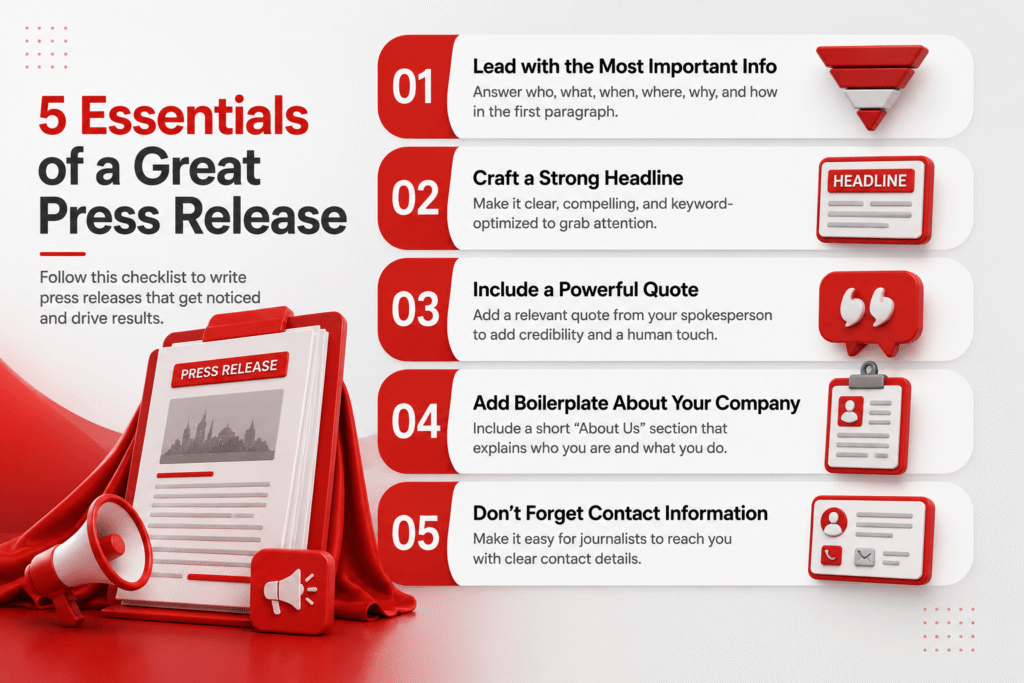
Before the examples — the five things that separate a release journalists use from one they ignore:
Inverted pyramid structure. The single most important fact goes in the headline and first sentence, not buried in paragraph three.
A headline that states the news, not a slogan. “Nordholm Living Opens First Turkish Showroom in Istanbul” beats “Nordholm Living Expands Its Vision.”
At least one quotable, substantive quote. Not “We’re thrilled” — a quote that adds information a journalist could use as a standalone line.
A boilerplate paragraph. A short, consistent “About [Company]” block journalists can lift directly.
A real media contact. Name, email, and phone — not a generic “info@” inbox.
15 Press Release Examples by Type
The examples below are illustrative and written to demonstrate structure and tone; company names and details are not real.
Product Launch Announcements
[SaaS feature launch]“Acme Analytics Launches Real-Time Fraud Detection for E-Commerce Platforms” — lead: “Acme Analytics today announced the launch of its real-time fraud detection module, giving mid-market e-commerce platforms enterprise-grade protection without added checkout friction.”
[Consumer product launch]“Nordholm Living Debuts Modular Sofa Collection Designed for Small-Space Living” — lead: “Scandinavian furniture brand Nordholm Living today unveiled its new modular sofa line, built specifically for apartments under 70 square meters.”
[B2B software launch]“Vertex Logistics Software Adds AI-Powered Route Optimization” — lead: “Vertex today released an AI-driven route optimization engine that cuts average delivery times by 18% in early customer trials.”
Market Entry & Expansion Announcements
[Retail market entry]“IKEA-Style Retailer Nordholm Living Enters the Turkish Market with Istanbul Flagship Store” — lead: “Nordholm Living announced today it will open its first Turkish location in Istanbul’s Kadıköy district this fall, marking the brand’s entry into the Turkish home furnishings market.”
[Tech expansion]“Fintech Platform PayFlow Expands Operations to Turkey, Targeting SME Merchants” — lead: “PayFlow today announced its expansion into Turkey, bringing its merchant payment platform to small and mid-sized businesses across Istanbul, Ankara, and Izmir.”
[Regional office opening]“Global PR Firm Opens Istanbul Office to Serve Growing Client Base in Turkey” — lead: “The firm’s new Kadıköy office will be led by a team of Turkish-market specialists serving both domestic and international clients.”
Partnership & Collaboration Announcements
[Distribution partnership]“Nordholm Living Partners with Turkish Retailer Modalife for National Distribution” — lead: “The partnership gives Nordholm Living access to Modalife’s 40-store Turkish retail network, accelerating its market entry timeline by an estimated six months.”
[Technology integration]“Acme Analytics and PaymentCo Announce Integration Partnership” — lead: “The integration allows PaymentCo merchants to access real-time fraud scoring directly within their existing checkout flow, with no additional setup required.”
Funding & Investment Announcements
[Series A]“PayFlow Raises $12M Series A to Expand Payment Infrastructure Across Southeast Europe” — lead: “The round, led by [Investor], will fund PayFlow’s expansion into Turkey, Greece, and Romania over the next 18 months.”
[Growth investment]“Nordholm Living Secures Growth Investment to Fund European Retail Expansion” — lead: “The investment will fund five new showroom openings across Europe, including the brand’s first Turkish location.”
Executive Hire & Leadership Announcements
[Regional lead hire]“PayFlow Names [Name] as Country Manager for Turkey” — lead: “[Name] brings over a decade of fintech leadership experience in the Turkish market, having previously led expansion efforts at [Prior Company].”
[C-suite hire]“Nordholm Living Appoints [Name] as Chief Retail Officer to Lead International Expansion” — lead: “[Name]’s appointment comes as the company prepares to open its first stores outside Scandinavia, including its planned Istanbul flagship.”
Company Milestone & Anniversary Announcements
[Growth milestone]“Acme Analytics Surpasses 500 Enterprise Customers Worldwide” — lead: “The milestone comes 18 months after the company’s Series B funding round and reflects a 140% year-over-year increase in enterprise adoption.”
[Anniversary]“Vertex Logistics Marks 10 Years of Operations with Launch of Sustainability Initiative” — lead: “To mark the milestone, Vertex is committing to carbon-neutral last-mile delivery across its European network by 2028.”
[Award/recognition]“PayFlow Named to [Publication]’s List of Top Fintech Companies to Watch” — lead: “The recognition cites PayFlow’s rapid expansion into Southeast European markets as a key factor in its selection.”
3 Free Press Release Templates
Template 1: Product Launch
FOR IMMEDIATE RELEASE
[Company Name] Launches [Product/Feature Name]
[City, Country] — [Date] — [Company Name] today announced the launch of [Product/Feature Name], [one-sentence description of what it does and who it’s for].
[2-3 sentences on the problem this solves and why it matters now.]
“[Substantive quote from a company spokesperson — should add information, not just express excitement],” said [Name, Title].
[Optional: a supporting statistic, customer quote, or availability detail.]
[Product/Feature Name] is available starting [date] at [where/how].
About [Company Name]
[2-3 sentence boilerplate — what the company does, who it serves, any notable credentials or partnerships.]
Media Contact:
[Name]
[Email]
[Phone]
Template 2: Market Entry / Expansion
FOR IMMEDIATE RELEASE
[Company Name] Enters the Turkish Market with [Store/Office/Launch Detail]
Istanbul, Turkey — [Date] — [Company Name], [one-line description of the company], today announced its entry into the Turkish market with [specific detail: a flagship store, local office, partnership, etc.].
[2-3 sentences: why Turkey, why now, what this means for Turkish customers/partners specifically — avoid generic “exciting market” language, cite something real: market size, existing demand, local partnership.]
“[Quote from company leadership on the Turkey decision],” said [Name, Title].
“[Optional second quote — from a local partner, distributor, or the company’s Turkey country lead, if one exists],” said [Name, Title].
[Company Name] plans to [next concrete step: additional locations, hiring, product localization timeline].
About [Company Name]
[Boilerplate.]
Media Contact:
[Name]
[Email]
[Phone]
Template 3: Partnership Announcement
FOR IMMEDIATE RELEASE
[Company A] and [Company B] Announce Partnership to [Shared Goal]
[City, Country] — [Date] — [Company A] and [Company B] today announced a partnership to [one-sentence description of what the partnership does].
[2-3 sentences on what each party brings and why the combination matters to customers/the market.]
“[Quote from Company A leadership],” said [Name, Title, Company A].
“[Quote from Company B leadership],” said [Name, Title, Company B].
The partnership [takes effect / rolls out] starting [date/detail].
About [Company A]
[Boilerplate.]
About [Company B]
[Boilerplate.]
Media Contact:
[Name]
[Email]
[Phone]
A Full Worked Example — Market-Entry Press Release for a Foreign Brand Entering Turkey
Worked example: Nordholm Living — Turkey market entry
FOR IMMEDIATE RELEASE
Nordholm Living Opens First Turkish Showroom in Istanbul’s Kadıköy District
ISTANBUL, TURKEY — [Date] — Nordholm Living, the Scandinavian furniture brand known for its modular, small-space furniture collections, today announced the opening of its first Turkish showroom in Istanbul’s Kadıköy district, marking the company’s entry into the Turkish home furnishings market.
The 400-square-meter showroom will carry Nordholm Living’s full modular sofa and storage collections, alongside a Turkey-exclusive line designed in response to local demand for compact furniture suited to Istanbul’s apartment-heavy housing market. The opening follows eighteen months of market research and a distribution partnership with Turkish retail group Modalife.
“Istanbul was a deliberate choice, not just an obvious one,” said [Name], CEO of Nordholm Living. “Apartment living here shares a lot with the Scandinavian cities we started in — space is at a premium, and people want furniture that adapts rather than furniture they have to work around. That’s exactly the problem we’ve spent a decade solving.”
“Turkish consumers have been asking for accessible modular design for years,” said [Name], Country Director at Modalife. “Nordholm Living’s approach fits the market better than anything currently available locally.”
The Kadıköy showroom opens to the public on [date]. Nordholm Living plans to open two additional Turkish locations, in Ankara and Izmir, by the end of next year.
About Nordholm Living
Nordholm Living designs and manufactures modular furniture for small-space living, with showrooms across Scandinavia and Northern Europe. Founded in [year], the company has sold over [number] units worldwide.
Media Contact:
[Name]
[Email]
[Phone]
(Nordholm Living is an illustrative placeholder brand, not a real PRTURKEY client — used here purely to demonstrate structure for a Turkey market-entry release. This section will be updated with real client examples as they become available.)
What Makes News Actually Land With Turkish Media
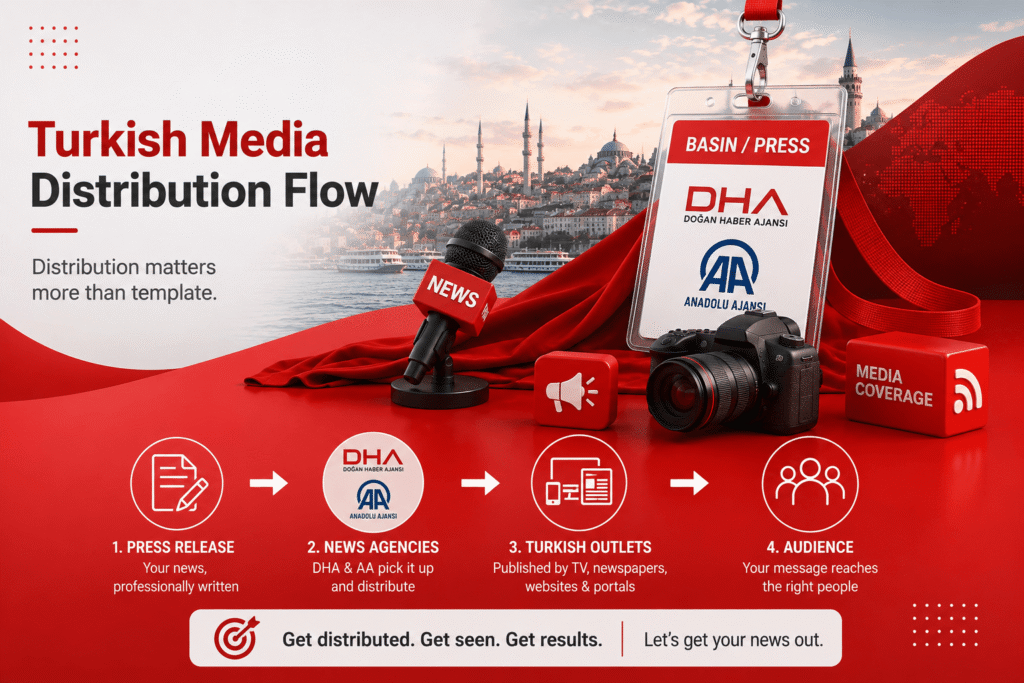
A release built like the examples above still depends on how it’s distributed. Reach through Turkey’s national wire services — DHA and Anadolu Agency (AA) — generally matters more for pickup than the raw number of outlets a distribution package claims.
A product launch press release is an official statement that tells journalists about a new product, service, or major feature. This page gives you what you need to write one: five complete product launch press release examples, a copy-and-paste template, and a step-by-step writing guide. If you are launching in Turkey, you will also find a section on local media and distribution.
What Is a Product Launch Press Release?
A product launch press release is an official corporate statement distributed to journalists, industry analysts, and media outlets to formally announce a new product, service, or major feature. It aims to generate editorial news coverage by providing reporters with essential, factual details. This document may also be called a “new product press release,” “product release announcement,” or “product announcement press release.”
Standard components include:
Clear dateline and geographical location
Strong, news-driven headline and subheadline
The 5Ws (Who, What, When, Where, Why) in the lead paragraph
Strategic executive quotes
Boilerplate and media contact information
What Is a Product Launch Press Release Used For?
A standard product launch press release serves as the factual foundation for any media outreach campaign. Journalists receive hundreds of pitches daily; a well-structured document ensures your news is verifiable, authoritative, and easy to quote.
This specific type of release is utilized in several distinct corporate scenarios:
Brand New Product: Introducing a completely novel item to the market.
Major Feature Update: Announcing a significant technological upgrade to an existing platform.
Product Line Expansion: Adding new variants, flavors, or models to a current portfolio.
International Market Entry: Launching a proven product into a new geographical territory.
Rebranding or Repositioning: Relaunching a product with a new identity or target demographic.
PR for Product Launch: Where the Press Release Fits
A press release is part of a broader product launch PR strategy, rather than the entire campaign. It can support interest before the launch by giving journalists a clear, verifiable news angle and useful background material. Editorial coverage may also improve visibility in search results and help investors or business partners understand the product’s relevance. Publication and coverage remain at the discretion of journalists and cannot be guaranteed.
Product Launch Press Release vs. Product Announcement: What’s the Difference?
While often used interchangeably, a press release for product launch and a general product announcement serve entirely different purposes and target completely different audiences. Understanding this distinction prevents brands from sending overly promotional material to journalists.
Feature
Product Launch Press Release
Product Announcement
Primary Audience
Journalists, editors, industry analysts
Existing customers, newsletter subscribers
Tone and Style
Objective, journalistic, third-person
Promotional, enthusiastic, direct-to-consumer
Core Objective
Secure earned media coverage and backlink placements
Drive immediate direct sales and user adoption
Distribution Channel
Wire services, media pitches, targeted agency networks
Company blog, social media, email marketing
Content Structure
Standardized (Dateline, 5Ws, Boilerplate)
Flexible (Visuals, emojis, heavy sales copy)
If you send a standard product announcement to a news desk, it will likely be ignored or flagged as an advertorial request. Reporters require the objective structure of a traditional press release.
Product Introduction Press Release: Is It the Same Thing?
A product introduction press release is the same document as a product launch press release. Some companies use “introduction” when the product is new to the market but not yet on sale, and “launch” when it is available now. The structure is identical: headline, dateline, 5Ws, quote, boilerplate, and media contact. If the product is not available yet, state the expected availability date in the lead paragraph so journalists know when readers can buy or use it.
What to Include in a Product Launch Press Release
Securing media attention requires adhering to strict journalistic standards. Every successful product press release contains seven mandatory elements. If any of these are missing, your credibility with editors drops significantly.
1. The Headline
The headline must be factual, concise, and immediately state the news. Avoid clickbait.
Good:TechCorp Launches AI-Powered Analytics Dashboard for Mid-Sized Retailers
Bad:You Won’t Believe the Amazing New Tool We Just Invented!
2. The Subheadline
This provides secondary context and expands on the value proposition without cluttering the main headline.
Good:New cloud-based platform reduces manual data entry by 40%, integrating directly with existing CRM systems.
Bad:It is the best software on the market and everyone should buy it today.
3. The Lead Paragraph (The 5Ws)
The opening paragraph must cover Who, What, When, Where, and Why. Journalists should understand the entire story simply by reading this section.
Good:LONDON, Oct. 12, 2026 – TechCorp today announced the global availability of DataFlow AI, a new analytics dashboard designed to help mid-sized retailers automate inventory tracking ahead of the holiday season.
Bad:We are so excited to announce that we have been working hard on something new and it is finally here for our customers to use.
4. Product Description
A clear, jargon-free explanation of how the product works and the specific problem it solves for the end user.
Good:DataFlow AI utilizes machine learning algorithms to predict stock shortages 14 days in advance.
Bad:Our synergistic paradigm-shifting tool revolutionizes the ecosystem of commercial retail.
5. Key Features and Benefits
Use bullet points. Journalists scan texts rapidly, and bulleted features allow them to extract core specifications easily.
Good:Features include real-time sync, mobile dashboard, and automated vendor alerts.
Bad:It syncs fast. It works on phones. It emails vendors for you.
6. The Executive Quote
Quotes should provide human insight, vision, or market perspective—not just repeat the product features.
Good:“Mid-sized retailers have historically been priced out of predictive analytics,” said Jane Doe, CEO of TechCorp. “DataFlow AI democratizes this technology, allowing local stores to compete with massive e-commerce giants.”
Bad:“I am very happy we launched this product because it has great features,” said Jane Doe.
7. Call to Action (CTA) and Boilerplate
Tell the reader exactly where to go next (e.g., a landing page or press kit) and include a standardized “About the Company” section with media contact details.
Provide product photographs, brand logos, relevant screenshots, and a product video when available. Share these assets through a clearly labeled press kit link rather than attaching large files to the media pitch, so journalists can access the formats they need.
How to Write a Press Release for a Product
Mastering how to write a press release for a product requires shifting your mindset from a marketer to a reporter. You are writing a foundational news document, not a sales flyer. Before you begin drafting, we highly recommend reviewing our comprehensive guide on How to Write a Press Release to grasp core journalistic writing techniques.
Define the News Angle: Ask yourself why a journalist would care today. Tie the launch to a current industry trend, a pressing consumer problem, or a seasonal shift.
Draft the Dateline and Lead: Start with the City, Country, and Date. Follow immediately with a single sentence that summarizes the entire launch. Do not bury the lede.
Construct the Narrative: Move from the most important information to the least important (the Inverted Pyramid structure). Place critical specifications early in the text.
Format the Executive Quote: Ensure the quote sounds like a real human speaking. Use it to convey the company’s vision or industry impact, leaving the technical specs for the bulleted lists.
Finalize the Formatting: Add “###” at the very end of the document to signify to editors that there is no further copy. Ensure the media contact includes a direct email and phone number, not a generic “info@” address.
Product Launch Press Release Examples (5 Full Samples)
Below are five complete product launch press release examples, each with a headline, lead paragraph, product details, executive quote, boilerplate, and media contact. All companies, people, prices, and results are fictional. Copy the structure, not the facts. For more industry samples, see our Press Release Examples: Best Industry Samples.
Scenario 1: Brand New Product (B2B SaaS)
FOR IMMEDIATE RELEASE
CloudSecure Launches Compli-Core, an Automated Compliance Platform for European Financial Institutions
New platform automates audit evidence collection and cuts regulatory reporting time by up to 60%
BERLIN, Nov. 5, 2026 — CloudSecure, an enterprise cybersecurity provider, today announced the launch of Compli-Core, an automated auditing platform designed to help European financial institutions reduce regulatory reporting time by up to 60%. The platform is available immediately across all EU jurisdictions.
Banks and insurers still collect much of their audit evidence by hand. Compli-Core connects to existing systems and prepares audit-ready reports automatically. In a pilot with four mid-sized banks, average reporting time fell by 58%.
Key features of Compli-Core include:
Automated evidence collection: pulls records from core banking, CRM, and document systems without manual exports.
Regulation mapping: matches internal controls to EU requirements and flags gaps in real time.
One-click audit reports: generates regulator-ready reports in PDF and XML.
“Compliance teams spend their weeks gathering documents instead of managing risk,” said Anna Keller, CEO of CloudSecure. “Compli-Core gives them that time back and gives regulators a clearer audit trail.”
Compli-Core is available now through annual subscription, starting at €2,400 per month. A demo can be booked at compli-core.example.com.
About CloudSecure
CloudSecure is a Berlin-based cybersecurity and compliance software company. Founded in 2016, it serves more than 200 financial institutions in Europe. For more information, visit cloudsecure.example.com.
What makes this example work: The headline names the product, the audience, and the benefit. The lead has all 5Ws. The quote says something about the problem instead of praising the product. Price and availability are stated.
Scenario 2: Mobile App Launch Press Release
FOR IMMEDIATE RELEASE
FitTrack Introduces PaceMaker, an AI-Powered Running Coach App for iOS and Android
App adjusts weekly marathon training plans daily based on each runner’s recovery data
SAN FRANCISCO, Jan. 15, 2026 — FitTrack today announced the global release of PaceMaker, a mobile app that uses artificial intelligence to build adaptive training plans for marathon runners. PaceMaker is available now on the Apple App Store and Google Play.
Most training plans are fixed, even when a runner sleeps badly or feels sore. PaceMaker reads daily recovery data from the user’s wearable and adjusts weekly mileage and workout intensity accordingly.
Key features of PaceMaker include:
Adaptive plans: recalculates the next workout each morning based on sleep, resting heart rate, and recent load.
Wearable sync: works with Apple Watch, Garmin, and Fitbit.
Race-day pacing: creates a split-by-split pacing strategy for the user’s target time.
“A plan that ignores how your body feels is just a spreadsheet,” said Priya Nair, co-founder and CEO of FitTrack. “PaceMaker treats recovery as part of training.”
PaceMaker is free to download. The premium plan costs $9.99 per month, with a 14-day free trial. Download links and press images are available at fittrack.example.com/press.
About FitTrack
FitTrack is a San Francisco-based fitness technology company founded in 2021. Its apps help more than 300,000 runners train for races. For more information, visit fittrack.example.com.
Media Contact:
Daniel Ortiz, PR Manager
press@fittrack.example.com | +1 415 555 0142
What makes this example work: It states platforms (iOS/Android), who it is for, and what it does in the first paragraph. The pricing and trial are in one line. The press kit link gives journalists images without attachments.
Scenario 3: Product Line Expansion
FOR IMMEDIATE RELEASE
Artisan Coffee Co. Expands Single-Origin Line With Sustainably Sourced Colombian Dark Roast
New whole-bean roast is sourced directly from independent cooperatives in Huila
SEATTLE, March 10, 2026 — Artisan Coffee Co. today expanded its premium whole-bean lineup with a new Colombian Dark Roast. Sourced directly from independent cooperatives in the Huila region, the roast adds notes of dark chocolate and black cherry to the brand’s single-origin range. It is available from today online and in 120 partner stores.
The new roast is the fifth single-origin coffee in the lineup. Artisan buys directly from farming cooperatives and pays above the local market price.
Key details:
Flavor notes: dark chocolate, black cherry, light caramel finish.
Format: 12 oz whole-bean bag, compostable packaging.
Price and availability: $16.50 at artisancoffee.example.com and participating retailers from March 10.
“Customers kept asking for a darker single-origin that did not taste burnt,” said Laura Mills, Head of Coffee at Artisan Coffee Co. “The Huila cooperatives gave us exactly that, and the direct relationship means the farmers share in the growth.”
About Artisan Coffee Co.
Artisan Coffee Co. is a Seattle-based specialty roaster founded in 2012. It sells single-origin and blended coffees online and through partner stores across the United States. For more information, visit artisancoffee.example.com.
Media Contact:
Sam Reyes, Communications Lead
media@artisancoffee.example.com | +1 206 555 0178
What makes this example work: It makes clear what is new while reminding the reader of the existing brand. Format, price, and where to buy are all given.
Scenario 4: Feature Update
FOR IMMEDIATE RELEASE
TaskMaster Adds Real-Time Collaborative Whiteboards to Support Remote Team Workflows
New feature lets teams brainstorm and turn ideas into assigned tasks in one workspace
AUSTIN, Texas, May 22, 2026 — TaskMaster, a project management platform used by more than 50,000 teams, today released native real-time whiteboards. The feature lets remote teams sketch ideas together and convert sticky notes into tasks without leaving the platform. It is available to all paid plans starting today.
Until now, many TaskMaster customers used separate diagramming tools and copied results back by hand. The new whiteboards remove that step.
Key features include:
Real-time collaboration: up to 50 people can edit the same board at once.
Notes to tasks: convert any sticky note into a task with an owner and due date.
Templates: includes retrospective, roadmap, and brainstorm layouts.
“Our customers told us that the idea phase and the planning phase lived in different tools,” said Chris Dalton, VP of Product at TaskMaster. “Whiteboards put them in the same place.”
Whiteboards are included at no extra cost on Team and Business plans. A short product tour is available at taskmaster.example.com/whiteboards.
About TaskMaster
TaskMaster is an Austin-based project management software company founded in 2018. For more information, visit taskmaster.example.com.
Media Contact:
Hannah Cole, Senior PR Manager
press@taskmaster.example.com | +1 512 555 0190
What makes this example work: The angle is how the update changes the user’s workflow, not a list of buttons. It says which plans get the feature and what it costs.
Scenario 5: International Market Entry (Focus: Turkey)
FOR IMMEDIATE RELEASE
PayStream Launches Operations in Turkey With Low-Fee B2B Payments to 40 European Countries
Europe-based payment provider commits €5 million to Turkish infrastructure and plans local hiring
ISTANBUL, Sept. 14, 2026 — PayStream, a European cross-border payments company, today announced the start of its operations in Turkey. Following regulatory approval and an initial infrastructure investment of €5 million, PayStream will offer Turkish SMEs low-fee, same-day B2B payments to 40 European countries.
Turkish exporters often wait days for international payments and pay high conversion fees. PayStream settles euro payments within hours and shows the total fee before a transfer is made.
Key details:
Coverage: payments to businesses in 40 European countries, with settlement in TRY, EUR, and USD.
Pricing: transparent flat fee, shown before each transfer.
Local presence: Turkish-language support and an Istanbul office opening in Q4 2026.
“Turkish SMEs are central to Europe’s trade flows, and they deserve payment infrastructure to match,” said Elena Rossi, CEO of PayStream. “We are investing in Istanbul, hiring locally, and building long-term partnerships with Turkish banks.”
Turkish businesses can register at paystream.example.com/tr. The company plans to hire 40 employees in Turkey by the end of 2027.
About PayStream
PayStream is a Dublin-based payments company founded in 2017. It processes cross-border B2B payments for more than 15,000 businesses in Europe. For more information, visit paystream.example.com.
What makes this example work: The investment amount, local hiring commitment, and local currency show Turkish editors why the news matters to their readers.
<a id=”template”></a>
Press Release Sample for Product Launch: Free Template
Use this press release sample for product launch as a starting point. Copy it, replace every bracketed item with your own details, and delete anything that does not apply. A good release is usually 300 to 500 words.
FOR IMMEDIATE RELEASE
[Headline: Company Name] Launches [Product Name] to Help [Target Audience] Achieve [Main Benefit]
[Subheadline: One sentence expanding on the headline, highlighting a key feature, metric, or competitive advantage.]
[CITY, COUNTRY] – [Date] – [Company Name], a [brief description of company, e.g., leading provider of cloud solutions], today announced the launch of [Product Name]. This new [software/hardware/service] is designed specifically to solve [specific industry problem], enabling [Target Audience] to [major outcome or benefit].
“Our team recognized a critical gap in how [Target Audience] manages [specific task],” said [Executive Name], [Executive Title] at [Company Name]. “With [Product Name], we are democratizing access to [key technology/feature], allowing businesses to focus on growth rather than operational friction.”
Key features of [Product Name] include:
[Feature 1]: [Brief explanation of how it works and the benefit].
[Feature 2]: [Brief explanation of how it works and the benefit].
[Feature 3]: [Brief explanation of how it works and the benefit].
[Product Name] is available immediately starting at [Price] and can be purchased directly at [Link to Product Page].
About [Company Name]
[Company Name] is a [location]-based company specializing in [core competency]. Founded in [Year], the company has helped over [Number] clients achieve [Brand Mission]. For more information, visit [Website URL].
Media Contact:
[Name]
[Title]
[Email Address]
[Phone Number]
How to fill in each part
Headline: Company name, a verb (launches, introduces, unveils), the product name, and the benefit for the audience. Under 100 characters if possible.
Subheadline: One sentence with a number, a differentiator, or availability.
Dateline and lead: City, country, date, then who is announcing what and why it matters, in one or two sentences.
Quote: One person with a title. Say why the product exists or what changes for the customer. Do not repeat the feature list.
Features: Three to five bullets, each with a feature and its benefit.
Availability: Price, launch date, where to buy or sign up.
Boilerplate: Two to three sentences about the company, plus its website.
Media contact: A named person with direct email and phone.
Adapt the template for your product type
Software or app: add “Available for [iOS / Android / web / Windows]” and the pricing plan in the availability line.
Physical product: add size, materials, colors, and “available in [countries/stores]” in the key details.
Feature update: replace “launch of [Product Name]” with “released [Feature Name], a new feature in [Product Name]” and state which plans include it.
Service: describe who it is for, what is included, and how to book.
Need your release in the Turkish media? PR Turkey adapts your product launch press release into Turkish and distributes it to national news agencies and media outlets. Get a free distribution quote
How to Launch a Product in Turkey: What International Brands Need to Know
Expanding into the Eurasian market requires more than just translating your English product press release into Turkish. The Turkish media landscape operates on distinct cultural and infrastructural rules. To guarantee coverage, international brands must adapt their PR strategy to fit local journalistic expectations. For a deeper dive into agency networks, consult our guide on Press Release Distribution in Turkey.
The Power of Local News Agencies
Unlike the US or UK, where direct pitching to journalists is heavily relied upon, the Turkish media ecosystem is deeply integrated with major wire services. Demirören Haber Ajansı (DHA) and Anadolu Ajansı (AA) supply the vast majority of daily content to national newspapers, regional outlets, and mainstream digital portals. Distributing your announcement through these national channels usually gives you wider reach than cold emailing individual reporters, because their stories are republished by many outlets.
True Localization vs. Direct Translation
Turkish is a high-context language. Direct translations of sales-heavy marketing copy often sound unnatural in Turkish editorial style. Keep the tone informative and neutral. Furthermore, localize the data. If you state a software saves “$500 a month,” convert this to Turkish Lira (TRY) or frame it in a percentage context that resonates with the local economic climate.
Timing and Formats
Timing matters significantly in Istanbul’s fast-paced news cycles. Many PR professionals prefer to send releases on Tuesday to Thursday mornings, when newsrooms are fully staffed. Test different times and check which stories got pickup. Finally, Turkish business journalists favor concrete commitment. When structuring the executive quote, prioritize mentions of local hiring, regional investment figures, or long-term commitments to the Turkish market over generic praise of the product’s features.
Common Mistakes in Product Launch Press Releases
Even minor structural errors can result in an editor deleting your pitch. Avoid these frequent pitfalls to maintain a professional brand image.
Mistake
Why It Fails
Fix
Missing the Dateline
Journalists cannot verify if the news is current or where the corporate entity operates.
Always start the lead paragraph with “CITY, Country, Date —”
Burying the Price and Availability
Reporters will not hunt through your website to find out when consumers can actually buy the item.
Clearly state the launch date, starting price, and where to purchase in the final body paragraph.
Using Jargon and Buzzwords
Terms like “synergistic,” “revolutionary,” or “next-gen” dilute the facts and sound like paid advertising.
Stick to concrete nouns and active verbs. Let the specifications prove the product is innovative.
Attaching Massive PDF/Image Files
Large attachments clog journalist inboxes and trigger corporate spam filters, preventing delivery.
Host high-resolution logos and product shots in an external cloud folder (Dropbox/Drive) and provide a link.
Failing to Localize
Sending an English-only document to Turkish media desks greatly reduces your chances of pickup, since editors rarely have time to translate.
Partner with a local PR agency to culturally adapt the text for international markets.
Key Takeaways
Executing a successful media rollout requires precision, restraint, and an understanding of journalistic workflows. Keep these core principles in mind:
Ensure your announcement contains a clear dateline, the 5Ws, and standard boilerplate elements.
Separate your media relations strategy from your direct-to-consumer marketing efforts.
Utilize bullet points to highlight technical specifications for fast scanning.
Craft executive quotes that offer market vision rather than repeating feature lists.
Localize your narrative—especially when targeting the Turkish market—by utilizing local currency, cultural context, and national wire services like DHA or AA.
Always provide a secure link to a digital press kit containing high-resolution multimedia assets.
Start from a proven template, and adapt the headline, quote, and key details to your own product instead of copying a sample word for word.
Frequently Asked Questions (FAQ)
What is a product launch press release?
It is a formal corporate document distributed to the media to announce a new item or service. It provides journalists with the factual 5Ws, executive quotes, and specifications needed to write an objective news story about the release.
How do you write a press release for a product launch?
Start with a factual headline, include a dateline, and summarize the entire story in the first paragraph. List key features using bullet points, add an insightful executive quote, and conclude with pricing, availability, and company contact details.
What is the difference between a product announcement and a press release?
An announcement is promotional marketing copy aimed directly at existing customers via blogs or social media. A press release for product launch is an objective, third-person document designed specifically to secure earned media coverage from journalists.
Can I use a product launch press release template?
Yes. Our product launch press release template above includes a headline, dateline, quote, key features, boilerplate, and media contact. Copy it, replace the bracketed text, and remove sections you do not need. Using a template helps you avoid missing elements editors expect.
What should a press release sample for product launch include?
A professional sample must feature a compelling headline, a subheadline for context, a lead paragraph covering the 5Ws, bulleted product benefits, a strategic quote from leadership, and clear details regarding pricing and market availability.
How do I distribute a product launch press release in Turkey?
To succeed in Turkey, you must localize the content culturally and linguistically. Instead of cold-pitching, distribute the localized text through major national wire services like DHA and AA, preferably with the guidance of a local PR agency.
When should I send a new product press release?
Tuesday through Thursday mornings are generally a practical starting point for outreach to Turkish newsrooms, although the best timing depends on the story and editorial schedule. Sending a release late on a Friday often means lower visibility, as many newsrooms run with smaller teams going into the weekend.
What is a product introduction press release?
A product introduction press release is another name for a product launch press release. It announces a new product to journalists with the same structure: headline, 5Ws, quote, boilerplate, and media contact.
How long should a product launch press release be?
Most are between 300 and 500 words, or about one page. Put the most important facts in the first paragraph and link to a press kit for details and images.
Where can I find a product launch press release example?
This page includes five complete examples: a B2B software launch, a mobile app, a product line expansion, a feature update, and an international market entry in Turkey.
Securing impactful media coverage requires treating reporters with professional respect by providing properly formatted, highly factual documents. Every successful product launch press release balances technical specifications with a broader narrative about industry impact. When scaling internationally, especially into vibrant markets like Turkey, localization and correct distribution channels are non-negotiable for success. If your brand is preparing to introduce a new technology, app, or service to the Turkish media landscape, contact PR Turkey today to build your customized distribution strategy.
Understanding exactly what is a newswire remains a fundamental requirement for any corporate communications professional looking to scale their brand’s visibility. This comprehensive guide explains the core newswire definition, details the underlying mechanics of modern distribution networks, and provides actionable examples. By the end of this article, you will know how to leverage these platforms to secure earned media, with a special focus on strategic market entry tactics for international brands.
What Is a Newswire?
A newswire is a specialized electronic communication network designed to distribute press releases, official corporate announcements, and multimedia news content directly to journalists, newsrooms, financial data terminals, and online media outlets. Rather than sending individual emails to reporters, organizations use these established pipelines to ensure their news is delivered instantly, securely, and simultaneously to thousands of targeted media endpoints.
The core function of a newswire is to act as a verified, trusted bridge between the source of the news (the company or PR agency) and the publishers (the media). When a brand submits a document to a newswire, it bypasses standard spam filters and arrives directly in the editorial dashboards used by reporters to source their daily stories. This automated syndication generates rapid visibility, bolsters search engine presence, and establishes a definitive digital footprint for corporate milestones.
The History of Newswires: From Telegraph to Digital
The history of news syndication began in the mid-19th century with the invention of the telegraph, allowing organizations like the Associated Press (AP) and Reuters to transmit real-time updates across vast distances. Initially, these networks were strictly reserved for journalistic endeavors, sharing breaking news among allied newspapers to reduce reporting costs. However, the digital revolution of the late 20th century transformed this infrastructure entirely. Today’s commercial distribution networks operate on sophisticated API integrations and web-based dashboards, completely shifting the industry from clunky teletype machines to instantaneous, SEO-optimized digital syndication that reaches global audiences in milliseconds.
Types of Newswire Services
Selecting what is the best newswire service for international brands requires understanding the distinct categories operating in the modern media landscape. Not all distribution networks function in the same way, and choosing the wrong tier can result in wasted budgets and zero media pickup.
Traditional News Agencies
These are the foundational pillars of global journalism. Organizations such as Reuters, Associated Press (AP), and Agence France-Presse (AFP) employ thousands of independent journalists to gather and distribute breaking news to subscribing newspapers and broadcasters. They are fiercely independent and do not accept direct, unedited corporate press releases for guaranteed publication. Earning a spot on these wires requires a story of massive public or macroeconomic interest, usually pitched by a highly connected PR professional.
Commercial PR Newswire Services
This tier represents the core of the modern B2B communications industry. Platforms like PR Newswire, Business Wire, and GlobeNewswire allow corporations to pay a fee to broadcast their official, unedited statements over proprietary networks. These companies have established syndication agreements with major portals, financial terminals (like Bloomberg), and regional newspapers. They guarantee a certain baseline of visibility by automatically publishing the release on a network of partner websites, while simultaneously placing the text in front of subscribed journalists for potential organic coverage.
Modern Self-Service Distribution Platforms
Designed primarily for agility and budget flexibility, these cloud-based platforms allow small to medium-sized enterprises (SMEs) to upload, format, and distribute content without dealing with heavy editorial gatekeeping. While their direct reach into top-tier financial terminals might be lower than legacy commercial wires, they excel at generating broad digital footprints, securing online syndication, and providing immediate, transparent analytics dashboards for SEO-focused digital PR campaigns.
How Does a Newswire Work? Step by Step
Many marketing teams wonder about the mechanics behind the curtain. How does a newswire work in practice? The process transitions a simple Word document into a globally syndicated news event through a highly structured workflow.
Step 1: Content Creation and Targeting
The organization drafts a comprehensive press release following universal journalistic standards, specifically utilizing the inverted pyramid structure. During the upload phase on the chosen platform, the user selects specific distribution circuits. These circuits act as filters, allowing the brand to target journalists based on geography (e.g., North America, Europe, the Middle East) or specific industry verticals (e.g., technology, healthcare, finance).
Step 2: Editorial Review and Formatting
Before any document touches the public network, it undergoes a mandatory screening by the platform’s editorial desk. Editors check the content for legal compliance, verify the identity of the sending company to prevent stock manipulation or libel, and ensure the formatting (datelines, boilerplate, media contacts) aligns with industry standards. This verification is crucial because it maintains the network’s trusted reputation among receiving journalists.
Step 3: Algorithmic Syndication and Delivery
Once approved, the technology takes over. The text is injected into the network’s API and distributed via RSS feeds, direct FTP transfers, and proprietary software directly into the content management systems (CMS) of newsrooms. Simultaneously, the document is sent to the financial terminals of investors and syndicated automatically onto hundreds of partner websites, ensuring immediate digital visibility.
Step 4: Media Monitoring and Analytics Reporting
The final step separates professional platforms from basic email blasts. The system tracks the digital journey of the announcement, aggregating data into a comprehensive report. Brands receive actionable metrics detailing exactly which media outlets published the story, the geographic location of the readers, potential audience reach, and the click-through rates on the embedded hyperlinks, providing a clear calculation of return on investment (ROI).
Newswire vs Press Release Distribution: What’s the Difference?
When planning a media campaign, professionals often search for “press release vs newswire which one to choose for product launch.” While the terms are frequently used interchangeably in casual conversation, they represent two distinctly different components of a PR strategy. A press release is the product; the newswire is the delivery vehicle.
Feature
Press Release
Newswire Service
Core Definition
A written, official corporate document detailing a specific news event.
The technological infrastructure and network used to transmit the document.
Format
Text, images, dateline, boilerplate, and contact information.
API feeds, digital dashboards, editorial desks, and syndication channels.
Objective
To convey facts objectively and secure earned media coverage.
To guarantee secure, simultaneous, and targeted delivery to journalists.
Creation Control
Authored entirely by the brand, PR agency, or copywriter.
Managed by the distribution company ensuring compliance and reach.
Cost Structure
Cost of labor (writing and formatting the text).
Distribution fees (per word, per circuit, or flat-rate models).
Understanding this distinction is vital. You can have a brilliantly written press release, but without a powerful newswire to push it into the correct editorial hands, it remains invisible. Conversely, utilizing a premium distribution network for a poorly written, non-newsworthy document will yield zero organic engagement from journalists.
Newswire Examples by Announcement Type
To understand the practical application of these services, it is helpful to look at examples of newswire distribution for B2B tech companies and other corporate entities. The format and tone of the announcement directly dictate how it will be received by the editorial desk.
1. The Strategic Product Launch
When a software company releases a new artificial intelligence tool, the newswire distribution targets technology editors and SaaS industry portals. The newswire examples in this category focus heavily on the problem the product solves, featuring high-resolution interface screenshots and a visionary quote from the Chief Technology Officer. The goal is to secure review articles and feature placements in tech publications.
2. Mergers, Acquisitions, and Funding Rounds
Financial announcements require strict compliance and rapid, broad distribution to prevent insider trading advantages. A startup securing $20 million in Series B funding will use a premium circuit that directly feeds into Bloomberg, Yahoo Finance, and venture capital journals. These releases are data-heavy, focusing on market valuation, investor profiles, and future scaling plans, relying on the network’s speed and security.
3. Executive Leadership Appointments
Announcing a new CEO or a high-profile board member utilizes specialized HR and industry-specific circuits. These announcements serve to reassure investors and signal strategic shifts to the market. The text typically highlights the new executive’s past achievements, includes a professional portrait, and outlines the company’s future trajectory under their leadership.
4. Market Entry and International Expansion
When a brand decides to open a regional headquarters in a new country, localized distribution becomes paramount. The announcement is translated, culturally adapted, and sent through a network that specifically targets the business press of the new region. This establishes immediate local credibility, signals hiring intentions, and alerts regional competitors to the brand’s arrival.
How Newswires Work in Turkey: What International Brands Need to Know
For global corporations, understanding how to use a newswire service in Turkey without local contacts is the most critical hurdle to successful market penetration. The Turkish media ecosystem is highly unique, centralized, and fiercely protective of its native language standards. A standard English press release blasted into this market will almost universally be ignored.
The Turkish news cycle is heavily dominated by powerful national agencies such as Demirören News Agency (DHA), Anadolu Agency (AA), and İhlas News Agency (İHA). These organizations supply the vast majority of daily content to local newspapers, television broadcasters, and high-traffic online portals. A successful newswire Turkey strategy mandates that your corporate news is ingested and validated by these primary sources. If a story breaks through DHA, it automatically cascades to hundreds of regional and national outlets via syndication.
Furthermore, localization is non-negotiable. Turkish editors operate under immense time pressure and will not translate an English press release on behalf of a foreign brand. A Turkey newswire campaign must feature flawless, native-level Turkish translation that respects local journalistic styling, cultural nuances, and regional economic contexts. Simply translating a global template word-for-word often results in awkward phrasing that immediately disqualifies the text from editorial consideration.
This is where specialized regional agencies become indispensable. International brands must leverage distribution partners who possess established, direct relationships with Turkish editorial desks. A dedicated service not only handles the linguistic localization but also navigates the complex backend of Turkish media syndication, ensuring that the brand’s narrative is positioned correctly in front of the right national journalists, maximizing the return on PR investment.
How to Choose the Right Newswire Service
Evaluating how much does a newswire service cost for small businesses versus large enterprises reveals a chaotic pricing landscape. Selecting the optimal partner requires a rigorous assessment of their technical capabilities and their pricing transparency.
Geographic and Vertical Reach: Does the network actually reach the specific countries and industry reporters you need, or do they only offer generic web syndication? Ensure their partner list includes reputable, high-domain-authority publishers.
Pricing Transparency: Many legacy platforms utilize a punitive pricing model based on word counts (e.g., charging extra for every 100 words over a 400-word limit) and levy heavy fees for embedding logos or videos. Look for modern services offering flat-rate pricing with multimedia inclusions to protect your marketing budget.
Localization Capabilities: If targeting foreign markets, assess whether the service offers native translation and culturally adapted editorial formatting, or if they just push English text into non-English territories.
Editorial Support: A premium service should provide a layer of human editorial review to catch formatting errors and ensure compliance with journalistic standards before the release goes live.
Comprehensive Analytics: The post-distribution report must go beyond basic metrics. It should provide exact URLs of published articles, audience engagement data, and geographic heat maps to help you prove ROI to stakeholders.
Key Takeaways
Navigating the complexities of global media relations requires the right technological infrastructure. Here are the core principles to remember:
A newswire is a vital distribution channel that bridges the gap between corporate communications and targeted media professionals.
Understanding the difference between the written press release and the syndication network is essential for budgeting and strategy.
The effectiveness of a campaign relies entirely on precise targeting, choosing the right geographic and industry-specific circuits.
When entering localized markets like Turkey, direct translation is insufficient; cultural adaptation and access to national agencies (like DHA or AA) are mandatory for success.
Always evaluate distribution partners based on pricing transparency, analytics capabilities, and their ability to provide actual earned media opportunities, not just automated spam.
FAQ
What is a newswire service?
It is a specialized digital platform that distributes corporate announcements, press releases, and multimedia content directly to journalists, newsrooms, and financial terminals. It automates media outreach, ensuring secure, rapid, and targeted delivery to generate earned media coverage and online syndication.
What is a news wire service?
The term “news wire service” is simply an alternative spelling of newswire. It refers to the exact same communication networks—like AP or commercial platforms—that transmit real-time news and corporate statements to global publishers, databases, and reporting desks.
How does a newswire distribute press releases?
The platform utilizes automated API integrations, RSS feeds, and direct FTP transfers to push approved documents directly into the content management systems of newsrooms. Simultaneously, it emails targeted journalists based on their subscribed industry beats and syndicates the text to partner websites.
Newswire vs press release: what’s the difference?
A press release is the actual written document containing the news, formatted with a dateline, quotes, and company details. The newswire is the technological delivery network that transmits that document to the media. You write the release; the wire distributes it.
How do newswires work in Turkey?
In Turkey, successful distribution relies heavily on major national agencies like DHA and AA. International releases must be flawlessly translated into native Turkish and adapted to local journalistic standards, as Turkish editors rarely publish or translate foreign-language corporate texts directly.
How much does a newswire service cost?
Costs vary drastically. Legacy platforms often charge $500 to $1,500+ per release, utilizing strict word-count limits and extra fees for multimedia. Modern regional specialists often offer flat-rate packages, providing comprehensive distribution and translation without hidden penalties for longer texts.
Do I need a newswire service to enter the Turkish market?
Yes. Without a dedicated distribution network, navigating the localized media landscape and bypassing spam filters is nearly impossible. A specialized service provides the necessary translation, cultural formatting, and direct access to Turkey’s centralized news agencies, ensuring immediate brand visibility.
Conclusion
Mastering the mechanics of global syndication is the fastest route to establishing authority in a new market. By understanding exactly what is a newswire and how to leverage its targeting capabilities, brands can transition from sending ignored emails to securing high-value media placements. Whether you are announcing a product launch, a financial milestone, or expanding your operations internationally, the right distribution partner transforms your corporate message into verified news. If your brand is preparing to penetrate the dynamic Turkish economy, explore our specialized solutions and discover how to execute a flawless media strategy: Review our strategic distribution packages Turkey PR Services.
Modern communications teams face a critical operational crossroads: licensing self-service software or partnering with a managed service provider. Relying solely on automated software platforms often leads to unverified data noise, missed crisis signals, and misallocated staff hours. Choosing the right path depends on internal analytical bandwidth, regional media complexity, and tolerance for false positives. Media monitoring services bridge this gap by pairing advanced tracking technologies with human expertise to deliver actionable reputational intelligence.
What Are Media Monitoring Services?
Media monitoring services combine enterprise-grade tracking software with dedicated media analysts who curate, verify, and translate media mentions into strategic business intelligence. Unlike standalone software, managed services deliver human-checked reporting tailored to corporate goals.
Key capabilities include:
Custom Boolean query construction and ongoing keyword tuning
Human-verified sentiment analysis and false-positive filtering
Real-time crisis alerts issued by human analyst teams
Executive-ready media analytics and Share of Voice (SOV) reporting
What Are Media Monitoring Tools and How Do They Work?
Media monitoring tools are self-service software platforms that scan online news, print publications, broadcast channels, and social networks for specific keywords. These systems rely on Application Programming Interfaces (APIs), RSS feeds, and automated web scrapers to gather data into a single web dashboard. When configured properly, they collect vast quantities of public content in real time.
Operating these tools effectively requires technical setup. Users must build complex Boolean search strings using operators like AND, OR, and NOT to narrow down mentions. A typical enterprise search string looks like this: (“Brand Name” OR “Executive Name”) AND (“Crisis” OR “Lawsuit” OR “Earnings”) NOT (“Sponsorship” OR “Job Posting”).
While automated media monitoring tools offer raw speed and broad reach, their primary weakness is a lack of contextual understanding. Software detects word occurrences but cannot evaluate tone, sarcasm, or brand relevance. Without dedicated internal personnel to clean and filter incoming data, communication teams quickly suffer from alert fatigue. Utilizing a self-service media monitoring platform means your internal staff must manage this entire parsing and filtering layer themselves.
What Are Managed Media Monitoring Services?
Managed media monitoring services pair software scraping capabilities with human analyst oversight. Instead of logging into a raw software dashboard every morning, communications leaders receive pre-filtered briefs containing verified mentions and contextual executive summaries.
The core value of managed media monitoring services lies in human judgment. For instance, brands with generic names—such as “Summit,” “Pinnacle,” or “Horizon”—generate thousands of irrelevant mentions daily. Automated tools struggle to separate a company named “Summit Logistics” from news about a mountain summit or a political summit meeting. Human analysts review incoming mentions every morning, stripping away up to 80% of irrelevant data before generating reports.
Furthermore, managed services deliver qualitative context that software algorithms cannot replicate. Analysts synthesize coverage trends, assess journalist influence, and evaluate message delivery across Tier-1 publications. This human oversight transforms raw media mentions into strategic advisory reports for C-suite leaders.
Cost Difference Between Media Monitoring Software and Agencies
Evaluating media tracking investments requires calculating the Total Cost of Ownership (TCO) rather than comparing software license fees against agency invoices. The cost difference between media monitoring software and agencies becomes clear when factoring in internal labor, training, and configuration overhead.
When we look at the upfront software cost, self-service software (SaaS) typically ranges from $5,000 to $30,000 per year, whereas this cost is completely included in the service retainer for managed media monitoring services.
In terms of internal labor overhead, self-service tools require a high commitment, often demanding 10 to 20 hours per week from a team member just to manage the platform. Managed services, on the other hand, require a very low time commitment of only 1 to 2 hours per week for reviewing the finished reports.
Data cleanup and triage also differ drastically. With a software platform, manual internal effort is constantly required to weed out irrelevant data. With a managed service, this is fully handled by external analysts. Sentiment accuracy similarly heavily favors managed services, which boast a 95%+ human-verified accuracy rate, compared to the 60% to 75% machine learning average seen in SaaS products.
Finally, setup and maintenance for self-service software require an in-house Boolean expert to constantly tweak queries. Managed services offer a turnkey onboarding experience with ongoing, proactive optimization. Adding internal salary costs to software licensing often pushes the true expense of self-service software beyond the price of an outsourced managed service contract.
In-House Social Media Monitoring vs Outsourced Agency
Social networks generate vast volumes of uncoordinated public conversation, making real-time tracking complex. Deciding between in-house social media monitoring vs outsourced agency setups comes down to your primary operational objective: customer engagement or reputational risk management.
Handling social media monitoring internally works well for frontline community managers responding to customer service inquiries or product feedback. In-house teams excel at real-time brand engagement. However, relying solely on internal teams for macro-level reputation tracking often leads to blind spots during off-hours or sudden viral spikes.
Outsourcing high-volume social monitoring transfers the burden of data triaging to an external partner. Experienced service providers deploy dedicated analysts who monitor conversations around the clock, filtering out bot spam and isolated complaints. When a genuine crisis pattern emerges, the agency escalates verified intelligence to leadership, protecting internal teams from continuous notification fatigue.
Can Media Analytics Be Fully Automated Without Human Review?
Artificial Intelligence and Natural Language Processing (NLP) engines have advanced significantly, yet asking whether can media analytics be fully automated without human review yields a clear answer: full automation creates significant reporting errors.
Automated sentiment classification routinely misinterprets nuanced language, sarcasm, and regional expressions. Consider a public comment such as: “Great job taking two weeks to respond to my urgent support ticket!” Automated software flags words like “Great” and “job” as positive sentiment, logging this severe complaint as a favorable brand mention and corrupting your overall sentiment score. A human analyst instantly detects the sarcasm and delay, accurately categorizing it as a negative sentiment.
Automated media analytics also struggle with calculating true Share of Voice (SOV). Software treats a brief mention in a low-tier blog equally with an exclusive interview in a major national financial newspaper. Human analysts weight media coverage by publication authority, journalist beat alignment, and message retention, delivering accurate metrics that accurately reflect brand equity.
Best Setup for Local News Monitoring in the Turkish Market
Global enterprise software platforms often fail when deployed in regional markets with unique linguistic and media structures. Implementing the best setup for local news monitoring in the turkish market requires local media access and language-specific processing models.
Tracking media in Turkey presents distinct technical and operational challenges. First, there is agglutinative grammar complexity. Turkish relies on extensive suffix attachments added to root words. Global NLP models trained primarily on English fail to recognize stemmed keyword variations, causing missed mentions or inaccurate Boolean matches.
Second, the regional print and digital outlets present a major hurdle. Hundreds of influential regional newspapers and industry portals across Turkey operate behind local paywalls or lack standard RSS infrastructures. Global scrapers miss these sources entirely, whereas local managed services actively monitor them.
Third, cultural and political nuance is critical. Evaluating brand sentiment in Turkish news requires an understanding of regional political contexts, local idioms, and subtle editorial stances. Achieving complete local news monitoring across Turkish print, broadcast, and digital platforms requires an agency with direct relationships with regional publishers and native language analysts who review coverage daily.
How to Choose Media Monitoring Services for Crisis Management
Reputational threats spread rapidly across modern digital media ecosystems. Knowing how to choose media monitoring services for crisis management ensures your organization receives actionable warnings when early risk signals appear.
When evaluating potential service providers for crisis preparedness, demand specific operational guarantees:
Alert Escalation SLA: Require explicit Service Level Agreements (SLAs) defining how quickly analysts verify and escalate emerging threats outside regular business hours.
Human-in-the-Loop Filtering: Ensure alerts are reviewed by a human analyst before delivery to eliminate false alarms caused by trending pop-culture keywords or irrelevant bot activity.
Post-Crisis Impact Auditing: Verify that the service provider delivers post-crisis reports analyzing root causes, message retention rates, and long-term SOV recovery metrics.
Partnering with a provider that combines automated tracking tools with real-time human verification protects your brand from unexpected reputational damage.
Frequently Asked Questions
Are automated media tracking tools accurate for non-English content?
No. Most automated tools struggle with non-English grammar, idioms, and sarcasm. Agglutinative languages like Turkish require native human review to ensure accurate sentiment classification and query coverage.
What is the main difference between media tracking software and a managed service?
Software provides a self-service dashboard requiring internal staff to build queries and clean raw data. A managed service provides human analysts who filter data, verify sentiment, and deliver finished reports.
How do managed services prevent false-positive mentions?
Human analysts manually review daily media clips before reports are issued. They strip out irrelevant matches caused by generic company names, homonyms, or unaligned search terms.
Can a managed media service integrate with our internal PR team?
Yes. Managed services function as an extension of internal teams, handling data triaging, media clip preparation, and analytical reporting so internal PR managers can focus on strategy and journalist outreach.
Conclusion
Navigating corporate reputation management requires balancing raw technological reach with human analytical accuracy. While self-service software offers speed for internal teams, managed media monitoring services provide the context, accuracy, and noise reduction necessary for executive decision-making. By eliminating false positives, managing language nuances, and providing human-verified crisis alerts, dedicated services turn raw data into strategic advantage. Ready to upgrade your media intelligence with human-verified insights? Contact Us → /media-monitoring-reporting to speak with our experts today.
Choosing the wrong partner can cost your brand thousands in wasted retainer fees and lost search engine visibility. A reliable digital PR agency bridges the gap between high-tier media coverage and measurable SEO growth. This comprehensive buyer’s checklist delivers a strict evaluation framework to help you separate data-driven experts from vanity-metric vendors.
What Is a Digital PR Agency?
A digital PR agency is a specialized marketing firm that builds online brand awareness, earns high-authority backlinks, and drives organic traffic through targeted storytelling. Unlike traditional public relations, they focus entirely on measurable digital impact. Core deliverables typically include:
Data-led content campaigns
Reactive newsjacking and expert commentary
Earned media placements on high Domain Authority (DA) sites
SEO-aligned link building strategies
Why Hiring the Wrong Digital PR Company Hurts Your Brand
Partnering with an inexperienced digital PR company does more than just drain your marketing budget. It actively jeopardizes your long-term organic growth. Agencies that rely on outdated tactics, such as mass syndication or purchasing links on low-quality private blog networks (PBNs), can trigger search engine penalties that take months to reverse.
When you invest in online PR services, you are trusting a third party with your brand’s reputation. Poorly researched press releases or spammy outreach emails sent on your behalf can permanently damage relationships with top-tier journalists in your industry. Furthermore, a lack of alignment between PR efforts and your broader content marketing goals means you miss out on compounding organic traffic. The opportunity cost of a failed six-month retainer agreement often exceeds $20,000, not including the resources required to clean up toxic backlinks.
8 Critical Questions to Ask Your Next Digital PR Agency
Evaluating a potential partner requires moving beyond their sales pitch. You must investigate their operational methodologies, reporting standards, and historical performance. Use these questions to thoroughly audit any agency before signing a contract.
Do They Share Live Placement URLs?
A competent firm will gladly showcase their previous successes. Ask for a portfolio of live placement URLs rather than screenshots or logos of publications. Screenshots can be fabricated, and generic publication logos do not prove that a specific campaign earned an active, follow backlink.
When reviewing these URLs, check if the links are naturally integrated into editorial content or if they look like paid advertorials. An authentic earned media placement typically features your brand’s data or expert quote within a relevant, journalistic context.
What Is Their Pricing Model for Digital PR Services?
Understanding how you will be billed is critical for budget forecasting. What is the average retainer cost for a digital pr firm compared to a pay-per-link model? Most reputable agencies operate on a monthly retainer, while others offer performance-based pricing.
Requires 3-6 month commitment, no guaranteed link count
Pay-Per-Link
$350 – $1,500/link
You only pay for successful placements
Encourages quantity over quality, high risk of spammy tactics
Project-Based
$5,000 – $15,000
Good for one-off data campaigns or product launches
Less momentum building, higher upfront cost
Is the Coverage Earned or Paid?
Earning a link requires creating compelling stories that journalists naturally want to reference. Paying for a link (sponsored content) violates search engine guidelines if not tagged correctly (e.g., rel=”sponsored”). Ask the agency explicitly how they secure placements. If they guarantee a specific number of links on Forbes or Entrepreneur within a week, they are likely buying placements. True digital PR is earned, requiring strategic outreach and high-quality assets.
How to Choose a Digital PR Agency for B2B SaaS?
If you operate in the B2B technology space, generic consumer PR tactics will fail. You must determine how to choose a digital pr agency for b2b saas by analyzing their industry-specific experience. Ask them to explain how they translate complex software features into compelling narratives for business publications.
A strong B2B agency will focus on thought leadership, leveraging your internal data to secure placements in niche technology journals rather than chasing irrelevant mainstream lifestyle magazines.
How Do They Integrate with Your Existing SEO Strategy?
Digital PR should never operate in a silo. The agency must understand Search Engine Optimization (SEO) fundamentals. Ask them how they choose target pages for backlinks. Do they coordinate with your internal SEO team to identify commercial pages that need an authority boost, or do they only build links to the homepage? A strategic partner will map their outreach targets to your most profitable keywords.
How to Measure ROI of Online PR Services Accurately?
Reporting separates the professionals from the amateurs. Inquire about how to measure roi of online pr services accurately within their reporting framework.
Look for reporting dashboards that track:
Number of placements and average Domain Authority (DA)
Referral traffic generated from specific campaigns
Changes in organic rankings for targeted keywords
Brand search volume increasesAvoid agencies that only report on “Potential Reach” or “Ad Value Equivalency” (AVE). These are outdated metrics that do not reflect actual business impact.
What is Their Link Prospecting Process?
Understanding who the agency pitches to is just as important as the pitch itself. Ask them to explain their media list building process. Do they use automated scraping tools to blast thousands of journalists simultaneously, or do they curate highly targeted lists based on a journalist’s recent beats? Hyper-personalized outreach yields significantly better results and protects your brand’s image.
How Do They Handle Rejections and Crisis Management?
Not every campaign goes viral. Ask the agency for an example of a campaign that failed and how they pivoted. A transparent partner will explain their testing methodology—if a story angle doesn’t gain traction within 48 hours, they should have a backup plan or secondary angle ready to deploy without requiring additional budget.
Red Flags to Avoid in a Digital PR Firm
During your procurement process, watch out for these warning signs that indicate a digital pr firm might use manipulative tactics or provide substandard service.
First, beware of guaranteed backlink quotas. While forecasting is normal, an agency promising exactly 20 links per month on high DA sites is usually relying on a private network or paying for placements secretly. True earned media is subject to the news cycle and cannot be strictly guaranteed.
Second, extreme secrecy regarding their outreach lists is a major red flag. If an agency refuses to let you review the publications they are pitching on your behalf, they might be targeting low-quality, toxic domains. You have the right to approve the media list.
Third, look out for poorly written content. If the agency’s own website, blog, or proposal contains grammatical errors or generic, AI-generated filler, they will likely send similar low-effort pitches to journalists. Your brand deserves meticulous attention to detail.
Realistic Pricing Ranges and Timelines for Online PR Services
Setting realistic expectations is vital for a successful partnership. Digital PR is a long-term investment, not a quick fix for declining sales.
Most established agencies charge a monthly retainer ranging from $4,000 to $10,000, depending on the scope of the campaigns, the number of target markets, and the required content production (e.g., interactive data visualizations). Agencies charging under $1,500 a month often cut corners by outsourcing content creation to non-native speakers or using automated mass-email software.
Regarding timelines, do not expect immediate SEO results. While a successful campaign might secure placements in the first 30 days, the organic search impact—higher keyword rankings and increased organic traffic—typically takes 3 to 6 months to materialize. Search engines need time to crawl the new backlinks, recalculate your site’s authority, and adjust the SERPs accordingly.
Essential Criteria for the Turkish Market
When expanding your brand into specific regions, localization becomes your primary hurdle. Finding a digital pr company with local turkish media access requires evaluating specific regional competencies that global agencies often lack.
First, assess their relationship with Turkish journalists and editors. The Turkish media landscape relies heavily on personal relationships and direct communication via platforms like WhatsApp, rather than just email. An agency must have established trust with reporters at major national outlets (e.g., Hürriyet, Milliyet) and niche industry portals.
Second, verify their ability to secure placements on platforms registered with Google News TR. Links from these approved publishers carry significant weight in regional search algorithms.
Third, evaluate the quality of their Turkish content creation. Translating an English press release directly into Turkish often results in awkward phrasing that local editors will immediately reject. The agency must employ native copywriters who understand local cultural nuances, current events, and media consumption habits.
Traditional PR vs Digital PR Agency: Which is Better?
Many brands struggle to allocate their budgets between conventional media outreach and digital campaigns. When considering traditional pr vs digital pr agency which is better, you must align the choice with your primary business goals.
Long-term impact (backlinks provide ongoing SEO value)
For most modern businesses looking to scale their online customer acquisition, digital PR offers a superior return on investment due to its direct impact on search engine performance.
How to Build a Winning Digital PR Strategy Together
A successful campaign requires active collaboration between your internal team and the agency. You must define a clear digital pr strategy during the onboarding phase.
Start by identifying your most valuable target audiences and the specific keywords you want to rank for. Share your internal data, customer surveys, and unique industry insights with the agency. The best PR campaigns are built on proprietary data that nobody else has.
Establish clear Key Performance Indicators (KPIs) beyond just link counts. Define what success looks like in terms of referral traffic, lead quality, and organic revenue growth. Schedule bi-weekly alignment calls to review ongoing pitches, analyze feedback from journalists, and refine your messaging based on real-time market reactions. By treating the agency as an extension of your marketing department rather than a detached vendor, you maximize the impact of every campaign.
Frequently Asked Questions
How do I choose the right digital PR agency?
Look for transparent reporting, a portfolio of live earned media links, and alignment with your SEO goals. Avoid agencies that guarantee exact link counts or refuse to share their outreach lists. Prioritize firms that specialize in data-driven storytelling and have relevant industry experience.
What is the difference between SEO and digital PR?
SEO is the technical and content foundation of your website. Digital PR is an off-page strategy used to acquire high-authority backlinks and brand mentions from external media sites, which directly boosts your SEO performance. They work best when fully integrated.
How long does it take to see results from a digital PR campaign?
While media placements can happen within the first 30 days, the SEO benefits—such as increased organic traffic and improved keyword rankings—typically take 3 to 6 months to fully materialize as search engines process the new authority signals.
Is digital PR more expensive than traditional PR?
Digital PR often requires a similar monthly budget to traditional PR, ranging from $3,000 to $10,000+. However, the ROI is much easier to track through digital metrics like organic traffic and conversions, making it a more quantifiable investment for performance-focused brands.
Conclusion
Selecting the right partner is a critical decision that dictates your brand’s digital trajectory for years to come. By using this checklist to evaluate their methodology, pricing structures, and transparency, you can secure a digital pr agency that delivers tangible SEO growth rather than empty vanity metrics. Focus on data-driven storytelling, demand proof of earned placements, and ensure their strategy aligns with your commercial goals. Ready to elevate your brand’s authority with proven online PR services? Contact to schedule a customized strategy session with our experts today.
This gallery provides a curated collection of realistic press release examples to inspire your corporate announcements. If you are looking for step-by-step formatting instructions, structural rules, or AP Style guidelines, please read our comprehensive writing guide: How to Write a Press Release. Below, you will skip the basic definitions and dive straight into realistic samples across seven major industries, complete with editorial analysis explaining why each headline and lead paragraph effectively captures media attention.
What Are the Best Press Release Examples?
The best press release examples are concise documents that immediately deliver the core news value to journalists without promotional fluff. They prioritize factual information over marketing jargon. A highly effective press release sample typically falls into one of these structural categories:
Product and service launches
Funding and investment rounds
Strategic corporate partnerships
Mergers and acquisitions (M&A)
Executive leadership appointments
Crisis management statements
Major industry events
What Are the Best Product Launch Press Release Examples?
A successful product launch press release example instantly communicates what the product is, who it serves, and why it matters right now. Reporters ignore vague teasers; they need concrete specifications, availability dates, and clear value propositions. Below are three distinct approaches based on target audiences.
1. B2B SaaS Launch Example
Finding a product launch press release example for b2b software requires focusing on workflow efficiency and integration capabilities rather than emotional appeal.
Headline: CloudGrid Unveils AI-Powered Supply Chain Dashboard to Reduce Freight Delays by 30%
Lead Paragraph: SAN FRANCISCO, Jan. 15, 2026 — CloudGrid, a leading enterprise logistics software provider, today announced the general availability of PredictiveFreight, a new AI-driven dashboard designed to help mid-market distributors anticipate and mitigate supply chain bottlenecks. Available starting February 1, the platform integrates directly with existing ERP systems to provide real-time rerouting recommendations.
Why This Works: This headline works because it includes a specific, measurable outcome (“Reduce Freight Delays by 30%”). The lead paragraph respects the Inverted Pyramid principle by immediately stating the product name, its core function, availability date, and its target user (mid-market distributors), leaving no guesswork for industry journalists.
2. Consumer Electronics (B2C) Launch Example
Headline: NovaAcoustics Launches ‘Aura Pro’ Wireless Earbuds with 48-Hour Battery Life and Adaptive Noise Cancellation
Lead Paragraph: AUSTIN, Texas, March 10, 2026 — NovaAcoustics today introduced the Aura Pro, its next-generation wireless earbuds engineered for audiophiles and frequent travelers. Featuring a proprietary dual-driver system and an industry-leading 48 hours of continuous playback, the Aura Pro will be available nationwide at major consumer electronics retailers beginning April 5 for $149.
Why This Works: Consumer tech journalists look for battery life, feature sets, and pricing upfront. This example highlights the 48-hour metric in the headline and clearly states the price and availability in the lead, making it an excellent press release sample for B2C hardware.
3. Eco-Friendly CPG Launch Example
Headline: VerdePak Introduces 100% Biodegradable Beverage Packaging for the North American Market
Lead Paragraph: PORTLAND, Ore., May 22, 2026 — Sustainable materials manufacturer VerdePak today launched a new line of 100% biodegradable, plant-based beverage containers. Certified by independent environmental testing facilities, the new packaging decomposes within 90 days in commercial composting environments, offering a viable alternative to single-use plastics for independent beverage brands.
Why This Works: It focuses on a major industry pain point (single-use plastics) and backs up the “eco-friendly” claim with a concrete timeframe (“decomposes within 90 days”). The mention of independent certification adds crucial credibility for skeptical environmental reporters.
Feature Focus
B2B Software Launch
B2C Consumer Product
Headline Priority
ROI, efficiency metrics, integrations
Price, battery life, aesthetic, lifestyle
Lead Paragraph
Target enterprise size, core problem solved
Availability date, retail locations, price point
Quote Style
Focus on workflow transformation from C-suite
Focus on design philosophy and user experience
Funding Announcement Press Release Samples
A funding announcement press release serves a dual purpose: attracting talent and signaling market strength to competitors. The best press release examples for tech startups specifically highlight the venture capital firms involved and exactly how the new capital will be deployed.
1. Seed Round Announcement
Headline: HealthTech Innovator MediSync Raises $4M Seed Round to Expand AI Diagnostics Platform
Lead Paragraph: BOSTON, Aug. 12, 2026 — MediSync, a digital health startup developing AI-assisted diagnostic tools for independent clinics, today announced the closing of a $4 million Seed funding round. The round was led by Apex Venture Capital, with participation from HealthFuture Angels. The capital will be utilized to double the engineering team and accelerate FDA clearance processes for its flagship software.
Why This Works: The headline clearly states the funding amount, the stage (Seed), and the company’s sector. The lead paragraph explains the “use of funds” (hiring engineers, FDA clearance), which is the exact information financial journalists and potential investors look for.
2. Series B Growth Round
Headline: FinEdge Secures $35M Series B to Scale Cross-Border Payment Infrastructure Across Europe
Lead Paragraph: LONDON, Nov. 4, 2026 — FinEdge, a payment processing platform for e-commerce merchants, today announced a $35 million Series B investment led by Global Horizon Ventures. This latest round brings the company’s total funding to $52 million. FinEdge plans to use the new funds to launch operations in Germany and France, and to enhance its fraud-detection algorithms.
Why This Works: Growth-stage announcements require context. By mentioning the total funding amount ($52 million) alongside the new capital, it establishes a track record. Highlighting specific geographic expansion (Germany and France) provides a solid news hook for regional wire services.
3. Pre-IPO Strategic Investment
Finding a cost effective funding announcement press release distribution strategy often relies on having a headline strong enough to get picked up organically.
Headline: Robotics Pioneer AutoShift Receives $100M Strategic Investment from Global Motors
Lead Paragraph:DETROIT, Feb. 18, 2026 — AutoShift, a developer of autonomous manufacturing robotics, today announced a $100 million strategic investment from Global Motors’ venture arm. The partnership will integrate AutoShift’s automated assembly units into three existing Global Motors facilities by Q4 2026, marking a significant step toward the automaker’s transition to fully automated production lines.
Why This Works: This is not just a funding round; it is a validation from an industry giant. The lead paragraph immediately explains the physical application of the investment (integration into three facilities by Q4), transforming a financial story into a major manufacturing industry milestone.
Strategic Partnership Press Release Example Scenarios
Partnership announcements must clearly articulate the mutual benefit to both customer bases. A strong partnership press release example avoids vague terms like “synergy” and instead details the technical or operational reality of the collaboration.
1. Technology Integration Partnership
Headline: DataFlow and SecureCloud Announce Strategic Partnership to Deliver End-to-End Encrypted Data Storage
Lead Paragraph: SEATTLE, April 7, 2026 — DataFlow, a leading analytics provider, and SecureCloud, a cybersecurity infrastructure firm, today announced a technical partnership to integrate their platforms. Effective immediately, DataFlow enterprise users can route their analytics through SecureCloud’s military-grade encryption servers natively, eliminating the need for third-party compliance software.
Why This Works: It directly answers the “What’s in it for the customer?” question. By stating that users can now bypass third-party software natively, the lead paragraph highlights a concrete operational benefit rather than just corporate back-patting.
2. Retail Distribution Partnership
Headline: Artisan Brews Partners with National Grocer FreshMart to Expand Distribution Across 500 Stores
Lead Paragraph: DENVER, June 14, 2026 — Craft beverage company Artisan Brews has entered into an exclusive retail distribution agreement with FreshMart, a national organic grocery chain. Starting in September, Artisan Brews’ core line of kombucha and cold-brew coffees will be available in the refrigerated sections of over 500 FreshMart locations nationwide, marking the brand’s first major expansion outside the Pacific Northwest.
Why This Works: The inclusion of specific numbers (“500 stores”, “September”) makes the announcement tangible. It highlights the scale of the expansion, which is the primary news value for food and beverage industry publications.
3. Non-Profit and Corporate Collaboration
Headline: TechForward Teams Up with Code for Tomorrow to Provide 10,000 Laptops to Underfunded Schools
Lead Paragraph: CHICAGO, Sept. 3, 2026 — Enterprise hardware provider TechForward today announced a multi-year partnership with education non-profit Code for Tomorrow. Through a $2 million initial commitment, TechForward will supply 10,000 refurbished laptops and ongoing IT support to underfunded public schools across the Midwest over the next two academic years.
Why This Works: Corporate social responsibility (CSR) releases can often sound self-serving. This example succeeds by leading with the measurable impact (10,000 laptops, $2 million commitment) rather than the corporation’s altruistic feelings.
Merger Press Release Example vs. Acquisition Announcement
Understanding the difference between a merger press release example versus acquisition announcement is critical for maintaining accurate corporate communication. Mergers imply a union of equals, while acquisitions involve a clear buyer and target.
1. Acquisition Announcement (Buyer-Focused)
Headline: Vertex Logistics Acquires Regional Carrier SwiftTransit to Expand East Coast Delivery Network
Lead Paragraph: ATLANTA, Oct. 11, 2026 — Vertex Logistics, a national supply chain operator, today announced the acquisition of SwiftTransit, a premier regional freight carrier based in New Jersey, for an undisclosed sum. The acquisition adds a fleet of 400 vehicles to Vertex’s operations and guarantees next-day delivery capabilities across the entire Eastern Seaboard.
Why This Works: The headline clearly identifies who is buying whom and why it matters (expanding the delivery network). The lead paragraph quantifies the asset gain (400 vehicles) and the resulting customer benefit (next-day delivery), which is exactly what stakeholders and industry analysts need to know.
2. Merger of Equals
Headline: AlphaPharma and BioCore Announce Definitive Merger Agreement to Create Global Biotech Leader
Lead Paragraph: ZURICH, Switzerland, Dec. 5, 2026 — AlphaPharma and BioCore today announced they have entered into a definitive agreement to combine their operations in an all-stock merger of equals. The combined entity, which will operate under the new name AlphaCore Therapeutics, will possess a joint R&D budget of $1.2 billion and a robust clinical pipeline targeting rare genetic disorders.
Why This Works: Mergers of equals require careful balancing of both brand identities. The lead paragraph highlights the financial mechanism (“all-stock merger of equals”), the new corporate entity name, and the combined operational strength ($1.2 billion R&D budget), ensuring neither company appears subordinate.
3. Talent Acquisition (Acqui-hire)
Headline: NextGen AI Acquires Engineering Team from Visionary Labs to Accelerate Machine Learning Models
Lead Paragraph: SAN JOSE, Calif., July 19, 2026 — NextGen AI today announced it has acquired the core engineering and research team from Visionary Labs, a startup specializing in computer vision technologies. While NextGen AI will not acquire Visionary Labs’ existing product line, the integration of its 15-person engineering team is expected to accelerate NextGen’s proprietary machine learning models by six months.
Why This Works: Acqui-hires can be tricky to explain. This lead clarifies exactly what is being acquired (the talent, not the product line) and the strategic business reason behind it (accelerating development by six months), preventing market confusion.
Leadership Appointment Press Release Examples
When sharing a leadership transition, the focus should be on the new executive’s track record and how their expertise aligns with the company’s future goals.
1. Chief Executive Officer (CEO) Appointment
Headline: GlobalRetail Appoints Supply Chain Veteran Sarah Jenkins as New CEO to Spearhead Digital Transformation
Lead Paragraph: NEW YORK, Jan. 8, 2026 — The Board of Directors of GlobalRetail today announced the appointment of Sarah Jenkins as Chief Executive Officer, effective February 15. Jenkins, who previously served as Chief Operating Officer at MegaMart where she oversaw a 40% increase in e-commerce revenue, will focus on modernizing GlobalRetail’s omnichannel distribution strategy.
Why This Works: It immediately justifies the appointment by citing a specific past achievement (“oversaw a 40% increase”). It also tells the market exactly what her mandate is (“omnichannel distribution strategy”), reassuring stakeholders.
2. Board of Directors Addition
Headline: CleanEnergy Corp Adds Former EPA Administrator David Vance to Board of Directors
Lead Paragraph: DENVER, March 22, 2026 — CleanEnergy Corp, a utility-scale solar provider, today announced the election of David Vance to its Board of Directors. Vance brings over three decades of environmental policy experience, including a four-year tenure as Administrator of the Environmental Protection Agency, where he authored key renewable energy infrastructure guidelines.
Why This Works: Board appointments are about signaling credibility and regulatory foresight. Highlighting Vance’s specific government experience instantly elevates the company’s regulatory standing in the eyes of industry media.
How Do You Structure a Crisis Press Release Example for Data Breaches?
Crisis communication requires absolute precision, empathy, and adherence to legal standards. A crisis press release example must avoid speculation. The Media Contact section must be strictly managed by the crisis PR team.
1. Data Breach Statement
If you need a crisis press release example for data breach scenarios, transparency and immediate action are the only viable angles.
Lead Paragraph: CHARLOTTE, N.C., Sept. 14, 2026 — On September 12, SecureBank identified and contained an unauthorized intrusion into a third-party server hosting our customer loyalty rewards portal. While core banking systems, financial data, and passwords remain entirely secure and unaffected, the names and email addresses of approximately 12,000 loyalty program members may have been exposed. SecureBank has initiated a full forensic investigation alongside federal law enforcement.
Why This Works: It isolates the incident geographically (a third-party server, not core banking), clearly states what was NOT stolen (financial data, passwords), quantifies the impact (12,000 members), and outlines the immediate remedy (forensic investigation). This minimizes panic while satisfying regulatory disclosure requirements.
2. Product Recall Announcement
Headline: PrimeFoods Issues Voluntary Recall of Batch 402 Frozen Spinach Due to Potential Contamination
Lead Paragraph: CHICAGO, Nov. 2, 2026 — Out of an abundance of caution, PrimeFoods is voluntarily recalling all 12-ounce packages of frozen spinach marked with lot code 402, distributed in the Midwest region. Routine internal testing indicated the potential presence of Listeria. No illnesses have been reported to date. Consumers are advised to discard the product or return it to the point of purchase for a full refund.
Why This Works: Following official health authority protocols, this lead provides the exact identifying information (lot code 402, 12-ounce packages, Midwest region) and clear instructions for the consumer. Stating that “no illnesses have been reported” provides vital context without downplaying the severity.
Event Announcement Press Release Samples
Event announcements need to highlight the speakers, the core theme, and the registration details immediately.
1. Industry Conference
Headline: InnovateTech Summit 2026 to Feature Keynote by AI Pioneer Dr. Elena Rostova
Lead Paragraph: LAS VEGAS, May 5, 2026 — The annual InnovateTech Summit, North America’s premier gathering for software developers, today announced its complete three-day agenda for the upcoming conference on October 10-12. The event will be headlined by Dr. Elena Rostova, who will discuss the ethical deployment of autonomous systems. Early-bird registration opens next week for the expected 5,000 attendees.
Why This Works: It answers the 5W1H instantly and provides a strong hook (Dr. Rostova’s keynote on a trending topic) to encourage early registration.
2. Charity Gala Announcement
Headline: Horizon Foundation Announces 10th Annual Gala to Fund Pediatric Cancer Research
Lead Paragraph: MIAMI, July 30, 2026 — The Horizon Foundation will host its 10th Annual Starlight Gala on November 15 at the Grand Azure Hotel, aiming to raise $1.5 million for pediatric cancer clinical trials. Sponsored by Coastal Bank, the evening will feature a silent auction and a performance by the City Symphony, with 100% of ticket proceeds directly funding local research hospital grants.
Why This Works: It clearly states the financial goal ($1.5 million) and exactly where the money goes (local research hospital grants), establishing trust. The mention of the corporate sponsor (Coastal Bank) fulfills partnership obligations smoothly.
Sık sorulan sorular
Are press release examples different for B2B and B2C?
Yes. B2B examples focus on workflow efficiency, ROI metrics, and enterprise integrations. B2C examples prioritize pricing, availability, lifestyle benefits, and consumer aesthetics. Both formats require a clear, factual lead paragraph, but their core value propositions target entirely different decision-makers.
How long should a standard press release be?
A standard announcement should ideally be between 400 and 600 words. Journalists prefer concise documents that fit on a single page or screen. If your draft exceeds this length, consider moving secondary background information to a separate media kit or your corporate newsroom.
Is it necessary to include quotes in a press release?
Yes. Including a quote from a C-suite executive or key stakeholder provides journalists with a ready-to-use soundbite. The quote should offer a visionary perspective or human element, rather than just repeating the dry facts already stated in the lead paragraph.
Can I use these templates for wire distribution?
Yes. These examples are structured following standard AP Style guidelines and Inverted Pyramid principles, making them fully compatible with major wire services. Always ensure you append your company’s standard Boilerplate and accurate Media Contact information at the bottom.
Conclusion
Reviewing top-tier press release examples is the fastest way to understand how successful brands capture media attention. Whether you are navigating a sensitive data breach, announcing a Series B funding round, or launching a revolutionary B2B software, matching your format to the industry standard is crucial. Always prioritize clear facts, concrete metrics, and a direct lead paragraph over promotional marketing language. To turn these structural insights into a polished, media-ready document, review our step-by-step formatting instructions at How to Write a Press Release.
Crisis management is the strategic process of preparing for, mitigating, and responding to disruptive events that threaten an organization’s operations, financial stability, or brand reputation. In modern public relations, it requires anticipating vulnerabilities before they escalate into public scandals. By understanding core principles and establishing protocols in advance, PR professionals can transform potential disasters into opportunities to demonstrate corporate accountability and resilience.
What is Crisis Management in Reality?
Crisis management means executing a structured, pre-planned sequence of actions to neutralize sudden threats to a business. While the media often highlights the public response, true crisis handling begins long before any incident occurs through rigorous vulnerability assessments and operational readiness.
The core lifecycle of managing an organizational emergency consists of four primary stages:
Preparedness: Identifying risks, drafting protocols, and training spokespersons.
Response: Activating the command center, securing operations, and issuing initial holding statements.
Recovery: Restoring normal business functions while maintaining transparent updates with stakeholders.
Mitigation: Analyzing the post-incident data to update protocols and prevent future recurrences.
What is the Difference Between Crisis Management and Crisis Communication?
A common pitfall in public relations is confusing the operational reality of an emergency with the messaging surrounding it. Understanding what is the difference between crisis management and crisis communication is essential for deploying an effective corporate defense strategy. They are entirely separate disciplines that must work in perfect synchronization to protect the brand.
Crisis management focuses on the physical, operational, and legal steps required to solve the actual problem. If a manufacturing plant catches fire, the management component involves evacuating employees, shutting down hazardous machinery, coordinating with local fire departments, and halting supply chain logistics. It is heavily focused on infrastructure, safety, and business continuity. The ultimate goal is to neutralize the threat and restore normal operations as quickly as possible.
Conversely, crisis communication is strictly about how the organization translates those operational realities to the public, employees, investors, and the media. It involves drafting press releases, managing social media channels, and fielding journalist inquiries. If the management team is putting out the literal fire, the communication team is putting out the reputational fire. When an organization attempts to communicate its way out of a crisis without actually managing the underlying operational failure, stakeholders immediately perceive the messaging as empty spin.
Discipline Focus
Primary Objective
Key Deliverables
Main Target Audience
Crisis Management
Stop the operational threat and ensure business continuity.
Protect brand reputation and maintain stakeholder trust.
Holding statements, press releases, media interviews.
Customers, journalists, general public, investors.
Understanding PR Crisis Management
When operational emergencies intersect with public perception, PR professionals step into the spotlight. PR crisis management specifically deals with preserving the brand’s integrity, ensuring that the narrative surrounding an event remains factual, and preventing misinformation from dominating search engine results and news cycles. In the digital age, a PR crisis does not always require a physical disaster; a rogue executive tweet, a leaked internal memo, or a sudden boycott can severely damage a company’s market capitalization within hours.
The digital landscape has fundamentally altered the timeline of PR responses. Historically, communications teams had a 24-hour news cycle to gather facts and draft a polished statement. Today, PR professionals operate under the “Golden Hour” rule. If a brand does not issue a preliminary holding statement within the first 60 minutes of a digital scandal breaking, the public narrative will be hijacked by commentators, critics, and competitors. A holding statement does not need to have all the answers; it simply needs to acknowledge the situation, express concern, and promise further updates, thereby buying the operational team time to investigate.
Furthermore, identifying the best crisis management strategies for social media backlash requires specialized digital listening tools. PR teams must continuously monitor algorithmic shifts, sentiment analysis, and trending hashtags. When a backlash occurs, the strategy must pivot from broad broadcasting to targeted stakeholder mapping. This means addressing the core grievances of the most impacted audience segments rather than issuing generic, corporate-speak apologies that often exacerbate public anger.
How to Build a Crisis Management Plan for Small Business and Enterprise
A sophisticated response strategy is useless if it only exists in the minds of the executive team. A formalized crisis management plan acts as the definitive playbook during an emergency, eliminating the need for real-time guesswork. Whether you are leading a multinational corporation or researching how to build a crisis management plan for small business operations, the foundational architecture remains the same.
The first step in building a robust plan is conducting a comprehensive vulnerability audit. Organizations must gather department heads to brainstorm every conceivable threat, ranging from data breaches and product recalls to natural disasters and executive misconduct. Once identified, these risks are plotted on a 3×3 matrix evaluating their likelihood of occurrence against their potential reputational impact. This matrix dictates prioritization; a high-probability, high-impact event (such as a server outage for a tech company) requires extensive, detailed planning, whereas low-probability events require generalized response frameworks.
The second critical component is the development of pre-approved communication assets. During a live emergency, waiting for legal and executive approval on a 100-word press release can cause devastating delays. A solid plan includes a library of fill-in-the-blank templates for various scenarios. Additionally, advanced PR teams deploy “dark sites”—pre-built, hidden websites containing safety protocols, executive contacts, and factual backgrounders. The moment an incident occurs, the PR team flips a switch, turning the dark site into the primary source of truth, thereby centralizing information flow and preventing media outlets from relying on unverified rumors.
Finally, a crisis management plan must mandate regular simulation training. A plan in a binder gathers dust; a plan tested through tabletop exercises builds muscle memory. By simulating a high-pressure scenario—such as a mock ransomware attack—the response team identifies bottlenecks in communication, ensures contact lists are up-to-date, and verifies that backup systems function under stress.
Building Your Command Center and Crisis Management Team
No single executive can navigate a severe organizational threat alone. Establishing a dedicated crisis management team prior to an event is the most critical logistical step a company can take. The composition of this team must be cross-functional, ensuring that every strategic decision accounts for legal, financial, operational, and reputational risks simultaneously.
The command center must be led by a designated Crisis Manager, who acts as the ultimate decision-maker and project manager during the incident. This individual is rarely the CEO; the CEO must remain focused on the overarching vision and external stakeholder confidence, while the Crisis Manager handles the minute-to-minute tactical execution. Reporting directly to the Crisis Manager are the heads of Legal, Human Resources, IT, Operations, and Public Relations.
For organizations wondering how to handle a pr crisis without an in-house team, the initial hours are critical. The immediate step is to assign temporary roles based on existing competencies: a senior manager assumes the Crisis Manager role, an HR lead handles internal communication, and a marketing lead monitors external sentiment. Simultaneously, the organization must retain a specialized legal counsel and engage external PR support to guide the strategic messaging. Attempting to navigate complex media inquiries and legal liabilities without dedicated experts is a high-risk gamble that frequently results in compounded reputational damage.
The choice of the lead spokesperson is also a critical team-building decision. The spokesperson is the face and voice of the organization during its most vulnerable moments. This individual must possess high emotional intelligence, the ability to stick strictly to approved messaging under aggressive questioning, and a deep understanding of the operational facts. Crucially, the spokesperson should not necessarily be the PR Director; often, a subject matter expert or an operational leader provides more credibility and E-E-A-T (Experience, Expertise, Authoritativeness, Trustworthiness) when explaining technical failures to the press.
Key Crisis Management Strategies and Essential Skills
Navigating an emergency requires a blend of rigorous protocol adherence and adaptable soft skills. The most effective crisis management strategies hinge on the organization’s ability to remain transparent while aggressively solving the underlying issue. PR professionals must master specific competencies to guide their organizations through intense public scrutiny.
Transparency and accountability are the non-negotiable cornerstones of modern PR strategy. The public is highly forgiving of honest mistakes, but ruthlessly punitive toward cover-ups. If an organization is at fault, the strategy must follow the “Steal the Thunder” approach. This involves the company proactively announcing the bad news itself, rather than allowing an investigative journalist or a whistleblower to break the story. By releasing the negative information voluntarily, the organization frames the narrative, demonstrates accountability, and instantly deflates the shock value that media outlets rely on for clicks.
Another critical strategy involves aggressive stakeholder segmentation. During a crisis, a company does not have a single audience; it has multiple distinct groups, each requiring different information. Employees need to know if their jobs are safe and what to tell clients. Investors need reassurance about financial viability. Customers need to know how the issue impacts their daily lives. A monolithic press release fails to address these distinct anxieties. Instead, PR teams must deploy customized messaging through specific channels—internal memos for staff, dedicated investor calls, and targeted social media updates for consumers.
From a skills perspective, professionals in this field must exhibit extreme situational awareness and emotional regulation. During a crisis, information changes rapidly, and initial reports are frequently wrong. A skilled crisis manager knows how to verify data before acting, avoiding the trap of issuing corrections that erode public trust. Furthermore, they must possess strong negotiation skills to manage conflicting priorities between the legal team (who usually advises saying nothing to limit liability) and the PR team (who advises maximum transparency to preserve the brand).
How to Handle a PR Crisis: Real-World Implementation
Theoretical frameworks only go so far; understanding how to handle a PR crisis requires examining real-world application. Every crisis follows a unique trajectory, but the core principles of rapid response, operational alignment, and transparent communication remain constant across industries.
Consider a scenario involving a severe data breach at a financial technology firm. The operational team discovers that customer credit card information has been compromised. The immediate crisis management step is to isolate the affected servers, patch the vulnerability, and notify relevant cybersecurity authorities and legal regulators according to data protection laws.
Simultaneously, the PR crisis management protocol activates. Within the Golden Hour, the PR team issues a holding statement on the company’s official channels acknowledging unusual network activity and confirming that a forensic investigation is underway. As the operational team secures the system, the PR team deploys the dark site, updating it with a detailed FAQ for concerned customers. When the full extent of the breach is known, the CEO steps forward as the spokesperson, taking full responsibility, outlining the exact operational fixes implemented, and offering free credit monitoring to all affected users. Because the company “stole the thunder” and controlled the narrative from hour one, media coverage focuses on their swift, responsible action rather than the breach itself.
In contrast, consider a social media boycott triggered by an insensitive advertising campaign. In this scenario, there is no physical infrastructure failure; the crisis is entirely perceptual. The best strategy is to immediately pull the offending campaign across all platforms to stop the bleeding. The PR team must then analyze the sentiment of the backlash to understand the specific community offended. The response should not be a defensive justification of the campaign’s intent, but an unequivocal apology paired with a concrete commitment to altering internal review processes to ensure diverse perspectives are consulted in future marketing efforts.
Evaluating the Cost of Hiring a PR Crisis Management Agency
When facing a significant threat, organizational leaders must decide whether to handle the situation internally or seek specialized external support. Understanding the financial implications, specifically the cost of hiring a PR crisis management agency, is a crucial part of executive decision-making. Budgeting for crisis response should be viewed as an insurance policy for brand equity rather than a discretionary expense.
The financial structure of crisis agencies generally falls into two categories: retainer models for preparedness, and hourly/project rates for active crisis response. An ongoing retainer ensures that an agency is familiar with your operational nuances and has pre-approved plans ready to deploy immediately. This proactive approach requires a steady, predictable budget. Conversely, hiring an agency in the middle of a blazing public relations disaster commands premium emergency rates, as the agency must drop other priorities, onboard immediately, and work around the clock to stabilize the situation.
Engagement Type
Scope of Services
Estimated Budget Impact
Best Suited For
Preparedness Retainer
Vulnerability audits, plan drafting, media training, dark site setup.
Predictable, moderate monthly fee.
Corporations seeking long-term risk mitigation.
Active Crisis Response
24/7 command center support, statement drafting, media fielding, reputation repair.
High, unpredictable hourly billing or massive project fee.
Organizations caught in a severe, unexpected scandal without internal capacity.
Post-Crisis Rebuilding
SEO suppression, long-term brand rehabilitation, trust-building campaigns.
Moderate to high project fee spanning several months.
Brands that suffered verifiable market share loss due to negative perception.
While the immediate cost of an elite PR agency can seem daunting, organizations must calculate the alternative: the total cost of a mismanaged crisis. A botched response can result in plummeting stock prices, mass customer exodus, regulatory fines, and the permanent loss of executive credibility. In many cases, the investment in professional crisis management pays for itself by mitigating these catastrophic financial losses and accelerating the brand’s return to normal operations.
Frequently Asked Questions
What is the primary goal of crisis management?
The primary goal is to minimize the negative impact of an unexpected event on an organization’s operations, financial standing, and reputation. It aims to protect stakeholders, ensure business continuity, and swiftly restore normal operations through strategic, pre-planned actions.
Who should be the spokesperson during a corporate crisis?
The spokesperson should be an authoritative figure with deep knowledge of the situation and high emotional intelligence. While the CEO is appropriate for existential threats, technical experts or operational directors often provide better credibility for specific, localized failures.
How often should a crisis management plan be updated?
A comprehensive plan should be reviewed and updated at least annually. Furthermore, it requires immediate revision following any major organizational change, such as a merger, the launch of a new product line, or a shift in the executive leadership team.
Can a small business survive a major PR crisis?
Yes. Small businesses can survive severe crises if they respond with speed, extreme transparency, and genuine accountability. Because they lack corporate bureaucracy, small businesses can often deploy holding statements and operational fixes much faster than large enterprises.
Conclusion
Mastering crisis management is an ongoing strategic discipline, not a reactive panic button. By understanding the distinct roles of operational recovery and public communication, PR professionals can build resilient frameworks that protect corporate reputations under extreme pressure. From conducting rigorous vulnerability audits and building specialized teams to deploying transparent, rapid-response strategies, every step in the planning phase dramatically reduces the impact of future emergencies. Organizations that invest in comprehensive preparedness do not just survive disasters; they emerge from them with renewed stakeholder trust and proven operational integrity.
Contact PR Turkey experts to create a robust crisis management plan that protects your company's reputation and to manage risks through professional PR strategies.
Personal online reputation management is the strategic process of shaping, protecting, and improving public perception of an individual across digital platforms. In today’s hyper-connected world, your digital footprint acts as your primary resume, business card, and background check all rolled into one. By mastering this process, you can ensure that search engines highlight your greatest achievements while mitigating the impact of outdated or negative information.
What is Personal Online Reputation Management?
Personal online reputation management involves monitoring, influencing, and controlling how you appear in Search Engine Results Pages (SERPs) and social media platforms. It focuses on ensuring that anyone searching your name finds accurate, positive, and professionally beneficial information.
A successful strategy typically includes the following core components:
Continuous Monitoring: Tracking mentions of your name across the web using automated alerts.
Content Creation: Publishing high-quality, authoritative content that ranks well in search engines.
Asset Optimization: Securing and optimizing personal websites and social media profiles.
Content Suppression: Pushing negative or irrelevant search results down to the second or third page of Google.
Review and Feedback Handling: Addressing public criticisms or false statements swiftly and professionally.
Why Personal Branding and Reputation Management Are Inseparable
The line between personal branding and reputation management has vanished entirely. While personal branding focuses on proactively broadcasting your unique value proposition, personal online reputation management acts as the defensive shield that protects that brand. If a recruiter, potential business partner, or investor searches your name, the first page of Google will dictate their initial impression. According to industry hiring reports, a vast majority of employers perform digital background checks before making executive-level offers.
When you fail to control your digital footprint, you leave your narrative in the hands of third parties. A single misunderstood social media post from a decade ago or a disgruntled client’s forum complaint can overshadow years of professional excellence. Therefore, a robust online reputation management strategy is not just about vanity; it is a fundamental requirement for career longevity and business growth. It ensures that your online presence accurately reflects your current expertise and professional standing.
How to Monitor Your Personal Online Reputation Effectively
Understanding your current digital standing is the mandatory first step before implementing any changes. Online reputation monitoring requires moving beyond a simple, occasional Google search and establishing a systematic approach to tracking your digital footprint. If you do not know what is being said about you, you cannot manage it.
To execute effective online reputation monitoring, you must audit both search engines and social platforms comprehensively. Begin by logging out of all your Google accounts, or use an “Incognito” window, to ensure personalized search history does not skew the results. Search your full name, variations of your name, and your name combined with your current or previous employers. Document every positive, neutral, and negative result on the first three pages of the SERPs.
Next, automate your ongoing monitoring. Set up Google Alerts for your exact name enclosed in quotation marks (e.g., “John Doe”). For deeper insights, utilize specialized social listening tools that scan public forums, news sites, and social media networks for your mentions. Categorize the sentiment of these mentions to understand your baseline reputation. By consistently analyzing these alerts, you position yourself to respond immediately if an unexpected crisis emerges.
Best Personal Online Reputation Management Strategies for Executives
High-level professionals face unique digital challenges. The best personal online reputation management strategies for executives focus on establishing unshakeable authority and dominating the top search results with premium, controlled assets. Executives cannot afford to have a fragmented or amateurish online presence.
The foundation of an executive strategy is digital real estate ownership. Every executive should own their exact-match domain (e.g., FirstnameLastname.com) and operate a professional website. This site serves as the central hub for your official biography, speaking engagements, published articles, and press mentions. Because search engines prioritize highly structured, relevant domains, an active personal website will almost always secure the number one spot for a name search.
Beyond a personal website, executives must optimize a carefully selected portfolio of social media profiles.
Strategy Component
Purpose for Executives
Implementation Tactic
LinkedIn Optimization
Primary B2B networking and hiring.
Publish long-form thought leadership articles monthly.
Executive Biography
Establishing authoritative narrative.
Distribute a standardized, professionally written bio across all corporate directories.
Industry Publishing
Building E-E-A-T (Experience, Expertise, Authoritativeness, Trustworthiness).
Secure guest posting opportunities on respected industry publications.
Digital Detox
Mitigating past liabilities.
Conduct a comprehensive audit of historical social media posts and delete controversial content.
By executing these strategies, executives create a robust digital fortress. When a board of directors or an investor investigates them, the SERPs return a curated, highly professional narrative that reinforces their leadership capabilities.
How to Repair Personal Online Reputation After a Crisis
Facing a digital crisis, whether due to a public misunderstanding, a targeted defamation campaign, or a professional misstep, requires immediate and calculated action. Knowing how to repair personal online reputation after a crisis is critical to minimizing long-term damage. The immediate instinct is often to panic and issue uncoordinated statements, but effective reputation repair demands strict discipline.
The first phase of reputation repair is containment. Pause all scheduled social media posts and assess the origin and spread of the negative information. Do not engage in public arguments in comment sections, as this only fuels the algorithm, pushing the negative content higher in search results. If the crisis involves false or defamatory information published by a third party, consult with a legal professional regarding official platform policies and the possibility of issuing a cease-and-desist letter.
The second phase is aggressive content suppression. Because removing content from third-party sites is notoriously difficult and often impossible without a court order, suppression is the most reliable tactic. This involves generating a massive volume of high-quality, SEO-optimized content designed to outrank the negative search results. You must create new social media profiles on high-authority platforms (like Medium, GitHub, or industry-specific directories), publish positive press releases, and consistently update your personal website. Over time, the weight of the new, authoritative content will push the negative links to the second or third page of the SERPs, where they receive negligible traffic.
How to Remove Negative Reviews from Personal Google Search Results
While most review platforms target businesses, individuals—especially freelancers, consultants, and independent practitioners—often face personal reviews. Figuring out how to remove negative reviews from personal Google search results is a common challenge, but the solutions require navigating strict platform guidelines.
Direct removal of negative reviews is only possible if the content explicitly violates the platform’s terms of service. For example, if a Google review contains hate speech, reveals private personal information (doxxing), or is demonstrably written by a competitor or a bot, you can flag it for removal. You must submit a detailed report to the platform, citing the specific policy violation. However, platforms will not remove a review simply because you disagree with the user’s opinion or because it harms your reputation.
When removal is not an option, proactive google review management becomes essential. You must publicly respond to the negative review in a calm, professional, and factual manner. A well-crafted response demonstrates to future readers that you are accountable and professional under pressure. Simultaneously, initiate a campaign to gather authentic, positive reviews from satisfied clients or colleagues. A steady influx of five-star ratings will mathematically dilute the impact of a single negative review and improve your overall aggregate score.
Cost of Personal Online Reputation Management Services vs. DIY
When deciding how to handle your digital footprint, the financial investment is a major consideration. The cost of personal online reputation management services varies drastically depending on the severity of the situation and the prominence of the individual, which often leads people to weigh professional help against a Do-It-Yourself (DIY) approach.
A DIY approach requires zero financial investment but demands hundreds of hours of labor. You will need to learn the intricacies of SEO reputation management, constantly monitor your own alerts, write all your own content, and manually manage every social profile. For entry-level professionals with minor digital footprint issues, this time-intensive approach is often sufficient.
Conversely, hiring a professional agency offers speed, expertise, and access to proprietary technology.
Approach
Estimated Financial Cost
Time Commitment
Best Suited For
DIY Management
Minimal (Software subscriptions only)
High (10-20 hours per month)
Entry-level professionals, minor cleanup.
Freelance Consultant
Moderate
Medium
Mid-level managers needing strategic guidance.
Professional Agency
High (Often thousands per month)
Low (Done-for-you service)
Executives, public figures, active crises.
Professional services typically involve a team of SEO specialists, public relations experts, and sometimes legal advisors. They utilize advanced software to map your digital entities and execute sophisticated suppression campaigns. When evaluating the cost, consider the potential financial loss of a missed career opportunity or a damaged business partnership due to a poor digital reputation.
Can I Do Personal Online Reputation Management Without Hiring an Agency?
Many individuals wonder, can I do personal online reputation management without hiring an agency? The definitive answer is yes, provided your situation does not involve complex legal defamation or a viral public relations crisis. For standard digital hygiene and proactive personal branding, the tools and strategies are accessible to anyone willing to invest the time.
To successfully manage your reputation independently, you must commit to a strict routine. Start by maximizing the privacy settings on your personal social media accounts (like Facebook or personal Instagram) to ensure casual posts are not indexed by search engines. Next, claim your name on every major professional and social platform, even if you do not plan to use them actively; this prevents impersonation and secures valuable digital real estate.
Finally, establish a consistent publication schedule. You do not need to be a professional writer to succeed. Sharing industry news on LinkedIn with a thoughtful comment, answering niche questions on Quora, or publishing a simple quarterly update on your personal blog can signal to search engines that your controlled entities are the most relevant results for your name. The key to DIY success is consistency; algorithms favor domains that are regularly updated with fresh, relevant information.
When Legal Action Intersects with Reputation Repair
In certain severe cases, standard SEO tactics and content creation are not enough. When false information is actively damaging your career, you must understand the legal frameworks that intersect with digital reputation. Defamation, which includes libel (written) and slander (spoken), occurs when false statements cause tangible harm to your reputation.
If you are a victim of defamation, legal action may be necessary to force content removal. This often involves an attorney issuing a cease-and-desist letter to the publisher or the website host. Furthermore, individuals in certain jurisdictions, such as the European Union, can invoke the “Right to be Forgotten” (GDPR). This legislation allows individuals to request that search engines delist specific, outdated, or irrelevant information connected to their name. However, it is crucial to note that this right is not absolute; search engines weigh the individual’s privacy against the public’s right to information, especially for public figures or in cases involving criminal records. Always consult with a qualified technology or defamation attorney before attempting to navigate these legal avenues.
Frequently Asked Questions
What is the best way to monitor my personal digital footprint?
Set up automated Google Alerts for your exact name and variations. Combine this with regular, manual “Incognito” searches of your name to see exactly what external parties view on the search engine results pages.
Can negative news articles be permanently deleted?
Generally, legitimate news organizations will not delete accurate historical articles. In these cases, you must focus on content suppression strategies to push the negative article down the search rankings by creating stronger, optimized positive assets.
How long does reputation repair typically take?
There is no overnight fix. Depending on the authority of the negative links, a dedicated content suppression and SEO campaign usually takes between three to six months to show significant shifts in the first page of search results.
Is it worth paying for an exact match personal domain name?
Yes. Purchasing “YourName.com” is the most cost-effective and powerful step in controlling your digital narrative. Search engines heavily favor exact match domains, making it the easiest way to secure the number one search ranking for your name.
Conclusion
Taking control of your digital narrative is no longer an optional luxury; it is a critical requirement for professional success in the modern era. Effective personal online reputation management demands continuous monitoring, strategic content creation, and swift action during a crisis. By proactively securing your digital real estate and understanding how search engines evaluate your entities, you can build a resilient and authoritative public image. Do not leave your career trajectory to the mercy of random search results or outdated information. Take decisive action today to audit your digital footprint and align your online presence with your true professional value.
Contact PR Turkey experts to secure your digital presence and professionally manage your reputation.