
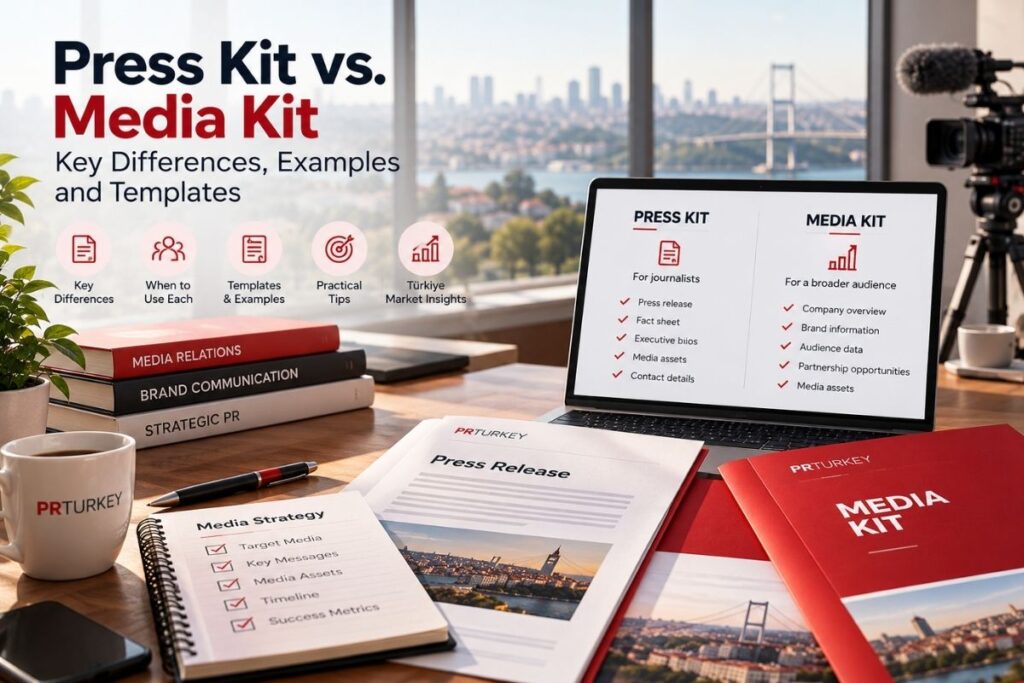
A press kit is primarily designed to help journalists report on a company, announcement, or event, while a media kit can serve a broader purpose, including introducing a brand to advertisers, sponsors, and potential partners. Both provide organized information and approved assets, but their contents depend on who will use them and what decision they need to make.
The distinction matters when launching a product, pitching a journalist, seeking a brand partnership, or entering a new market. Choosing the right format helps recipients find relevant information without sorting through unnecessary documents.
Press Kit vs. Media Kit: Quick Comparison
The simplest way to understand press kit vs. media kit is to compare their intended audiences and objectives. A press kit usually supports editorial coverage. A media kit may support editorial coverage, advertising opportunities, or commercial partnerships.
| Feature | Press Kit | Media Kit |
|---|---|---|
| Primary purpose | Help journalists research and report a story | Present a brand, publication, creator, or partnership opportunity |
| Typical audience | Journalists, editors, producers, and reporters | Journalists, advertisers, sponsors, agencies, and partners |
| Main focus | News, verified facts, and supporting evidence | Brand information, audience value, and relevant opportunities |
| Common contents | Press release, fact sheet, spokesperson details, images | Company profile, audience information, brand assets, media coverage, partnership details |
| Typical timing | Product launches, announcements, events, and ongoing media relations | Brand introductions, sponsorship discussions, advertising sales, and ongoing media relations |
| Format | Online newsroom, downloadable folder, or PDF with supporting files | PDF, presentation, website, or digital media room |
| Updates | Whenever announcement details or approved assets change | Whenever company details, audience data, offerings, or partnership information change |
| Success criteria | Relevant coverage, accurate reporting, and qualified media inquiries | Relevant inquiries, partnership discussions, or media use, depending on purpose |
Important distinction: These are common conventions, not universal definitions. In corporate public relations, organizations frequently use press kit and media kit interchangeably. A media kit prepared for journalists may contain almost exactly the same materials as a press kit.
What Is a Press Kit?
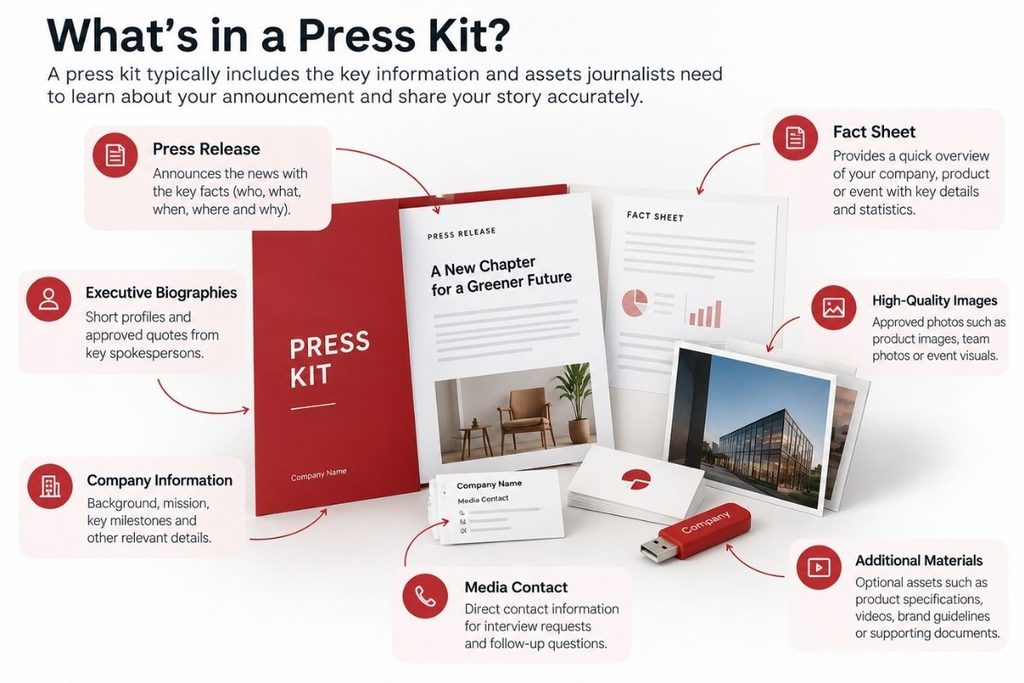
A press kit is a collection of approved documents, factual background information, and multimedia assets that helps journalists evaluate and cover a story. It may support a specific announcement or serve as a permanent source of corporate information.
For example, a technology company launching a product might prepare a press kit containing the announcement, product specifications, executive quotations, photographs, and a media contact.
The objective is to reduce the work required to verify basic information and identify relevant reporting opportunities.
A press kit commonly includes a press release, a company fact sheet, executive biographies, approved logos, photographs, and supporting documents. The exact selection should reflect the announcement rather than follow an unnecessarily large standard package.
For a detailed breakdown of individual components, see PRTURKEY’s press kit example and preparation guide.
What Is the Purpose of a Press Kit?
A press kit helps journalists answer three practical questions:
- What is the news? The announcement and its relevance should be immediately clear.
- Can the information be verified? Dates, names, claims, quotations, and supporting evidence must be accessible.
- Who can provide more information? The appropriate media contact or spokesperson should be easy to reach.
A press kit does not guarantee coverage. Journalists independently decide whether an announcement is newsworthy and appropriate for their audiences.
What Is a Media Kit?
A media kit is an organized presentation of information about an organization, publication, or content creator. Its purpose depends on the audience: it may help journalists understand a company, advertisers evaluate a publication, or brands assess a potential creator partnership.
This flexibility explains why the term media kit has several meanings.
Corporate Media Kit
A corporate media kit introduces a business to external audiences. It may contain the company background, leadership profiles, products or services, brand assets, recent announcements, and contact details.
When prepared for journalists, it often overlaps with a traditional press kit. The distinction may be largely a matter of naming.
Publisher or Advertising Media Kit
A publisher’s media kit is generally designed for prospective advertisers.
It may present readership or audience demographics, editorial categories, advertising formats, placement opportunities, specifications, and commercial contact information.
Any audience statistics should identify the measurement period and source. Advertising rates should be current and clearly labeled.
Influencer or Creator Media Kit
A creator media kit helps brands evaluate a potential collaboration.
Typical information includes the creator’s content niche, audience demographics, platform performance, previous collaborations, available content formats, and partnership contact details.
Unlike a news-focused press kit, this document is often part of a commercial evaluation process.
Is a Media Kit the Same as a Media Package?
Not always. A media package may refer to a collection of press materials, but in advertising it can also mean a bundled set of placements or promotional opportunities.
The term should be interpreted according to the sender’s industry and the recipient’s needs. Similarly, press packet and press package are often used to describe a set of materials supplied to journalists.
Press Kit vs. Media Kit: Seven Key Differences
The differences become clearer when each document is evaluated according to its intended use.
1. Audience: Who Receives the Kit?
A press kit typically addresses editorial professionals who need reliable information for independent reporting.
A media kit may address that same audience, but it can also target advertisers, sponsors, investors, agencies, or prospective collaborators.
Audience selection should determine which information is included. A journalist evaluating a product launch needs different information from an advertiser considering a sponsorship.
2. Purpose: Editorial Coverage or Business Introduction?
A press kit is generally organized around a news story or the information required to support ongoing media coverage.
A media kit can present a broader proposition. For a publisher, that proposition might be advertising access to a particular audience. For a creator, it might be a collaboration opportunity.
The distinction is about purpose, not which document looks more professional.
3. Content: What Information Matters Most?
A press kit emphasizes verified facts, news releases, approved quotations, product details, and media-ready visuals.
A commercial media kit may emphasize audience characteristics, brand positioning, previous partnerships, advertising formats, or sponsorship options.
Some materials belong in both. Logos, contact information, company background, and approved photographs can serve multiple audiences.
4. Timing: When Is It Needed?
Press kits are particularly useful around announcements, launches, conferences, and interviews. They may also remain available year-round through an online newsroom.
Media kits are often maintained as ongoing reference documents, particularly when supporting advertising or partnership discussions.
Neither document has a fixed expiration date. Both require updates when the information they contain changes.
5. Format: How Is It Shared?
A press kit may be provided through an online press room, a downloadable folder, or a collection of linked documents.
A media kit may use a presentation, PDF, web page, or interactive format.
The best format depends on usability. Journalists should be able to download original images without extracting them from slides, while prospective partners may benefit from a concise presentation.
6. Maintenance: Who Keeps It Accurate?
Press kit maintenance often involves the PR or corporate communications team, with input from product specialists, legal reviewers, and authorized spokespersons.
A commercial media kit may be maintained by partnerships, advertising sales, marketing, or creator management teams.
Regardless of ownership, every kit should have a designated person responsible for keeping information current.
7. Measurement: What Does Success Look Like?
For a press kit, useful indicators may include relevant media inquiries, the use of approved materials, accuracy of published information, and resulting coverage.
For a commercial media kit, useful indicators may include qualified partnership inquiries, proposal requests, and resulting collaborations.
Downloads alone are not proof of success. A kit is effective when it helps the intended audience take the appropriate next step.
Media Kit or Press Kit: Which One Do You Need?
Choosing a media kit or press kit should begin with the situation, not the document’s name.
| Situation | Recommended Format | Why |
|---|---|---|
| Announcing a new product | News-focused press kit | Journalists need announcement details, specifications, and approved assets |
| Introducing a company to journalists | Corporate press kit or media kit | A reusable company profile supports ongoing coverage |
| Selling advertising space | Publisher media kit | Advertisers need audience and placement information |
| Pitching influencer partnerships | Creator media kit | Brands need audience, content, and collaboration details |
| Hosting a press conference | Event-specific press kit | Attendees need event facts, spokesperson information, and images |
| Entering the Turkish market | Localized press kit plus corporate media kit | Journalists need local news context and verified company background |
| Maintaining a corporate newsroom | Combined digital press and media kit | One maintained resource can serve several editorial needs |
When Should You Create Both?
Creating both documents makes sense when the organization has distinct editorial and commercial audiences.
Consider a consumer brand launching in Türkiye. Its press kit could contain a Turkish-language launch announcement, local product availability, spokesperson quotations, and approved images.
Its corporate media kit could explain the company’s history, international presence, product portfolio, and brand identity.
Both may share approved assets, but each should prioritize information relevant to its recipients.
Press Kit vs. Media Kit Examples
The following example illustrates how the same company can prepare two different information packages.
Illustrative scenario: A fictional company called Northstar Home is introducing a home organization product line in Türkiye. The company and launch are hypothetical; no real commercial claims are implied.
Example 1: Product Launch Press Kit
Audience: Business, consumer, and home-design journalists.
Purpose: Help journalists evaluate and report on the company’s market-entry announcement.
Suggested files:
Northstar_Home_Turkey_Launch_Press_Release.pdfNorthstar_Home_Turkey_Fact_Sheet.pdfNorthstar_Home_Product_Information.pdfNorthstar_Home_Spokesperson_Biography.pdfNorthstar_Home_Approved_Product_Images.zipNorthstar_Home_Media_Contact.pdf
The release would identify the launch, its confirmed timing, relevant products, local availability, and why the announcement matters to the intended market.
The fact sheet would provide information that journalists can reference quickly. Product images would be supplied separately, with appropriate credits and usage guidance.
For a more extensive worked example, PRTURKEY’s press kit example demonstrates how these documents can be organized.
Example 2: Corporate Media Kit
Audience: Potential commercial partners, distributors, and organizations requesting a broader company introduction.
Purpose: Explain the company’s identity, activities, and relevant partnership context.
Suggested sections:
| Section | Example Content |
|---|---|
| Company overview | Business description, history, and markets served |
| Brand positioning | Product categories and intended customer groups |
| Leadership | Approved executive profiles |
| Product portfolio | Current products and confirmed availability |
| Brand assets | Logos, approved images, and visual guidelines |
| Corporate developments | Relevant milestones and public announcements |
| Partnership information | Available collaboration channels and contact details |
| Media contact | Appropriate communications representative |
The corporate media kit should not present speculative audience figures, unconfirmed distribution arrangements, or unsupported claims about market leadership.
What Changes Between the Two?
The press kit answers: What has happened, why is it newsworthy, and what can journalists verify?
The media kit answers: Who is this organization, what does it offer, and why might the recipient want to engage with it?
That distinction is more useful than treating the two documents as rigidly separate formats.
Press Kit and Media Kit Templates
A practical press kit template or media kit template should be easy to adapt without encouraging unsupported claims or unnecessary content.
The following outlines can be copied into a document, presentation, or online newsroom.
Press Kit Template: News Announcement
1. Announcement overview
Company: [Official company name]
Announcement: [Confirmed news]
Date and location: [Verified details]
Target media: [Relevant publications or editorial categories]
2. Press release
Headline: [Specific announcement]
Opening paragraph: [Who, what, when, where, and why]
Supporting facts: [Verified details and evidence]
Approved quotation: [Name, title, exact quotation]
3. Fact sheet
Company background: [Concise verified information]
Product or event details: [Relevant facts]
Availability or timing: [Confirmed information]
4. Media assets
Approved logos: [Download links]
Photography: [Download links and credits]
Video or additional assets: [Links, if available]
5. Media contact
Name or team: [Contact]
Email: [Verified address]
Interview availability: [Confirmed details]
For the announcement itself, PRTURKEY’s guide to writing a press release explains how to structure a factual headline, opening paragraph, supporting evidence, and media contact information.
Media Kit Template: Corporate or Partnership Introduction
1. Company or creator profile
Name: [Official name]
Overview: [What the organization or creator does]
Positioning: [Relevant audience and value proposition]
2. Audience and activities
Primary audience: [Description]
Relevant markets: [Locations]
Verified audience data: [Source and measurement period, if applicable]
3. Portfolio and credentials
Products, services, or content: [Current offerings]
Relevant previous work: [Documented examples]
Public recognition: [Verifiable information]
4. Available opportunities
Advertising or partnership formats: [Actual offerings]
Relevant requirements: [Eligibility or specifications]
Commercial terms: [Provide separately when appropriate]
5. Approved assets and contact
Logos and photography: [Links]
Brand guidelines: [Link, if available]
Contact person: [Name or team]
Contact details: [Verified information]
A corporate media kit prepared for journalists may omit commercial sections and include press releases or newsroom resources instead.
Example Digital Folder Structure
A simple structure can make materials easier to find and update:
Brand_Media_Resources/
├── 01_Company_Overview/
│   └── Company_Fact_Sheet.pdf
├── 02_Press_Releases/
│   └── Latest_Announcement.pdf
├── 03_Leadership/
│   └── Approved_Biographies.pdf
├── 04_Images/
│   ├── Product_Images/
│   └── Executive_Portraits/
├── 05_Brand_Assets/
│   └── Approved_Logos/
└── 06_Media_Contact/
    └── Contact_Information.pdf
This structure is illustrative. A smaller announcement may require only a few files, while an established newsroom may use a searchable web interface.
How to Create and Maintain a Digital Media Kit
A digital press or media kit should make information accessible without creating unnecessary work for its recipients.
Define the Intended Audience
Identify whether the kit is primarily for journalists, advertisers, sponsors, or corporate partners.
If multiple audiences need substantially different information, create clearly labeled sections or separate versions.
Verify and Approve the Materials
Confirm names, dates, product information, quotations, statistics, and relevant claims before publication.
Check that every image and video can be distributed for its intended purpose. Usage permissions, credits, and restrictions should be documented where necessary.
Make Important Assets Accessible
An online media room should provide clear navigation and practical download options.
A journalist should not have to register for a marketing account or request access merely to retrieve basic approved press photographs.
Where possible, supply original files separately from presentation PDFs.
Assign Update Responsibilities
Record who maintains the kit and when it was last reviewed.
Updates should be triggered by meaningful changes, such as new leadership, revised product details, updated contact information, or a superseded announcement.
A digital kit is not necessarily better because it contains more content. Its value comes from accuracy, relevance, and accessibility.
Press Kit vs. Media Kit for Brands Entering Turkey
International brands entering Türkiye often need both an announcement-focused press kit and a broader corporate information package.
A global media kit may explain the organization effectively but still fail to answer questions that matter to Turkish journalists.
For example, an international company announcing expansion into Türkiye should clarify what is changing locally. A general statement about global growth may be less useful than verified information about local operations, product availability, customer support, or partnerships.
Localize the Press Kit, Not Just the Language
Localization should address editorial relevance as well as translation.
For a Turkish-market announcement, review the following:
| Element | Localization Requirement |
|---|---|
| Press release | Explain the announcement’s relevance to Türkiye |
| Company overview | Clarify local operations and the relationship to the international business |
| Product information | Confirm Turkish-market availability and relevant specifications |
| Spokesperson details | Identify authorized contacts and interview language options |
| Visual assets | Supply images appropriate to the local announcement |
| Dates and figures | Check local conventions, currencies, units, and context |
| Media contact | Provide a practical route for Turkish journalists to ask questions |
If local investment, employment, distribution, or availability details are not confirmed, they should not be presented as established facts.
Connect the Kit to a Media Outreach Strategy
Preparing a kit and distributing a press release are related but separate activities.
The kit supplies supporting materials. Distribution and direct outreach determine how the announcement is presented to relevant media recipients.
For a broader explanation of channel selection and outreach, see how to distribute a press release.
PRTURKEY focuses on press release distribution and digital PR visibility for brands seeking coverage in Turkish media. Its international press release service provides a relevant next step for organizations planning a Türkiye-focused announcement.
Common Press Kit and Media Kit Mistakes
Even professionally designed materials can fail to serve their intended purpose when the information is poorly selected or maintained.
Using the wrong kit for the audience. An advertiser may not need an event press release, while a journalist may have little use for sponsorship pricing.
Replacing facts with promotional claims. Descriptions such as “industry-leading” should not substitute for verifiable evidence.
Using outdated audience figures. A commercial media kit should identify when and how performance data was measured.
Providing inaccessible assets. Broken links, restricted folders, and low-resolution images create unnecessary delays.
Leaving image permissions unclear. Recipients need to know which assets are approved and whether credits or restrictions apply.
Forgetting the media contact. A kit should provide a reliable way to request clarification or an interview.
Treating localization as literal translation. International announcements may require market-specific context to become meaningful to local publications.
Press Kit and Media Kit Checklist
Before sharing either document, confirm that it meets the recipient’s needs.
- The intended audience and purpose are clear.
- The most important information is easy to locate.
- Company names, dates, titles, and factual claims are verified.
- The contents match the type of kit being shared.
- Images, quotations, and other assets are approved.
- Usage rights and credits are provided where necessary.
- Download links and file permissions have been tested.
- Audience statistics include a source and reporting period, if used.
- Contact details are accurate and current.
- Local-market information has been reviewed where relevant.
- Someone is responsible for future updates.
A short, accurate kit that passes these checks is often more useful than a larger document containing irrelevant or outdated material.
Frequently Asked Questions
What is the difference between press and media?
In public relations, the press commonly refers to journalists and news organizations involved in reporting. Media is a broader term that may include news outlets, broadcasters, digital publications, advertising channels, and other communication platforms. Their meanings overlap, and the distinction depends on context.
What is the difference between a press release and a media kit?
A press release is a specific announcement written for news distribution. A media kit is a collection of information and assets about an organization, creator, or opportunity. A press release may be one component of a media kit, but the kit can also contain background information, images, biographies, and contact details.
What is the difference between a press release and a media pitch?
A press release presents an announcement in a structured, factual format. A media pitch is a targeted message explaining why a particular story may interest a specific journalist or publication. A pitch can link to a press release and supporting press kit, but it should be tailored to the recipient.
Do companies still use press kits?
Yes. Press kits remain useful for launches, events, interviews, and ongoing media relations. Many organizations now provide them through digital newsrooms or downloadable folders instead of printed packages. The format has evolved, but journalists still need accessible facts, approved images, and reliable contact information.
What is an example of a press kit?
A product launch press kit might include the launch announcement, a product fact sheet, executive quotations, approved photographs, a company overview, and media contact details. The contents should reflect the announcement. A leadership appointment, for example, may need more biographical information and fewer product images.
What is the difference between a media kit and a one-sheet?
A one-sheet is usually a concise, single-page overview of a person, organization, product, or opportunity. A media kit is typically more extensive and may contain multiple documents or sections. A one-sheet can be included within a media kit as a quick reference, but it does not always replace the supporting information.
Conclusion: Choose the Right Kit for Your Communication Goals
The most useful distinction in press kit vs. media kit is the purpose each document serves. A press kit prioritizes accurate information and assets for editorial reporting, while a media kit may support corporate introductions, advertising, or commercial partnerships. The terms can overlap, particularly when organizations maintain a single digital newsroom.
Rather than focusing on the label, identify the intended audience, select relevant materials, and keep every claim and asset current.
For international brands preparing announcements in Türkiye, a localized press kit can support more relevant media communication. Explore PRTURKEY’s press release distribution services to plan the next stage of your outreach.