

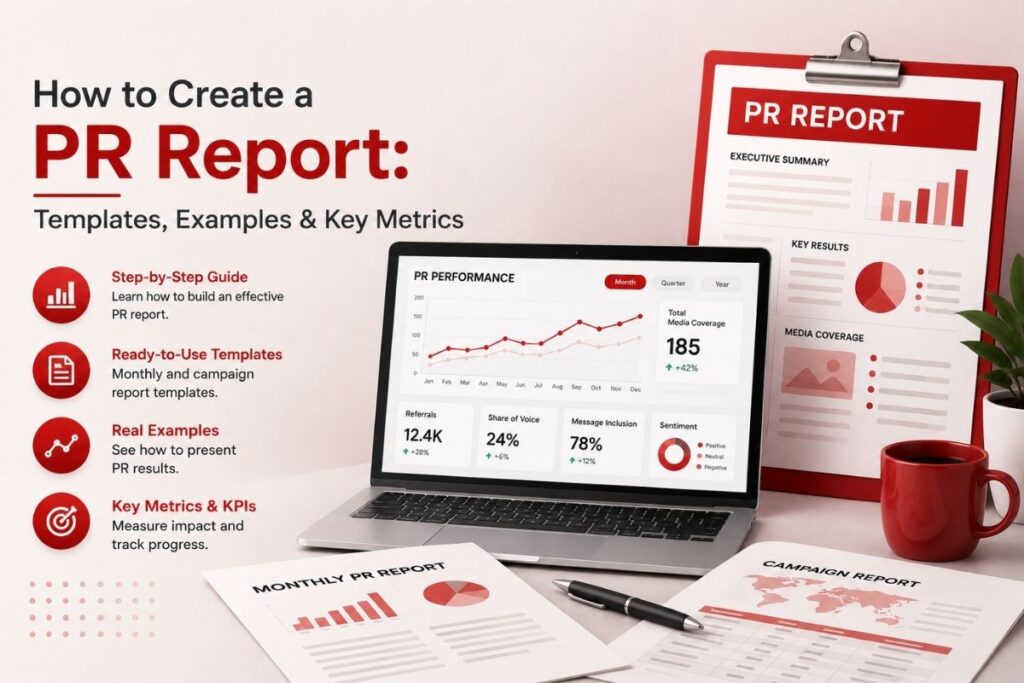
PR reporting is the process of collecting, analyzing, and presenting public relations activities, media coverage, audience responses, and campaign outcomes in a structured report. A well-prepared PR report explains what a communications team accomplished, how those activities performed against objectives, and what should happen next.
An effective report goes beyond counting media mentions or estimating potential reach. It evaluates whether coverage appeared in relevant publications, whether important messages were communicated accurately, and whether the campaign contributed to meaningful organizational objectives.
For example, a company entering a new market may want to measure relevant media coverage, brand discovery, and qualified business inquiries. A nonprofit organization may prioritize public understanding, stakeholder engagement, or changes in awareness. The reporting framework should reflect these different goals.
This guide explains how to create a PR report, which metrics to include, how monthly and campaign reports differ, and how to present findings using practical templates and examples.
It also covers PR analytics, media coverage reporting, common measurement mistakes, and ways to turn communications data into actionable recommendations.
What Is a PR Report?
A PR report is a document or dashboard that summarizes public relations activities and evaluates their results over a defined period.
It provides stakeholders with evidence of what was executed, what was published, how audiences responded, and whether the work supported the organization’s communication objectives.
A public relations report may cover a single campaign, a monthly communications program, a product launch, an event, or an annual reputation management initiative.
A typical report includes:
- Executive summary and key findings
- Campaign objectives and reporting period
- PR activities completed
- Earned media coverage and distribution results
- Audience relevance and coverage quality
- Media monitoring and sentiment analysis
- Website traffic and engagement
- Progress against key performance indicators
- Challenges, limitations, and lessons learned
- Recommendations for the next reporting period
The purpose is not simply to demonstrate activity. It is to explain performance and support better decisions.
What Is PR Reporting?
PR reporting is the broader workflow behind producing a PR report.
It involves setting objectives, selecting KPIs, gathering reliable data, checking coverage, analyzing results, and communicating findings.
For example, a PR team may track outreach activity throughout the month, review media coverage weekly, and prepare a monthly report for management.
The report is the final output. Reporting is the continuous process used to produce it.
PR Reporting vs. PR Analytics
PR reporting and PR analytics are closely related, but they serve different functions.
PR analytics focuses on examining communications data to identify patterns, relationships, and performance insights.
PR reporting organizes those findings into a format stakeholders can understand and use.
| PR Reporting | PR Analytics |
|---|---|
| Summarizes performance | Investigates performance |
| Presents results to stakeholders | Examines patterns and relationships |
| Tracks progress against KPIs | Identifies drivers and possible explanations |
| Uses tables, charts, and commentary | Uses data analysis and comparisons |
| Answers “What happened?” | Helps answer “Why might it have happened?” |
| Supports accountability | Supports strategic optimization |
A strong PR report uses analytics to explain the results rather than simply display numbers.
Why Is PR Reporting Important?
Public relations activities often influence audiences indirectly and over time.
A media article may introduce a company to potential customers. An executive interview may strengthen industry credibility. A crisis response may help maintain stakeholder confidence.
These outcomes cannot always be measured through a single conversion event.
Structured reporting helps organizations evaluate the available evidence without overstating the contribution of PR.
Demonstrating Communications Performance
A report documents completed activities and observable results.
This allows stakeholders to understand what was delivered during the reporting period and how the work aligned with the agreed scope.
Connecting PR With Business Objectives
A communications campaign should support a defined organizational objective.
For example, a B2B company may want to improve recognition among industry decision-makers.
Its report could evaluate specialist media coverage, executive visibility, relevant website visits, and qualified inquiries.
The report should explain the relationship between these indicators rather than automatically attribute every commercial outcome to PR.
Improving Future Campaigns
Reporting can reveal which story angles, publications, geographic markets, and outreach approaches generated relevant engagement.
These findings help teams refine their media strategy.
Supporting Transparent Decision-Making
A useful PR report should explain both positive and negative results.
If coverage volume increased but message accuracy declined, stakeholders need to understand that trade-off.
Transparent reporting makes communications performance easier to evaluate and improve.
Types of PR Reports
Different reporting formats serve different purposes.
| Report type | Main purpose | Typical reporting frequency |
|---|---|---|
| PR activity report | Document completed communications activities | Weekly or monthly |
| Monthly PR report | Review ongoing performance and progress | Monthly |
| PR campaign report | Evaluate a defined campaign | During and after the campaign |
| Media coverage report | Analyze published media mentions | Weekly, monthly, or campaign-based |
| PR evaluation report | Assess results against objectives | At milestones or campaign completion |
| PR analysis report | Investigate performance trends and findings | As required |
| Executive PR report | Summarize strategic outcomes and decisions | Monthly or quarterly |
| Annual PR report | Evaluate long-term communications performance | Annually |
These formats can overlap. A monthly report may contain both an activity summary and a media coverage analysis.
PR Activity Report
A PR activity report records the work completed during a defined period.
Typical activities include journalist outreach, press release preparation, media briefings, interviews, press kit updates, and event coordination.
Activity reports are useful for operational accountability.
However, completing an activity does not necessarily mean it produced a communications outcome.
Monthly PR Report
A public relations monthly report evaluates ongoing PR performance over a calendar month or another consistent reporting period.
It should include current results, comparisons with previous periods, progress against objectives, and priorities for the next month.
A monthly report is especially useful for organizations working with a PR agency on a retainer basis.
PR Campaign Report
A PR campaign report evaluates a specific initiative, such as a product launch, partnership announcement, research release, or market entry campaign.
It should compare results against objectives established before the campaign began.
For campaigns involving press releases, PRTURKEY’s guide to measuring press release performance explains announcement-specific tracking and measurement considerations.
PR Evaluation Report
A PR evaluation report examines whether communications activities achieved their intended objectives.
It may include baseline comparisons, audience research, media analysis, and evidence of behavioral or organizational change.
Evaluation is broader than counting outputs.
How to Create a PR Report in 8 Steps
Creating a professional PR report requires a consistent workflow.
The following process can be adapted for agencies, in-house communications teams, and international PR campaigns.
Step 1: Define the Reporting Objective
Begin by identifying what the report needs to demonstrate.
Possible objectives include increasing relevant media visibility, improving brand awareness, supporting a market launch, communicating key messages, or generating qualified inquiries.
Avoid selecting KPIs before defining the objective.
For example, if the objective is to improve visibility among technology decision-makers, coverage in relevant technology and business publications may be more meaningful than total coverage volume.
Step 2: Establish the Reporting Period and Baseline
Specify the exact reporting dates.
For recurring reports, use consistent comparison periods whenever possible.
A monthly report might compare September with August or compare the current quarter with the previous quarter.
However, differences in the number of days, campaign activity, and seasonality should be acknowledged.
A baseline provides the starting point against which change can be evaluated.
Without a baseline, an increase in media coverage or branded search interest may be difficult to interpret.
Step 3: Select Relevant PR KPIs
Choose metrics that reflect the communications objective.
A useful framework distinguishes activity, media outputs, audience responses, and organizational outcomes.
| Measurement level | Example KPIs |
|---|---|
| Activities | Pitches sent, releases prepared, interviews arranged |
| Outputs | Verified placements, articles published, message inclusion |
| Audience response | Engagement, recall, referral visits, sentiment |
| Outcomes | Qualified inquiries, subscriptions, stakeholder actions |
| Organizational impact | Reputation change, market access, business contribution |
Not every report needs every metric.
Select a manageable group of indicators that can be measured reliably.
Step 4: Collect and Verify Data
Gather information from relevant sources, such as media monitoring platforms, publication websites, outreach records, Google Analytics 4, Google Search Console, and internal CRM systems.
Verify media coverage before adding it to the final report.
A publication link should be checked to confirm that the article exists, contains the relevant brand or announcement, and falls within the reporting scope.
Separate independent editorial coverage from press release syndication and paid placements.
Step 5: Analyze Media Coverage Quality
Media coverage should be assessed according to relevance and content quality, not only quantity.
Consider the publication’s audience, the prominence of the brand, the accuracy of the information, and whether the article includes priority messages.
For international campaigns, geographic relevance is particularly important.
A company targeting business decision-makers in Türkiye may benefit more from relevant Turkish business and trade publications than from unrelated international mentions.
Step 6: Evaluate Audience Response
Where data is available, examine whether media activity was followed by relevant audience behavior.
Possible indicators include referral visits, branded search interest, engaged sessions, inquiries, or survey responses.
Do not assume that every change was caused by PR.
Advertising, events, social media, seasonality, and other factors may influence the same metrics.
Step 7: Write the Executive Summary
The executive summary should communicate the most important findings without requiring the reader to examine every chart.
A practical structure is:
- What was the objective?
- What were the most important results?
- What do those results mean?
- What should happen next?
Prioritize three to five decision-relevant findings.
Step 8: Provide Recommendations
End the report with clear recommendations based on the evidence.
For example, if specialist publications generated the most relevant responses, future outreach could prioritize similar outlets.
If media coverage frequently omitted a key message, the next campaign may need a clearer press release or stronger spokesperson briefing.
Recommendations should be specific enough to guide action.
What Should a PR Report Include?
A comprehensive PR report should be structured so that stakeholders can understand the results quickly.
1. Executive Summary
Present the reporting period, objectives, key achievements, significant challenges, and recommended next steps.
2. Campaign Objectives
State the communications objectives and the intended audience.
Include agreed targets where available.
3. Activities Completed
Summarize media outreach, press releases, interviews, events, partnerships, and other relevant work.
4. Media Coverage Overview
Report verified placements and classify them accurately.
Distinguish earned editorial coverage, syndicated releases, paid placements, and owned content.
5. Coverage Quality Analysis
Evaluate publication relevance, message accuracy, prominence, and editorial context.
6. PR Analytics and Audience Response
Include available website, search, engagement, and audience research data.
Explain the limitations of each source.
7. KPI Performance
Compare actual results with targets and relevant baselines.
8. Conclusions and Recommendations
Explain what worked, what did not, and which changes should be made.
PR Report Template: Copyable Structure
The following PR report template can be used for monthly reporting or adapted for a specific campaign.
PR Report — Monthly Template
Client / Organization: [Organization Name]
Reporting Period: [Start Date – End Date]
Prepared By: [PR Team or Agency]
Reporting Objective: [Primary Communication Objective]
Executive Summary
[Summarize the three most important findings, explain their significance, and identify the main recommendation.]
PR Activities
| Activity | Planned | Completed | Notes |
|---|---|---|---|
| Press releases | [ ] | [ ] | [ ] |
| Media pitches | [ ] | [ ] | [ ] |
| Interviews | [ ] | [ ] | [ ] |
| Media briefings | [ ] | [ ] | [ ] |
| Other activities | [ ] | [ ] | [ ] |
Media Coverage
| Metric | Previous Period | Current Period | Change |
|---|---|---|---|
| Earned editorial placements | [ ] | [ ] | [ ] |
| Syndicated release placements | [ ] | [ ] | [ ] |
| Relevant publication mentions | [ ] | [ ] | [ ] |
| Priority message inclusion | [ ] | [ ] | [ ] |
| Referral sessions | [ ] | [ ] | [ ] |
Key Coverage Highlights
[Include links to important articles, publication names, dates, and a short explanation of their relevance.]
Audience and Digital Performance
[Summarize available referral traffic, engagement, branded search, and relevant conversion data.]
Key Findings
[Explain what the evidence suggests, including limitations and alternative explanations.]
Recommendations
[Identify the next actions, responsible teams, and relevant deadlines.]
Monthly PR Report Example
The following is a fictional example showing how a PR team might report one month of activity.
All figures are illustrative and do not represent actual PRTURKEY client performance.
Example: September 2026 PR Performance
Organization: Example Technology Company
Objective: Increase visibility among relevant technology and business audiences.
Reporting Period: September 1–30, 2026
<escape>Executive Summary</escape>
During September, the company generated more verified earned media placements than in August. Coverage in specialist technology publications increased, and referral sessions from media websites also rose.
However, the proportion of articles including the campaign’s primary message declined slightly. The next reporting period should prioritize clearer message development and more targeted media briefings.
Example KPI Dashboard
| KPI | August | September | Change |
|---|---|---|---|
| Verified earned placements | 12 | 18 | +50.0% |
| Relevant specialist placements | 7 | 12 | +71.4% |
| Referral sessions | 420 | 610 | +45.2% |
| Articles containing primary message | 9 | 12 | +33.3% |
| Primary message inclusion rate | 75.0% | 66.7% | −8.3 percentage points |
| Qualified inquiries from identifiable referrals | 8 | 11 | +37.5% |
Example Performance Analysis
Earned placements increased from 12 to 18, representing 50% growth.
Specialist publication coverage increased from 7 to 12 placements, suggesting that the media targeting approach reached more relevant outlets.
Referral sessions rose by approximately 45.2%.
However, the message inclusion rate declined from 75% to 66.7%, despite an increase in the absolute number of articles containing the primary message.
This distinction matters: more coverage does not necessarily mean more consistent communication.
The 11 qualified inquiries provide a useful indicator of identifiable audience response, but they do not establish that PR alone caused all subsequent commercial activity.
Example Recommendations
- Prioritize specialist technology publications in the next outreach cycle.
- Refine the primary message and supporting evidence.
- Provide journalists with a shorter, clearer fact sheet.
- Continue monitoring media referral quality.
- Review message inclusion rates after the next campaign.
A useful monthly PR report should make these decisions clear without forcing stakeholders to interpret raw spreadsheets.
PR Campaign Reporting Example
A campaign report focuses on a defined initiative rather than ongoing monthly performance.
Consider a fictional company announcing a new software platform.
Campaign Overview
Campaign: Product Launch Announcement
Objective: Establish awareness among enterprise technology decision-makers.
Campaign Period: October 1–21, 2026
Target Audience: IT leaders, technology journalists, and enterprise software buyers.
Illustrative Campaign Results
| Metric | Result |
|---|---|
| Relevant journalists approached | 80 |
| Verified earned articles | 14 |
| Syndicated release placements | 22 |
| Interview requests | 5 |
| Referral sessions | 920 |
| Qualified demo requests from identifiable referrals | 18 |
These figures describe different parts of campaign performance and should not be combined into one total.
The 14 earned articles represent independently published editorial coverage.
The 22 syndicated placements represent distribution or republication of the announcement.
The five interview requests indicate journalist interest but are not themselves published coverage.
The 18 demo requests represent identifiable website actions associated with referral traffic, not necessarily incremental sales caused solely by PR.
Example Campaign Conclusion
The campaign generated relevant editorial attention and measurable website engagement.
Future outreach should examine which publications produced the most qualified referral traffic and which story angles generated substantive editorial interest.
This provides a stronger foundation for the next campaign than simply repeating the highest-volume distribution approach.
Essential PR Reporting Metrics and Formulas
PR reporting becomes more useful when calculations are clearly defined.
Media Coverage Growth Rate
This metric measures the percentage change in verified coverage between comparable periods.
Formula:
Coverage Growth (%) = ((Current Coverage − Previous Coverage) ÷ Previous Coverage) × 100
Example:
Previous period: 20 placements
Current period: 30 placements
Growth = 50%
If the previous period contains zero placements, report the absolute increase instead of calculating a percentage.
Key Message Inclusion Rate
This metric measures how often the intended message appears in the coverage reviewed.
Formula:
Message Inclusion Rate (%) = (Articles Including the Key Message ÷ Articles Reviewed) × 100
Example:
15 articles include the message out of 25 reviewed.
Message inclusion rate = 60%
Define what qualifies as message inclusion before reviewing the articles.
Share of Voice
Share of voice measures a brand’s share of a defined media conversation.
Formula:
Share of Voice (%) = (Brand Mentions ÷ Total Relevant Mentions in the Comparison Set) × 100
Example:
A brand receives 40 relevant mentions in a defined competitive set containing 200 mentions.
Share of voice = 20%
The result depends on the selected competitors, search queries, media sources, geography, and reporting period.
A larger share of voice is not automatically positive if much of the coverage is unfavorable.
PR Referral Conversion Rate
This metric measures the proportion of identifiable PR referral sessions that produce a specified action.
Formula:
PR Referral Conversion Rate (%) = (Tracked Conversions ÷ Relevant Referral Sessions) × 100
Example:
24 inquiries from 1,200 referral sessions.
Conversion rate = 2%
This calculation describes tracked behavior, not the complete causal contribution of PR.
PR Activity Completion Rate
This operational metric measures completed planned activities.
Formula:
Activity Completion Rate (%) = (Completed Planned Activities ÷ Total Planned Activities) × 100
Example:
18 completed activities out of 20 planned.
Completion rate = 90%
Activity completion is useful for workflow management but should not be treated as evidence of campaign effectiveness.
How to Create a Media Coverage Report
A PR coverage report documents and evaluates published media mentions.
The report should include more than a collection of screenshots or article links.
For each placement, record the publication, URL, date, coverage type, relevance, and editorial context.
Media Coverage Report Template
| Publication | Date | Coverage Type | Audience Relevance | Key Message | Article URL |
|---|---|---|---|---|---|
| Example Business Daily | Oct. 5 | Earned editorial | High | Included | [URL] |
| Example Industry Review | Oct. 8 | Earned editorial | High | Partially included | [URL] |
| Example News Network | Oct. 9 | Syndicated release | Medium | Included | [URL] |
| Example Partner Website | Oct. 12 | Partner content | Medium | Included | [URL] |
All publication names and records are fictional.
Separate Coverage Categories
Earned media, syndicated releases, paid content, and owned publications should be classified separately.
A press release appearing on a distribution partner’s website should not automatically be described as independent journalism.
This distinction is especially important when comparing campaigns or evaluating earned media performance.
Evaluate Coverage Quality
A relevant article in a specialist publication may be more valuable for a particular objective than multiple unrelated mentions.
Useful quality indicators include:
- Publication and audience relevance
- Accuracy of reported information
- Prominence of the organization
- Inclusion of key messages
- Original editorial reporting
- Relevant links or next steps
- Tone and reputational context
Coverage quality scoring can support internal consistency, but any scoring model should have documented criteria.
PR Analytics Reporting: Which Tools Should You Use?
Different tools provide different types of evidence.
| Tool or source | Main reporting use |
|---|---|
| Media monitoring platform | Discover and organize media mentions |
| Journalist outreach platform | Track pitching activity and responses |
| Google Analytics 4 | Analyze website referral traffic and actions |
| Google Search Console | Examine branded search and organic discovery |
| CRM system | Review qualified inquiries and sales interactions |
| Social media analytics | Measure owned and shared-channel engagement |
| Surveys and interviews | Assess awareness, understanding, and perceptions |
| Excel or Google Sheets | Consolidate data and prepare reporting tables |
Google Analytics 4
GA4 can help teams examine referral sessions, engagement, and recorded key events.
Where links are under the campaign team’s control, consistent campaign parameters can support source analysis.
For independent editorial links, use available referral information and avoid assuming every visitor can be attributed to a specific article.
Google Search Console
Google Search Console can provide data on search impressions, clicks, queries, and average positions.
Changes in branded search may indicate greater discovery, but they can also be influenced by advertising, social media, events, and other activity.
Media Monitoring Platforms
Monitoring tools can help discover published coverage and organize results.
However, estimated audience figures, automated sentiment, and coverage classifications should be reviewed carefully.
A monitoring platform does not automatically establish whether an article was independently earned or whether readers acted on its content.
How to Build a PR Analytics Dashboard
A PR analytics dashboard should make important performance indicators easy to understand.
It does not need to display every available metric.
A useful dashboard can be organized into four sections.
Section 1: Executive Performance
Show the reporting period, objective, overall assessment, and three to five important KPIs.
Section 2: Media Performance
Display verified earned coverage, publication relevance, message inclusion, and important coverage highlights.
Section 3: Audience Response
Show referral traffic, relevant engagement, branded search changes, and other available audience indicators.
Section 4: Insights and Actions
Summarize what the data suggests and which actions should follow.
For example:
Finding: Specialist publications generated a higher proportion of relevant inquiries than general-interest outlets.
Recommendation: Allocate more research and pitching time to specialist publications in the next campaign.
The value of a dashboard comes from the decisions it supports, not the number of charts it contains.
How to Report PR ROI Without Overstating Results
PR teams are frequently asked to demonstrate return on investment.
However, communications activities can influence awareness, trust, and decision-making across multiple channels and time periods.
Not every result can be attributed directly to one article or campaign.
A credible report distinguishes between observable results and estimated contribution.
Directly Observable Results
Examples include verified media placements, referral sessions, recorded inquiries, and completed interviews.
Estimated or Modeled Results
Examples include potential audience reach and calculated media value.
These estimates should be labeled and explained.
Organizational Outcomes
Examples include changes in qualified demand, reputation, partner interest, or customer behavior.
These outcomes may be influenced by several activities simultaneously.
Why Earned Media Value Requires Caution
Earned Media Value (EMV) is an estimated monetary value assigned to publicity or media exposure.
It is not the same as revenue, profit, or proven return on investment.
Different platforms may produce different EMV estimates because their assumptions and methodologies differ.
PRTURKEY’s guide to calculating Earned Media Value explains the formulas, assumptions, and limitations in greater detail.
For a stronger PR evaluation report, use EMV only with appropriate methodological context and prioritize evidence of relevant communication outcomes.
PR Reporting for International Campaigns
International PR reporting introduces additional challenges.
A campaign operating across several markets may involve different languages, publication categories, reporting standards, and audience expectations.
A single global total can hide important differences between countries.
Separate Results by Market
Report country-specific coverage and audience response where possible.
A campaign generating 50 placements across five countries should identify where those placements appeared and whether they reached the intended audiences.
Evaluate Local Media Relevance
A publication’s importance depends on the market and audience.
For brands targeting Türkiye, understanding the Turkish media landscape can help evaluate national, regional, business, and specialist coverage.
Use Consistent Definitions
Define earned coverage, syndicated content, sentiment, and message inclusion consistently.
If local teams use different methods, explain those differences rather than combining incompatible figures.
Account for Language and Context
Automated sentiment analysis may misinterpret sarcasm, idioms, technical language, or regional context.
Human review is particularly important for high-impact coverage and multilingual reporting.
Connect Reporting With Market Objectives
An international market-entry campaign may aim to improve brand recognition, support distributor relationships, or increase qualified inquiries.
A useful framework should connect these objectives with appropriate evidence.
PRTURKEY’s guide to measuring a brand launch in Turkey provides a more detailed framework for launch-specific measurement.
Common PR Reporting Mistakes
1. Reporting Activities as Outcomes
Sending 100 pitches is an activity.
It does not mean 100 journalists read the message or that the campaign generated meaningful coverage.
Report outreach activity separately from resulting media outcomes.
2. Treating Potential Reach as Actual Readership
A publication’s estimated audience is not the verified number of readers of a particular article.
Label reach estimates appropriately.
3. Combining Earned and Paid Coverage
Sponsored placements and independently selected editorial stories have different characteristics.
Do not combine them into an undifferentiated earned media total.
4. Ignoring Publication Relevance
A high number of irrelevant mentions can obscure weak performance among the intended audience.
Assess relevance alongside volume.
5. Using Metrics Without a Baseline
A report showing 30 placements provides limited context if stakeholders do not know the objective or previous performance.
Include relevant comparisons.
6. Claiming Every Conversion as PR Revenue
Website conversions may be influenced by several channels.
Use attribution language that reflects the available evidence.
7. Presenting Data Without Insights
Charts should support an interpretation.
Explain what changed, why it may matter, and what action should follow.
8. Hiding Weak Results
Transparent reporting should acknowledge missed targets, inaccurate coverage, or unsuccessful outreach.
These findings can help improve the next campaign.
PR Reporting Best Practices
Effective reporting should be consistent, transparent, and useful for decision-making.
Start with the objective. Every important metric should connect to a defined communications goal.
Use consistent definitions. Document how placements, reach, sentiment, and conversions are calculated.
Verify the evidence. Check article links, publication details, and classifications before presenting them.
Compare appropriate periods. Explain differences in campaign intensity, duration, and market conditions.
Distinguish fact from inference. Observed changes do not automatically prove causation.
Prioritize meaningful insights. Explain which findings should influence future strategy.
Adapt the presentation to the audience. Executives may need a concise summary, while communications specialists may require detailed supporting data.
Keep the methodology accessible. Stakeholders should be able to understand how results were produced.
Frequently Asked Questions About PR Reporting
What is a PR report?
A PR report is a structured document that summarizes public relations activities, media coverage, audience responses, and campaign results over a defined period. It helps organizations evaluate communication performance and make informed decisions about future PR activities.
How do you write a PR report?
To write a PR report, define the objective and reporting period, select relevant KPIs, collect and verify data, analyze media coverage, and evaluate audience response. Present the findings in an executive summary, include supporting evidence, and finish with actionable recommendations.
What should a monthly PR report include?
A monthly PR report should include an executive summary, completed activities, media coverage, KPI performance, audience engagement, comparisons with previous periods, significant findings, and next steps. It should explain the meaning of the results rather than simply present numbers.
What is PR campaign reporting?
PR campaign reporting is the process of evaluating a specific public relations initiative against its objectives. It typically examines campaign activities, media results, audience response, and relevant organizational outcomes. Campaign reports should distinguish earned coverage from paid and syndicated placements.
What is a PR activity report?
A PR activity report documents communications work completed during a defined period. It may include media outreach, press release preparation, interviews, briefings, and event coordination. Activity reports demonstrate operational progress but do not independently prove communication effectiveness.
What is a PR evaluation report?
A PR evaluation report assesses how effectively public relations activities achieved their objectives. It may compare results with a baseline and examine coverage quality, audience understanding, engagement, behavior, and organizational outcomes where measurable.
What is PR analytics reporting?
PR analytics reporting combines communications data analysis with structured performance reporting. It uses information from media monitoring, outreach platforms, website analytics, search data, and other sources to explain results and identify opportunities for improvement.
What KPIs should a PR report include?
Relevant PR KPIs may include verified earned placements, publication relevance, key message inclusion, share of voice, referral traffic, engagement, branded search, and qualified inquiries. The appropriate selection depends on the campaign’s objectives and available evidence.
How do you calculate PR reporting ROI?
Financial PR ROI requires a defensible estimate of attributable financial benefit and the relevant cost of the activity. Where attribution is incomplete, report observable communications outcomes and qualified business indicators separately rather than presenting estimated exposure as revenue.
What is the difference between a PR report and a media coverage report?
A media coverage report focuses on published mentions, coverage types, publication relevance, and editorial context. A PR report is broader and may also include activities, audience responses, campaign KPIs, business-related indicators, and strategic recommendations.
How often should PR reports be prepared?
Reporting frequency depends on the program. Ongoing PR retainers often use monthly reports, while time-sensitive campaigns may require weekly updates. Campaign evaluations should also be prepared at meaningful milestones and after completion.
Can Google Analytics measure PR performance?
Google Analytics can measure identifiable website referrals, engagement, and recorded actions associated with PR-related traffic. It cannot measure every offline media exposure, untracked interaction, or the complete causal impact of a PR campaign by itself.
What is a PR report template?
A PR report template is a reusable structure for presenting communications activities, KPIs, media coverage, analysis, and recommendations. It helps teams report consistently and makes comparisons between campaigns or reporting periods easier.
Conclusion: Turn PR Reporting Into Better Decisions
Effective PR reporting does more than document publicity.
It explains whether communication activities reached relevant audiences, delivered important messages, and contributed to meaningful organizational objectives.
A strong PR report combines verified evidence, clear KPI definitions, thoughtful analysis, and practical recommendations.
Monthly reports help teams monitor ongoing performance. Campaign reports evaluate specific initiatives. Media coverage reports provide detailed publication analysis. PR analytics helps explain patterns and identify opportunities.
The most valuable reporting approach brings these elements together without confusing activities, estimated exposure, and measurable outcomes.
For international brands communicating in Türkiye, reliable media classification, local market context, and transparent measurement are especially important.
PRTURKEY supports brands with press release distribution, media communication, and reporting services designed to make PR activity more transparent and measurable.
Explore PRTURKEY’s digital PR and press release distribution services to learn more about building a structured communications program.