
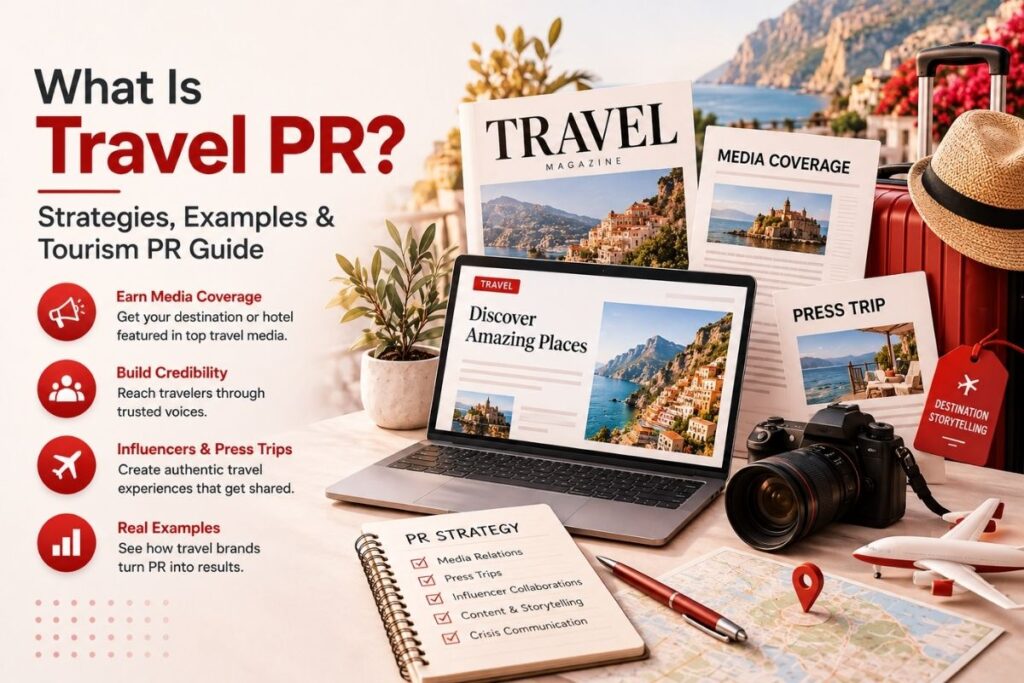
Travel PR (travel public relations) is the strategic management of a travel brand’s reputation, media relationships, and public communication. It helps hotels, destinations, tourism boards, tour operators, and travel companies build awareness and credibility through relevant media coverage, storytelling, partnerships, and reputation management.
Unlike traditional advertising, which purchases media space, travel PR seeks to make a brand’s story relevant to journalists, travelers, and other stakeholders. Its activities can include earned media outreach, destination storytelling, press trips, executive interviews, influencer relations, and crisis communication.
An effective travel and tourism PR strategy connects these activities with business objectives such as entering a new market, increasing qualified brand awareness, supporting direct bookings, or building confidence in a destination.
For example, a boutique hotel opening in Istanbul might pitch its restoration of a historic building to architecture and travel editors. A tourism board promoting a lesser-known region could develop stories around local food, cultural heritage, and sustainable tourism. In both cases, the goal is to provide editorially valuable information rather than simply advertise a destination.
This guide explains what travel PR means, how tourism public relations works, which strategies travel brands can use, and how to measure results. It also explores travel PR in Türkiye, with practical examples for international hospitality and tourism businesses.
Key Takeaways
- Travel PR builds visibility and reputation through media relations, storytelling, partnerships, and strategic communication.
- Travel marketing and travel PR complement each other, but paid promotion and independent editorial coverage are not interchangeable.
- Hotels, destinations, travel agencies, and tourism boards require different PR strategies because their audiences and business objectives differ.
- Effective travel industry PR combines newsworthy stories, targeted journalist outreach, useful visual assets, and clear performance measurement.
- International travel brands entering Türkiye benefit from localized stories, relevant regional media, and market-specific communication.
- PR performance should be evaluated through coverage quality, audience relevance, referral traffic, engagement, and appropriate business outcomes—not publicity volume alone.
What Is Travel PR?
Travel PR is a specialized branch of public relations focused on how travel and hospitality brands communicate with the media, travelers, industry partners, and the wider public.
It includes activities intended to establish credibility, maintain positive relationships, explain brand developments, and respond to issues that could affect public confidence.
The scope of travel PR depends on the organization.
For a hotel, it might involve promoting a property opening, introducing a new culinary experience, or communicating a renovation.
For a tourism board, it may involve promoting a destination’s cultural identity, highlighting lesser-known attractions, or addressing concerns about visitor safety.
For a tour operator, travel public relations may focus on explaining unique itineraries, demonstrating responsible tourism practices, and establishing expertise in particular destinations.
The common objective is to communicate information that audiences and media organizations consider useful, credible, and relevant.
What Does Travel PR Mean?
The term travel PR means public relations activities designed specifically for the travel and tourism sector.
It includes managing communication about destinations, accommodation providers, travel experiences, transportation services, and tourism businesses.
In practical terms, travel PR professionals develop stories, research journalists, prepare press materials, coordinate interviews, support media visits, and monitor the resulting coverage.
They may also advise on reputational risks and help organizations communicate during disruptions.
Travel PR is not limited to luxury hotels or international tourism boards. Smaller guesthouses, regional tourism initiatives, travel technology businesses, and specialist tour operators can also benefit from targeted public relations.
What Is PR in Tourism?
PR in tourism is the process of building and maintaining relationships between tourism organizations and their audiences through strategic communication.
It can support destination awareness, visitor confidence, cultural understanding, and stakeholder relationships.
For example, a regional tourism authority may use public relations to introduce an emerging destination to international travel journalists. A hotel group may communicate new sustainability measures, while a local tour company may highlight community-based travel experiences.
In each case, effective communication depends on factual accuracy, audience relevance, and a clearly defined objective.
Travel PR vs. Travel Marketing: What’s the Difference?
Travel PR and travel marketing share an interest in attracting and retaining travelers, but they use different methods.
Travel marketing encompasses promotional activities such as paid advertising, email campaigns, search marketing, social media advertising, and booking promotions.
Travel PR focuses primarily on reputation, relationships, credible storytelling, and communication with journalists and other stakeholders.
| Factor | Travel PR | Travel Marketing |
|---|---|---|
| Primary objective | Build credibility, awareness, and reputation | Generate demand, inquiries, and bookings |
| Typical channels | Earned media, journalist outreach, interviews, public communication | Paid search, social ads, email, promotional campaigns |
| Editorial control | Independent publishers decide whether and how to cover a story | Brands control most paid promotional messages |
| Typical content | News stories, interviews, expert commentary, destination features | Advertisements, landing pages, offers, promotional videos |
| Measurement | Coverage quality, message inclusion, awareness, referral traffic | Clicks, leads, conversion rate, revenue, return on ad spend |
| Main limitation | Editorial coverage cannot be guaranteed | Visibility usually depends on continued promotional investment |
Consider a resort launching a new wellness retreat.
Its marketing team might run search advertisements targeting travelers interested in wellness holidays.
Its PR team might approach travel editors with a story about the retreat’s distinctive treatment philosophy, qualified practitioners, or connection to local wellness traditions.
Both activities can support demand, but they serve different functions.
The strongest approach coordinates the two without treating editorial coverage as a paid advertising placement.
Why Is Public Relations Important in Travel and Tourism?
Travel decisions often involve uncertainty.
Before booking, travelers may evaluate a destination’s safety, accessibility, service quality, cultural appeal, and overall reputation.
Public relations can help organizations address these questions through credible information and relevant third-party coverage.
Building Trust Before Booking
A traveler considering an unfamiliar hotel may research reviews, editorial articles, destination guides, and the property’s own website.
Relevant independent reporting can provide context that brand-owned promotional materials cannot offer on their own.
However, a positive media feature does not automatically guarantee a booking. Its value depends on the audience, the information presented, and how travelers use that information.
Improving Destination Awareness
Some destinations have strong tourism infrastructure but limited international recognition.
Tourism public relations can introduce these locations through distinctive stories about heritage, food, nature, architecture, or local communities.
The objective should be to communicate what makes a place worth understanding, not to manufacture an image disconnected from reality.
Supporting Brand Differentiation
Hotels and travel operators often compete in crowded categories.
Generic claims such as “luxury experience” or “unforgettable vacation” provide limited differentiation.
A more effective PR story identifies a specific reason the brand matters.
For example, a restored historic property, a locally developed culinary concept, or an accessible travel initiative may offer a stronger editorial angle than a standard promotional announcement.
Managing Reputation During Disruptions
Tourism businesses may face weather events, transportation interruptions, operational problems, public health concerns, or other disruptions.
Clear and timely communication can help reduce confusion.
A crisis communication process should identify who is responsible for confirming facts, approving statements, responding to journalists, and updating affected travelers.
Supporting Long-Term Search Visibility
Relevant editorial coverage may generate brand searches, referral traffic, and links to useful resources.
Some earned links can support discoverability, but search rankings are not guaranteed, and not every publication provides a followed link.
The SEO value of travel PR should therefore be evaluated alongside coverage relevance, audience response, and measurable traffic.
What Does Travel PR Include?
A comprehensive travel industry PR program combines several communication activities.
The exact mix depends on the organization, campaign objectives, available resources, and target markets.
1. Earned Media Relations
Earned media relations involve developing stories and approaching journalists who cover relevant subjects.
A destination campaign might target travel writers, culture reporters, food journalists, or sustainability publications.
A hospitality investment announcement may be more suitable for business, property, or industry media.
The goal is not to send every announcement to every journalist.
Instead, teams should identify why a particular story matters to a publication’s readers.
A targeted approach begins with a well-researched media list that records relevant publications, editorial beats, contact sources, and outreach status.
2. Press Releases and Media Announcements
Press releases communicate confirmed developments in a structured format.
Travel-related announcements may include:
- Hotel and resort openings
- New international routes
- Tourism investment projects
- Destination partnerships
- Cultural festivals
- Hospitality leadership appointments
- Research into traveler behavior
- Verified sustainability initiatives
A strong release explains what happened, why it matters, where it applies, and who can provide further information.
Brands preparing announcements can consult PRTURKEY’s press release distribution services to understand how distribution and media monitoring fit into a wider communications program.
3. Press Trips and Familiarization Visits
Press trips, often called FAM trips or familiarization trips, allow journalists or other relevant media professionals to experience a destination, hotel, or travel service firsthand.
A well-organized press trip may include property tours, interviews, cultural experiences, and opportunities to examine the destination independently.
However, inviting a journalist does not guarantee favorable coverage.
Editorial independence should be respected, and any hosted arrangements should be disclosed in accordance with applicable publication policies.
A press trip should be built around a legitimate editorial opportunity, not an expectation of positive reporting.
4. Influencer and Creator Relations
Travel creators can introduce destinations and experiences to specific online communities.
Their work may include destination videos, hotel reviews, itinerary content, or first-person travel experiences.
Influencer partnerships should be assessed according to audience relevance, content quality, authenticity, and transparent disclosure.
Paid collaborations should not be represented as independent earned media.
Brands should also distinguish between creator reach, actual engagement, qualified traffic, and booking-related outcomes.
5. Destination Storytelling
Destination storytelling connects a place with meaningful narratives.
Potential themes include culinary heritage, architecture, community initiatives, local craftsmanship, seasonal experiences, and cultural events.
A destination’s most recognizable attraction is not always its only compelling story.
For example, a region known primarily for beaches may also have important archaeological sites, hiking routes, traditional food production, or local arts.
The best stories are supported by accessible facts, knowledgeable sources, and appropriate visual materials.
6. Crisis and Reputation Communication
Crisis communication helps travel organizations respond when events threaten safety, operations, or public confidence.
A practical crisis plan identifies the decision-making team, spokesperson, verification process, response channels, and procedures for updating information.
Travel brands should avoid making unsupported assurances.
During a disruption, accurate operational information and traveler welfare should take priority over promotional messaging.
7. Digital PR and Search Visibility
Digital PR connects media outreach with online discovery.
Activities may include publishing useful research, creating original destination resources, developing data-led stories, and securing relevant editorial mentions.
For example, a tourism organization could publish an accessible report about seasonal visitor patterns, with clearly documented methodology and limitations.
Journalists may use the findings if they are timely and relevant.
Any resulting coverage should be measured for its editorial quality and audience value, rather than judged solely by link counts.
8 Travel PR Strategies for Hotels, Destinations, and Tourism Brands
The following strategies can help travel brands develop a structured public relations program.
Strategy 1: Identify a Specific Audience
A campaign aimed at international luxury travelers will require different publications and messages from one targeting domestic families or corporate travel planners.
Start with the people the organization needs to reach.
Define their geography, travel interests, information needs, and likely media sources.
Strategy 2: Develop a Newsworthy Story
Journalists generally need more than a description of a service.
Look for genuine developments such as a new property opening, original research, a distinctive partnership, or a meaningful local initiative.
Ask what is new, what can be verified, and why the audience should care now.
Strategy 3: Build a Relevant Media List
Research journalists who regularly cover travel, tourism, hospitality, lifestyle, culture, or the specific subject of the announcement.
Segment the list by country, language, publication type, and editorial beat.
A specialist publication with a relevant audience may be more valuable than a large general-interest outlet.
Strategy 4: Prepare Useful Media Materials
Create an accurate press release, fact sheet, approved photography, spokesperson biography, and relevant background information.
High-quality images and clear captions are especially useful for travel coverage.
A professional press kit can reduce the time journalists need to verify details and prepare a story.
Strategy 5: Personalize Media Pitches
Explain why the story fits a journalist’s recent reporting and audience.
Avoid generic messages that could be sent unchanged to hundreds of contacts.
A destination story about traditional gastronomy may require a different angle for a food editor than for a travel business publication.
Strategy 6: Coordinate Media Experiences
Where appropriate, arrange interviews, site visits, familiarization trips, or access to relevant local experts.
Provide clear itineraries and factual materials.
Do not make favorable editorial treatment a condition of participation.
Strategy 7: Connect PR With Digital Discovery
Publish useful supporting information on the brand’s website.
A destination campaign might include detailed visitor information, transport guidance, accessibility details, or cultural background.
These resources can help travelers who discover the brand through media coverage continue their research.
Strategy 8: Measure Results and Improve
Evaluate which publications responded, which stories generated relevant coverage, and whether audiences took meaningful actions.
Review campaign performance against objectives established before outreach.
Use the findings to improve future story selection, media targeting, and supporting content.
Travel PR Strategies by Business Type
Different travel organizations need different communication priorities.
| Business type | Typical PR objective | Suitable story angles | Useful channels |
|---|---|---|---|
| Hotels and resorts | Build awareness and credibility | Opening, restoration, culinary concept, guest experience | Travel, hospitality, lifestyle and business media |
| Tourism boards | Increase destination awareness | Heritage, regional experiences, festivals, visitor infrastructure | Travel, culture, national and international media |
| Travel agencies | Establish specialist expertise | Curated itineraries, traveler insights, destination expertise | Travel, consumer and specialist media |
| Tour operators | Differentiate experiences | Local guides, responsible travel, specialist tours | Adventure, lifestyle and trade publications |
| Airlines | Explain routes and service developments | New routes, connectivity, operational improvements | Aviation, business and travel media |
| Travel technology companies | Build product credibility | Verified research, platform developments, industry partnerships | Technology, travel trade and business media |
Travel PR for Hotels and Resorts
Hotel PR should focus on the property’s genuine distinguishing features.
For a new hotel, this may include architecture, location, design, dining, accessibility, or connections to the local community.
For an established hotel, stories may focus on a meaningful renovation, a new hospitality concept, or a verified operational development.
A successful hotel PR campaign requires accurate property information, approved images, available spokespeople, and a clear understanding of the intended guest segment.
Travel PR for Tourism Boards
Tourism boards often need to represent an entire destination rather than a single business.
Their communication may involve multiple stakeholders, including local authorities, cultural institutions, hospitality businesses, and community organizations.
A tourism PR strategy should communicate the destination’s distinctive qualities while considering visitor experience and community interests.
Travel Agency PR
Travel agency PR helps agencies demonstrate expertise, differentiate their services, and communicate useful travel information.
A specialist agency offering cultural tours might contribute expert commentary on itinerary planning, seasonal travel considerations, or emerging traveler interests.
The most credible stories provide information beyond a direct sales pitch.
Travel and Hospitality PR for International Brands
Travel and hospitality PR becomes more complex when a brand operates across several countries.
Communication must account for language, local market expectations, media structures, and the actual availability of services.
A global campaign should maintain consistent facts while allowing each market to emphasize information relevant to its audience.
How to Create a Travel PR Campaign: Step-by-Step Example
Consider a fictional boutique hotel preparing to open in Istanbul.
The hotel occupies a restored building, offers locally inspired dining, and aims to attract international travelers interested in architecture and culture.
The following example illustrates a possible PR workflow. It is not a real client case study.
Step 1: Define the Objective
The primary objective is to introduce the property to relevant travel and hospitality audiences.
Secondary objectives include generating qualified website visits and establishing the hotel as a distinctive cultural accommodation option.
Step 2: Identify the Audience
Potential audiences include international city-break travelers, architecture enthusiasts, cultural travelers, and relevant travel industry professionals.
Step 3: Develop the Story
Instead of using a generic headline such as “New Luxury Hotel Opens in Istanbul,” the campaign could focus on the building’s documented restoration and its relationship to the surrounding neighborhood.
The story must be supported by verified historical and architectural information.
Step 4: Select Media Targets
The media list could include architecture publications, travel editors, hospitality industry outlets, and relevant regional or international media.
Each target would be evaluated according to its audience and editorial interests.
Step 5: Prepare Materials
The campaign would require professional photography, property facts, a verified restoration history, approved quotes, and an interview contact.
Step 6: Conduct Outreach
High-priority journalists would receive tailored pitches explaining the property’s relevance to their coverage.
Where editorially appropriate, the hotel could offer a site visit or interview.
Step 7: Monitor Coverage
The team would record coverage, article accuracy, referral traffic, relevant inquiries, and any observable booking-related activity.
Step 8: Evaluate the Outcome
The campaign would be assessed against the original objectives.
A single detailed feature in a relevant architecture publication might be more valuable than several unrelated mentions.
The result would depend on the quality of coverage and the audience it reaches, not simply the number of articles published.
Travel PR in Turkey: Opportunities for International Tourism Brands
Türkiye offers diverse tourism stories spanning major cities, coastal destinations, archaeological sites, gastronomy, cultural heritage, and regional travel experiences.
However, a travel PR campaign targeting Türkiye should not rely on a direct translation of an international announcement.
The communication needs to reflect local audiences, media structures, and the specific facts that make the story relevant.
Understanding the Turkish Media Landscape
Türkiye’s media environment includes national news organizations, digital publishers, business publications, television, news agencies, and regional outlets.
These channels serve different audiences and have different editorial requirements.
For a more detailed overview, read PRTURKEY’s guide to the media landscape in Turkey.
An international hotel group announcing a property in Istanbul may need national business and hospitality coverage.
A destination initiative in Antalya may benefit from tourism trade media and relevant regional publications.
A cultural tourism project in Cappadocia may require a different mix of travel, heritage, and international lifestyle outlets.
The right media strategy depends on the announcement.
Localize the Story, Not Just the Language
Effective localization goes beyond translating a press release.
Journalists may need details about the property’s location, investment, local partnerships, employment, visitor accessibility, or relevance to Turkish tourism.
International brands should confirm that local names, geographic descriptions, spokesperson titles, and operational claims are accurate.
Avoid presenting plans as completed developments.
Combine National and Regional Media
National media can support broader awareness.
Regional publications can provide local context, especially for destination developments, cultural initiatives, and tourism investment.
For example, a new hospitality development in İzmir may be relevant to both national business reporters and local outlets covering employment, infrastructure, or regional tourism.
These audiences may require different story angles.
Prepare for Multilingual Communication
International tourism announcements may require Turkish and English materials.
Both versions should use consistent facts and verified terminology.
Media teams should also be prepared to respond to questions in the language appropriate for each target publication.
Distinguish Distribution From Earned Coverage
Press release distribution can make announcements available across a media network.
Independent editorial coverage occurs when a journalist or publication chooses to report on the story.
These outcomes should be distinguished in campaign reporting.
PRTURKEY provides international press release distribution and media communication services for brands seeking visibility in Türkiye and other markets.
For tourism organizations, these services can support announcements about openings, partnerships, investments, and other verified developments.
How to Measure Travel PR ROI
Travel PR measurement should begin with the campaign’s objectives.
A campaign intended to improve destination awareness should not be evaluated using exactly the same criteria as a hotel opening campaign designed to support qualified inquiries.
The measurement framework should distinguish communication activity, media outcomes, audience response, and business impact.
Essential Travel PR KPIs
| KPI | What it measures | Why it matters |
|---|---|---|
| Earned media placements | Independent editorial coverage | Indicates media pickup |
| Publication relevance | Fit with target audiences | Helps assess coverage quality |
| Message inclusion | Whether important facts appear accurately | Measures communication effectiveness |
| Referral traffic | Website visits from coverage | Shows attributable discovery |
| Engaged sessions | Interaction from referred visitors | Helps assess audience quality |
| Branded search interest | Changes in brand-related search activity | Provides a possible awareness indicator |
| Qualified inquiries | Relevant requests after campaign exposure | Connects communication to potential demand |
| Assisted conversions | Conversions involving PR-related visits | Provides additional context for commercial contribution |
| Coverage sentiment | Tone and context of media mentions | Helps assess reputational impact |
| Earned backlinks | Relevant links from editorial coverage | Supports digital visibility analysis |
How to Calculate PR-Related Conversion Rate
When appropriate tracking is available, a basic conversion rate can be calculated as:
PR Referral Conversion Rate = (Conversions From PR Referral Sessions ÷ PR Referral Sessions) × 100
For example, if editorial referrals generate 800 tracked sessions and 16 completed inquiries, the referral conversion rate is:
(16 ÷ 800) × 100 = 2%
This example is illustrative.
The calculation does not establish that PR alone caused the inquiries. Visitors may have interacted with other marketing channels before converting.
Why Media Impressions Are Not Enough
Estimated impressions describe potential exposure, not confirmed readership.
A publication’s audience size should not be treated as the number of people who actually read a particular article.
Similarly, the estimated monetary value of media coverage is not equivalent to revenue.
For a more detailed explanation, see PRTURKEY’s guide to Earned Media Value (EMV), its calculation, and limitations.
A credible travel PR report should explain what was measured, which assumptions were used, and how results relate to the campaign objective.
Measuring the Connection Between PR and Bookings
Travel brands can examine whether relevant coverage is followed by increases in qualified website traffic, direct inquiries, branded searches, or booking activity.
Useful tools may include Google Analytics 4, booking engine reports, campaign-tagged URLs, and media monitoring platforms.
However, correlation is not necessarily causation.
Seasonality, pricing, paid advertising, availability, and broader market conditions can also influence booking behavior.
PR reporting should acknowledge these factors rather than claim every subsequent booking as a direct result of publicity.
How to Choose a Travel PR Agency
A travel public relations agency should understand both the tourism sector and the media environment in which the client operates.
An agency’s suitability depends on the organization’s objectives, geographic markets, resources, and required services.
Evaluate Sector Knowledge
Ask whether the agency understands the differences between hotel PR, destination PR, tourism investment communication, and travel technology.
These categories may share some media contacts but require different story development.
Review Media Targeting Methods
A relevant media list is more important than a large, generic contact database.
Ask how the agency researches journalists, verifies contacts, and determines which publications are appropriate for each campaign.
Examine the Reporting Framework
The agency should explain how it distinguishes distributed announcements, paid placements, and independent editorial coverage.
Reporting should include relevant performance indicators rather than rely exclusively on estimated reach.
Assess Localization Capabilities
For international brands, local market expertise can be particularly important.
An agency should understand language requirements, cultural context, national and regional media, and local news priorities.
Clarify the Scope of Services
Some travel PR consultants focus primarily on strategy or media relations.
Other agencies also offer content development, press release distribution, digital PR, monitoring, or crisis communication support.
Confirm what is included, which activities are handled by external partners, and what results can realistically be reported.
Questions to Ask Before Hiring
| Question | What to look for |
|---|---|
| Which travel sectors do you specialize in? | Relevant sector experience |
| How do you select journalists? | Editorial research and contact verification |
| Do you provide localized content? | Appropriate language and market expertise |
| How do you distinguish earned and paid media? | Transparent reporting |
| What metrics will you report? | KPIs aligned with campaign objectives |
| How are press trips managed? | Clear logistics and editorial independence |
| How do you respond to negative coverage? | Defined escalation and crisis procedures |
| What deliverables are included? | Clear responsibilities and scope |
For a broader procurement framework, see PRTURKEY’s guide to choosing a digital PR agency.
Travel PR Trends for 2026 and Beyond
Travel public relations continues to evolve as travelers discover destinations through multiple digital channels.
Several developments deserve attention.
AI-Assisted Travel Discovery
Travelers can now research destinations through traditional search engines, social platforms, and AI-powered assistants.
This creates an additional reason for brands to publish clear, accurate, accessible information.
Independent editorial coverage may contribute to a brand’s wider information footprint, but no PR agency can guarantee inclusion in AI-generated answers.
Travel brands should prioritize verifiable facts, useful destination information, and consistent brand details across relevant sources.
Greater Demand for Authentic Experiences
Travel storytelling can highlight local culture, distinctive experiences, and community participation.
However, authenticity should be demonstrated through real practices and evidence.
Generic claims about unique experiences provide limited editorial value.
More Scrutiny of Sustainability Claims
Environmental claims should be specific and substantiated.
A hotel claiming to reduce water consumption should be able to explain the measurement period, methodology, and actual results.
Unverified sustainability language can create reputational risk.
More Integrated PR Measurement
Travel brands increasingly need to connect communications reporting with digital analytics and business objectives.
That means examining not only where coverage appeared, but also whether relevant audiences engaged with the information.
Continued Importance of Local Expertise
Global tourism campaigns must remain sensitive to local conditions.
Language, cultural expectations, regional news priorities, and operational realities can affect how a story is received.
A locally informed approach can make international campaigns more relevant and reduce avoidable communication errors.
Frequently Asked Questions About Travel PR
What does travel PR mean?
Travel PR means public relations for the travel and tourism industry. It involves managing media relationships, developing relevant stories, communicating with travelers and stakeholders, and protecting brand reputation. Travel PR can include earned media coverage, press trips, influencer relations, destination storytelling, and crisis communication.
What is PR in tourism?
PR in tourism is the strategic communication used by destinations, tourism boards, hotels, and travel companies to build awareness, trust, and stakeholder relationships. It helps organizations explain developments, share credible information, manage reputation, and communicate with relevant media audiences.
What is a travel PR strategy?
A travel PR strategy is a structured plan defining a tourism brand’s communication objectives, target audiences, key messages, media channels, activities, and performance indicators. It may include journalist outreach, press releases, destination storytelling, media visits, and reputation management.
What are the top travel PR agencies?
There is no universally accepted ranking of the top travel PR agencies. The best choice depends on the brand’s target markets, sector, budget, and required services. Compare agencies based on relevant experience, media targeting, local expertise, reporting transparency, and their ability to support specific campaign objectives.
How is travel PR different from travel marketing?
Travel PR focuses on reputation, media relationships, and credible communication, while travel marketing includes activities designed to promote services and generate demand. PR often seeks independent editorial coverage, whereas marketing may use paid advertising and other controlled promotional channels. Both can contribute to travel business growth.
What does a travel public relations agency do?
A travel public relations agency develops communication strategies, researches relevant media, prepares press materials, manages journalist outreach, supports media visits, monitors coverage, and advises on reputation. Services vary by agency and may also include digital PR, influencer relations, and crisis communication.
How do you create a travel PR campaign?
Start by defining the objective and audience. Develop a newsworthy story, identify relevant publications, prepare accurate media materials, and conduct targeted outreach. Monitor coverage and audience response, then evaluate the results against the original campaign goals.
What makes a good travel PR pitch?
A good travel PR pitch is concise, factual, timely, and relevant to the journalist’s editorial interests. It explains what is newsworthy, why the story matters to the publication’s audience, and which supporting materials or interviews are available. Avoid generic promotional claims and unsupported statistics.
How do you measure travel PR ROI?
Travel PR ROI can be assessed through relevant media coverage, referral traffic, qualified inquiries, audience engagement, and business outcomes where attribution is reasonably supported. Measurement should distinguish PR activity from actual results and avoid treating estimated impressions or earned media value as confirmed revenue.
How long does travel PR take to show results?
The timeline depends on the announcement, news cycle, target publications, and campaign objectives. Some timely announcements may receive attention quickly, while reputation-building programs can require sustained activity over several months. Independent editorial coverage and business results cannot be guaranteed within a fixed period.
What is a PR visit in tourism?
A PR visit is a planned visit intended to introduce journalists, creators, or other relevant stakeholders to a destination, property, or travel experience. It may include interviews, site tours, and firsthand experiences. In tourism, these activities are often called press trips or familiarization trips. Any hosted arrangements should be transparent, and editorial independence should be respected.
Can travel PR help hotels increase bookings?
Travel PR can support hotel discovery and credibility through relevant coverage and useful information. This may contribute to website visits, inquiries, and bookings, but the commercial effect varies. Pricing, availability, guest reviews, seasonality, and other marketing activities also influence booking decisions.
Why is travel PR important for destinations entering new markets?
Travel PR can help destinations communicate with unfamiliar audiences, explain their distinctive appeal, and develop relevant media relationships. Localized storytelling, accurate information, and appropriate journalist targeting are particularly important when entering a new geographic market.
Conclusion: Building a Travel PR Strategy That Creates Lasting Value
Travel PR is more than distributing announcements or collecting media mentions.
It is a strategic communication discipline that helps hotels, destinations, travel agencies, and tourism organizations build credibility, explain their value, and maintain relationships with the audiences that matter.
Effective travel and tourism PR starts with a clear objective and a genuinely relevant story. It combines accurate media materials, targeted outreach, appropriate local expertise, and meaningful performance measurement.
For international travel brands operating in Türkiye, understanding the local media landscape is particularly important. National publications, regional outlets, business media, and specialist tourism channels may each require different information and communication approaches.
PRTURKEY supports brands with media targeting, press release distribution, digital PR, and reporting services for the Turkish market.
Explore PRTURKEY’s press release distribution and digital PR services to develop a more targeted communication approach for your travel or hospitality brand.