
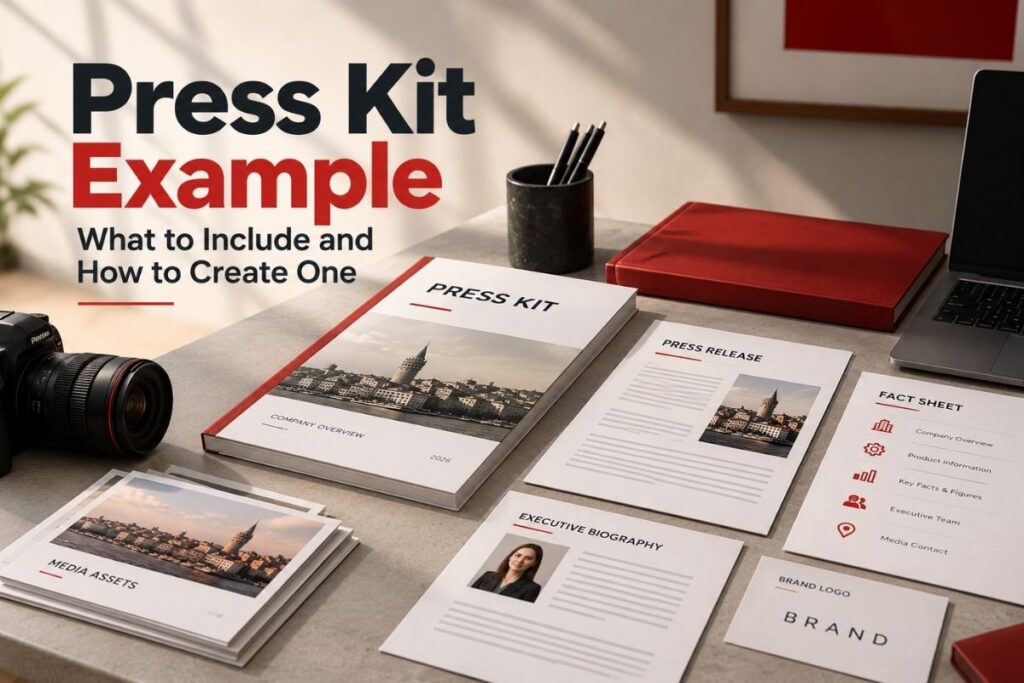
A press kit is a collection of essential information and media assets that helps journalists, editors, and other media professionals understand and report on a company, product, event, or announcement. A well-prepared press kit typically includes a company overview, fact sheet, press release, executive biographies, approved images, and media contact details.
For brands preparing a product launch, entering a new market, or announcing a major development, a press kit provides a reliable starting point for media coverage. The most effective kits are accurate, easy to navigate, and tailored to the story being presented.
What Is a Press Kit?
A press kit, sometimes called a media kit or press package, is a collection of approved materials designed to give journalists the background information and resources they need to cover a story.
Unlike a promotional brochure, a press kit prioritizes verifiable facts, editorial relevance, and accessible supporting materials. It helps media professionals understand what has happened, why it matters, who is involved, and where additional information can be obtained.
A press kit may be delivered as a downloadable folder, a PDF with supporting files, or an online newsroom. The format depends on the organization, the announcement, and the needs of its intended media audience.
For companies managing several announcements or maintaining an ongoing media presence, a dedicated press room can provide a central location for current releases, corporate information, photography, and media contacts.
What Should a Press Kit Include?
A professional press kit should contain enough information for a journalist to evaluate a story without searching across multiple websites or requesting basic background materials.
The exact contents vary by announcement, but the following components form a practical starting point.
| Press kit component | What it should include | Why it matters |
|---|---|---|
| Company overview | Business description, activities, location, and background | Establishes who the organization is |
| Press release | The announcement, relevant facts, and attributed statements | Explains the news |
| Fact sheet | Essential company, product, or event information | Supports quick fact-checking |
| Executive biographies | Names, roles, relevant experience, and approved profiles | Identifies key spokespersons |
| Brand assets | Logos, approved images, and usage guidance | Supports accurate visual representation |
| Product or service information | Features, availability, specifications, or relevant details | Adds context to the announcement |
| Media contact | Contact name or team, email, and relevant communication details | Enables follow-up questions |
Not every press kit needs every component. A product launch may require detailed specifications and product photography, while a leadership announcement may prioritize executive biographies and organizational background.
Company Overview and Background
A company overview should explain what the organization does, where it operates, and which activities are relevant to the announcement.
Keep the description factual. Unsupported claims such as “the world’s most innovative company” provide less editorial value than a clear explanation of the organization’s products, markets, and operations.
A concise overview is often more useful than a lengthy corporate history. Additional background can be provided through a separate document when necessary.
Press Release and Key Announcement
The press release is usually the central document in a news-focused press kit.
It should explain the announcement early, identify the relevant organization, and provide the most important confirmed details. Supporting paragraphs can then add context, quotes, and background.
For organizations communicating a new development to journalists, press release distribution is a separate consideration from preparing the materials themselves. A complete press kit supports media outreach, but it does not guarantee editorial coverage.
Executive Biographies and Quotes
Executive biographies help journalists identify the people responsible for a project, decision, or announcement.
Each biography should include the person’s current role, relevant professional background, and relationship to the news. Where appropriate, a short approved quotation can provide the organization’s perspective.
Quotes should add meaningful information rather than repeat promotional language. They must be accurately attributed and approved before distribution.
Images, Logos, and Multimedia Assets
Journalists may need photographs, product images, executive portraits, or video footage to accompany a story.
Images should be clearly labeled, available at suitable resolution, and accompanied by relevant credits or usage information. Logos should be supplied in practical formats, including vector files when available.
A press kit should also clarify whether an image may be cropped, edited, or reused. Making these conditions clear reduces unnecessary communication and helps prevent incorrect visual representation.
Press Kit Example: A Product Launch
A product launch press kit provides a useful example of how different media materials work together.
Consider a fictional technology company called Northstar Devices, preparing to introduce a workplace air-quality monitoring product.
The following press kit example is illustrative. The company, product, and announcement details are fictional.
Example Press Kit Overview
Company: Northstar Devices
Announcement: Launch of the Northstar AirSense workplace monitor
Location: Istanbul, Türkiye
Announcement date: October 19, 2026
Primary audience: Business, technology, and workplace publications
Media contact: Northstar Devices Communications Team
The press package would contain the following files:
Northstar_AirSense_Press_Release.pdfNorthstar_Company_Fact_Sheet.pdfNorthstar_AirSense_Product_Information.pdfNorthstar_Executive_Biography.pdfNorthstar_AirSense_Approved_Images.zipNorthstar_Media_Contact.pdf
These filenames allow recipients to identify each document without opening every file.
Example Press Release Opening
Northstar Devices Introduces AirSense Workplace Monitoring Product in Istanbul
Istanbul, October 19, 2026 — Northstar Devices has introduced AirSense, a workplace monitoring product designed to help organizations review indoor environmental conditions. The company announced the product during a launch presentation in Istanbul and outlined its intended applications in office environments.
According to Northstar Devices, AirSense is being developed to support workplace teams seeking clearer information about indoor conditions. Additional product documentation and approved images are available in the company’s press kit.
This example establishes the announcement, the organization, the location, and the product’s intended purpose without making unsupported performance claims.
A real release would also need confirmed product specifications, availability information, and appropriate supporting evidence before publication.
For organizations planning a similar announcement, press event and product launch management in Turkey involves coordinating the event, media communications, and the materials journalists need to understand the launch.
Press Kit Fact Sheet Example
A press kit fact sheet is a concise reference document containing the most important verified information about an organization, product, or announcement.
Its purpose is to make essential facts easy to locate. It should not duplicate the entire press release or introduce claims that have not been substantiated.
Below is a reusable press kit fact sheet example.
| Field | Example content |
|---|---|
| Company name | Northstar Devices |
| Headquarters | Istanbul, Türkiye |
| Business activity | Workplace monitoring technology |
| Product name | Northstar AirSense |
| Product category | Indoor environmental monitoring |
| Announcement date | October 19, 2026 |
| Product purpose | Supporting the review of indoor workplace conditions |
| Intended users | Workplace and facilities teams |
| Availability | To be confirmed before publication |
| Media contact | Northstar Devices Communications Team |
Illustrative example only; all details refer to a fictional company.
How to Write an Effective Fact Sheet
An effective fact sheet should be short enough to scan quickly but detailed enough to answer common factual questions.
For a corporate fact sheet, include the company’s official name, location, business activities, relevant history, and verified organizational details.
For a product fact sheet, prioritize specifications, intended applications, compatibility, availability, and any limitations that could affect how the product is described.
If information has not been confirmed, do not replace it with estimates. Clearly mark the detail as pending internal verification and remove unresolved placeholders before external distribution.
A fact sheet is particularly useful when journalists need to distinguish confirmed product information from statements about future plans.
How to Create a Press Kit Step by Step
Creating a press kit involves more than collecting marketing documents. Each item should support a specific editorial need and contribute to a coherent account of the announcement.
1. Identify the Story and Media Audience
Begin by defining the news.
Is the company announcing a product launch, partnership, investment, leadership appointment, or research finding?
The answer determines which materials belong in the kit.
A technology publication may need technical specifications and product imagery. A business journalist may prioritize investment details, executive statements, and market context.
Identifying the intended audience helps prevent the press kit from becoming an oversized collection of unrelated documents.
2. Gather and Verify the Essential Facts
Before writing, confirm the fundamental details: who is involved, what is being announced, when and where it is happening, how the development works, and why it matters.
Check official company names, dates, titles, product descriptions, and any numerical claims.
If an announcement includes performance figures, financial information, or research results, ensure that the supporting documentation is available and that the claims can be accurately explained.
3. Prepare the Core Documents
Draft the press release, company overview, fact sheet, and relevant biographies.
Each document should have a distinct function. The release explains the news, the fact sheet provides reference information, and the company overview supplies broader context.
For announcements involving another organization, an accurate explanation of the relationship is particularly important. A partnership announcement press release can illustrate how companies structure communications around a collaborative development.
4. Organize Approved Media Assets
Collect the photographs, logos, illustrations, and other assets that support the announcement.
Use descriptive filenames, such as Company_Product_Front_View.jpg, rather than generic labels such as IMG_0042.jpg.
Where necessary, include image captions, photographer credits, and usage restrictions. Confirm that the organization has the appropriate rights to distribute each asset.
5. Choose a Practical Digital Format
A digital press kit can be presented through a dedicated web page, a shared folder, or a downloadable package.
For many announcements, a web page with clearly labeled downloadable files offers a practical balance between accessibility and organization.
PDFs remain useful for press releases and fact sheets, but journalists should not have to extract high-resolution images from a PDF.
Whenever possible, provide separate downloadable media files and avoid access barriers that require recipients to request permission.
6. Review the Kit Before Distribution
Check the kit as though receiving it for the first time.
Open every document, test each download link, confirm the media contact details, and review the consistency of names, dates, and product descriptions.
A final editorial review should also identify exaggerated claims, outdated materials, missing credits, and information that could be misunderstood without additional context.
Press Kit vs. Media Kit: What’s the Difference?
The terms press kit and media kit are sometimes used interchangeably, particularly in corporate public relations. However, their meaning can vary depending on the audience and purpose.
A press kit usually focuses on providing journalists with information and assets for editorial reporting.
A media kit may serve the same function, but the term is also widely used for advertising sales materials, publisher information, and influencer collaboration proposals.
| Feature | Press kit | Media kit |
|---|---|---|
| Typical purpose | Support news reporting | Support media relations, advertising, or partnerships |
| Primary audience | Journalists and editors | Journalists, advertisers, brands, or partners |
| Common materials | Press releases, fact sheets, biographies, images | Audience profiles, media information, rates, or brand assets |
| Main emphasis | News and factual background | Varies according to commercial or editorial use |
The distinction is not absolute. A corporate online media kit may contain exactly the same materials as a press kit.
What matters is whether the information matches the recipient’s needs.
What Is a Media Kit for Influencers?
An influencer media kit is generally a presentation used to introduce a creator to potential brand partners.
It may include audience demographics, content categories, platform statistics, previous collaborations, and contact information.
Unlike a traditional corporate press kit, its primary purpose is often to help a brand assess a potential commercial partnership.
What Is a Social Media Kit?
A social media kit can refer to a collection of brand assets, templates, visual guidelines, and messaging materials prepared for social platforms.
In some contexts, the term also describes an influencer’s partnership presentation.
Because the terminology overlaps, organizations should clearly label the intended purpose of their materials rather than assume every recipient understands the term in the same way.
Digital Press Kit Design and Format Tips
An effective press kit does not require elaborate visual design. Clear navigation, accurate information, and accessible files are more valuable than decorative presentation.
A professional digital press kit should make it easy to locate the announcement, understand the organization, and download relevant materials.
Keep the Layout Simple
Use clear section headings, readable typography, and consistent branding.
Place the main announcement and media contact information where recipients can find them quickly. Avoid burying essential details beneath lengthy introductions or promotional graphics.
Make Assets Easy to Download
Provide separate links for the press release, fact sheet, photographs, and other media files.
If a folder contains several image versions, identify them clearly. Where practical, offer both web-friendly previews and higher-resolution originals.
Test the download experience on desktop and mobile devices before sharing the kit.
Keep Information Current
A press kit should reflect the organization and announcement at the time it is distributed.
Outdated executive biographies, superseded logos, incorrect contact details, and expired product information can create avoidable reporting errors.
For organizations maintaining an online press room, assigning responsibility for updates is an important part of ongoing media relations.
Common Press Kit Mistakes to Avoid
A press kit can contain all the expected documents and still be difficult for journalists to use.
Several recurring problems reduce its practical value.
Using promotional language instead of verifiable facts. Claims such as “revolutionary” or “industry-leading” should not replace specific information about what a product does or why an announcement matters.
Providing too many unrelated files. A press kit should be relevant to the announcement. Large collections of generic presentations can make essential materials harder to locate.
Leaving out the media contact. Journalists may need clarification, an interview, or an additional image. A clear contact point helps them follow up.
Distributing unapproved assets. Photographs, quotations, and brand materials should be reviewed for accuracy and appropriate usage rights.
Ignoring the recipient’s market. A press kit created for one country may need adaptation before being shared with journalists elsewhere.
The last point is particularly important for international brands entering Türkiye.
Press Kits for International Brands Entering Turkey
International companies preparing media outreach in Türkiye should consider how their materials will be understood by local journalists and audiences.
A press kit developed for another market may contain unfamiliar terminology, unsupported local claims, or product availability information that does not apply in Türkiye.
Effective localization goes beyond translating a press release.
For example, a company announcing a product launch in Türkiye should clarify whether the product is actually available in the country, which organization is responsible for local operations, and who can answer media questions about the Turkish market.
Executive titles, company names, geographic references, and technical descriptions should also remain consistent across translated materials.
What Should Be Localized?
The level of localization depends on the announcement, but several elements deserve particular attention:
- Press release: Adapt terminology and explain the announcement’s relevance to the Turkish market.
- Company fact sheet: Confirm local operations, legal entity names, and market-specific information where relevant.
- Executive biographies: Identify appropriate local or international spokespersons.
- Product information: Verify local availability, specifications, and any market-specific conditions.
- Media contacts: Provide a contact route suitable for journalists covering Türkiye.
Localization should preserve the meaning of the original announcement. It should not introduce claims or commercial commitments that the company has not approved.
For brands preparing coordinated market-entry communications, PR Turkey’s press event and launch services provide a relevant starting point for understanding how press materials fit into a wider announcement.
Press Kit Checklist Before Sending It to Journalists
Before distributing a press kit, review both the completeness of the information and the usability of the files.
- The announcement is clearly explained.
- Company names, dates, and spokesperson titles are accurate.
- The press release has been approved.
- The fact sheet contains verified information.
- Executive biographies and quotations are current.
- Images and logos are approved for distribution.
- Image credits and usage information are included where necessary.
- File names are descriptive and consistent.
- All download links work without unnecessary access restrictions.
- Media contact details are visible and correct.
- Market-specific information has been checked.
- Unsupported claims and outdated materials have been removed.
A final review can prevent journalists from receiving conflicting information or spending unnecessary time requesting basic materials.
Frequently Asked Questions About Press Kits
What does a media kit include?
A corporate media kit commonly includes a company overview, press releases, fact sheets, executive biographies, approved logos, photographs, and media contact information. Depending on its purpose, it may also contain product specifications, research materials, or event information. Advertising and influencer media kits may instead emphasize audience data, partnership opportunities, and commercial details.
What should my media kit look like?
A professional media kit should be clearly organized, visually consistent, and easy to navigate. Use readable typography, descriptive headings, and clearly labeled downloadable assets. The design should support the information rather than distract from it. For journalists, accurate facts and accessible files are generally more useful than elaborate presentation effects.
How do you make a press kit?
Start by identifying the announcement and its intended media audience. Gather verified company and product information, prepare a press release and fact sheet, collect approved media assets, and organize everything into an accessible digital format. Before distribution, confirm the accuracy of the materials and test all download links and contact details.
Is a press kit the same as a media kit?
The terms can overlap, particularly in corporate public relations. A press kit usually focuses on materials intended for journalists, while media kit may also describe advertising information or influencer partnership materials. The appropriate contents depend on the intended audience and purpose rather than the label alone.
Should a press kit be a PDF or a website?
Both formats can work. A PDF is useful for a press release or fact sheet, while a website or online press room can make multiple files easier to organize and update. For image-heavy announcements, separate downloadable media assets are preferable to embedding every file in a single PDF.
Conclusion: Build a Press Kit Journalists Can Actually Use
A strong press kit gives journalists a clear, accurate, and accessible foundation for evaluating a story. It brings together the announcement, supporting facts, relevant people, and approved media assets without overwhelming recipients with unnecessary promotional material.
The most useful press kit example is one that can be adapted to the specific announcement, whether it involves a product launch, partnership, or corporate development. A well-structured fact sheet, clearly labeled files, and reliable contact information can make that process more efficient.
For international organizations planning announcements in Türkiye, press kit preparation should also account for local context and media expectations. PR Turkey’s press release distribution services can be explored as part of a broader media outreach strategy.